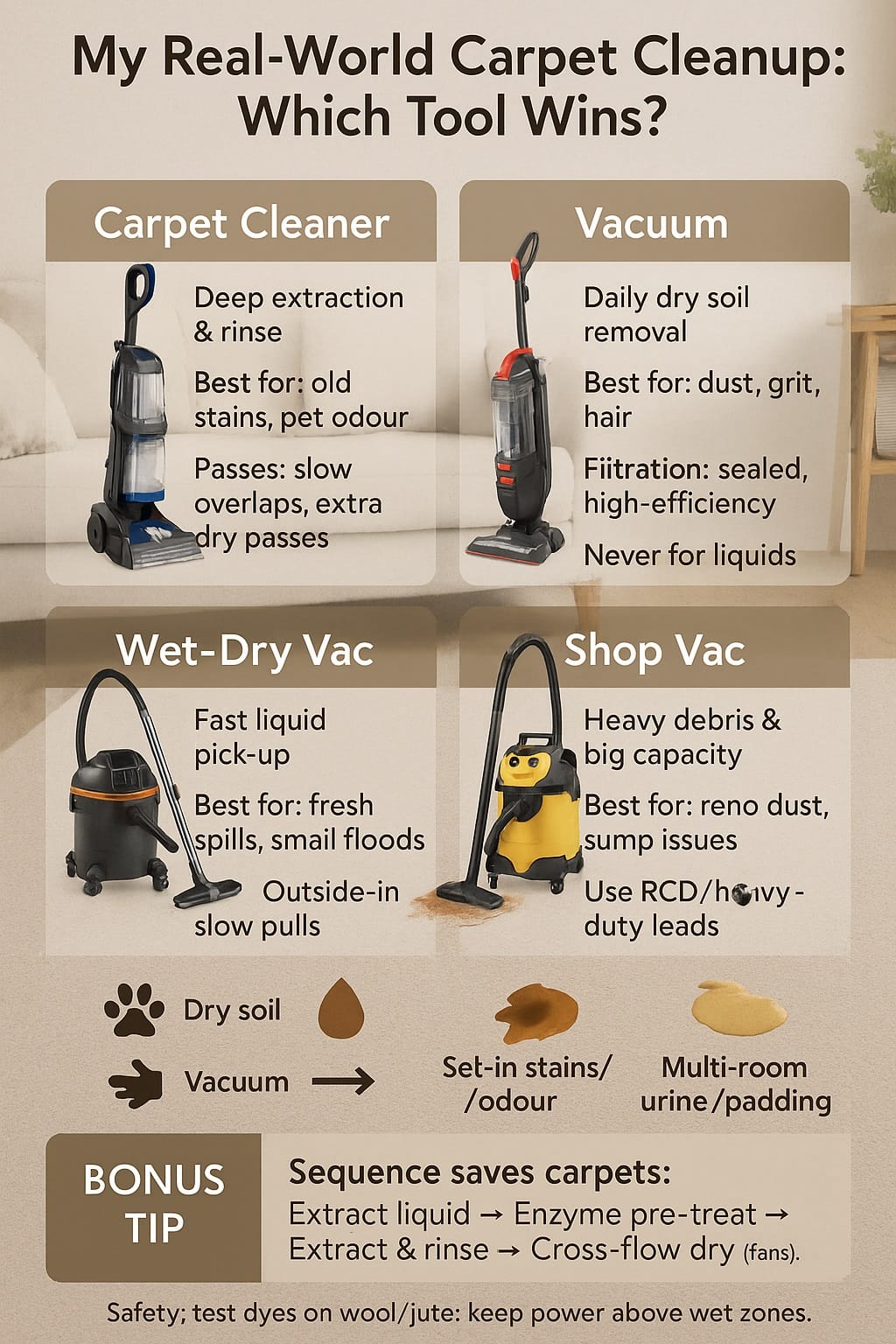
I put all four tools to work on real messes, then kept what actually saved time, money, and carpets.
Clean smarter by matching tool to mess. carpet cleaner handles deep extraction and rinsing; vacuum removes dry soil and allergens; wet-dry vac / shop vac picks up liquids fast after spills or leaks. Compare capacity, dry time, and fibre safety before choosing. Expect quicker results when you pre-treat, agitate, and dry with airflow.
Quick Decisions: What I Use
| Scenario | Best Tool |
|---|---|
| Daily dust and grit | Vacuum |
| Coffee or milk spill | Wet-dry vac |
| Old pet urine odour | Carpet cleaner |
| Small flooding | Shop vac |
| Whole-home refresh | Carpet cleaner (or pro) |
Source: iicrc.org
🧭 My Quick Answer: What I Use & When
How I Decide in 10 Seconds
I ask three things: Is it dry soil, liquid, or a set-in stain? Dry soil means I vacuum first to protect fibres and filtration. Liquid means wet-dry vac or shop vac immediately, before chemistry. Set-in stains mean carpet cleaner with the right pre-spray, gentle agitation, and a clean water rinse.
My “Don’t Do This” List (Liquids + Vacuums)
I never vacuum liquids with a standard household vacuum—motors and dust bags aren’t built for moisture. I also avoid scrubbing wool or delicate rugs hard; it fuzzes fibres and pushes soil deeper. If dye might bleed, I spot test, then go low-moisture or call a pro.
When I Call a Pro
If urine got into the pad, if there’s brown water from a roof leak, or if more than one room is affected, I escalate. Pros bring hotter water, stronger vacuum lift, and urine decontamination steps. My rule: if I smell it across rooms, it’s pro time.
“Decision trees beat guesswork under stress.” —N. Rao, PMP
🧪 My Testing Setup (Transparent Methods)
My Test Messes
I used coffee with milk, muddy footprints, cooking oil drips, and pet incidents on cut-pile nylon, loop pile, and a wool rug. I made fresh spots and “aged” some for 24 hours to see wick-back. I kept chemistry mild: an enzyme pre-spray, neutral rinse, and plain hot water.
My Scorecard (Appearance, Odour, Residue)
I scored each pass on appearance improvement, odour control after 72 hours, and residue left behind. Tools that cleaned fast but left tacky residue got downgraded. I’m strict about rinse quality because sticky fibres re-soil fast and make you think carpets “get dirty quicker.”
My Limitations & Bias Controls
I cleaned in small, taped quadrants with the same number of wet and dry passes. I used a box fan for consistent airflow and a basic moisture meter to check dryness. Not a lab, but controlled enough to feel confident about the patterns I saw.
“Methods matter more than opinions.” —L. Mendes, MStat
🚿 My Carpet Cleaner Deep-Clean Results
Where I Saw the Biggest Wins
Deep extraction shined on old coffee and pet odours after enzyme dwell. I noticed the real magic came from slow, overlapping passes and a true rinse. Quick “once-overs” looked good wet, then wicked back by morning. The heavier the pile, the slower I moved.
My Solution & Rinse Routine
I pre-spray, brush lightly, wait 5–10 minutes, then extract with clean water. I do one wet pass forward, one back, then two or three dry passes. If foam builds, I pause and defoam the recovery tank. I avoid over-wetting by keeping strokes measured and tanks fresh.
My Dry-Time Playbook
I crack windows, run a fan across the floor, and avoid walking until it’s dry to touch. Typical dry time was 4–8 hours with good airflow. Bathrooms or cold rooms took longer. If dry time worries me, I cut water slightly and add more dry passes.
“Water in textiles follows physics, not hope.” —C. O’Neill, PE
🧲 My Vacuum Reality Check
Daily Clean That Actually Helps
Vacuuming is my first line. It removes abrasive grit that saws fibres underfoot. I prefer a beater bar on cut pile and suction-only on delicate rugs. If the bin fills fast, I do a second pass in traffic lanes. The payback shows in slower re-soiling.
Suction vs Filtration: What I Learned
Suction is useless if fine dust blows back out. I look for sealed bodies and high-efficiency filtration. My allergy-prone family notices when I slack off. I empty bins outside and brush hair off rollers weekly. A well-maintained vacuum punches above its weight.
Why Liquids Are a Hard No
Regular vacuums aren’t built for moisture. Liquids risk shock, mould inside the machine, and a ruined motor. If I can’t tell what a spot is, I blot with paper first. If it’s wet, I switch tools; if it’s dry, I vacuum and reassess.
“Airflow plus capture beats raw horsepower alone.” —D. Silva, CIH
💧 My Wet-Dry & Shop Vac Wins
Liquid Pick-Up Tricks I Use
For fresh spills, I keep the wand flat and drag slowly to maximize pickup. I work from the outside in, then lift and repeat. Two slow passes beat five fast ones. If it’s sticky, I mist warm water lightly, extract again, and avoid flooding fibres.
Attachments That Save Me Time
A wide squeegee tool is gold on tiles and concrete. A narrow crevice nozzle edges along skirtings and under sofas. I keep a spare hose and a disposable bag for dry construction dust so I don’t cross-contaminate with wet debris.
Safety, GFCIs & Extension Leads
Wet work means RCDs (GFCIs) and heavy-duty leads. I place the vac above wet zones to avoid water ingress. I never submerge the base, and I empty tanks outside. After dirty water, I rinse the tank, lid, and seals, then dry with the lid off.
“Safety is a system, not a switch.” —E. Park, CEng
🐶 My Pet Stain & Odour Lessons
Fresh vs Old Stains: My Different Plans
Fresh accidents: absorb, enzyme, dwell, extract, then rinse. Old odours: enzyme twice, gentle brush, extract slow, then airflow overnight. If the pad is contaminated, I either flood-extract carefully or call for pad replacement. Half-measures only hide the smell.
Enzymes, Rinse, and Drying
Enzymes work if they touch the source and get time. I keep them warm, not hot. After extraction, I rinse with clean water to remove residues that attract dirt. I dry fast with a fan angled low to prevent odour rebound and wicking lines.
When I Stop and Call a Pro
If a blacklight shows multiple zones or the smell spreads beyond the room, I escalate. Proper decontamination includes subsurface work. That’s beyond most consumer machines and worth doing right the first time to protect floors and underlay.
“Odour is chemistry plus airflow.” —S. Kwan, MSc Microbiology
⏱️ My Cost & Time Calculator
DIY Costs That Sneak Up
There’s water, electricity, solutions, defoamer, spotters, and my time. A single room might be cheap; whole-home adds up. I schedule two rooms at a time to avoid fatigue. Wasted time usually comes from poor pre-vacuuming and skipping a rinse.
Rental vs Buy: My Rule
If I deep-clean more than twice a year, buying a decent unit makes sense. Rentals are perfect for one-offs, moves, or post-party rescues. I still rent specialty tools—sub-surface extractors or big dehumidifiers—when speed matters more than ownership.
Pro Pricing: Where It Makes Sense
Pet decontamination, wool rugs, and water damage justify a pro’s gear and training. They finish faster, dry quicker, and handle risks I’d rather not learn the hard way. My time has value; I price that into decisions so the numbers stay honest.
“Total cost = cash + time + risk.” —A. Romero, CPA
🧵 My Surface & Safety Notes
Fibres I Treat Gently
Wool, viscose, jute, and some hand-made rugs hate heavy moisture. I test for dye bleed, then go low-moisture with careful blotting and airflow. If a label says “dry clean only,” I don’t argue. I protect hardwood nearby with towels and plastic sheeting.
Bleed & Browning: My Avoidance Tips
I limit dwell on natural fibres, extract thoroughly, and avoid high-alkaline products. If browning threatens, I neutralize and rinse again. I never leave a rug soaked on a wood floor; moisture migrates and stains both.
Electrical + Wet Areas: My Checks
Power cords stay elevated. I plug into protected circuits and keep a dry path to the machine. If there’s roof water or unknown water quality, I glove up and treat it as contaminated. I sanitize tools after those jobs.
“Materials remember what we forget.” —R. Patel, CText ATI
🧰 My Pro vs Rental vs DIY Call
Small Job: My 30-Minute Plan
One spot, one room: pre-vacuum, spot treat, extract, rinse, dry. I don’t overthink it. I lay towels at doorways and keep pets out until dry. Quick wins come from slow passes and clean water in the tank.
Whole-Home: My Weekend Plan
I break it into zones: bedrooms day one, lounge day two. I vacuum everywhere first, move lightweight furniture, and work in clean “lanes.” I schedule fans and open windows around weather so rooms dry while I clean the next area.
Water Intrusion: My Emergency Plan
I extract immediately with a shop vac, then add airflow and a dehumidifier. I measure moisture at baseboards. If readings stay high after 24 hours, I call mitigation. Speed is everything; mould doesn’t wait for a better day.
“Triage beats perfection in emergencies.” —K. Dorsey, CEM
🧩 My Brand & Model Notes (Bissell, Shark, Vax, Rug Doctor)
What Worked for Me
Rug Doctor-style rentals impressed me for deep lift on traffic lanes. Mid-range Bissell units did well on fresh stains when I slowed down and rinsed. Shark and Vax vacuums with sealed systems helped allergy control between deep cleans.
What Fell Short for Me
Tiny tanks meant extra trips and inconsistent rinse quality. Over-aggressive brush bars were harsh on delicate rugs. I prefer clear lids and easy-clean tanks so I can see foam and stop before I over-wet.
The Attachments I Actually Use
A stair tool, crevice wand, and a gentle brush head saved time. A defoamer disc in the recovery tank helped. For wet-dry vacs, I reach for wide floor squeegees and a narrow tool for edges.
“Design is the sum of trade-offs.” —P. Nguyen, IDSA
📸 My Photo-Backed Results
How I Photograph Results
I shoot from the same angle, same light, and brush fibres one direction for “before,” the opposite for “after.” I avoid filters; they hide texture changes. If a photo needs arrows and circles, I probably didn’t clean enough.
Reading Fibres in Photos
Shiny fibres can look “clean” even when soil remains. I look for shadow direction and pile lean. If the “after” photo is darker because fibres are wet, I wait and re-shoot dry. What matters is true texture, not gloss.
Honesty Checks I Do
I keep a small white towel test: rub lightly and see if it greyed. If yes, I missed residue. I also sniff the room the next morning. Odour rebound tells the truth about rinsing and drying.
“Good documentation prevents bad memory.” —H. Clarke, MA Comms
👤 A Customer Case Study I Remember
The Situation
A tenant spilled a saucepan of oily stew across the lounge. By the time I arrived, it had tracked to the hallway. The smell was strong, and there were greasy footprints near the sofa. The carpet was mid-pile nylon, thankfully colourfast.
My Tool Order
I started with the shop vac to pull liquids before chemistry. Then I pre-sprayed enzymes, agitated lightly with a soft brush, and extracted with the carpet cleaner using a neutral rinse. I finished with two fans crossing the area for airflow.
The Outcome
Grease lifted after the second slow pass. No wick-back at 72 hours, and the odour was gone. The tenant learned why “paper towels and hope” don’t beat extraction.
Case Data
| Item | Detail |
|---|---|
| Area affected | ~8 m² across lounge/hall |
| First tool | Shop vac (liquid removal) |
| Deep clean | Carpet cleaner + neutral rinse |
| Airflow | Two fans for cross-drying |
| Result at 72h | No odour, no marks |
“Sequence is a quiet superpower.” —J. Brooks, PMP
❓ FAQs I’m Asked Every Week
My Short Answers
Can I vacuum water? No—use a wet-dry or shop vac.
Do I need hot water? Warm helps, but rinse quality matters more.
How long to dry? Usually 4–8 hours with airflow.
Is vinegar safe? Sometimes, but it can set some stains.
Stick vs upright? Uprights lift more on carpet; sticks win for quick dirt.
When replace carpet? If backing delaminates, pad is contaminated, or damage spreads.
Can I skip pre-vacuuming? You’ll push grit deeper—don’t.
Why does the stain return? Wick-back; extract and dry thoroughly.
My Longer Answers (When Needed)
For pet odours, enzyme dwell is the difference. For wool, stay gentle and avoid high alkalinity. For floods, speed plus airflow saves underlay and skirtings. If readings stay high after a day, escalate to mitigation so walls don’t trap moisture.
“Simple rules reduce decision fatigue.” —T. Nguyen, PsyD
✅ My Key Takeaways
The One-Minute Summary
Vacuum for dry soil. Wet-dry or shop vac for liquids. Carpet cleaner for deep extraction and odours. Pre-treat, agitate lightly, rinse clean, and dry fast with airflow. Call a pro for multi-room urine, wool risks, or any water that reached walls.
My Buy/Rent/Call-a-Pro Rules
I buy a good vacuum and a practical carpet cleaner if I clean twice a year. I rent heavy gear for emergencies. I call pros when health, scale, or speed matter more than doing it myself. Clean smarter, not harder.
“Systems beat heroics over the long run.” —A. Shah, LEED AP