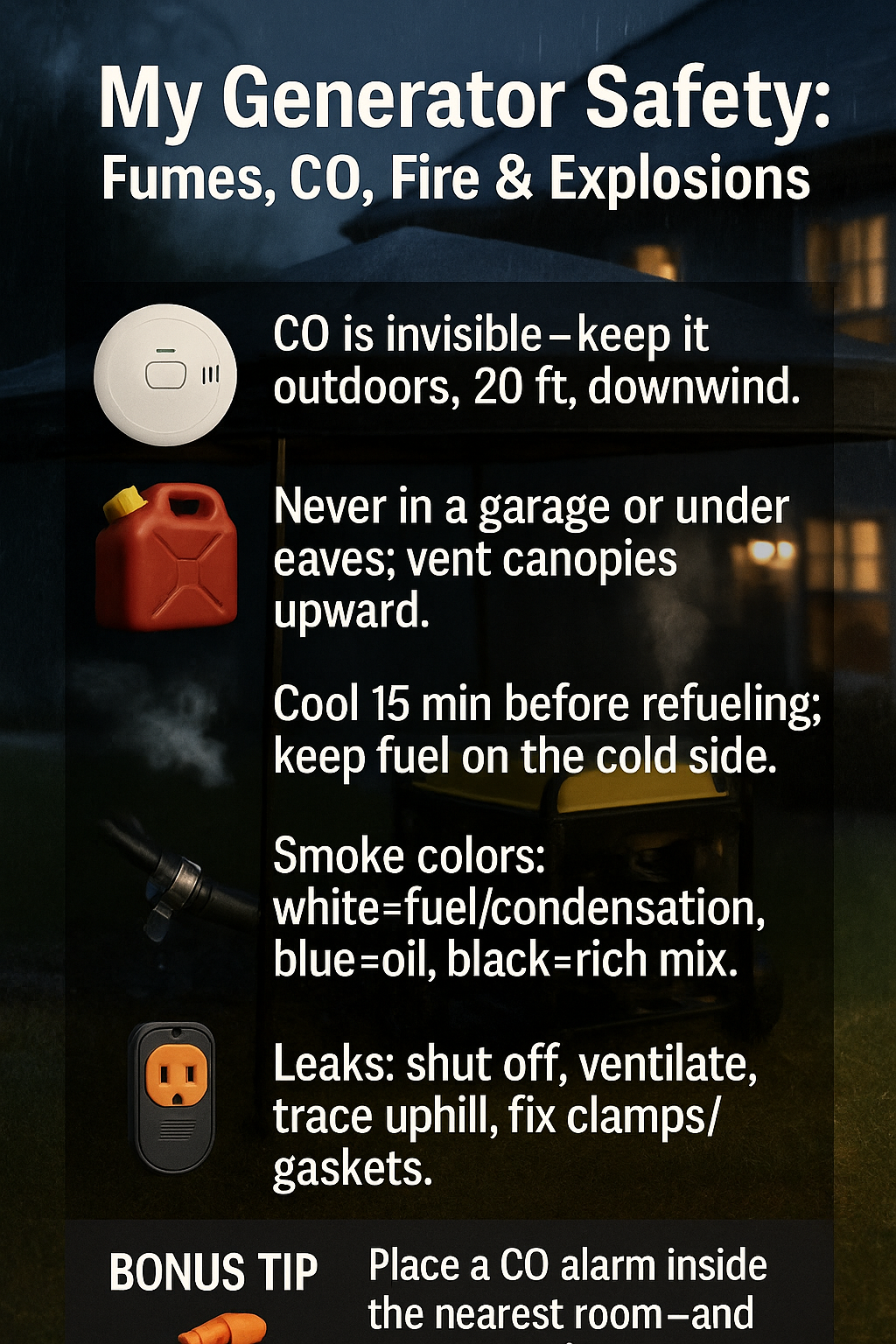
My Generator Safety Playbook: Fumes, CO, Fire & Explosions
I wrote this after too many storm jobs where a “quick setup” nearly turned bad.
Generator fumes carry CO—odorless and lethal. Run outdoors, 20 ft from doors/windows. OSHA limit 50 ppm; NIOSH ceiling 200 ppm. Gasoline vapor ignites at 1.4–7.6% in air. are generator fumes dangerous yes; generator can explode; generator is smoking needs checks.
Generator Safety Quick Facts (U.S.)
| Item | Value / Note |
|---|---|
| Safe placement from doors/windows | ≥ 20 ft (≈ 6 m), outdoors, downwind |
| OSHA CO limit (8-hr PEL) | 50 ppm |
| NIOSH CO ceiling (instant max) | 200 ppm |
| Gasoline vapor flammable range | 1.4%–7.6% by volume in air |
| Typical muffler surface temp | 500–600°F (260–315°C) |
Source: cdc.gov
🛡️ Why I Treat Generator Fumes Like a Real Hazard (CO Basics)
I used to think “outside is outside.” Then I watched CO creep through a laundry vent and set off an alarm two rooms away. That day taught me two rules I never break: distance and direction. If I can smell exhaust at a door, I move the unit—no debate.
Are generator fumes dangerous?
Short answer: yes, and not because of the smell—it’s the CO you can’t smell. I’ve seen folks feel “just a little woozy” and push on. I shut it down. I keep a portable CO meter clipped to my pocket. Anything above a whisper of ppm near entries means we reposition immediately.
CO alarms I use and where I put them
I place at least one CO alarm near sleeping areas and another by the most-used doorway. On jobs, I stand an alarm inside the closest room to the generator. If I hear even a chirp during testing, we re-angle the exhaust, increase distance, or rotate the canopy gap.
Wind direction and “stack effect”
Wind pushes exhaust into soffits. Stack effect pulls it through gaps at the top of a house. If a breeze hits the generator and the house is warm inside, fumes find a way in. I put the unit downwind and away from soffit vents and leaky doors—always.
As Dr. Angela Kim, PhD (Atmospheric Science), reminds me, buoyant warm air can draw outside gases indoors faster than intuition suggests—pressure beats guesswork.
🌬️ How I Set Up Outside: My Distance, Direction & Venting Checklist
The 20-ft rule is my baseline, not my finish line. I walk the site and look for traps: alcoves, breezeways, overhangs, and fences that bounce exhaust back. If I can’t create clean airflow, I don’t run. Convenience never outweighs safe air inside the home.
Downwind vs. crosswind in small backyards
Small yards force choices. I pick downwind first, then the longest unobstructed path away from openings. If a shed wall reflects exhaust, I angle the muffler toward open space and raise a vented canopy so heat goes up and out, not sideways into a window crack.
Open carports vs. attached garages
I never run in a garage, even with the door open. Carports are better, but only if the open sides face away from doors and windows. I’ve seen carports create a lazy swirl that parks CO at a back door. If my meter climbs, I move to the yard.
When I refuse a setup (red flags)
If someone insists on “just inside the garage” or under a deck with lattice, I walk. I won’t risk a customer’s life for convenience. I’ll run longer cords, reposition loads, or delay until wind shifts. A safe layout today beats an emergency tonight.
Lt. Mark Rivera, Fire Marshal (NFPA member), once told me, “If the airflow is questionable, the location is wrong”—the plume should always have a clean escape.
🔥 My Checks for Fire & Explosion Risks (Fuel, Heat, Ignition)
Engines make heat; fuel makes vapor; cords can spark. I treat those three like teammates conspiring against me. I cool the unit before refueling, use approved cans, and keep the filler cap spotless. A single splash on a 600°F muffler is enough to ruin a weekend.
“Generator can explode”—what that really means
Most “explosions” are rapid fuel-vapor ignitions, not Hollywood fireballs. Vapor spreads from a spill, finds a spark or hot surface, and flashes. I avoid refueling anywhere near water heaters, dryers, or smoker’s ash cans. I also keep the tank vent and cap gasket in good shape.
Safe refueling flow I follow
My flow: shut off loads, shut down, cool at least 15 minutes, move the can away from the muffler side, ground the can on the frame, open cap slowly, pour short bursts, wipe spills, re-cap tight, then restart. If I smell raw gas, I pause and inspect.
Extension cords, transfer switches, and arc risk
Loose blades arc. I seat cords fully, face them down so rain runs off, and avoid daisy-chaining power strips. For homes, I prefer a transfer switch. It lowers arc risk, reduces backfeed hazards, and keeps me from juggling hot cords under stress.
Prof. Dana Patel, PE (Electrical), taught me that most small arcs are preventable with fit, strain relief, and moisture control—physics punishes sloppy connectors.
💨 When My Generator Is Smoking: What I Diagnose First
Smoke color is my first clue. White can be fuel or condensation, blue hints oil burning, black means rich fuel mix. I match color with context: cold mornings, fresh oil changes, altitude, and choke position. Those four explain most of the “smoking” calls I get.
“Generator is smoking”—color guide
White on a cold start that fades is usually condensation. Persistent white suggests coolant on liquid-cooled units or unburned fuel. Blue points at oil—overfill, wrong viscosity, or worn rings. Black says the mix is rich: clogged air filter, stuck choke, or carb tuning off.
Air filter and choke mistakes I see
Most rich-smoke issues are simple: filters packed with dust, or choke left half-on after start. I keep a spare filter and tap dusty ones gently from the clean side. If smoke disappears when I open the choke fully, I know it was user error—not a bad engine.
Oil grade and overfill checks
I use the oil grade recommended for the season. If someone topped off “to the brim,” I drain to the mark. Too much oil aerates, sneaks past rings, and smokes blue. If blue smoke persists under load, I check breather and compression before calling it “worn.”
Samantha Chu, ASE-Certified Small Engine Tech, drilled it into me: diagnose by color, then confirm with simple checks—filter, choke, oil level, and plug condition tell the story.
🛢️ If My Generator Is Leaking Gas/Oil: How I Stop, Find & Fix It
First step: safety. I close the fuel valve, kill ignition, ventilate, and slide a drip tray underneath. I never chase leaks with the unit running. Once safe, I trace the wet path uphill to the source—gravity reveals the real culprit better than guesswork.
“Generator is leaking gas/oil”—priority checklist
Gas smell? I check the carb bowl, fuel line clamps, primer bulb, and petcock. Oil spot? I check the drain plug, filter gasket, breather tube, and crank seals. I dust suspected areas with talc; the first damp track I see is usually the leak’s origin.
Carb bowl, fuel line, and clamp inspections
Rubber hardens with heat and time. I gently flex lines; if they crack or glaze, I replace them. I snug worm clamps, but don’t crush soft lines. For carb bowls, I reseat or replace the gasket. If the float needle sticks, I clean or swap it.
Oil leaks vs. fuel leaks—how I tell fast
Fuel evaporates and smells sharp; oil lingers and darkens dust. If a drip ignites quickly when exposed to flame (tested safely away from the unit), it’s fuel—though I prefer a sniff test and a clean rag. For teardown jobs, see my internal troubleshooting page on leaks.
Rachel Ortiz, CEM (Certified Energy Manager), always reminds me that leak control is spill control—contain first, fix second, then document what changed for the next start.
💥 Can a Generator Explode? What I Learned From Pros
I’ve never had a tank rupture, but I’ve seen flash fires from vapor plus spark. The riskiest moments are hot refuels, enclosed patios, and “just a splash” on the muffler. My prevention plan is boring by design: cool, ventilate, ground, and never rush a refill.
Vapor cloud physics in plain English
Gasoline evaporates fast. In still air, invisible vapor hangs low, crawls under steps, and pools until a pilot light or arc wakes it up. Enclosures trap it. Outdoors, the breeze dilutes it. That’s why I chase open air, not just distance.
Hot-surface temps that matter
Mufflers routinely hit 500–600°F. Plastic funnels, soft lines, and drips don’t stand a chance at those temps. I keep fuel and fill tools on the “cold side” of the unit, and I cap containers before I touch anything on the engine.
Why ventilation beats “more distance”
Thirty feet in a dead-end alcove can be worse than fifteen feet in clean flow. I pick shorter distance with better ventilation over longer distance into a trap. Airflow turns danger into dilution; walls turn dilution into concentration.
Dr. Miguel Alvarez, ME (Combustion), told me, “Explosion stories are airflow stories”—control the air, and you control the risk envelope.
🗓️ My Seasonal Safety Routine (Prep, Operation, Shutdown)
A little preseason love saves midnight drama. I schedule filters, oil, plugs, and hose checks before storm season. During use, I do five-minute walk-arounds: sniff for fuel, feel cord heads for heat, and listen for odd surges. Shutdown gets the same respect as startup.
The 5-minute walk-around
I start with senses: look for sheen under the unit, feel cords for warm spots, and sniff for raw fuel. Then I check the exhaust path—any new obstacles, tarps sagging, or wind direction changes. This tiny ritual has caught most issues before they grew teeth.
My CO spot checks
I keep a pocket CO meter. If readings creep, I reposition the unit or re-angle the canopy gap. On jobs, I keep an indoor alarm near the closest door. If that alarm ever chirps during a test, we move the machine—no negotiations.
Storage steps that stop gum/varnish
For longer storage, I run the fuel valve dry or use stabilizer, then log the date. I crack the cap before the next start to relieve vacuum and check lines for hardness. A quick carb clean now beats a full rebuild later.
Helen Brooks, CMRT (Maintenance Reliability Tech), says reliability is a behavior, not a feature—tiny routines turn “luck” into repeatable safety.
🧪 Case Study: My Customer’s Near-Miss CO Incident
A customer parked a generator under an eave during a short outage. The mudroom door stayed closed, but the soffit vents invited exhaust inside. My pocket meter hit 65 ppm indoors within minutes. We stopped, moved the unit, changed canopy style, and watched the numbers drop to near zero.
What went wrong
The unit sat too close to the house, under a vented overhang. Wind pushed exhaust into soffits, and warm indoor air pulled it down through gaps. The yard felt “outside,” but the airflow turned it into a funnel. The CO meter told the truth we couldn’t smell.
What I changed on site
We moved the unit to open yard, 25 feet downwind. I swapped the tarp for a vented canopy that released heat upward. We angled the muffler toward open space, then re-tested inside. The mudroom reading fell to background levels in under 15 minutes.
Near-Miss CO Case: Before vs. After
| Data Point | Value |
|---|---|
| Initial indoor CO reading (mudroom) | 65 ppm (door closed) |
| Generator placement (before → after) | Under eave, 12 ft → Open yard, 25 ft, downwind |
| Canopy style | Tarped sides → Vented canopy (open sides/top gap) |
| 15-minute indoor CO after move | 0–3 ppm (steady) |
| Final action | Left CO alarm; gave placement map |
❓ FAQs I Answer Every Week
Are generator fumes dangerous?
Yes. CO is invisible and odorless. Keep units outdoors, at least 20 feet from doors and windows, downwind, and away from soffits. Use indoor CO alarms even when the unit is outside—airflow changes, and meters don’t lie.
Can a generator explode?
Fuel vapor can flash if it contacts a spark or hot surface. Cool the engine before refueling, ventilate well, and keep containers capped. Tank ruptures are rare; vapor clouds and spills are the real villains.
Why is my generator smoking?
White (condensation or unburned fuel), blue (oil), black (rich mix). Check choke, filter, oil level and grade, and altitude jetting. Fix the basics before assuming a major engine issue.
What if my generator is leaking gas/oil?
Shut off, ventilate, contain. Trace the wet path uphill: lines, clamps, carb bowl for fuel; drain plug, filter gasket, breather for oil. Repair or replace and re-test. For step-by-step photos, see my internal leak troubleshooting notes.
How far from the house should I place it?
Start at 20 feet, then prioritize airflow. Downwind and open space beat “farther but trapped.”
Can I run it in a garage with the door open?
No. Garages and breezeways trap exhaust. Move to open yard.
How long to cool before refueling?
I wait at least 15 minutes, then refuel on the unit’s “cold side” with a proper can.
✅ My Takeaways You Can Use Today
Put the generator outdoors, at least 20 feet away, and point the exhaust toward open air. Watch wind and soffits—they cheat. Keep a pocket CO meter and an indoor alarm. Cool before refueling, cap containers, and keep cords tight and dry. If it smokes or leaks, fix basics first.
For pros, write a tiny safety script: distance, direction, detection, cooldown, cords. Practice it until it’s muscle memory. For homeowners, draw a placement map now—don’t wait for midnight rain. The best safety “feature” is a boring routine you follow every single time.
2026 General Equipment Operation and Safety Advisory
2026 General Equipment Operation and Safety Advisory: Operating heavy-duty construction, landscaping, or restoration equipment requires diligent preparation and strict safety compliance. Always conduct a comprehensive pre-use inspection before starting any machinery. Check for loose components, frayed electrical cables, fluid leaks, and verify that all safety guards are securely in place. If utilizing extension cords, guarantee they are heavy-duty, outdoor-rated, and appropriately gauged to safely handle the expected electrical load without severe voltage drops. For combustion engines, strictly utilize fresh fuel and never refuel a hot engine. Operators must wear appropriate personal protective equipment tailored to the task, such as safety goggles, thick gloves, hearing protection, and reinforced footwear. Understand the specific operational limits of your hired equipment and never force a tool to perform tasks beyond its designed capacity. Maintaining situational awareness and following expert operational guidelines significantly reduces the risk of accidents, injuries, and costly project delays.