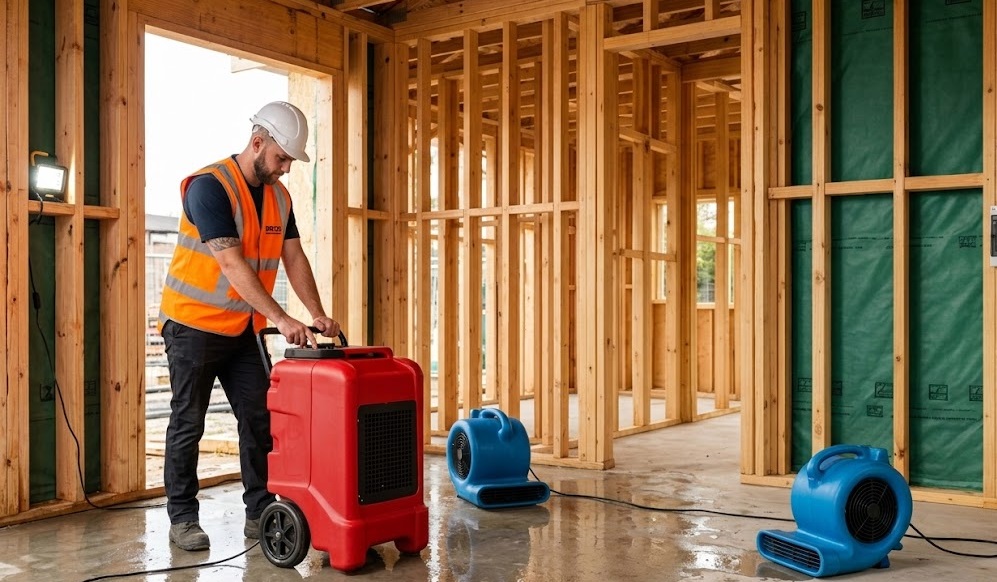
Timber-Frame Drying That Clears Pre-Line — Auckland
When framing gets wet, your build schedule stalls. 7 Hire sets up a controlled drying environment, tracks moisture every day, and hands you a council-ready report so you can line and move on.
Typical timeframe: 48–72 hours for standard homes; winter or complex footprints can take longer.
Drying Combo
-
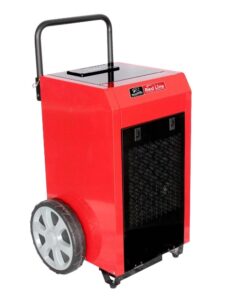
The Core Power: Large 90 L Industrial Dehumidifier
-
FREE: 2 Drying Fans (Accelerates evaporation)
-
FREE: Moisture Meter (Track exactly when your materials are dry)
-
FREE: On-Site Thermal Image Test (Pinpoint hidden structural moisture tracks)
-
FREE Delivery & Pick Up (Auckland-wide straight to your property or job site)

Our Pricing Rates:
-
💳 Short Term Rate: $75 + GST per day (Minimum 3-day hire)
-
📅 7-Day Package Rate: $400 + GST for 7-Day hire
- Call Now: 021-877-504
DIY Timber Drying Checklist
Prep & Containment
-
Close doors/windows; only vent if outside humidity is lower.
-
Shrink the zone with 200 µm plastic “tents.”
Dehumidifiers
-
Use commercial units (≈50–90 L/day+); add more for bigger/wetter zones.
-
Continuous drain to sink/drum for 24/7 run.
-
Best at ~20–27 °C; add safe heat if cold.
-
Cold spaces (<12–15 °C): favour desiccant units.
Fans & Airflow
-
Sweep air across wet timber (not straight at one spot).
-
Create a loop (one pushes, one pulls) to kill dead zones.
-
Move fans periodically; target shaded/low-airflow spots (garages, wardrobes, under-stairs).
Targets & Monitoring
-
Daily log: temperature, RH, timber moisture.
-
Hold RH 40–55%; timber ≤18% MC before lining.
-
Probe plates, corners, penetrations; use a moisture meter.
Power & Safety
-
One 10 A NZ socket ≈ 2300 W total—stay well under it; no daisy-chains.
-
RCD-protected outlets; heavy-duty, short leads; keep cords off wet floors.
-
Clean filters; allow dehu defrost cycles.
-
Secure gear: chain-lock to framing; label with your number.
Speed-ups
-
Tent off wet walls/floors to concentrate the dehu.
-
Gently warm the air to boost removal.
-
Remove wet linings/insulation that trap moisture (where safe).
Common Mistakes
-
Windows open (you’ll fight the dehu).
-
Blasting one spot (case-hardens; core stays wet).
-
Stopping early—hold targets 24–48 h to confirm.
Quick Rule of Thumb
-
Start with 1 dehu + 1–2 axial fans per room; if RH isn’t <~55% in 12–24 h, add capacity, heat, or better containment.
Why builders book Dry Me Now
-
Pre-Line Proof Included — Dated meter readings (before / during / after) plus a final moisture report you can show your inspector.
-
IICRC-Certified Team — Trained in structural drying and flood restoration for when leaks or storms are involved.
-
Rapid Mobilisation — We size the job quickly, deliver kit, and set airflow paths for even drying.
-
Right-Sized Equipment — Commercial LGR dehumidifiers, axial/cross-flow air movers; desiccant and heat options for cold or stubborn moisture.
-
Builder-Friendly Options — Choose a managed install or a simple hire bundle with guidance.
Two service paths
Managed Drying (hands-off)
-
Site sizing and plan
-
Placement of dehumidifiers, fans, and containment where needed
-
Daily moisture checks with adjustments for even results
-
Final moisture report for pre-line sign-off
Builder-Led Hire (with guidance)
-
Kit tailored to footprint and conditions (e.g., 90 L commercial dehumidifier + axial fan)
-
How-to guide for checks and adjustments
-
Moisture testing included; upgrade to desiccant/heat if required
How we get frames dry (and proven)
-
Stabilise — Contain the area, manage temperature and airflow direction.
-
Evaporate & Capture — Move dry air across studs and plates; dehumidifiers remove the moisture load.
-
Verify — Take dated readings at representative studs, plates, and corners.
-
Sign-off — Supply a council-ready moisture report aligned to pre-line targets (commonly ≤18% MC; tighter specs on request).
What we measure: timber moisture (%MC), ambient RH/temperature, and progress trend.
Timeframes & expectations
-
48–72 hours is common for mid-size homes with good containment.
-
2–5+ days if timber sections are heavier, the site is cold, or there’s limited ventilation.
-
We’ll tell you upfront if desiccant or supplemental heat is recommended to speed results.
Add-ons when conditions demand it
-
Containment & make-safe for open shells and winter builds
-
Heaters to keep air within an efficient drying range
-
Desiccant units for low-temperature, high-moisture scenarios
-
Data logging for long jobs or insurance documentation
FAQs
Do you guarantee a pre-line pass?
We guarantee clear documentation and the right setup. Most frames clear once the environment is controlled; if extra steps are needed, we’ll outline them straight away.
Will this damage timber or linings?
No. We use controlled airflow, appropriate temperature, and professional dehumidification to dry within safe ranges.
Can you help after a leak or flood?
Yes. Our team can handle extraction, sanitising, and structural drying end-to-end.
Ready to move your programme forward?
Call or text 021-877-504 for a quick sizing and start date.
Professional dehumidifiers • Air movers • Containment • Council-ready moisture reports