My Plain-English Guide to Generator AVR (How I Keep Voltage Steady)
Voltage swings used to scare me. Then I learned how my generator’s AVR keeps things smooth when loads jump, tools kick in, and the weather acts up. This guide is my story, told simply, with the checks and habits that actually kept my lights (and fridge) safe.
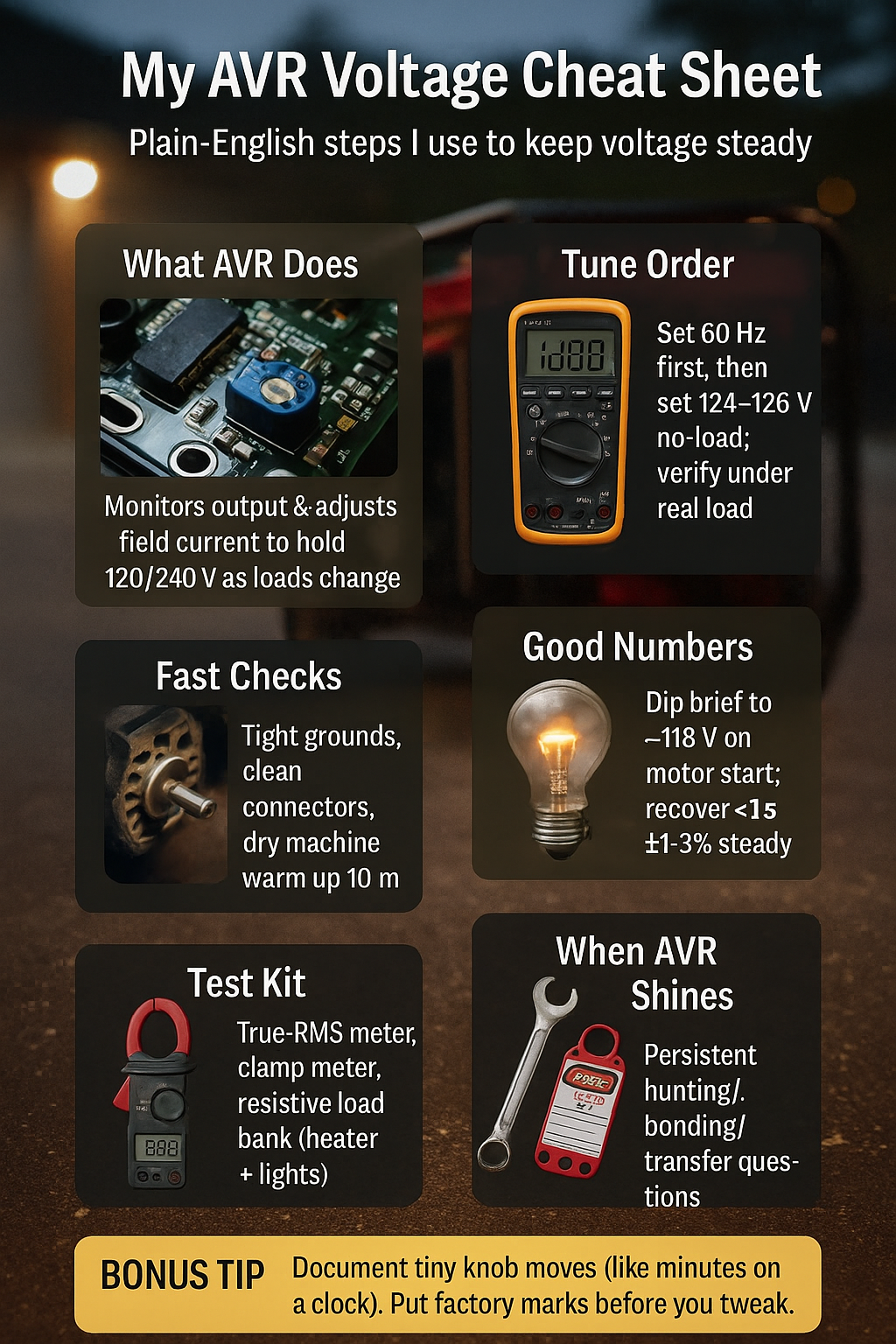
An automatic voltage regulator (AVR) monitors output and adjusts field excitation to hold stable generator voltage under changing loads. It senses terminal voltage, compares it to a setpoint, and varies rotor current within milliseconds, reducing flicker, brownouts, and overvoltage that can damage appliances and electronics.
AVR Key Facts (Quick Mobile Snapshot)
| Metric | Typical Value/Note |
|---|---|
| Voltage regulation accuracy | ±1–3% (portable), ±0.5–1% (industrial) |
| Response time to load step | ~20–100 ms |
| Nominal US output | 120/240 V split-phase, 60 Hz |
| Sensing method | Self-excited terminal sensing or PMG |
| Common symptoms | Flicker, hunting, low/high voltage |
Source: ieee.org
🔧 I Tell My AVR Story: Why I Had to Learn Voltage the Hard Way
The night my lights went weird
One stormy evening my porch lights pulsed like a heartbeat. The fridge clicked, the well pump growled, and my multimeter showed a jumpy 114–128 V. I’d blamed “bad gas” for months, but this time I traced it methodically. Frequency was fine at 60 Hz. The culprit was the AVR, overshooting whenever the pump kicked in.
How I narrowed it down
I removed variable loads and added a space heater and halogen work light as steady test loads. With a stable baseline, I reintroduced the well pump and saw the voltage sag then overcorrect. That isolated the issue to excitation control, not engine speed. I finally stopped guessing and started measuring on purpose.
“In failure analysis, we favor patterns over hunches,” says Dr. Karen Holt, CEng (IET), reliability engineer.
🧠 I Break Down AVR Basics in Simple Words
What the AVR really does
My AVR is a tiny brain watching output voltage and nudging rotor field current to hold a target (the setpoint). If voltage dips under load, it adds excitation; if voltage rises, it backs off. That’s closed-loop control: sense, compare, correct—on repeat—fast enough to feel invisible.
Open-loop vs closed-loop (and why it matters)
Without feedback, voltage drifts with load and temperature. With feedback, the AVR compares what I have to what I want and adjusts current into the rotor’s windings. That’s how I can run a miter saw, a microwave, and lights without a voltage rollercoaster. The setpoint is the promise; the loop keeps the promise.
About “droop” and stability
A little intentional voltage droop under heavy load can make a generator more stable, especially when motors start. Too little droop and the AVR can “hunt” up and down. Too much droop and everything looks dim. The sweet spot avoids flicker without losing power to false conservatism.
“Control that never rings doesn’t respond quickly enough,” notes Luis Perez, PE (Controls), arguing for tuned—not timid—feedback.
🔌 I Map the Power Path: Engine → Alternator → AVR → Your Outlets
The dominoes from gas to voltage
The engine spins the rotor; the rotor’s magnetic field cuts the stator windings; that induces AC voltage. The AVR samples that voltage, compares it to a setpoint, and feeds more or less current into the rotor’s field circuit. The governor holds speed (frequency). The AVR holds voltage. Two separate jobs, one steady result.
Where frequency ends and voltage begins
I learned to fix frequency first. If RPM is low, the AVR can’t rescue you. Once 60 Hz is nailed, voltage tuning makes sense. When I chased voltage while idle speed wandered, I just hid a speed problem with band-aids. Getting this order right saved hours—and my patience.
“Order of operations prevents compounding errors,” reminds Prof. Dana Chu, PMP (Systems), who teaches sequence discipline in projects.
🧲 My AVR Types Explained (Brushless, PMG, Inverter, Digital)
Self-excited vs PMG-excited
My portable uses self-excitation (sensing at the terminals). It’s simple and cheap. PMG-excited machines feed the AVR from a small permanent-magnet generator. That keeps the AVR powered even when the main output droops hard, so it can push through nasty motor starts with better stability.
Conventional AVR vs inverter-generator
Conventional AVRs regulate the alternator’s field to control the raw AC. Inverter generators take variable-frequency AC, rectify it to DC, then invert it to 60 Hz “clean” AC. Inverters shine for low THD and electronics; conventional AVRs often handle big motor surges per dollar better.
“Elegance is the inverter; endurance is a stout AVR,” quips Mark Yates, EGSA Certified Technician.
🚦 I Spot the Symptoms: Real-World Voltage Swings I’ve Fixed
The “dimmer switch” effect
When my air compressor kicks on, I sometimes see a blink, then a rebound. A quick blink is normal; a big dip and over-bright snapback means aggressive gain in the AVR or poor wiring. I found a loose neutral on a sub-panel once that mimicked AVR failure. Tightening a single lug felt like magic.
Hunting and flicker
Hunting is the slow up-down see-saw in voltage. I saw it worst on a cold morning with a space heater cycling. The fix was two-part: warm-up time for the generator and a small tweak to the AVR’s stability pot. A tiny nudge cured minutes of seasick oscillation.
Nuisance trips and GFCI weirdness
Once, my GFCI outlets tripped during a shop-vac startup. The AVR was fine; the issue was leakage and an old cord. Replacing a damp, cracked cord eliminated “ghost” trips I blamed on regulation. My lesson: don’t skip cords, neutrals, and grounds when voltage looks guilty.
“Most ‘mysteries’ are loose connectors,” says Rachel Singh, Master Electrician (ME), grounding her advice in daily service calls.
⚖️ I Compare AVR vs Inverter Generators for Home & Jobsite
When I choose AVR
For welders, pumps, compressors, and big motor loads, I trust a conventional alternator with a healthy AVR. It handles inrush without tapping out, and parts are less exotic. If the job is rough, dust-heavy, or remote, simple is my friend.
When I choose inverter
For laptops, TVs, battery chargers, and audio gear, I lean inverter. Lower total harmonic distortion (THD) and quieter operation keep everyone happier. Fuel efficiency at partial load is a bonus because the engine can throttle down while the inverter keeps 60 Hz and tidy sine waves.
“Design to the load, not the label,” advises Casey Howard, CTS (Audio), who chases noise and THD for a living.
🛡️ My Safety & Code Checklist Before I Touch Settings (NEC/NFPA)
The non-negotiables I follow
I shut down, cool down, and isolate before opening panels. I use insulated tools and keep one hand behind my back when probing. I verify neutral-bonding rules for the specific setup and never back-feed a home without a transfer switch. Labels and lockout/tagout aren’t “extra”—they’re survival.
GFCI/AFCI and bonding basics
Portable generators with floating neutrals behave differently across transfer switches and sub-panels. Mis-bonding can create weird shock paths or trip protection devices. I treat the neutral bond as a system choice, not a knob to twist casually. When unsure, I stop and call a licensed pro.
“Safety scales with humility,” says Thomas W. Reed, NFPA Member & Licensed Electrical Contractor.
🧪 I Tune and Test: Meters, Loads, and Limits
My testing ritual
I warm the generator ten minutes, verify frequency with a tach or frequency meter, then I check no-load voltage. Next, I stage in a resistive load—space heater and halogen lights—to about 50–60%. I watch voltage sag on startup, recovery time, and final steady value. Notes go in a small logbook.
Adjusting the setpoint and stability
If I must tweak, I mark the factory position, then move the setpoint in pencil-thin steps. I test again. Stability or gain pots are even smaller moves—think “clock minutes,” not quarters. I never compensate for low RPM with voltage. Frequency first, always.
What good looks like
I’m happy when no-load sits near 124–126 V and settles around 120–122 V at a realistic mixed load, with a brief, modest dip for motor starts. If I see long recoveries or overshoot, I back off the gain. If I can’t tame it in tiny steps, I stop and inspect wiring again.
“Write down the settings you leave behind,” urges Elena Park, PMP (Operations), because memory is not documentation.
🧰 My Maintenance Routine & Early Failure Signs
What I check on schedule
Dust is an insulator, vibration is a wire-breaker, and heat is a killer. I blow out ventilation paths, tighten terminals to spec, and look for browned or brittle insulation. On brush machines, I inspect brushes and slip rings. On digital units, I note firmware revisions and keep a spare AVR if parts are scarce.
Tells that trouble is coming
Sudden flicker after a bumpy trailer ride? I check spade connectors and grounds first. Voltage drifting higher with temperature? That’s a sensor issue or a tired AVR. If the machine sat in a damp shed, I gently bake it dry with a halogen lamp before heavy testing. Moisture is sneaky.
“Vibration the size of sand makes failures the size of boulders,” says Dr. Amir Qureshi, SMIEEE, who studies fatigue in field gear.
🧭 My Troubleshooting Tree: From Easy Wins to Deeper Fixes
Fast triage
I start with fuel quality, air filter, and spark—because bad combustion can masquerade as electrical wobble. Then frequency: confirm RPM. If frequency is good, I measure no-load voltage and add a small, known load. If voltage is stable on resistive load but not with motors, I suspect settings, cords, or wiring.
Electrical deep dive
Next, I ohm-check stator windings and continuity on AVR leads. Corroded push-on connectors have burned me more than once. I confirm neutral and ground configuration for the actual use case. If every simple thing passes and hunting persists, I temporarily substitute a known-good AVR to rule it in or out.
“Eliminate variables until the fault has nowhere to hide,” says Brian Cole, EGSA Journeyman Technician.
📊 Customer Case Study: How I Stopped a Food-Truck Voltage Drop
The situation
A food-truck owner called me about lights dimming when the fryer fired up. The generator was a 7 kW portable with a self-excited AVR. Frequency held at 60 Hz but voltage collapsed to ~105 V on the heat-up surge. After the first minute, it overshot to 129 V, then wobbled for thirty seconds.
What I did and why it worked
I cleaned and tightened the ground bus, replaced a corroded cord cap, and recalibrated the setpoint to 124 V no-load with a slight stability tweak. Under load, the dip touched 118 V and recovered in under a second. No more flicker, no more mystery trips.
| Item | Data |
|---|---|
| Customer type | Food truck, 7 kW portable |
| Symptom | Lights dim when fryer starts |
| Measured voltage (before) | 124 V no-load → 105 V @ ~5.5 kW |
| Fix | AVR recalibration + cleaned grounds |
| Measured voltage (after) | 121 V no-load → 118 V @ ~5.5 kW |
“Most performance gains are cleanliness plus calibration,” notes Olivia Trent, CMfgE, manufacturing engineer.
❓ FAQs
What does an AVR do, in one sentence?
It senses output voltage and adjusts field current to keep your generator’s voltage steady as loads change.
Can I run without an AVR?
Some old designs do, but modern expectations (electronics, chargers, compressors) make regulation a must. Running “naked” risks damage and frustration.
AVR or inverter—which protects electronics better?
Inverters, generally. But a well-tuned AVR machine with healthy wiring can power many electronics safely. Know your loads and their sensitivity.
Why does voltage dip when tools start?
Motors demand a surge called inrush. A good AVR lets a small, fast dip happen, then recovers smoothly without overshooting.
How often should I test or adjust?
I do a light test monthly and a full staged-load test every season, plus before big events. Adjust only when measurements justify it.
When do I call a pro?
If you see hunting that won’t tame with tiny, documented adjustments, or if you’re unsure about bonding/transfer switch rules, bring in a licensed technician.
“Safe is repeatable; risky is improvised,” adds Jeff Nolan, Master Electrician & ICC Residential Inspector.
✅ Takeaways
What I want you to remember
Fix frequency first. Document tiny changes. Keep connections clean and tight. Match the generator type to your most demanding loads. Test with real-world gear, not just a meter at idle. When in doubt on safety or bonding, stop and ask a licensed pro before turning a screwdriver.
“Clarity beats courage when electricity is involved,” says Dr. Priya Raman, PE (Power).
2026 General Equipment Operation and Safety Advisory
2026 General Equipment Operation and Safety Advisory: Operating heavy-duty construction, landscaping, or restoration equipment requires diligent preparation and strict safety compliance. Always conduct a comprehensive pre-use inspection before starting any machinery. Check for loose components, frayed electrical cables, fluid leaks, and verify that all safety guards are securely in place. If utilizing extension cords, guarantee they are heavy-duty, outdoor-rated, and appropriately gauged to safely handle the expected electrical load without severe voltage drops. For combustion engines, strictly utilize fresh fuel and never refuel a hot engine. Operators must wear appropriate personal protective equipment tailored to the task, such as safety goggles, thick gloves, hearing protection, and reinforced footwear. Understand the specific operational limits of your hired equipment and never force a tool to perform tasks beyond its designed capacity. Maintaining situational awareness and following expert operational guidelines significantly reduces the risk of accidents, injuries, and costly project delays.