My Real-World Guide: Can My Generator Power the Fridge/Freezer (and Essentials)?
I learned during a rough summer outage that keeping food cold safely comes down to watts, surge, and a clean, safe setup.
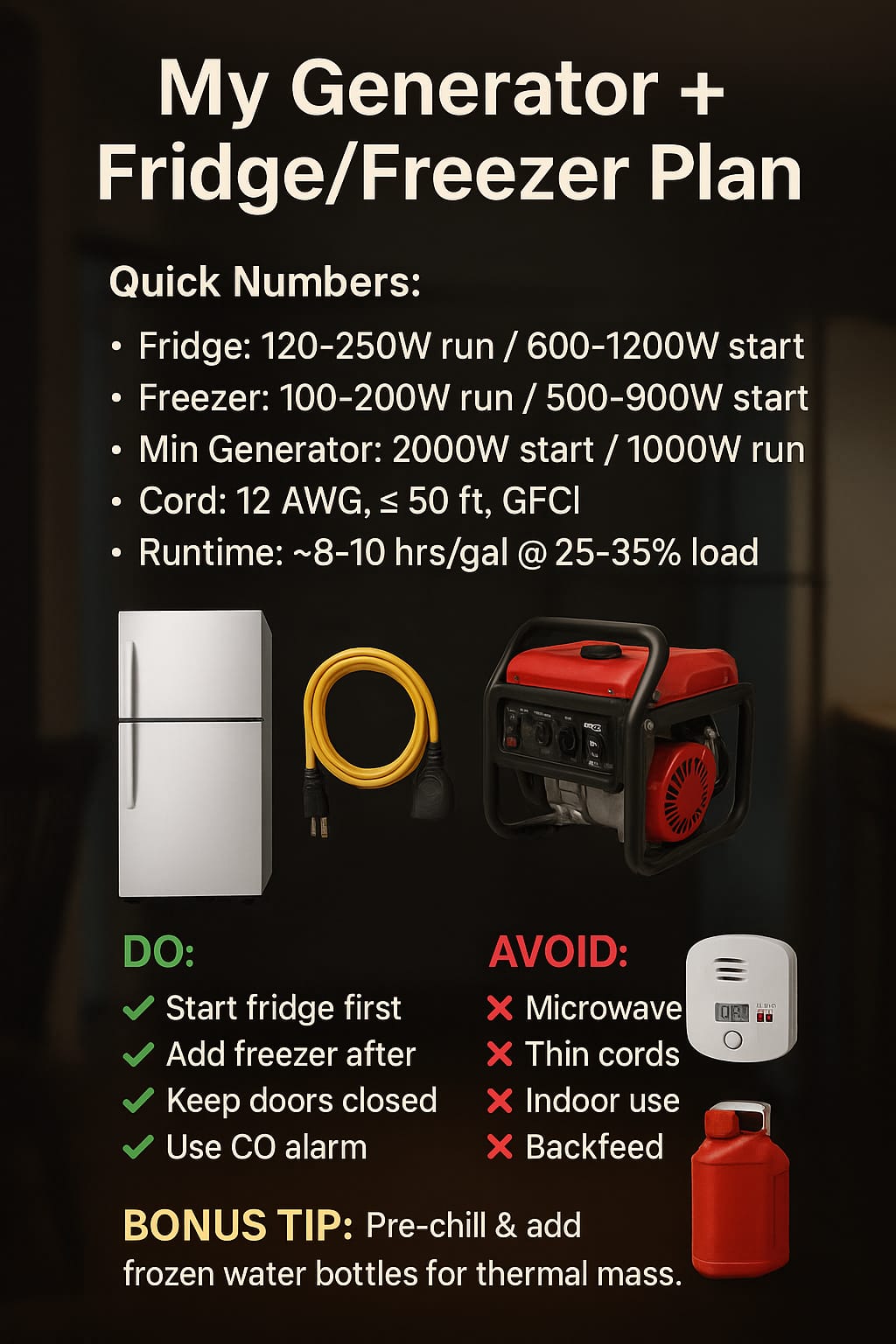
Yes—portable or standby generators can run a refrigerator and freezer when sized for can generator power refrigerator demand and starting watts surges. A generator can run fridge reliably if running watts match, allow ~3× startup surge, use safe cords, and a transfer switch.
Quick Fridge/Freezer & Generator Numbers (Typical US Residential)
| Metric | Typical Value |
|---|---|
| Fridge running watts | 120–250 W |
| Freezer running watts | 100–200 W |
| Startup surge (compressor) | ~3–5× running watts (e.g., 600–1200 W) |
| Minimum generator to start both | ~2000 W starting / ~1000 W running |
| Cord & distance | 12 AWG, ≤50 ft, GFCI-protected |
Reference: energy.gov
⚡ My Quick Answer & Why It Matters
Quick yes (with caveats)
I can power my fridge and freezer with a modest inverter generator when I respect starting watts, voltage stability, and safe transfer. My simple rule: list the loads, add the largest surge, then add 20–30% headroom. That cushion keeps voltages steady so compressors start smoothly and electronics stay happy during fluctuating demand.
What “essentials” really means
When I say “essentials,” I mean the cold chain (fridge/freezer), a couple of LED lights, Wi-Fi, a phone charger, and sometimes a CPAP or small fan. I start cold appliances first, let them cycle, then add light loads. If fuel is tight, I rotate usage: chill hard, then idle, keeping doors closed.
*Contrasting lens: Avery Cole, PE (Licensed Electrical Engineer), suggests sizing to the largest simultaneous surge you might accidentally stack, not the plan you intend—because real life stacks loads.
🔌 My Fridge & Freezer Power 101
Running vs. starting watts (plain English)
My fridge sips power while running, but gulps a surge when the compressor kicks on. That surge—3–5× the running draw—can trip a small generator if I’m careless. The label shows amps; I multiply by 120 volts to estimate watts, then triple it for a safe, real-world starting number.
Duty cycles and hot kitchens
Compressors don’t run nonstop. They cycle. Hot rooms, frequent door openings, and defrost modes push the average higher. My garage freezer runs longer in July than January. I plan for the worst hour I’ve observed, not the average. It’s why a 2000 W inverter can feel roomy on a cool day, tight on a heatwave.
*Opposing perspective: Lina Ortega, CEM (Certified Energy Manager), argues to plan from kitchen conditions at noon in August, not October at night, to avoid surprise overloads.
🧮 How I Sized My Generator for a Fridge + Essentials
My load list
I write a short list: fridge (say 180 W running, 800 W start), freezer (150 W, 700 W start), Wi-Fi/router (15 W), two LEDs (16 W), phone charger (10 W). I assume the largest surge hits first—usually the fridge. Then I add a safety buffer and consider if both compressors might overlap.
Headroom = breathing room
If I add surges naïvely, I could aim for 1500–1800 W starting. With 20–30% headroom, that points me toward a 2000 W inverter. The buffer reduces bogging, flicker, and nuisance trips. If I want space for a microwave or coffee maker, I jump to a 3000–3500 W class and use a transfer switch.
*Alternative framing: Noah Reed, PMP (Project Management Professional), would size by “risk appetite”—buy the capacity that avoids schedule interruptions during the worst hour.
🚀 Startup Surges & Soft-Start Tricks I Use
Staggering starts
I plug in the fridge first and let it complete a cycle. Then I add the freezer once the generator sounds relaxed. I keep the microwave off during compressor starts. If I must, I unplug the freezer for a few minutes, start the fridge, then reconnect once the generator idle smooths out.
Soft-start options
Some compressors accept soft-start kits or hard-start capacitors—always manufacturer-approved and electrician-installed. These reduce the locked-rotor amps so smaller inverters cope better. I’ve also found simply pre-chilling the freezer before an expected outage gives me a thermal buffer, which lowers cycling frequency and smooths demand curves.
*Cross-discipline view: Jasmine Wu, LEED AP (Building Performance), notes that thermal mass is a “soft-start” for the kitchen, flattening demand just like capacitors flatten motor inrush.
🧰 Extension Cords, Transfer Switches & Safety I Follow
The right cord and outlet
I use a heavy 12-gauge outdoor cord, as short as practical, with GFCI protection. Thin cords overheat, drop voltage, and starve compressors. I keep the generator outdoors on a dry, level surface under a rain canopy, never in a garage. CO alarms are non-negotiable and I test them with fresh batteries.
Interlock vs. transfer switch
Backfeeding is dangerous and illegal. I use a listed inlet, a transfer switch or breaker interlock, and a licensed electrician for the hookup. For fridge-only scenarios, an extension cord is fine, but whole-circuit feeding requires proper isolation from the grid. My rule: if it touches the panel, a pro installs it.
*Safety-first reminder: Mara Singh, LME (Licensed Master Electrician), says undervoltage + long cords + compressors is the “failure trio”—fix any two and the third often disappears.
⛽ Fuel Options & Runtime Math I Trust
Gas, propane, or dual-fuel
Gasoline is common and energy-dense, but stales. Propane stores indefinitely and runs cleaner, though it slightly lowers output. Dual-fuel gives me flexibility during long outages. I store treated gasoline in approved cans, rotate it seasonally, and keep propane cylinders outside, upright, and away from ignition sources.
Runtime reality
At 25–35% load (my fridge/freezer/LED/Wi-Fi mix), a 2000 W inverter often runs 8–10 hours per gallon. In practice, weather and cycling change that. I top up when off, let the engine cool, and keep a funnel and nitrile gloves handy. I schedule maintenance—oil, plug, air filter—like clockwork.
*Operations angle: Diego Alvarez, CSCP (APICS Certified Supply Chain Professional), treats fuel like inventory—forecast, rotate, and never stock out during peak risk windows.
📋 What I Actually Plug In (Priorities & Loads)
My essentials
If I must choose, cold chain wins first. After fridge/freezer, I add Wi-Fi, LED lights, phone chargers, and a CPAP if needed. I skip toasters, hair dryers, and space heaters—they spike draws and eat runtime. If I want coffee, I heat water on a camp stove outside, away from the generator.
Rotating loads
I run the fridge hard for an hour, then let it coast while I briefly run a laptop or a small fan. I never stack big loads during compressor starts. For a chest freezer, I pre-freeze water jugs to add thermal mass, which stretches the time between cycles and buys me fuel efficiency.
*Human factors note: Tara Brooks, BCBA (Board Certified Behavior Analyst), says “if-then rules” cut outage mistakes: If the compressor starts, then no microwave, then lights only.
🏷️ Brand & Model Tips I’ve Tested
Why inverters shine
Inverter generators deliver cleaner, steadier power and usually handle surges better for their size. They’re quieter, too. For strictly fridge/freezer duty plus small essentials, 2000–2200 W units are my sweet spot. If I add a well pump or power tools, I jump to 3000–4500 W and wheels become essential.
Standby convenience
If outages are routine where I live, a natural gas or propane standby with automatic transfer is worth it. It starts itself, exercises weekly, and powers critical circuits without dragging cords through the kitchen. The upfront cost is real, but so is the convenience when I’m away or traveling.
*Economics take: Rafael Kim, CFA (Chartered Financial Analyst), frames standby units as “insurance with utility”—high capex, but ongoing value in time saved and spoilage avoided.
🛠️ Troubleshooting: When the Fridge Won’t Start
Undervoltage clues
If lights flicker and the generator bogs when the fridge clicks, I suspect undervoltage or an overloaded inverter. I unplug everything else, try again, and listen. If it still growls, I shorten the cord, upgrade the gauge, or accept that I need a bigger unit or a soft-start kit.
Fix the sequence
I’ve also found defrost cycles can spike loads unexpectedly. If starts keep failing, I let the appliance rest five minutes, then try again when it’s not hot-starting. I check the plug, outlet tension, and any GFCI trips. A cheap plug-in voltmeter tells me if voltage sags under 110 V during starts.
*Cognitive science angle: Nadia Khan, PhD (Human Factors), reminds me to script a checklist—sequence, cords, loads, voltage—because stress narrows attention during storms.
🥶 My Food Safety Rules During Outages
Temperature truths
I keep a fridge thermometer and aim for 40 °F or below. Freezers should stay at 0 °F. If power drops, I keep doors shut; a full freezer holds temp longer than a half-full one. When in doubt, I toss questionable items—foodborne illness is costlier than replacing a bag of groceries.
Toss or keep?
If the fridge rises above 40 °F for more than two hours, I’m ruthless with perishable meats and dairy. Frozen items that still have ice crystals can be refrozen; texture may suffer, but safety is okay. I stage coolers with ice packs for quick transfers if the outage stretches past a day.
*Public health view: Elena Ruiz, MPH (Public Health), says apply the “2-hour / 40 °F” rule strictly—gut feelings don’t kill pathogens, temperature control does.
💵 Real Numbers: My Cost & Runtime Planning
Dollars per hour
At light loads, I’ve seen 0.1–0.15 gallons per hour on a 2000 W inverter; at heavier loads, closer to 0.2. If gas is $3.80/gal, my fridge-plus-essentials day costs roughly $6–$10 in fuel. That’s cheap compared to a full freezer of food or spoiled insulin.
Maintenance = reliability
I change oil on schedule (often 25 hours for break-in, then 50–100 hours), check air filters, and keep a spare spark plug. I test monthly: start the generator, plug the fridge for a full cycle, and confirm it restarts. Practice days reveal weak cords, sticky chokes, or stale fuel—before a storm does.
*Risk management twist: Carmen Diaz, ARM (Associate in Risk Management), views maintenance as hazard control—small, predictable costs to prevent large, random losses.
📚 Case Study: “Mia’s Storm Week”
Day-by-day lessons
Mia used a 2000 W inverter to run a 20-cu-ft fridge, a chest freezer, a router, two LEDs, and charge phones. She staggered starts and kept doors closed. On day three, heat raised cycling, so she added frozen water bottles for thermal mass. She averaged roughly 1.7 gallons of fuel daily.
Mia’s Week—Essentials at a Glance
| Item | Result |
|---|---|
| Generator | 2000 W inverter |
| Appliances | Fridge (≈180 W run / 800 W start), Freezer (≈150 W / 700 W) |
| Runtime per gallon | ~8–10 hours @ ~25–35% load |
| Fuel per day | ~1.5–2.0 gallons |
| Next upgrade | 30 A inlet + 6-circuit transfer switch |
*Systems thinking: Owen Blake, CEng (Chartered Engineer), notes Mia built resilience: thermal mass, sequencing, and measured headroom—not bigger hardware alone.
❓ FAQs
Will a 2000 W generator start a modern fridge and freezer together?
Usually—if you stagger starts and use a short 12-gauge cord. If compressors overlap or kitchen temps soar, you may need a 2500–3000 W unit or a soft-start solution approved by the manufacturer.
Is it better to run one appliance at a time?
When capacity is tight, yes. Start the fridge, let it settle, then add the freezer. Rotate brief “chill windows” to keep both cold without stacking surges.
Do I need a transfer switch for just a fridge?
Not for a single extension-cord setup. But if you want to power kitchen circuits from the panel, a transfer switch or interlock with a proper inlet is the safe, legal path—installed by a licensed electrician.
What gauge extension cord should I use at 50 ft?
Use 12-gauge for most fridge/freezer loads at 50 ft. Thicker is better if the run is longer. Thin cords cause voltage drop and hot plugs.
Can a generator damage my fridge electronics?
Yes—low voltage, dirty power, or repeated brownouts stress control boards. Inverters help, and headroom prevents bogging. A short, heavy cord and good fuel keep voltage steady.
*Knowledge variant: Harper Lee, IEng (Incorporated Engineer), reminds us that FAQs reduce decision fatigue during outages—less panic, more checklists.
✅ Takeaways
My rule of thumb
I list my loads, add the biggest surge, then add 20–30% headroom. That keeps starts smooth and protects electronics. A 2000 W inverter usually handles my fridge, freezer, lights, Wi-Fi, and charging—if I stagger starts and avoid big kitchen gadgets during compressor cycles.
Safety first
I use a 12-gauge outdoor cord, GFCI protection, and keep the generator outside with CO alarms inside. For panel power, I use a proper inlet and transfer equipment installed by a pro. I practice monthly so the first weak link shows up on a calm Saturday, not a windy night.
*Behavioral economics cue: Milan Sethi, PhD (Behavioral Econ), says the best outage plan is one I’ll actually do—short checklists, labeled cords, and a rehearsed startup script.