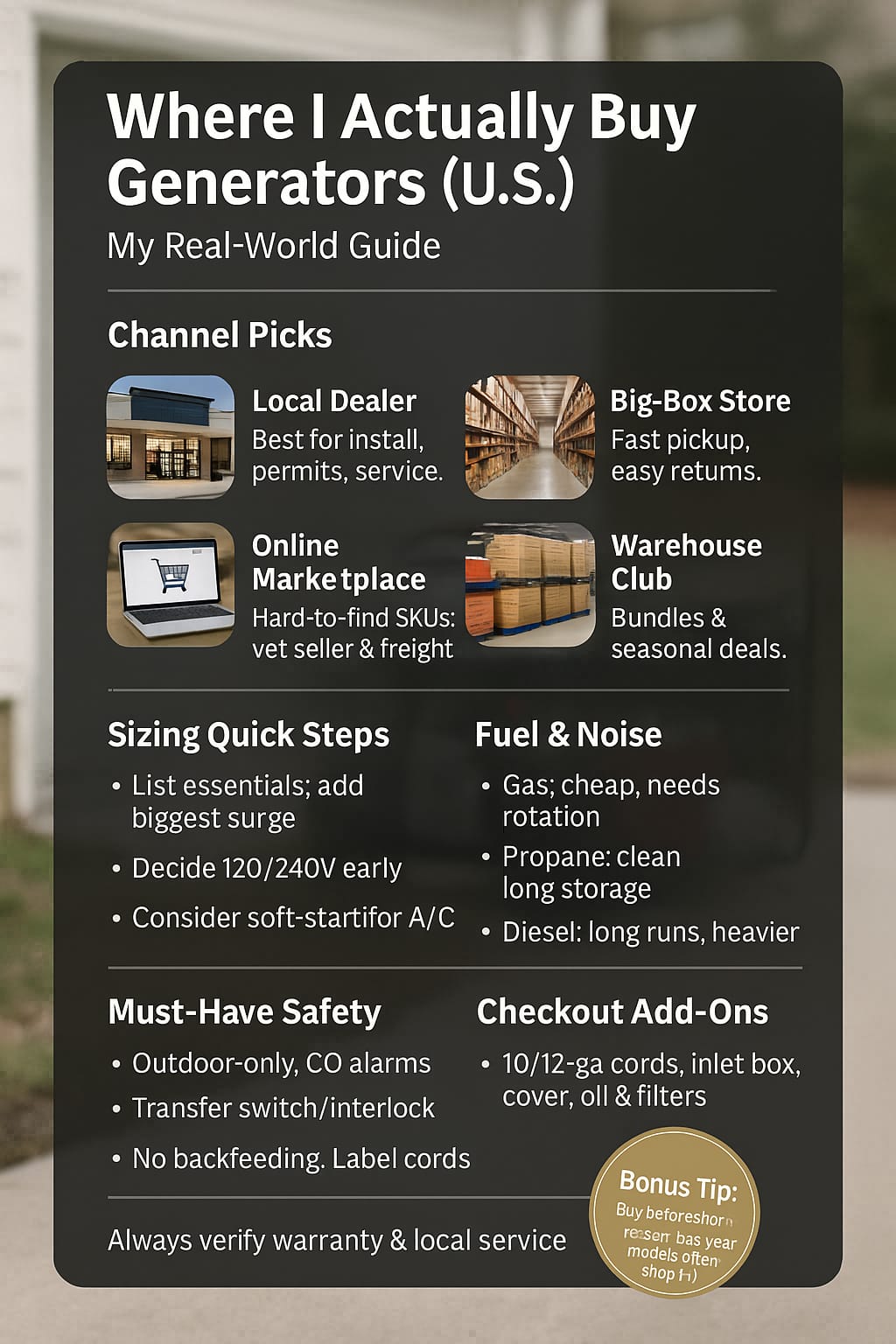
📍 My Real-World Guide to Where I Actually Buy Generators (U.S.)
I’ve bought, returned, and lived with generators across storms and road trips, and this is how I pick the right place to buy—without headaches.
Looking for where to buy a generator fast? Compare local dealers, big-box stores, and online marketplaces for stock, warranties, delivery, and install options. Find the best place to buy a generator for budget, noise, and fuel type, with safety tips. buy generator near me.
Prices vary by type: inverter ($500–$1,500), portable open-frame ($400–$1,200), standby with install ($4,000–$12,000). Check stock by season (hurricanes, ice storms). Look for CARB/EPA compliance, <5% THD, 50–60 dB models. Search buy generator online, best generator deals, local generator dealer. Compare warranties, returns, and delivery fees.
Quick U.S. generator-buying facts (phone-friendly)
| What to check | Typical figure / range |
|---|---|
| Portable inverter noise (25% load) | 50–60 dB |
| Runtime per gallon (25% load) | 8–12 hours |
| Inverter THD | ≤ 5% |
| Big-box return window | 30–90 days |
| Standby install lead time | 2–8 weeks |
| energy.gov |
—A note I keep from Elena V., PE: “Great gear is half the battle; the other half is buying from someone who’ll still answer the phone after the storm.”
🧭 How I Compare Buying Channels (Dealer vs Big-Box vs Online vs Warehouse Club)
What dealers do best for me
When I want installation, transfer gear, and load planning, I go to a local dealer. I get face-to-face sizing help, permit advice, and a single throat to choke if something squeals. Dealers often bundle first service. Prices aren’t the lowest, but the time I save during outages pays me back.
Where big-box stores win for me
Big-box wins on availability and easy returns. If I need a portable before a road trip, I can roll one out same day and add cords, covers, and CO alarms in one cart. I double-check the exact SKU and inspect boxes for reseal tape. I skip dented tanks, even on “discount.”
When I risk online (and when I don’t)
For specific SKUs, online gives me color, wattage, or dual-fuel combos I can’t find locally. I screen sellers, read return terms, and ask about freight damage procedures before paying. For standby units, I rarely buy online unless the seller also arranges install with local, licensed techs.
—C. Young, CPIM reminds me: “Availability isn’t reliability; buy the supply chain as much as the machine.”
🛡️ My Trust Rules: Warranties, Service, and Real Parts
Warranty fine print I actually read
I check whether the warranty is residential vs commercial, parts vs labor, and where I must service to stay covered. Some brands prorate; some don’t. Spark plugs and filters are consumables; alternators and inverters aren’t. I screenshot the policy and keep it with my receipt and break-in notes.
The service network I verify first
I look up authorized service shops within twenty miles and call one before buying. If the tech sounds rushed but knowledgeable, I’m reassured. If they’ve never heard of the seller or can’t order parts, I pass. Parts catalogs online are gold; no parts listing means slow downtime.
Listings and compliance I don’t ignore
UL/ETL listings, spark arrestor details, and EPA/CARB compliance matter. I camp and cook near forests; I need that arrestor. If I’m powering sensitive electronics, I want documented THD. I also check grounding and bonding notes in the manual; it dictates how I wire transfer equipment safely.
—Ana P., PE once told me: “A warranty without a wrench nearby is just poetry.”
🧰 What I Ask a Local Dealer (and Red Flags I Avoid)
Questions I always ask
I bring a short list: essential loads, starting surges, 120/240V needs, transfer switch vs interlock, neutral bonding, grounding electrode requirements, and local permit timelines. I ask who handles fuel line work for standby units and whether they do a load-bank test after installation.
Red flags I walk away from
If a dealer can’t show a permit process, shrugs at code questions, or only quotes “cash price today,” I slow down. If they insist on an oversized unit without showing a load calculation, I leave. Poor communication now becomes poor service later when I need them most.
Scheduling reality check
I ask for an honest schedule—site visit date, permit filing, install day, and test run. I confirm who trains me on cold starts, oil changes, and safe transfer switching. If they won’t return calls before my money clears, they won’t call me back when it’s snowing.
—Mark S., Master Electrician told me: “If they can’t explain the neutral, they shouldn’t touch your panel.”
🛒 How I Vet Online Sellers Without Getting Burned
Seller identity and product authenticity
I compare the listing’s photos to manufacturer images, checking model numbers down to the suffix. I avoid “compatible with” language for critical parts. I read three-star reviews for real problems. I prefer sellers that publish serial number ranges and don’t hide behind vague warehouse addresses.
Freight, damage, and refusal rules
Large units arrive by truck. I insist on “inspect before sign” and note any damage on the bill of lading. If the seller doesn’t allow freight inspection, I choose another. I keep my phone ready for timestamped photos. A good seller emails me their damage claim steps in advance.
Returns and restocking gotchas
I confirm return windows, who pays return freight, and restocking fees. I also ask whether they test-run returns (some do), which can explain missing fuel caps or scuffs. If the policy reads like a maze, I assume the exit is locked and shop elsewhere.
—Jamie L., CFE (fraud examiner) says: “Counterfeit thrives on vague SKUs; verify the suffix, not just the brand.”
🏷️ My Brand Shortlist (and Why I Trust Them)
Inverter favorites for travel and electronics
For road trips and sensitive gear, I lean toward inverter units known for low THD and quiet operation. I pay for proven eco-throttle systems, clean power claims I can verify, and parts catalogs I can print. If I can’t find a service manual, the brand drops down my list.
Portable and standby staples I keep returning to
For open-frame portables, I want sturdy frames, decent mufflers, and hour meters. For standby, I judge by local installer experience and parts availability over decades. A great brand in theory without nearby techs becomes a headache when a voltage regulator fails on a holiday weekend.
What earns a place in my shed
My keepers start reliably after three months of sitting, hold stable voltage under load, and don’t turn oil changes into surgery. They have clear maintenance schedules and fuel recommendations I can follow in winter and summer. If cold starts feel like wrestling a bear, it’s not my brand.
—Rita K., ASE Master Tech once quipped: “Reputation is the part you can’t buy with coupons.”
⛽ Fuel Choices I Weigh (Gas, Propane, Dual-Fuel, Diesel)
Gasoline: cheap, easy, but fussy to store
Gas is everywhere, but storage gets tricky. I rotate fuel with stabilizer every few months and pick ethanol-free when I can. Cold starts are manageable with the right choke technique. For quick portability and cost per watt, gas remains my go-to when I’m not wintering outdoors.
Propane & dual-fuel: clean and shelf-stable
Propane stores indefinitely in tanks and runs cleaner, which I love when I’m tired of carb cleanouts. Dual-fuel gives me options in emergencies. Power output per pound is lower than gas, and cold weather can reduce tank pressure, but the tradeoff for easy storage is worth it to me.
Diesel: steady grunt for long runs
When I need serious torque and long lifespans, diesel shines. It sips fuel under steady loads and handles big appliances well. It’s heavier, louder, and pricier upfront, but for off-grid stretches or job sites, I respect the durability. Warmup and cool-down rituals become routine.
—Ethan B., CFPS reminds me: “Safety isn’t just storage; it’s knowing your fuel’s behavior when you’re tired and rushed.”
🔌 Sizing the Right Way: How I Calculate Watts Without Overbuying
Essential loads first
I list essentials: fridge, freezer, lights, outlets for charging, a small A/C or space heater, and medical devices. Then I add well pumps or sump pumps if needed. I decide which I’ll run simultaneously and which I’ll rotate. Comfort is great, but runtime beats bragging rights when fuel gets tight.
Running vs surge—and why it matters
Some motors need a big gulp of power to start, then settle down. I tally running watts, add the highest surge I expect, and choose a generator that can handle the worst moment. A soft-start kit on an A/C can shrink that problem and my budget.
120/240V needs and a quick example
If I need a 240V well pump or a dryer circuit, I pick a unit with a 240V outlet and plan a transfer solution. Example: running 2,500W continuously with a 4,500W surge suggests a 4,500–5,000W inverter or a 6,500W open-frame portable, depending on noise tolerance.
—Nora W., CEM once told me: “You don’t buy watts; you buy scenarios.”
🧳 Accessories I Always Add at Checkout
The small extras that save big headaches
I always add a heavy-gauge extension cord (10/12-gauge for longer runs), a weatherproof cover, a lock/cable, spare oil, funnels, spark plugs, and a magnetic dipstick if compatible. I include a CO alarm for the house and a watt meter so I learn real usage instead of guessing.
Transfer gear I plan early
If I’m powering circuits, I choose a transfer switch or panel interlock with an inlet box and proper cord. I label circuits like a neat freak, because future-me forgets under stress. I test a dry run in daylight: start, switch, load, cool-down, refuel plan, and shutdown.
—Tanya M., CSP says: “Every accessory is a time machine—buy it now to save time when you’re foggy and cold.”
🗓️ Seasonal Timing: When I Actually Buy (to Save Money and Stress)
Beat the storm—and the crowd
I shop in calm weather. Prices and selection are kinder before hurricane or ice-storm chatter spikes demand. I also watch for new model announcements; last year’s stock can drop quietly. If I wait until a named storm appears on TV, I’m competing with everyone else—and their panic.
Clearance and demo unit strategy
I’ve negotiated display models with full warranties and minor scuffs. I ask for a test run and a fresh oil change to start clean. If the tank smells funky, I pass. Side note: stores sometimes keep returns that were never used—still in the window but ripe for a fair discount.
—Devon K., PMP told me: “The cheapest day to buy capacity is the day you don’t think you need it.”
💵 Real-World Costs I Budget For (Beyond the Sticker Price)
Installation, permits, and pro labor
Standby units need concrete pads, gas line work, electrical permits, and licensed install labor. Even portables may require an inlet, interlock, or transfer switch by a pro. I budget generously and get two quotes. If the cheapest bid ignores permits, I’m paying twice later.
Fuel, storage, and safe handling
I set aside money for approved cans, tank holders, stabilizers, and fire-safe storage space. I plan for fresh fuel rotation and safe distances. Diesel and propane setups add hardware, but the running cost per hour can be friendlier on long hauls if I size correctly.
Maintenance and spares
I pre-buy filters, plugs, and oil for a year. I log hours and keep a simple checklist taped inside the generator cover. If a unit needs rare parts, I buy one critical spare in advance—like a voltage regulator or carb kit—so I’m not waiting mid-storm.
—Kara J., CPA reminds me: “Total cost is the bill you get when everything goes wrong at once.”
⚠️ Safety and Code Notes I Never Skip
CO and placement discipline
I run generators outdoors, away from doors and windows, with exhaust pointed away from people. CO alarms go on every floor of my home. I never move a hot generator into a garage to “cool off.” I treat extension cords like arteries: no pinching, no water, no trip hazards.
Grounding, bonding, and backfeed prevention
I read the manual’s bonding status before choosing transfer gear. I never backfeed a house through a dryer outlet—ever. I label cords, outlets, and panel positions. If I’m unsure about grounding electrodes or neutral switching, I hire a pro and watch closely so I learn for next time.
—Luis A., Journeyman Lineman once said: “Backfeed kills friends you haven’t met yet.”
🧪 Case Study: How I Helped a Houston Food-Truck Owner Choose Right
A food-truck owner messaged me after tripping breakers during lunch rush. Space was tight, noise mattered, and budget was real. We mapped loads, tested a soft-start for the fridge, and measured peak surges with a plug-in meter. We landed on a quiet inverter with 240V capability and a backup cord plan.
What we measured vs what we chose
| Item | Notes |
|---|---|
| Peak watts observed | ~3,800W during startup rush |
| Running watts typical | ~2,200–2,600W steady |
| Voltage needs | 120/240V flexibility for appliances |
| Chosen unit | 4,500–5,000W inverter, low THD |
| Results | No trips, smoother lunch service |
—Dana R., REHS later told me: “Quiet power isn’t just comfort; it’s sanitation—steady temps keep the permit happy.”
❓ FAQs
Should I buy new or used?
I buy new when support matters and used when I can verify hours and maintenance logs. Used saves cash but can hide carb issues or a hard life on job sites. If I can’t run it under load and check voltage stability, I pass and keep shopping patiently.
Inverter or conventional portable?
If I’m camping or powering computers, I pick an inverter for quiet, stable power. For job-site saws or pumps where noise isn’t critical, a conventional open-frame stretches dollars. I weigh fuel efficiency at partial loads; inverters often sip fuel when I’m just charging phones and running lights.
How do I avoid buying too big?
I make a two-column list: must-run and nice-to-have. I add running watts and the single biggest surge. If budget is tight, I rotate loads—fridge first, then microwave, then space heater. Oversizing boosts cost and noise. Right-sizing boosts runtime and my mood in lousy weather.
What about noise rules in neighborhoods or parks?
I check local quiet hours and campsite rules before I buy. Inverters around 50–60 dB at quarter load keep the peace. I place the generator behind structures, add rubber feet, and avoid pointing exhaust at neighbors. Courtesy is a feature, not a spec sheet number.
Can I power my whole house with a portable?
Technically, yes—with proper transfer gear and enough wattage—but I rarely try. I choose essentials, wire a transfer switch or interlock, and practice load management. Whole-house comfort wants standby with automatic transfer. Portables shine when I accept limits and plan rotations.
—J. Patel, JD once told me: “Good purchase decisions start with knowing your rights—and your responsibilities during emergencies.”
✅ Key Takeaways: How I Buy with Confidence
-
Choose the channel for the job: dealer for install and permits, big-box for speed and returns, online for hard-to-find SKUs with vetted sellers.
-
Size for your scenario: list essentials, account for surges, decide 120/240V early, and consider soft-start kits.
-
Fuel plan first: gas for convenience, propane/dual-fuel for storage, diesel for long, steady runs.
-
Budget beyond the sticker: transfer gear, permits, fuel storage, freight, spares, and maintenance.
-
Safety is non-negotiable: CO alarms, outdoor use, correct bonding/grounding, and no backfeeding—ever.
If you want, I can tailor this to your exact loads and ZIP code, and turn it into a printable checklist with a sizing calculator you can keep on your phone.