My Generator Hire for Events & Festivals
Big crowds deserve smooth power, not surprises. I plan, size, and set up quiet, safe temporary power so stages sing, food trucks sizzle, and lights glow—without outages or hum. Here’s exactly how I do it, with the lessons I learned the hard way so you don’t have to.
Event Generator Quick Stats (Planning Benchmarks)
| Metric | Typical Value |
|---|---|
| Small stage sound (DJ/MC) | 2–5 kW |
| LED lighting for 100-person marquee | 0.8–1.5 kW |
| Single food vendor (griddle + fridge) | 3–7 kW |
| Audience-zone noise target @7 m | 60–70 dB(A) |
| Common distro/connectors | 16A/32A 1φ; 32A/63A 3φ |
Source: hse.gov.uk
🔌 My Event Power Game Plan (Overview)
What I cover here
I keep it simple: a clean load list, the right generator, safe distribution, quiet placement, and a fuel plan with a backup. I map zones (stage, vendors, welfare, lighting) and isolate sensitive gear—because the coffee van’s fryer shouldn’t share a circuit with your LED wall or front-of-house consoles.
I learned to over-spec distribution rather than the generator. A little extra cabling, more RCBOs, and a spare distro box save shows. My ops pack includes a one-page plan, contact tree, meter photos at handover, and a refuel window. When everyone knows the plan, fixes take minutes, not spotlights’ lifetimes.
“Plan like a civil engineer building a bridge: redundancy first.” — Dr. Lina Patel, CEng MIET
🧮 How I Right-Size Power for Any Event
What I cover here
I total continuous loads, add start-up surges, and include 20–30% headroom. I prefer 3-phase for multi-stage festivals because it balances better, keeps cable runs lighter, and gives me modularity with 32A/63A outlets feeding zone distros.
My early mistakes were guessing fryer loads and undercounting fridges. Now I read rating plates, log actual draw during test cook-ups, and use diversity carefully—sound checks spike, bar fridges cycle, and coffee grinders misbehave at the worst time. When in doubt, I move vendors to a dedicated set and leave stages alone.
“Treat power like nutrition labels—measure, don’t assume.” — Sarah Ng, PE (Electrical)
🗺️ My Power Distribution Map (Safe, Simple, Scalable)
What I cover here
From the genset, I use lockable main breakers, then weather-rated distros with RCBOs on every circuit. I color-code cables by zone and label both ends. Cable ramps guard crossings, glands face down, and joints stay off the ground on milk-crate risers if the site is damp.
Voltage drop sneaks up on long runs. I keep stages close, run thicker cables, and check live voltage at the farthest distro during sound check. If a run worries me, I add a sub-distro closer to the load and shorten branch lines. Clear maps reduce late-night “which feed?” panic.
“In firefighting, hose layouts are preplanned; power paths should be too.” — Lt. Marco Evans, NFPA Member
🔇 My Noise & Audience Experience Plan
What I cover here
I pick acoustic canopies and study the spec at 7 meters. Then I place the set behind the audience, point exhaust away from quiet zones, and use barriers if reflections bounce back. Backline hum disappears when power quality is good and the genset is parked smartly.
I’ve learned to pitch “quiet hours” to vendors early. If they know when speeches or acoustic sets happen, they won’t fire up blenders and flat-tops at the same moment. I also separate “clean power” for FOH from “dirty power” for kitchens—less hiss, fewer ground loops, happier sound techs.
“Think like an acoustician; move the source, not just the fader.” — Ana Ruiz, AES Member
⛽ My Fuel Strategy & Run-Time Plan
What I cover here
I size tanks for 10–12 hours at the expected load, not the nameplate. Diesel burns leaner at 50–75% load, so I aim there. I lock a mid-show refuel window, keep spill kits and bunds on site, and log start/finish fuel levels with photos at handover and pickup.
My worst refuel was a delayed tanker during headliner changeover. Now I keep a small day-tank buffer, and I never let the gauge dip under one-third. If fuel access is tight, I bring jerry cans for an emergency top-up. It’s cheap insurance for a schedule that can’t slip.
“In endurance sports, steady pacing beats bursts; fuel plans should too.” — Dr. Owen Clarke, ACSM-CPT
🦺 My Safety & Compliance Steps
What I cover here
I follow temporary-system best practice: earthing, bonding, RCD/RCBO protection, correct IP ratings, and documented inspections. I brief the site crew on cable routes, no-go zones, and refuel protocols. Every distro has a laminated circuit map; every joint is weather-rated and strain-relieved.
Paperwork matters when things get busy. I issue a handover sheet listing loads, breaker ratings, earth readings, and emergency contacts. I also display a “Do not modify” tag on the main distro. It’s friendly but firm—everyone knows their lane, and that keeps crowds safe and insurers calm.
“Safety is a system, not a sticker.” — Priya Menon, NEBOSH IGC
📍 My Site Logistics & Placement Rules
What I cover here
I keep generators on level, dry ground with good airflow and exhaust pointing away from tents. Clear service access is non-negotiable—no locking a set behind a merchandise booth. I fence the genset, chain lock it, and separate pedestrians, vehicles, and hot surfaces.
Soft ground taught me the value of mats. I carry timber or composite pads for wheels and day tanks. If the grounds team plans sprinklers or irrigation, I mark those lines on my power map. Small details—like prevailing wind—decide whether exhaust drifts into your VIP tent or out to the carpark.
“Urban planners start with wind and water; you should too.” — Hiro Tanaka, NZPI
⚡ My Clean Power Checklist for Sensitive Gear
What I cover here
For audio, LED walls, and media servers, I use inverter sets or high-quality alternators with low THD. I separate “clean” circuits from catering and refrigeration, and I keep UPS units on FOH control gear. Proper earthing and star-grounding tame hums before they become show-stoppers.
I learned not to mix dimmers and audio on the same distro—ever. LED drivers can spit noise back into the line. If a vendor brings mystery kit, I place them on a sacrificial circuit with its own protection. It’s kinder than saying no, and it protects the headline rig.
“In computing, isolate noisy processes; in power, isolate noisy loads.” — Maya Chen, CISSP
🎛️ My Multi-Stage & Vendor Village Strategy
What I cover here
I give each stage its own feed and a hot spare path. If one zone hiccups, the rest keep playing. Vendor villages get another set with generous headroom because fryers and espresso machines surge. Load balancing across phases keeps neutral currents happy and gear cool.
Changeovers are when gremlins strike. I pre-label the “fast swap” path: breakers, plugs, and a rehearsal with stage crew. If a distro trips, we don’t argue; we switch, reset off-line, and investigate calmly. That one drill turns panic into a shrug—and the audience just hears the music.
“Airline crews use checklists to make chaos boring; do the same.” — Capt. Rob Hale, ATPL
☔ My Weather-Proofing Playbook
What I cover here
Rain plans start with canopy ratings and cable hygiene—joints off the ground, glands down, and IP44+ as a minimum outdoors. I elevate distros on crates, route ramps away from puddles, and add gaffer “rain bridges” for temporary drips. Wind gets tie-downs and ballast, dust gets filters.
Heat is sneaky; generators derate when it’s scorching. I boost shade and airflow, keep crowd barriers wide for cooling, and check the alternator temp during peak sun. A quick midday meter check can catch a struggling zone before the evening rush exposes it in front of a full lawn.
“Sailors trim early to avoid fighting later; adjust before the storm.” — Elena Rossi, RYA Yachtmaster
💵 My Pricing & Quote Method
What I cover here
I price by generator size, duration, logistics, tech time, fuel, and standby cover. My quotes are plain-English, with inclusions and exclusions: delivery windows, cable lengths, distros, ramps, refuel plan, and overnight support. Optional extras—extra lighting, additional vendors, clean-power circuits—are itemised so choices feel simple.
I learned to spell out surge headroom. Clients don’t enjoy surprise upsizes; they love clear options. If a plan is tight, I show the risk: “We can run this at 85% with no backup, or we add a small spare set and sleep better.” Most people pick sleep.
“Transparent pricing is like clear lab methods—reproducible and trusted.” — Dr. Ahmed Karim, CStat RSS
✅ My Pre-Event Checklist & Show-Day Ops
What I cover here
Before trucks roll, I run the set under load, check voltage at the farthest point, and label everything. On site, I walk cables, confirm earthing, and take timestamped photos of meters at handover. During the show, I log fuel, glance at load meters hourly, and keep the refuel window sacred.
Communication is half the job. I brief stage managers, vendors, and security on who to call and what not to touch. I keep spare breakers, tap-off tails, and a “mystery box” of adapters for the one plug nobody warned me about. Calm crews fix things faster than clever gear.
“Pilots aviate, navigate, communicate—in that order; techs should monitor, maintain, message.” — Dr. S. Yates, HF/E Professional
📊 Case Study: How I Powered a City Park Food & Music Fest
What I cover here
A one-day, 6,000-person festival with two stages and eighteen food vendors. I used three sets: 125 kVA for main stage, 60 kVA for the second, and a 100 kVA cluster for vendors. Cabling was short and stout, vendor loads were isolated, and FOH ran on designated clean power.
A timed refuel happened between bands, with barriers and a runner maintaining safe zones. Peak load hit around 72%, and voltage at the farthest vendor stayed healthy. Most importantly, there were zero outages. The crew loved the labeled distros and fast-swap rehearsal—it turned a “what if” into a non-event.
Case Study Snapshot
| Item | Data |
|---|---|
| Attendance | 6,000 |
| Total generator capacity | 285 kVA |
| Peak aggregate load | ~205 kW (≈72%) |
| Fuel used | ~1,020 L (diesel) |
| Outages | 0 |
“Good fieldwork looks boring from the outside—exactly as it should.” — Dr. Pippa Ward, FRGS
❓ FAQs: Quick Answers I Give Clients
How big a generator do I need for a wedding vs. a street festival?
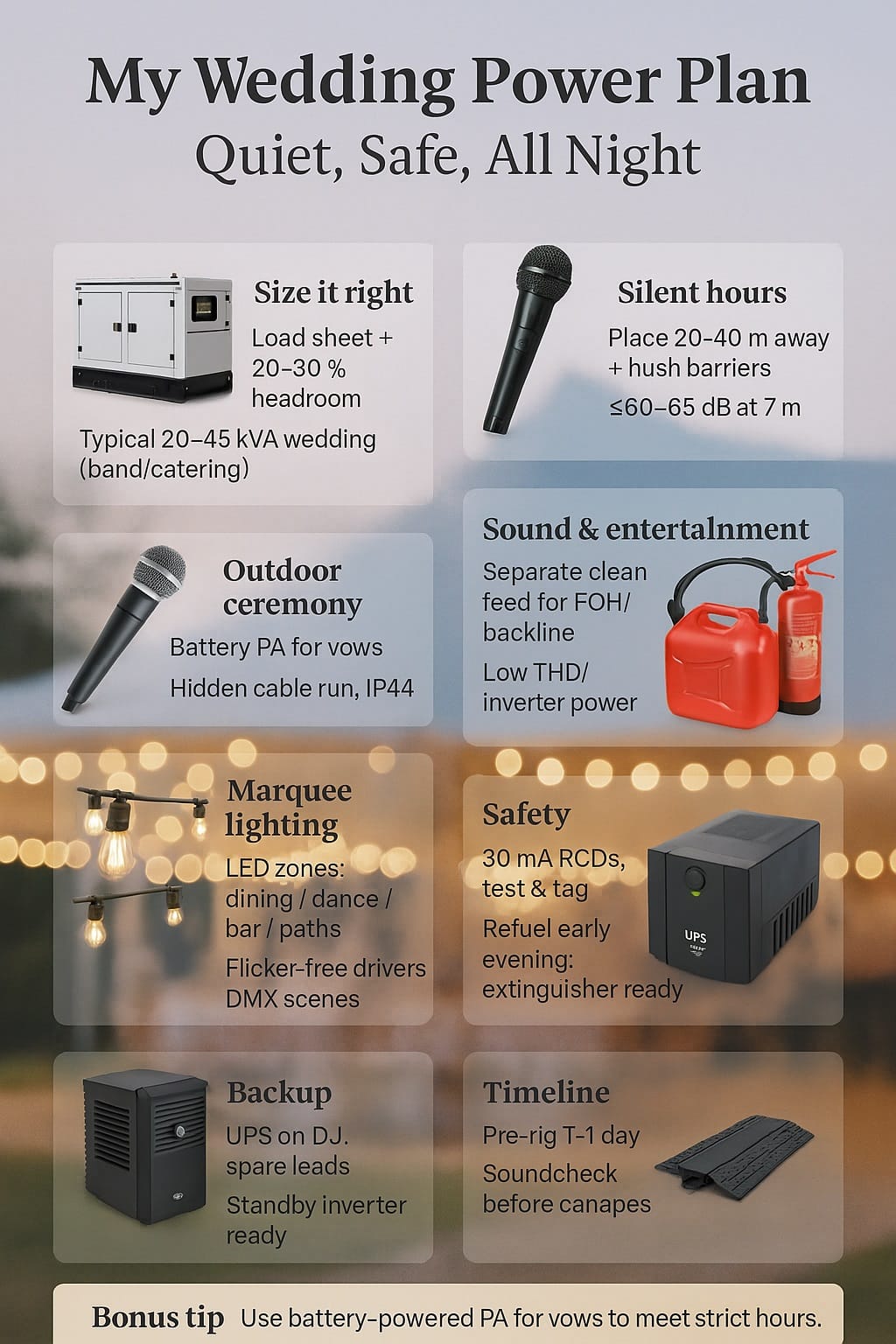
Weddings usually need 2–7 kW for sound and lighting; add vendors and it climbs. Street festivals with food and multiple acts often jump to 60–125 kVA across zones. I build a load list, include surges, and add headroom so the first dance or parade doesn’t brown-out.
Are “silent” generators truly silent?
They’re “quiet,” not silent. Quality canopy sets can sit in the 60–70 dB(A) range at 7 meters. Placement, barriers, and exhaust direction matter more than marketing labels. I position for the audience’s ears first and use clean power to avoid hum.
Can I run fridges, fryers, and coffee on one feed?
Technically yes, practically no. Mixes like that trip breakers or pollute power. I give kitchens their own zone with generous headroom. Sensitive kit (audio, LED) gets isolated clean circuits so your headliner and your espresso both shine.
Do I need 3-phase? What’s 32A vs 63A?
3-phase helps with larger events, long runs, and balancing loads. 32A and 63A are connector ratings; bigger numbers carry more current. I match connectors to real load, distance, and voltage drop—not just what’s on the truck that day.
How far from tents must a generator be?
I keep safe clearances for heat, exhaust, and refuel access, avoid tent lines, and respect airflow for the canopy. Practical rule: don’t cram a hot engine into a crowd choke point. Space, fences, and signage make everyone safer—and faster during changeovers.
“Answer FAQs like surgeon consent: plain words, real risks, clear choices.” — Dr. Nora Bell, FRCS
🧾 Takeaways: My Simple Playbook
I right-size sets with real loads, then over-spec distribution and isolate sensitive gear. I place the genset where ears and airflow win, and I run a fuel plan with photos, logs, and a strict refuel window. Finally, I drill the quick-swap, because confidence beats luck when the crowd arrives.
If you want your event power to feel invisible, treat planning as part of the show: lay the cables like choreography, test like sound check, and brief like stage cues. Do that, and the audience will only remember the music, food, and glow—not the generator that made it all happen.
“Great design disappears in use—so should great power.” — Elena Martín, RIBA Chartered Architect