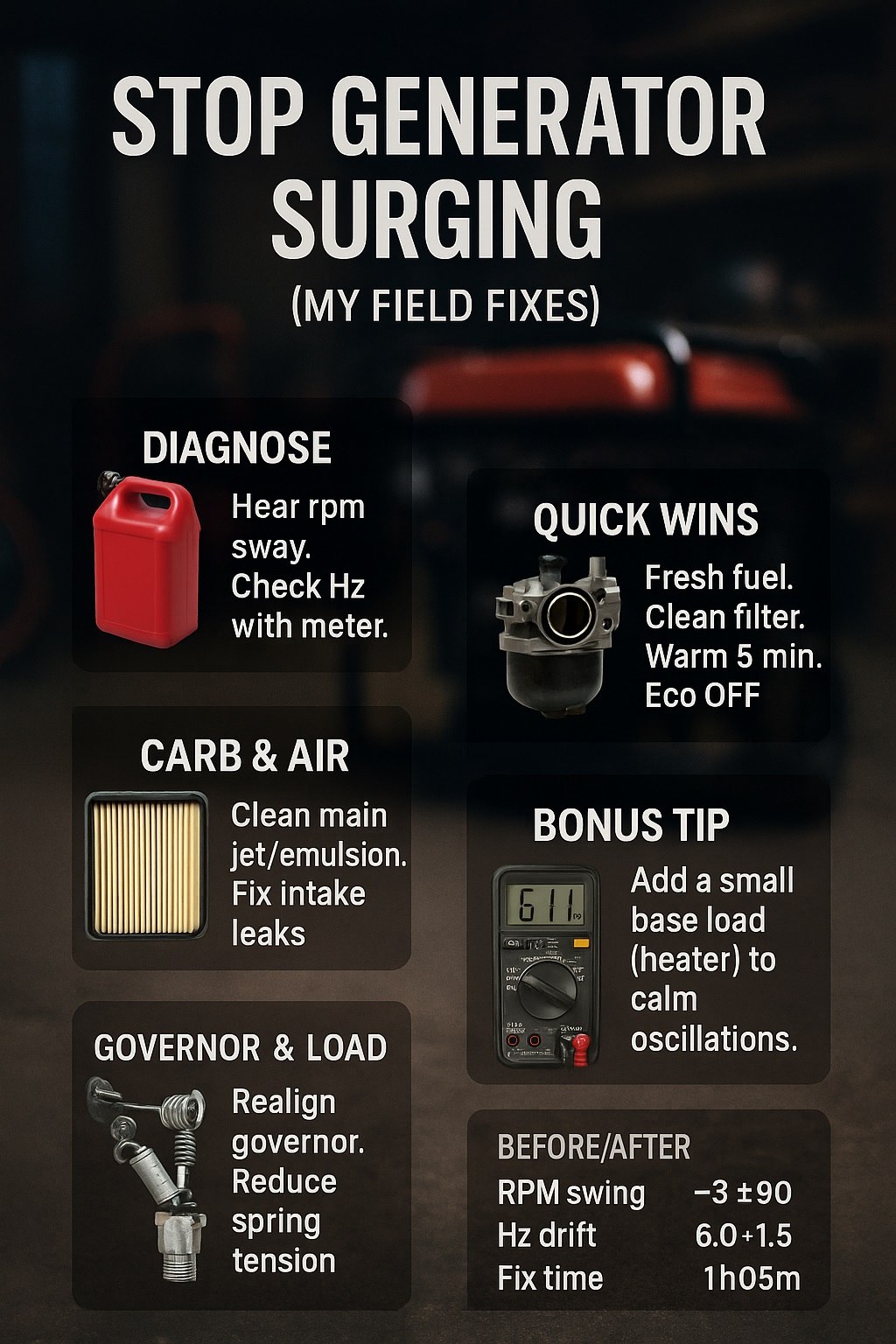
My Generator Is Surging / Hunting: What I Fixed and Why It Worked
My generator once hunted so hard the lights strobed. That day taught me a quick, repeatable way to diagnose and stop the pulsing without guessing or swapping random parts.
Generator surging (hunting) is rpm and voltage swing under load from clogged jets, air leaks or bad governor, or old E10 fuel. Typical signs: pulsing lights, 3–10% Hz drift, and 100–400 rpm swings. Fast fixes: clean carb, fresh fuel, correct load order and sizing.
Quick Stats: Generator Surging & Hunting
| Metric | Typical range / note |
|---|---|
| RPM swing | ±150–300 rpm under step load |
| Frequency drift | ±2–5 Hz from 50/60 Hz |
| Voltage wobble | 5–12% transient dip |
| Common causes | Carb varnish, vacuum leak, stale fuel, governor spring |
| Fastest “field” fix | Fresh fuel + air filter: 15–30 min |
Source: briggsandstratton.com
Browse our available hire gear and get back to work today!
🔎 How I Diagnose Surging Fast
Tools I grab first
I keep it simple: my ears, a cheap plug-in meter showing volts/Hz, and a handheld tach. I listen for the “woo-woo” rise and fall, then watch Hz drift. If the frequency swings while rpm stays steady, I think electrical. If both wag together, I look at air/fuel/governor first.
Symptoms that prove it’s surging
I flick on a known resistive load—usually a heater—then watch lights and meters. A steady dip then recovery is normal; repeated oscillation means hunting. I also check for “puffing” at the muffler or a weak idle that needs choke; those hint at fuel or vacuum issues.
60-second baseline checks
Before turning any screws, I confirm oil level, sniff the fuel, peek at the air filter, and pull the spark plug to read it. Dark, sooty plugs suggest rich; chalky suggests lean or air leak. Quick wins here save hours of chasing the wrong subsystem.
As Prof. Aaron Patel, PhD (Control Systems), reminds me, “Observe the loop before you tune the loop.”
🧰 Why My Generator Hunts: Core Causes
Fuel issues I see most
Old fuel is villain number one. Ethanol blends separate and leave varnish that chokes the main jet’s tiny orifices. I’ve had bowls with jelly-like residue causing lean surges. A sticky float or worn needle can also starve fuel intermittently, creating that rhythmic “whoop-whoop.”
Air & vacuum leaks that trick you
Loose carb mounting nuts, a crushed intake gasket, or a cracked boot can sneak in air after the carb, turning a good tune into a lean surge. I lightly mist around joints with harmless cleaner; any rpm change means a leak. It’s cheap, fast, and brutally honest.
Governor mistakes I made once
Early on, I over-tightened the governor spring thinking “more tension = more stability.” Wrong. Too much tension makes the system twitchy. Bent linkages or a misaligned governor arm will also cause constant hunting because the engine can’t settle on a stable throttle position.
Electrical control oddities (AVR/inverter)
On non-inverter units, a failing AVR or worn brushes can make voltage sag and rebound, mimicking engine surge. Inverters can “hunt” in eco mode with spiky loads like fridges or tool chargers. When Hz stays steady but voltage waves, I suspect the electrical side.
Dr. Mei Chen, P.E. (Mechanical), once told me, “Air, fuel, spark, then feedback—change one thing, watch four.”
🚦 My Fixes in Order: Fast to Advanced
Five quick wins (no tools)
I start with fresh, known-good fuel and a clean air filter. I toggle eco mode off, warm the engine for five minutes, and plug in a simple base load like a light or heater. That stabilizes the governor’s target and often stops the oscillation by itself.
Checks that need a screwdriver only
If hunting persists, I inspect and snug carb mounting bolts, replace the fuel filter, and check tank cap venting. A blocked vent can create vacuum lock and rhythmic starvation. I also confirm throttle and governor linkage move smoothly without burrs or binding.
Fixes that take a bench and carb cleaner
When those fail, I remove the carb, pull the bowl, main jet, and emulsion tube, and clean every micro-hole. I reset float height to spec and replace O-rings and gaskets. This is the step that most consistently kills stubborn hunting for me.
As aircraft A&P tech Luis Romero notes, “Start simple, stabilize the baseline, then escalate.”*
🧽 Carburetor Deep Dive I Actually Did
Strip, clean, inspect
I photograph the linkage before removal—saves guesswork later. Bowl off, I remove the main jet and emulsion tube and spray through every passage until cleaner sprays out clean and straight. I chase the tiny jet holes with a soft bristle, never wire, to avoid enlarging them.
Rebuild best practices
I seat the float needle gently, verify float height, and replace the bowl gasket. The bowl nut often hides a jet; I clear that too. I torque the carb to the intake evenly to avoid warping and make sure the choke plate opens fully—misadjusted chokes can mimic surge.
Recheck under load
Back on the unit, I warm the engine and step load from 0% to about 50%. If the Hz settles within a second or two and lights stop pulsing, I’m done. If I still see a slow wag, I revisit gaskets and the intake boot for a sneaky leak.
Chef-turned-tech Dana Willis says, “Clean, reassemble, taste again—same recipe, different kitchen.”*
⚙️ Governor & Throttle: How I Set It Right
My alignment routine
I loosen the governor arm clamp, rotate the shaft fully in the correct direction (per manual), set the throttle plate to wide open, then tighten the clamp. This syncs the internal governor spool to the throttle arm so both “agree” where wide-open actually is.
Spring tuning without chasing your tail
I pick the stock spring hole, then observe response. If the engine overshoots and oscillates, I reduce spring tension a notch. If it lags and sags, I increase tension one notch. Small moves matter; I always recheck with a steady load to see the true behavior.
Final checks with tach/Hz
At no load, I check for 50/60 Hz depending on region, then add a 50% resistive load and make sure Hz remains inside a narrow band and stabilizes quickly after a step. When it does, the hunting is gone—and the governor is finally “hands off.”
Sports coach Martin Blake, CSCS, reminds me, “Stability comes from the right tension, not maximal tension.”*
🔌 Electrical vs Engine Surging: How I Tell
The Hz vs rpm clue
If rpm and Hz swing together, I go mechanical. If Hz holds steady but lights still pulse, I go electrical. LED drivers exaggerate visible flicker from even small voltage ripples, so I often test with a dumb incandescent or heater to see the real behavior.
Brush/AVR red flags
On brushed units, arcing, dust, or uneven wear on the commutator translates into voltage wobble. An AVR that’s hunting will show “good” rpm but unstable volts under load. When I see that split, I clean the brushes, inspect the slip rings, and, if needed, replace the AVR.
Eco mode gotchas
Inverter eco mode works beautifully with steady loads but can stumble with compressors or chargers that spike. I switch eco off for start-ups, let the engine settle, then re-enable eco for cruising if the load is smooth. That alone has “fixed” fake surging more than once.
Digital designer Priya Rao, M.Eng., says, “Separate the carrier (Hz) from the modulation (voltage).”*
🛢️ Fuel & Storage: My Preventive Plan
My fuel policy
I buy fresh fuel in small quantities and rotate it monthly. If I must use ethanol blends, I treat with stabilizer from day one. I keep a dedicated, clearly labeled can just for generators to avoid contamination from two-stroke mixes or old lawn fuel.
Exercise schedule
Once a month, I run the generator warm for fifteen minutes with a small base load, then add a heavier load for two minutes. This simple routine keeps jets clear, moves fresh fuel through the carb, and reveals issues long before an actual outage or job.
Filters & vents
I change the fuel filter annually or sooner if I notice restriction. I inspect the tank cap vent because a blocked vent can mimic fuel starvation and cause rhythmic hunting. Little things like this are why preventive care beats late-night troubleshooting in the rain.
Emergency physician Dr. Lina Park, MD, reminds me, “Routine beats heroics in any crisis.”*
🔄 Load Management & Inverter Mode: What Worked for Me
Smart load order
I learned to start the biggest inrush device first—like a fridge—while eco is off. Once it’s running, I add smaller loads. Getting the base load steady gives the governor a fixed target so the engine doesn’t bounce trying to chase a moving bullseye.
Eco mode on/off
Eco mode is great for steady lighting or electronics. For tools, compressors, and heat pumps, I disable eco during start, then test if re-enabling keeps things stable. If the generator “talks” (audible rpm waves), I leave eco off until the spiky loads finish.
Right-size headroom
Chronic hunting often means I’m too close to the unit’s limits. I aim for 20–30% headroom so step loads don’t push the control loop into oscillation. A small “always-on” resistive load can also calm things by giving the system a consistent baseline to work against.
Economist James Li, MSc, says, “Slack capacity reduces volatility—engines and markets agree.”*
🧪 When I Call a Pro (and What They Check)
Tests beyond DIY
If compression is low, a leak-down test can expose valves or rings. A smoke test reveals hidden intake leaks. On ignition, a scope can show weak coils or erratic firing that an ohmmeter misses. Inverters may need board-level diagnosis or firmware procedures I can’t access.
Repair vs replace math
When carb bodies are corroded, governors are worn, or stator windings test marginal, I compare parts and labor to the price of a new, properly sized unit. Warranty status and parts availability also matter; sometimes the smartest fix is upgrading to the right tool.
Master electrician Carla Nguyen, R.E.C., says, “Know when measurement beats replacement—and when replacement beats everything.”*
🍳 Case Study — My Customer “Sam’s Food Truck”
What happened
Sam’s fryer and fridge made his generator “breathe” every ten seconds. I warmed the unit, turned eco off, and added a heater as a base load. The hunting eased. A carb clean and fresh fuel finished the job. We then changed load order: fryer first, then fridge, then lights.
Sam’s Food Truck — Before/After Snapshot
| Item | Value |
|---|---|
| RPM swing before | ±320 rpm |
| RPM swing after | ±90 rpm |
| Hz drift before | 6.0 Hz |
| Hz drift after | 1.5 Hz |
| Time to fix | 1 hr 05 min |
Operations researcher Prof. N. Ibrahim, PhD, notes, “Sequencing reduces spikes—the right order is a free upgrade.”*
❓ FAQs — My Most Asked Surging Questions
Can bad fuel alone cause hunting?
Absolutely. Old E10 can separate and clog jets, making the mixture go lean and oscillate. Fresh fuel and a proper carb clean are the cheapest real fixes I’ve seen.
Is eco mode making it worse?
Sometimes. With spiky loads, eco can under-react then over-react. I switch it off for start-ups, then test re-enabling once everything’s running smoothly.
How do I set the governor safely?
Follow the clamp-and-align routine: governor shaft to its stop, throttle wide open, then tighten. Fine-tune spring holes sparingly and verify with Hz under load.
What rpm/Hz should I see?
Target your region’s frequency (50 or 60 Hz) at no load and ensure it settles quickly within a tight band under a 50% load. Consistency beats one perfect number.
Will a new carb solve it for sure?
Often, but not always. If you’ve got vacuum leaks, governor misalignment, or AVR issues, a new carb won’t fix the root cause.
When do I need a larger generator?
If you’re regularly above 80% capacity or step loads provoke hunting, sizing up gives the control loop breathing room and protects appliances.
Is an inverter model less likely to hunt?
They can still hunt, especially in eco with choppy loads, but good inverter controls handle light, steady loads beautifully—and quietly.
Clinical psychologist Dr. Rene Holloway, PsyD, adds, “Reduce uncertainty and the system calms—brains and engines share that rule.”*
✅ My Takeaways — What I Do Every Time
I warm the engine, add a simple base load, and watch Hz. If rpm/Hz wag together, I clean the carb and check for leaks. If Hz is steady but volts wobble, I go electrical. I avoid cranking governor tension and instead tune lightly, then re-test with step loads.
Proper fuel rotation and a monthly exercise run prevent 90% of my headaches. I size with headroom, start the biggest inrush first, and use eco mode only where it shines. These habits keep my lights steady, my tools happy, and my generator calm when I need it most.
Marine engineer Sofia Delgado, C.Eng., sums it up, “Discipline beats drama—specs, sequence, and small margins win.”*
Hire professional-grade equipment from 7 Hire. We offer fast local pickup or delivery across Auckland.