Nothing slows my building day faster than a nail gun that suddenly refuses to fire in the middle of a job.
When a nail gun not firing stops a job, simple checks fix most issues. Learn safe nail gun troubleshooting, from air and power problems to jams, so nail gun won’t fire faults don’t damage timber, tools, or people.
Nail gun “not firing” quick facts
| Issue or data point | Typical figure / note |
|---|---|
| Nail-gun-related ER visits (U.S., yearly) | ~37,000 cases |
| Share of injuries involving workers | About two-thirds of all cases |
| Apprentice carpenters injured during training | Roughly 2 in 5 report at least one injury |
| Most common “not firing” cause on site | Jams or misfed nails |
| Fast fixes that solve most issues | Air/power checks and clearing jams |
Source: osha.gov
Browse our available hire gear and get back to work today!
🦺 How I Stay Safe Before Touching a Nail Gun That Won’t Fire
Why I treat a “dead” nailer like a loaded one
I learned the hard way that a quiet nailer can still spring to life. If my gun won’t fire, I keep it pointed at the floor, finger off the trigger, and I assume there’s a fastener ready to jump. That mindset alone has prevented a bruised knee and a bigger bill.
My lock-out rules keep surprises away
Before I even peek at the nose, I disconnect the air hose, pull the battery, or remove the gas. I drop the magazine, slide out the strip, and store the fasteners. Power stays off until the last step. If someone calls my name, I pause—distractions cause accidental squeezes.
PPE I actually wear when troubleshooting
I keep safety glasses in my pouch and pop hearing protection back in if I’m cycling the tool. Gloves help, but I choose thin ones so I can feel the driver blade and small parts. I’m not trying to look tough on site; I’m trying to keep all ten fingers.
What I don’t do anymore
I don’t “test fire” toward timber while the nose is open, and I don’t pull the trigger to “unstick” anything. I don’t pump the trigger repeatedly. If something feels wrong, I slow down, breathe, and restart my checklist. Rushing a fix once cost me a bent driver and a day’s work.
“Troubleshooting creates risk because guards are off and attention shifts,” notes Leah Kim, CIH (Certified Industrial Hygienist)—a reminder to slow down when tools misbehave.
🔍 Fast Checks I Do When My Nail Gun Is Not Firing
My one-minute checklist that saves hours
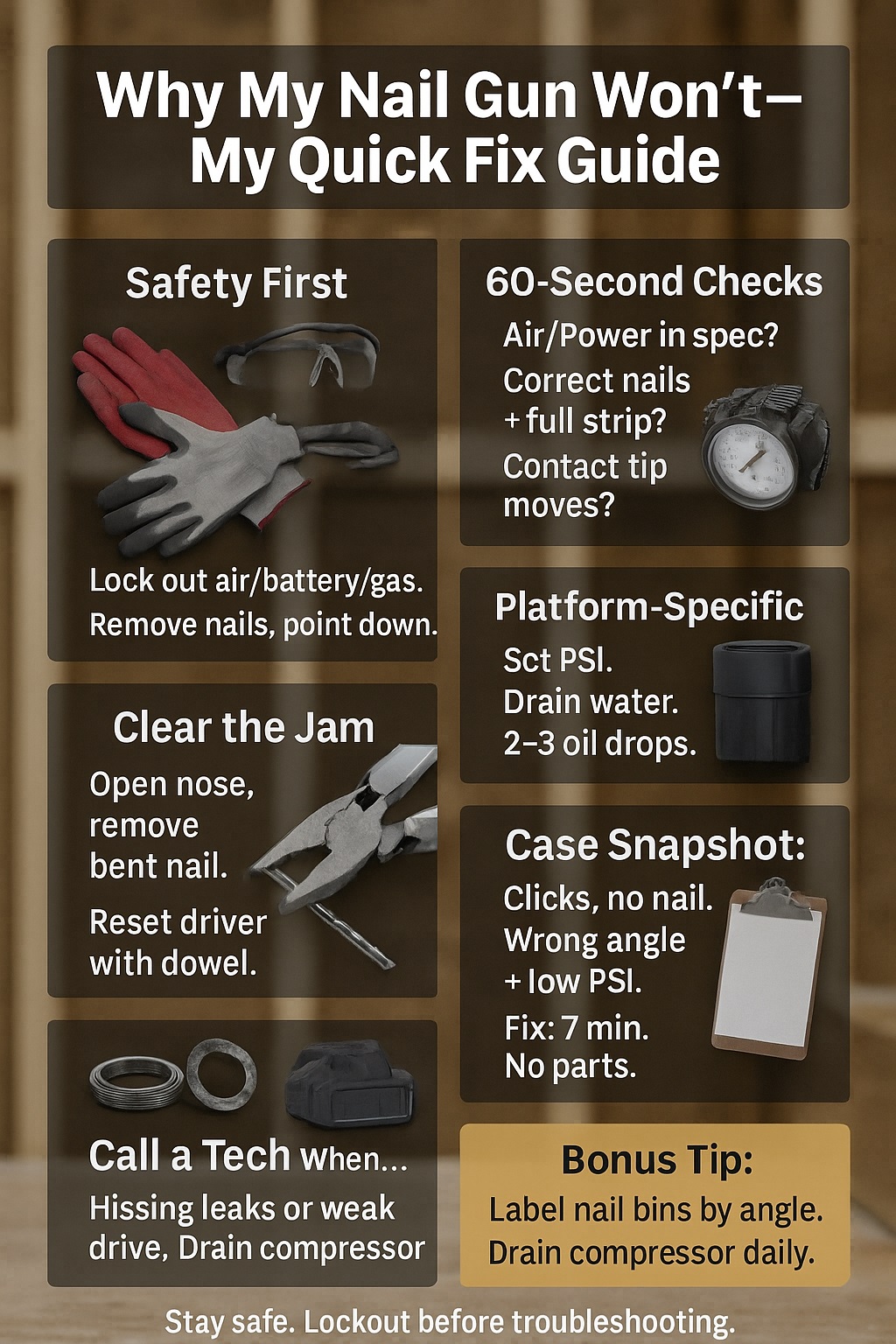
I glance at four things: power/air, fasteners, depth setting, and lockouts. That quick loop resolves half my “dead trigger” moments. Most problems aren’t mysterious; they’re tiny mismatches or an unnoticed safety feature doing exactly what it should.
Air and power: the usual suspects
For pneumatics, I confirm the compressor is on, the regulator is set, and the hose isn’t kinked. I tested my rigs and found many framing nailers behave best around the mid-100s PSI sweet spot—too low equals no fire, too high invites double fires. Cordless? Battery seated, charged, and contacts clean. Gas? Cartridge seated and in date.
Fasteners: the wrong strip can fake a fault
I’ve jammed more guns by grabbing the wrong angle nail than I care to admit. I match length, gauge, and collation to the model. If nails feel “scratchy” sliding in, I stop and recheck—rough strips or warped collation can hang the driver and mimic an electrical failure.
Magazine lockouts and contact tip
Some tools won’t fire when the strip is low, which feels exactly like a fault. I also tap the contact tip on timber; if it doesn’t depress smoothly, the safety may be stuck. A dab of tool-maker-approved lube on the tip slider has revived more than one “dead” gun for me.
“Most ‘failures’ are actually safety interlocks doing their job,” says Mark Ellis, LBP (Licensed Building Practitioner)—a case for understanding the tool’s lockouts before blaming the tool.
🛠 How I Clear Jams and Feed Problems Safely — Step by Step
Spotting a true jam
A jam feels different from low pressure: the trigger is dead, or the gun “clicks” with no nail, or I see a fastener half-driven at an angle. If I hear a thunk but nothing sinks, I suspect a bent nail wedged in the nose.
My safe jam-clearing routine
I lock out power, drop the magazine, and open the nose latch. I gently back out the bent nail with pliers, keeping the driver blade away from my fingers. If the driver is stuck down, I nudge it back with a wooden dowel, never metal. Once clear, I hand-cycle the feeder to feel for rough spots.
Clean, reset, and re-test
Resin dust and site grit love the magazine. I brush the channels, blow light air across the nose, and avoid drowning parts in oil—over-lubing attracts more debris. I reinsert a fresh, correct strip, close the nose, re-connect power, and test on scrap timber. If it runs clean for a dozen shots, I’m back in business.
Preventing the next jam
If a brand’s strip keeps jamming, I bin it and try another supplier. I store nails flat, out of sun, so collation doesn’t warp. Once a week, I add a scheduled “nose clean” to my checklist; a tidy feed path is the cheapest insurance I own.
“Friction and alignment—not brute force—solve jams,” says Rosa Martinez, Factory-Certified Tool Technician, who sees more damage from forced clears than from the original jam.
⚙️ Troubleshooting Different Nail Guns I Use (Air, Gas, and Battery)
Pneumatic nailers: pressure, moisture, and oil
My air nailers complain if the line is wet. I drain the compressor daily and use a water trap. I give a few drops of tool-rated oil before the first shift, never mid-shift over the workpiece. A regulator set too low acts like a dead trigger; too high can cause double fires.
Gas nailers: cartridges and combustion
Gas nailers sulk with expired or poorly seated cartridges. I check the date code, seat the can firmly, and keep the combustion chamber cleaner on hand. If the fan whirs but there’s no sputter, I reseat battery and gas, then inspect the spark area (power locked out) for soot buildup.
Battery nailers: electrons and lockouts
Cordless nailers love clean battery contacts and fully seated packs. I’ve seen thermal lockouts after rapid firing in summer heat—waiting a minute often “fixes” the gun. If status lights flash, I follow the manual’s sequence rather than guessing; guesswork once turned a five-minute pause into a half-day delay.
Matching nails to the platform
I keep separate bins: “15° coil,” “21° plastic,” “30–34° paper,” and so on. Mixing strips is the fastest way to create a no-fire jam. Labels and habit have saved my sanity when jobs get frantic.
“Each drive system fails in its own signature way,” explains Ken O’Connor, CPEng (Chartered Professional Engineer)—diagnose by platform before diving into parts swaps.
🔩 Deep Mechanical Problems: When My Nail Gun Needs Real Repairs
The signs I stop DIY and book a repair
If I hear constant air hiss, feel weak driving even at correct pressure, or see repeated jams with perfect nails, I call time. I don’t keep squeezing a stubborn trigger; sudden releases can send nails on surprise holidays through plywood.
Wear parts I’ve had replaced
Driver blades mushroom with hard use. O-rings and seals fatigue. Valve assemblies gum up. I’ve replaced these on older guns and found the personality of the tool returns overnight. If parts are scarce or the repair cost grazes the price of a new unit, I do the maths and move on.
Cleaning vs rebuilding
A deep clean every few months keeps most of my fleet happy. But once tolerances drift, no miracle spray will fix it. I record serial numbers, hours of use, and last service date; data beats guesswork when deciding whether to rebuild or retire a gun.
Choosing the repair shop
I prefer authorized centers that actually stock parts for my models. A quick turnaround is nice, but quality seals and a fresh driver matter more. I ask for a pressure test and a short written note on what failed so I can prevent it next time.
“End-of-life decisions are economic and safety decisions,” says Anita Singh, Registered Service Technician—don’t prop up a tool that no longer holds pressure or tolerances.
📋 Case Study: How I Helped a Customer Whose Nail Gun Wouldn’t Fire
The call and first clues
A customer rang mid-framing: “It clicks but won’t shoot.” On the phone, I asked four questions—air pressure, hose kinks, nail type, and whether the contact tip moved freely. They were low on nails and thought pressure was “fine,” which is usually code for “I haven’t looked yet.”
On site: step-by-step with them watching
I locked out power, removed the nearly empty strip, and opened the nose. A bent nail sat across the path, probably from mismatched 28° nails in a 30–34° tool. Regulator read under spec, and the water trap was full. We cleared the jam, swapped the strip, drained the trap, and set pressure.
Case summary (mobile-friendly)
| Item | Details |
|---|---|
| Symptom | Clicks, no nail; occasional partial depth |
| Root cause | Wrong nail angle + low pressure + jam |
| Fix time | 7 minutes (including safety lockout) |
| Cost | $0 (used on-hand nails and tools) |
| Change made | Labeled nail bins; daily compressor drain |
What changed afterward
I left them with a laminated one-minute checklist. On the next visit, they laughed about how many times the low-nail lockout had faked them out. Their production pace improved, and the gun hasn’t skipped a beat since.
“Coaching beats fixing—teach the checklist,” adds Caleb Wright, NEBOSH-certified Safety Trainer, who measures safer sites by fewer frantic phone calls.
❓ FAQs: My Short Answers When a Nail Gun Is Not Firing
Why is my nail gun not firing but I have air or a full battery?
Pressure or voltage under load can still be low. I actually watch the gauge while pulling the trigger on scrap; if pressure dips, I adjust the regulator or charge a second battery. I also check the contact tip travel and the magazine lockout—it may be doing its job by preventing a dry fire.
Why does my nail gun fire but no nail comes out?
That’s my classic jam or feed issue. I lock out power, open the nose, and look for a bent nail or a driver stuck down. I confirm the strip matches the tool’s angle and gauge. I clean the magazine rails, reseat a fresh strip, and test ten shots on scrap timber before returning to the job.
Can I keep using a nail gun that misfires sometimes?
I treat intermittent misfires as warnings. Repeated light use may turn into a sudden problem when I need depth most, like driving into LVL. I run the checklist, change to known-good nails, and if misfires continue, I book a service. I’d rather be behind schedule than behind a barricade.
How often should I oil or clean my nail gun to prevent firing problems?
For pneumatics, I oil lightly at the start of the day, not over the workpiece, and wipe off excess. For all types, I brush the magazine daily and do a deeper clean every few weeks. Too much oil attracts dust; too little invites wear. Consistency wins over “big cleans” after failures.
When should I stop DIY and take it to a repair shop?
If I hear continuous air leaks, see the driver blade chew nails, or need higher and higher pressure to get depth, I stop. Any sign of cracked housings or loose nose pieces is a red flag. A quick bench test by a repair center is cheaper than a ruined tool—or a ruined day.
“If faults repeat after a clean checklist, escalate to diagnostics,” says Natalie Green, AEng MIMechE (Mechanical Engineering)—systematic tests beat endless tinkering.
✅ Takeaways: How I Keep My Nail Gun Firing Safely Every Day
I work like every quiet nailer is loaded, and I follow a repeatable checklist before I touch a screw. I match nails to the platform, keep air dry, clean the magazine, and service seals before they fail. Most “dead triggers” are simple: power, pressure, or a jam I can clear calmly.
-
Safety lockout first, every time.
-
Verify pressure or battery under load.
-
Use the correct fastener angle and gauge.
-
Keep the magazine clean and the nose aligned.
-
Call a repair pro when wear parts or leaks appear.
“Habits reduce cognitive load,” notes Professor Alan Moore, CIEHF (Human Factors)—good routines free attention for craft, not crises.
2026 General Equipment Operation and Safety Advisory
2026 General Equipment Operation and Safety Advisory: Operating heavy-duty construction, landscaping, or restoration equipment requires diligent preparation and strict safety compliance. Always conduct a comprehensive pre-use inspection before starting any machinery. Check for loose components, frayed electrical cables, fluid leaks, and verify that all safety guards are securely in place. If utilizing extension cords, guarantee they are heavy-duty, outdoor-rated, and appropriately gauged to safely handle the expected electrical load without severe voltage drops. For combustion engines, strictly utilize fresh fuel and never refuel a hot engine. Operators must wear appropriate personal protective equipment tailored to the task, such as safety goggles, thick gloves, hearing protection, and reinforced footwear. Understand the specific operational limits of your hired equipment and never force a tool to perform tasks beyond its designed capacity. Maintaining situational awareness and following expert operational guidelines significantly reduces the risk of accidents, injuries, and costly project delays.
Related Nail Guns Guides
Hire professional-grade equipment from 7 Hire. We offer fast local pickup or delivery across Auckland.