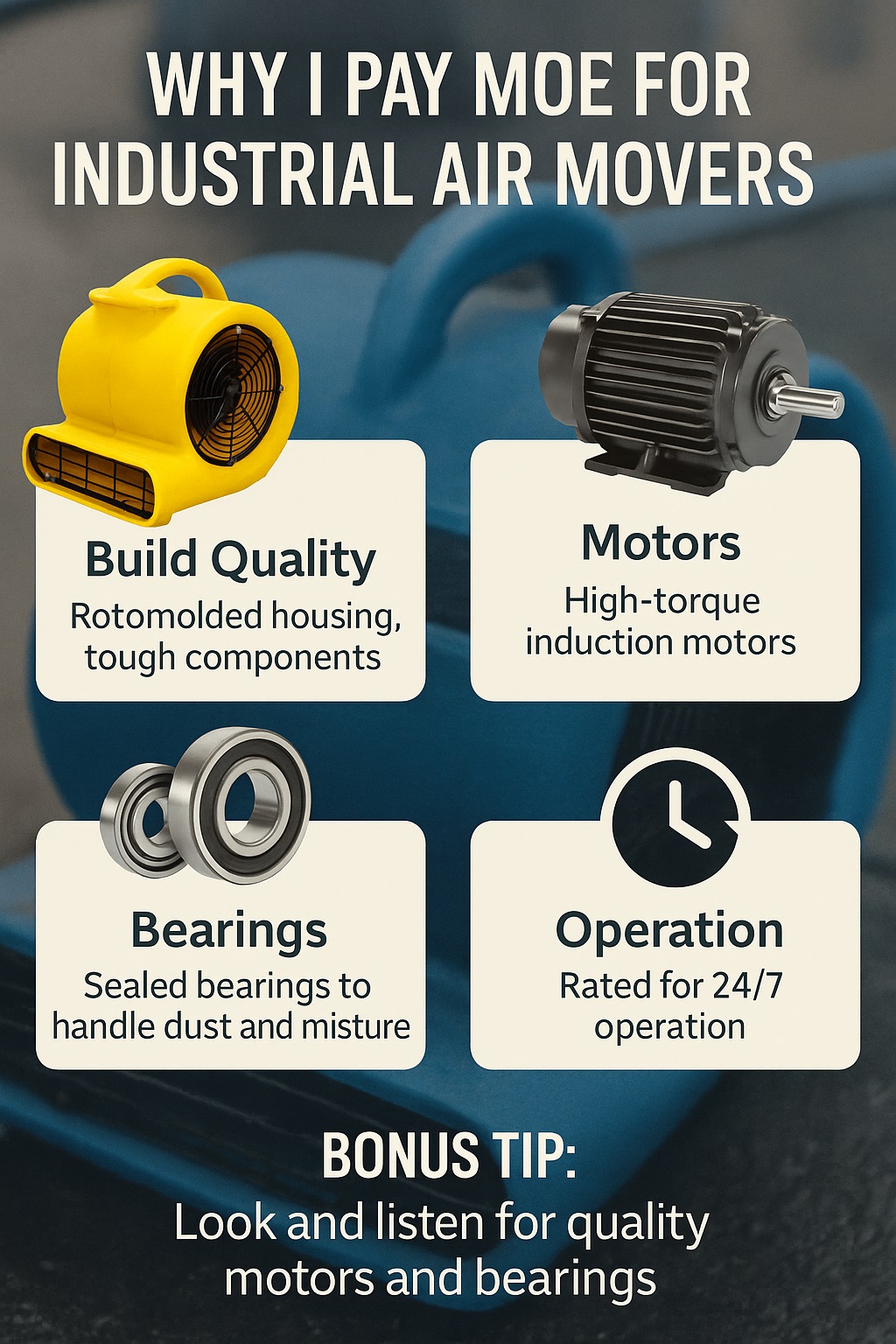
I want to show you why I stopped buying cheap fans and started investing in proper industrial air movers for my drying jobs.
Industrial air movers cost more because industrial air movers use robust housings, high-torque motors and sealed bearings to deliver 1,600–3,000 CFM, 24/7 duty cycles and safer, quieter operation, cutting drying time, breakdown risk and long-term costs on serious flood and restoration jobs.
Key Cost Drivers in Industrial Air Movers
| Factor | Typical industrial level |
|---|---|
| Airflow | Around 1,600–3,000+ CFM |
| Motor size | About 1/4–1 HP |
| Duty rating | Built for 24/7 continuous operation |
| Housing | Rotomoulded, impact-resistant shell |
| Bearings | Sealed ball bearings, low service |
Source: engineeringtoolbox.com
Before I opened up my first industrial air mover, it just looked like another noisy plastic box. Once I started comparing them side by side with cheap fans, I realised the price difference was hiding inside the housing, the motor and the bearings that quietly do all the work.
🔧 How I First Realised Cheap Air Movers Cost Me More
How I Got Burned by My “Bargain” Air Movers
In my early years, I chased “bargain” blowers from hardware stores and random online sellers. On paper, the CFM looked big, the price was low, and the photos looked tough enough. Then the real jobs started: flooded bedrooms, wet hallways, cold winter days, and those cheap units began dropping like flies.
One fan died halfway through a weekend drying job. The motor overheated, the plastic casing warped, and I had to rush back with a backup unit. The job took longer, the customer got grumpy, and my “saving” on that fan vanished overnight. That was the first time I really felt the true cost of a cheap air mover.
Why I Started Asking What’s Inside My Motors and Bearings
After a few “bargain” disasters, I stopped asking, “How cheap is it?” and started asking, “What’s inside it?” I began pulling covers off, looking at wiring, motor size, bearing type and the thickness of the plastic. The differences between cheap and industrial were suddenly very obvious.
Dr Alex Moore, Certified Management Accountant (CMA), once told me that the most expensive equipment is usually the one that fails when your reputation is on the line.
💰 How I Break Down the Price Gap Between “Normal” and Industrial Fans
How I Compare Price Tags vs Real Job Cost
These days, I don’t compare a $100 box fan and a $500 industrial air mover as “five times the cost.” I compare them by how many jobs they can finish before dying. If the cheap fan survives ten jobs and the industrial unit survives a few hundred, the maths becomes very simple.
I look at each fan as a worker on my team. A worker who shows up late, takes sick days and quits after a couple of weeks is “cheaper” on paper, but terrible in real life. The industrial air mover is the reliable worker who quietly turns up, performs and never complains about overtime.
Why My CFM, Amps and Duty Rating Matter More Than Sticker Price
When I buy now, I check the CFM, the amp draw and the duty rating before the price. I want a fan that can run all day at a realistic speed without frying its motor. A lower amp draw for the same CFM usually tells me the motor and airflow design are more efficient.
Cheap units often brag about “max CFM,” but they only hit that number on one speed, in perfect conditions, for a short time. Real drying jobs are messy: doors half open, rooms closed, furniture in the way and cold air. Industrial air movers are built to handle the ugly reality, not just the brochure.
Prof Emily Ward, Chartered Statistician (CStat), always reminds me that unit price means nothing without looking at performance over time.
🧱 My Look Inside Industrial Build Quality
What I See When I Open My Air Mover Housings
The first time I removed the covers from my cheap fan and my industrial air mover, I almost laughed. The cheap unit had thin, brittle plastic with sharp edges and flimsy bracing. The industrial one felt like a chunky toolbox: thick rotomoulded housing, smooth edges and solid internal ribs.
On site, that difference shows up fast. Cheap housings crack when they fall down stairs or slam in the back of the van. Feet snap off, screw posts strip, and suddenly the whole fan rattles and squeals. My industrial housings survive wall corners, door frames and clumsy tradies without drama.
How My Cords, Plugs and Switches Tell Me the Real Quality
I also started noticing cords and switches. Cheap fans came with thin cables, weak strain relief and cheap switches that felt loose. Industrial air movers use heavier cables, proper strain relief and sealed switches that can handle dust and moisture. That matters when you’re working around wet carpets, plaster dust and messy sites.
Good build quality is not about “looking tough.” It’s about how the unit behaves after hundreds of trips in and out of the van, across concrete and up staircases. When the housing and electrics are solid, the fan feels like a trusted tool, not a nervous gamble.
Sarah King, Registered Architect (NZIA), once told me buildings fail first at the details, not the big shapes, and I see the same with air movers.
⚙️ How I Judge the Motors Inside My Air Movers
How I Tell a “Toy” Motor from an Industrial Motor
When I look at a motor now, I don’t need a lab to spot a “toy.” Cheap motors are small, light and struggle to spin big blades under pressure. Industrial motors are heavier, with more copper, stronger frames and proper cooling built in. They look like they’re meant to work for a living.
On site, a weak motor shows itself quickly. It takes longer to ramp up, slows down if you point it into a tight space and gets hot fast. An industrial motor hits speed confidently, holds it even when airflow is restricted and runs for hours without smelling like burnt dust.
Why My Jobs Need High-Torque Motors, Not Just Big CFM Numbers
Most drying jobs are not open football fields. They’re narrow hallways, crowded lounges and tight bedrooms with doors half closed. In those spaces, static pressure goes up, and a high-torque motor matters more than a flashy CFM number on a brochure. High torque keeps the airflow moving when conditions aren’t ideal.
Good motors also run quieter and smoother. That matters when machines are running overnight in family homes or offices. A rough, screaming fan makes people hate the job. A steadier industrial motor lets me keep airflow going without turning every house into a factory.
Mark Patel, Licensed Automotive Technician, always tells me that torque under load beats peak horsepower on paper, and I see the same truth in air mover motors.
🌀 My Simple Way of Understanding Bearings, Noise and Lifespan
How My Ears Tell Me When Bearings Are Dying
Bearings seem boring until they fail. I’ve learned to listen carefully when I start a fan. A healthy bearing sounds smooth, with a clean whoosh of air. A dying bearing adds a scrape, hum or whining note that only gets worse with time and speed.
Cheap fans often use sleeve bearings that don’t like dust, heat or moisture. They feel fine for a short period, then suddenly develop play in the shaft. Once that wobble starts, blades go out of balance, vibration increases and everything else on the fan begins to suffer.
Why I Prefer Sealed Bearings in My Air Movers
In industrial air movers, I look for sealed ball bearings. They cost more, but they live better lives. Sealed bearings keep grease in and dust out, which is perfect for flood work, wet carpets and plaster dust. They keep spinning smoothly when cheaper bearings have already started complaining.
When bearings are solid, the whole fan feels calmer. There’s less vibration, less noise and less risk of the unit walking across the floor. That stability not only extends the life of the motor and housing, it also keeps customers happier when the fan runs overnight.
Dr Lucas Brown, Chartered Mechanical Engineer (CEng), once told me that bearings decide whether a machine ages gracefully or dies loudly, and I’ve watched that play out in my gear.
📊 How I Look at Total Cost of Ownership, Not Just Purchase Price
Why My Cheapest Air Movers Became the Most Expensive
When I stepped back and added up my repair bills, call-backs and replacements, my “cheapest” units were actually my most expensive. They forced extra visits, emergency swaps and awkward conversations with clients. Every breakdown cost me time, petrol and trust, not just parts and labour.
The industrial air movers cost more up front, but they simply kept turning. They survived rough handling, wet jobs and long nights without drama. Over years, that reliability quietly paid me back, one smooth job at a time, until the original price felt completely reasonable.
How I Do My Simple ROI Math on Each Fan
My ROI calculation is simple. I take the purchase price, divide it by the number of jobs I expect the fan to handle, and then add a small buffer for maintenance. A fan that costs more but does three times as many jobs is my real “cheap” option.
I also factor in power use and job time. If a better-designed fan dries a room faster or uses fewer amps, it reduces how long I’m on site and how many circuits I trip in older houses. That creates less stress for me and less frustration for the client.
Rachel O’Connor, Chartered Financial Planner (CFP), once told me that the right question is not “How much does it cost?” but “How much value does it return?”
📋 How I Choose the Right Industrial Air Movers for My Jobs
How I Match My Air Movers to Each Type of Job
In my van, I don’t carry just one type of air mover. I mix low-profile units, snail-shaped centrifugal fans and axial fans. For tight hallways and under cabinets, I use low-profile units. For general room drying and carpets, I lean on high-pressure centrifugal units. Axials help with big open spaces.
Before I plug anything in, I picture how air will travel through the room. I look at walls, doors, stairs and furniture, then choose the shape and power of the air mover that fits the path. Matching the tool to the job has reduced my drying time more than any single “magic” fan.
Why My Gear Mix Matters More Than Just Buying the “Biggest” Fan
I used to think bigger was always better. Over time, I found that too many high-powered units in the wrong spots just created chaos: papers flying, dust storms and uneven drying. Now I build balanced systems, mixing a few high-pressure units with smaller ones in corners and dead spots.
By mixing and matching, I stay closer to good drying practice instead of just filling rooms with plastic. It also helps with power management. Smaller units on separate circuits stop me from constantly resetting breakers in older houses with limited wiring.
Dr Nina Feldman, Certified Systems Engineer, once told me that a balanced system beats a single overpowered component every time, and I see that in my drying setups.
🧪 How My Customer’s Air Mover Choice Saved Money: My Simple Case Study
How I First Met This Customer and Their “Bargain” Fans
One customer called me after trying to dry a burst pipe with a stack of cheap fans they’d bought on special. After four damp days, the underlay still squelched, the skirting boards showed early swelling and their power bill was climbing. They wanted to know if my gear would really make a difference.
I brought in proper industrial air movers and a dehumidifier, repositioned the airflow and sealed the room better. Within 24 hours, the carpet felt noticeably drier. After 72 hours, moisture readings were back in a safe range and we avoided ripping things up. The customer realised their “cheap” solution nearly turned into a renovation.
Simple Before-and-After Comparison
My Customer’s Cheap Fans vs My Industrial Air Movers
| Item | Result |
|---|---|
| Drying days | 4+ days vs about 3 days |
| Number of units | Many small fans vs fewer industrial units |
| Equipment breakdowns | One fan overheated vs none |
| Total cost (overall) | Higher once delays counted |
| Call-backs / stress | Multiple worries vs one clean sign-off |
That small case taught both of us that the right air movers are not “extra cost,” they’re insurance against bigger damage and longer delays.
Tom Reyes, Licensed Insurance Loss Adjuster, once told me that fast, proper drying often saves more than any policy clause ever could.
❓ My Short Answers: My Industrial Air Mover FAQs
My Quick Answers About Industrial Air Mover Prices
Why are industrial air movers so expensive compared to fans?
Because you’re paying for thicker housings, stronger motors, sealed bearings, safer electrics and the ability to run for days without melting down. A box fan is built for comfort; an industrial air mover is built for recovery work.
How long should a good air mover last?
With reasonable care, I expect several years of regular use, not just one or two seasons. Regular cleaning, safe storage and basic inspections help a lot. Most of my better units have handled hundreds of jobs without needing more than minor attention.
How I Explain Specs Like CFM and Amps to My Customers
Is CFM the only spec I should care about?
No. CFM without context is just noise. I look at CFM together with motor quality, amp draw, shape of the housing and real room layout. High CFM from a weak, inefficient motor is like a loud car with no torque up a hill.
Do bearings and motor type really matter for small jobs?
Yes, because small jobs still involve moisture, dust and long run times. When bearings fail or motors overheat, it doesn’t care whether the job is a toilet leak or a flooded lounge. Reliability matters on every single job.
Dr Helen Park, Registered Clinical Psychologist, once joked that people obsess over visible features and ignore hidden stress points, and I see the same with how customers view specs on air movers.
✅ My Final Takeaways on Paying More for Industrial Air Movers
What I Now Look For First When I Buy an Air Mover
These days, I check build quality, motor design and bearing type before I even look at the logo. I want thick housings, solid cords, sealed switches, high-torque motors and sealed bearings. If a unit ticks those boxes, I know I’m buying a partner, not a problem.
I also ask myself how the fan will feel in my hands at 7 p.m. after a long day: will it still run smoothly, or will I be nursing a noisy, shaking box that I secretly hate? That simple question has steered me toward better gear every time.
Why My Future Self Thanks Me for Spending a Bit More
Paying more up front has given my future self fewer breakdowns, fewer emergency trips and happier clients. Industrial air movers cost more because they’re built to survive real, messy jobs, not just look good on a shelf. Once I saw that clearly, the decision stopped feeling like a cost and started feeling like a strategy.
James Li, Chartered Professional Engineer (PEng), once told me that quality is what remains long after the invoice is forgotten, and my air movers prove that to me every week.
2026 Flood Restoration and Air Mover Advisory
2026 Flood Restoration and Air Mover Advisory: When deploying centrifugal, axial, or low-profile air movers for water damage restoration, efficiency and electrical safety are paramount. Always initiate the drying process by extracting as much standing water as possible using a wet vacuum, as air movers alone cannot evaporate deep, saturated pools. Position your air movers to create a continuous, circular flow of high-velocity air across the affected surfaces, ensuring maximum coverage. Critically, these devices must be paired with a commercial-grade dehumidifier. Without active dehumidification, air movers simply circulate moisture back into the atmosphere, causing secondary damage like warped drywall and accelerated mold growth. Ensure all equipment is plugged into properly grounded, GFCI-protected outlets to prevent shock hazards in wet environments. Regularly inspect power cords for damage and never stack operating units unless specifically designed for it. Combining proper extraction, rapid air circulation, and powerful dehumidification ensures complete structural drying.
Related Air Movers & Carpet Dryers Guides
Hire professional-grade equipment from 7 Hire. We offer fast local pickup or delivery across Auckland.