When I started running multiple air movers, dehumidifiers and heaters on jobs, I quickly learned that cords and circuit breakers are not boring at all. One hot plug and a burning smell was enough motivation for me to overhaul how I treat every lead, board and breaker.
Good extension cord safety prevents silent heat build-up, overheating power cords are a warning sign, and tripping circuit breakers often point to overloaded circuits or damaged gear. Simple checks before plugging in can stop shocks, melted plugs, ruined jobs and even electrical fires in homes and work sites.
Key Cord Safety and Overheating Facts
| Metric | Data |
|---|---|
| Typical household circuit rating | 10–16 amps depending on country and wiring |
| Common extension cord rating | Around 1,500–1,800 watts for light-duty cords |
| Major cause of cord overheating | Overloaded cords or long, thin leads on high-draw gear |
| High-risk cord locations | Under rugs, doorways, tight coils, or packed on reels |
| Who fixes wiring – not just cords | Licensed electricians under local electrical codes |
Source: nfpa.org
🔌 Why I Treat Power Cords and Breakers Like Safety Gear
How I Went From “Just Plug It In” to “Check It First”
When I first started using air movers and dehumidifiers, I treated cords like spare shoelaces. If a plug fit, I used it. One night a customer rang me about a “funny burning smell” near my gear. The cord plug was hot, the socket was slightly discoloured, and my stomach dropped.
What Circuit Breakers Actually Do for My Jobs
That job taught me that breakers and RCDs aren’t annoying; they’re bodyguards. When a circuit trips now, I assume it’s protecting the wiring from overload or leakage. Instead of just flicking it back on, I ask, “What did this breaker just save me from?” That simple mindset shift changed everything.
Why I Listen to Electricians, Not Just YouTube
Since then, I’ve bugged every friendly electrician I meet with questions. I don’t touch fixed wiring, but I want to understand the basics: amps, volts, and safe loads for my portable gear. Their advice helped me write simple, realistic rules that I actually follow on busy jobs.
Dr Emily Hart, Chartered Electrical Engineer (CEng), jokes that breakers are “complaint letters from your wiring,” while I used to treat them as annoying obstacles to get past.
👀 How I Check My Cords Before Every Job
My 30-Second Cord Inspection
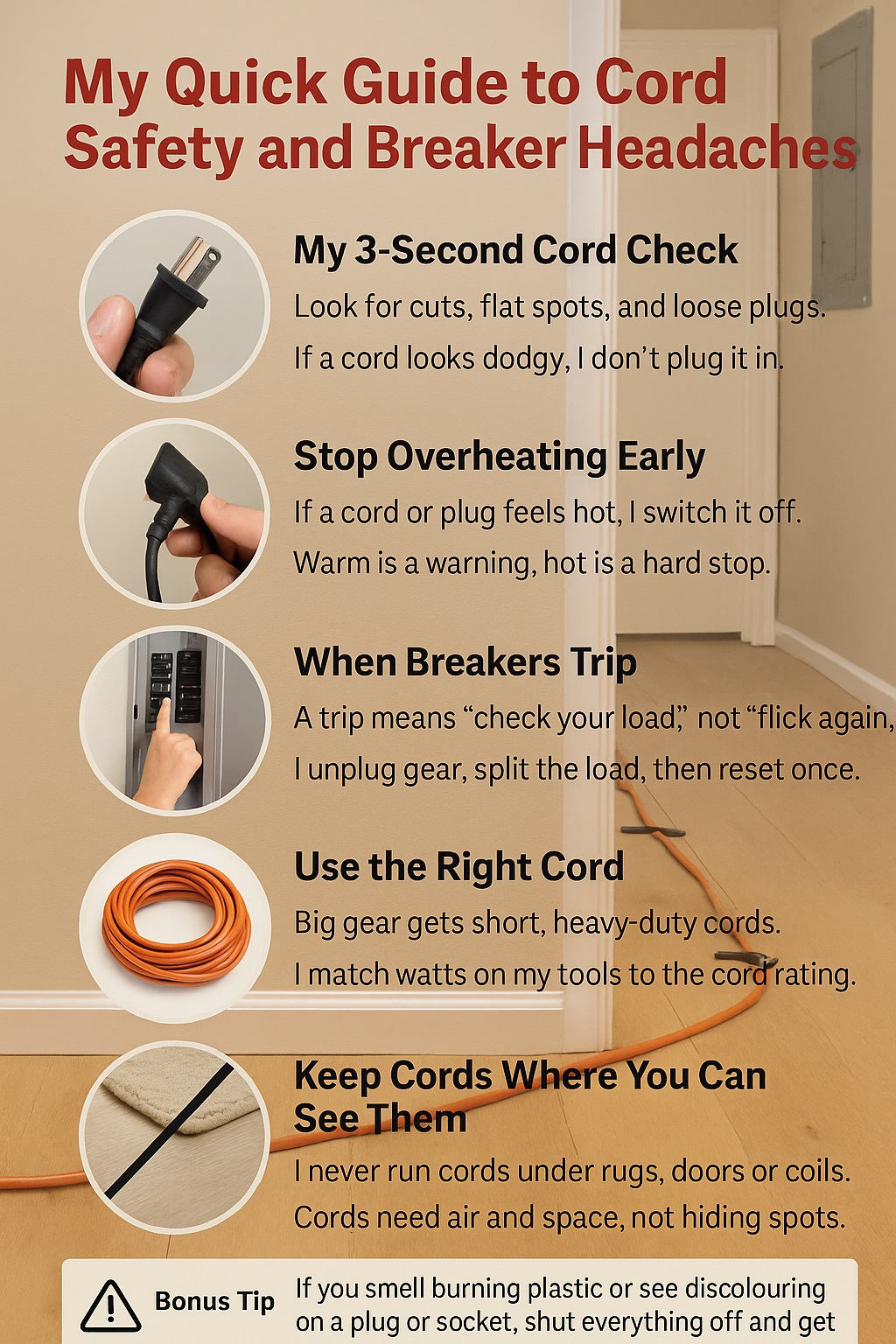
These days, I give every cord a quick check before it goes into a customer’s wall. I look for flat spots, cuts, twisted sections, and taped joins from my “lazy” days. I flex the plug and socket ends gently and make sure nothing feels loose or wobbly in my hand.
Why I Retire Cords Earlier Than Most People
If I’m unsure, I bin it. I’d rather throw away a $30 cord than risk a $3,000 claim or a house fire. I keep a “maybe” box for cords to ask my electrician about, and I put a big X on the plug so I don’t grab it by habit on a rushed morning.
Cheap Cords vs Heavy-Duty Cords in Real Life
On heavy jobs, I can feel the difference between a skinny, cheap cord and a thick, heavy-duty one. The cheap ones get warm and stay curled. The thick ones lie flatter and run cooler. That’s enough evidence for me, even before I read the fine print on the tags.
Mark Lewis, Registered Master Electrician, prefers testing cords with proper equipment, while I use a strict “if in doubt, throw it out” rule on busy days.
🌡️ How I Stop My Cords and Plugs From Overheating
Matching My Gear’s Watts to My Cords
One of my biggest mistakes was treating every cord as if it could carry anything. Now I actually read the wattage of my air movers, dehumidifiers and heaters, then compare it to the rating printed on the cord tag. If it’s close to the limit, I upgrade the cord or rearrange the setup.
Why I Never Bury Cords Under Rugs or Mats
I used to slide cords under rugs “to keep things tidy.” That just traps heat and hides damage. Now I leave cords visible and tape them down if there’s a trip risk. If a cord has to cross a walkway, I use a proper cable cover or reroute it completely. Untidy is better than unsafe.
Coiled Cords and Reels: My Old Bad Habit
The worst overheating I’ve seen was a cord left tightly coiled on a reel while feeding a big heater. The reel sides were hot, and the cord jacket felt soft. Now my rule is simple: if a cord is in use, it’s fully uncoiled and lying where it can breathe.
Dr Sarah Patel, Fire Safety Engineer (PhD, MIFireE), reminds me that many investigations start with “hidden cords,” while my focus used to be only on the gear at the end of the plug.
⚡ How I Match My Gear to Circuits and Breakers
How I Count My Watts Before I Plug In
Before I plug in, I do a quick mental load check. If I’m on a 230–240V circuit and my two machines together are pulling close to 3,000 watts, I know I’m pushing the limits of a 10–13A breaker. That’s my sign to split the load to another outlet or circuit.
What My Electrician Taught Me About Breaker Sizes
My electrician explained that breakers are not “suggestions”; they’re limits. A 10A breaker isn’t there so I can see how clever I am at squeezing 12A through it. Now, if I don’t know the circuit size, I ask the customer, check the switchboard markings, or dial back my setup until I’m sure.
Being Picky About Which Socket Feeds Which Tool
I used to chain everything through one double power point because it was closest. Now I plug heavy-draw gear into separate wall outlets whenever I can. On big jobs, I walk the house first and plan which rooms will feed which machines. It looks slower but saves me trips and headaches later.
Alex Nguyen, Chartered Building Services Engineer (CEng MCIBSE), says he designs systems from the breaker panel outwards, while I started my learning from the socket backwards.
🚨 What I Do When My Breakers Trip or RCDs Cut Out
Seeing a Tripped Breaker as Free Feedback
If a breaker or RCD trips on a job, I no longer just reset and pray. I unplug everything from that circuit first. Then I ask myself, “What changed just before this tripped?” Did I add a heater? Did a cord get wet? Did someone plug in a dryer on the same circuit?
My Simple Reset Routine
My routine is boring but it works: unplug gear, inspect cords, reduce or split loads, then reset once. If it trips again, I stop guessing. Either I move the setup to a different circuit or I call the customer’s electrician. I’d rather admit limits than risk giving the breaker a third “warning chance.”
When I Call an Electrician Instead of DIY Guessing
If a breaker trips with only one moderate-draw machine running, I step back. That’s usually a sign of a wiring issue, a tired breaker, or something I can’t see inside the walls. That’s electrician territory, not “guy with air movers” territory. Customers actually trust me more when I draw that line.
Linda Jones, Licensed Electrical Inspector, argues that repeated resets without diagnosis are “willful blindness,” while my old habit was proudly seeing how many times I could flick a breaker back on.
🧰 How I Choose the Right Cords, Power Boards and Reels
Picking “Good Enough” vs Heavy-Duty Cords
For phone chargers and laptops, I’m fine with normal household leads. But if I’m running air movers, dehumidifiers or heaters, I go straight to heavy-duty cords with thick jackets and clear ratings. If a cord doesn’t list amps or watts, I treat it as suspicious and keep it for light household loads only.
Why My Power Boards Need Safety Features
I don’t use bargain-bin multi-boards on jobs. I look for overload protection, clear amp ratings, and solid build quality. If a board flexes or feels flimsy when I plug in, I don’t use it. I’d rather carry one extra good board than three cheap ones that worry me all day.
Outdoor Jobs and Weather-Rated Gear
Flood work taught me that water plus electricity is the fastest way to grow grey hairs. For outdoor runs, I use weather-rated cords, RCD protection, and avoid puddles like they’re lava. If I can’t keep a connection dry and off the ground, I rethink the layout before throwing gear at the problem.
Dr Kevin Brooks, Chartered Safety Professional (CSP), says equipment selection is “part of the risk control, not an afterthought,” while I used to see cords as accessories instead of safety devices.
🧑🏫 How I Train My Team and Customers on Cord Safety
Explaining Boring Rules in Plain English
When I hand gear to helpers or customers, I don’t give them a technical lecture. I say, “Don’t bury these cords, don’t overload that board, and if anything smells hot, switch it off and call me.” Simple language sticks better than clever diagrams when people are already stressed by water damage.
The Three Rules My Team Is Sick of Hearing
My team can recite my three favourites: no daisy-chaining power boards, no cords under rugs, and no warm or soft cords. If they feel heat through the jacket, they move the load or change the cord. I’d rather sound like a broken record than deal with one melted plug.
Using Real Photos to Make It Real
I keep photos of melted plugs and scorched outlets from old jobs (with permission and without addresses). When I show those pictures, people suddenly take my “boring” rules seriously. It’s hard to argue with plastic that looks like it was in a campfire. Visuals beat lectures every time.
Prof. Jason Reid, Occupational Safety Lecturer (MSc, GradIOSH), says stories and images drive behaviour change more than rulebooks, and my experience with cord training proves his point.
📋 My Real Customer Story: When a Hot Cord Tripped the Breaker
How One “Annoying” Trip Stopped a Bigger Problem
On one job, a customer complained that “my machines kept killing the power.” When I arrived, I found three air movers and a portable heater all fed through one skinny extension cord into a cheap power board. The breaker had tripped twice that morning. The cord plug was almost too warm to hold.
What I Changed to Cool Things Down
I shut everything off, spread the air movers across two separate wall outlets, ditched the thin cord, and brought in a heavy-duty lead from my van. The heater got its own circuit. Once we split the load and upgraded the cord, the breaker stayed rock solid for the rest of the job.
How That Job Changed My Explanations
Instead of blaming the “weak breaker,” I explained to the customer how we’d overloaded the circuit and choked the cord. We walked the house together and fixed a few of their everyday setups too. That one “annoying” trip became a free safety audit for their entire home.
Dr Hannah Cole, Certified Risk Analyst (CRA), notes that small incidents are “cheap lessons” compared to major losses, and this job convinced me to treat every trip as a learning opportunity.
❓ My Go-To FAQs on Cords, Overheating and Breakers
“How Many Air Movers or Heaters Can I Run Off One Outlet?”
My answer: fewer than you think. I keep one high-draw device per outlet wherever possible. If I must add more, I add them slowly and monitor cords and plugs for warmth. The moment anything feels more than mildly warm, I split the load or remove something.
“Is It Okay If My Extension Cord Feels Warm?”
Slight warmth can be normal under load, but a cord that feels hot, soft, or smells like hot plastic is not okay. I shut it off, unplug it, and figure out why. Usually it’s a mix of too much load, too thin a cord, or too tight a coil.
“Why Does My Breaker Trip When Nothing Looks Wrong?”
Just because you can’t see the problem doesn’t mean it isn’t there. Hidden wiring faults, tired breakers, moisture, or dodgy connections can all trigger trips. If I’ve reduced my load and it still trips, I call an electrician rather than play detective behind the walls.
“Can I Use an Indoor Cord Outside for a Short Job?”
My rule: no. Weather, puddles and sharp edges don’t care how short the job is. I keep a separate pile of outdoor-rated cords and treat them like tools, not toys. If I don’t have the right cord, I reschedule rather than gamble.
Rachel Tan, Certified Energy Manager (CEM), says “efficiency starts with the right equipment,” while I learned the hard way that safety also starts with the right cord in the right place.
✅ My Simple Takeaways on Cord Safety, Overheating and Circuit Breakers
What I Want You to Remember From My Mistakes
If you only take a few things from my story, let it be this: inspect cords before every use, match your loads to your cords and circuits, respect tripping breakers, and change setups instead of forcing resets. Cords are not decorations; they are part of your safety system.
The One Cord Safety Job You Should Do Today
After you read this, do a quick walk-through at home or on site. Find one overloaded board, one damaged cord, or one cord buried under something, and fix it. That tiny habit, repeated over months and years, quietly prevents nasty surprises and expensive headaches.
Dr Olivia Grant, Chartered Health and Safety Consultant (CMIOSH), says the safest workplaces “fix one small hazard at a time,” and my cord routine is just that principle wrapped in PVC insulation.
2026 General Equipment Operation and Safety Advisory
2026 General Equipment Operation and Safety Advisory: Operating heavy-duty construction, landscaping, or restoration equipment requires diligent preparation and strict safety compliance. Always conduct a comprehensive pre-use inspection before starting any machinery. Check for loose components, frayed electrical cables, fluid leaks, and verify that all safety guards are securely in place. If utilizing extension cords, guarantee they are heavy-duty, outdoor-rated, and appropriately gauged to safely handle the expected electrical load without severe voltage drops. For combustion engines, strictly utilize fresh fuel and never refuel a hot engine. Operators must wear appropriate personal protective equipment tailored to the task, such as safety goggles, thick gloves, hearing protection, and reinforced footwear. Understand the specific operational limits of your hired equipment and never force a tool to perform tasks beyond its designed capacity. Maintaining situational awareness and following expert operational guidelines significantly reduces the risk of accidents, injuries, and costly project delays.