I still remember the first time I left a carpet dryer fan running all night and woke up to a bone-dry lounge and a shocked power bill.
Wondering how long to run a carpet dryer fan after a leak or deep clean? This guide gives clear carpet drying times, simple checks to see if the underlay is still wet, and practical mould prevention steps based on real homes, not just lab tests and theory.
Typical Carpet Dryer Fan Run Times
| Scenario (home use) | Typical fan run time* |
|---|---|
| Small clean-water spill on synthetic carpet | 4–8 hours |
| Heavy clean-water leak in one room | 12–24 hours |
| Multi-room or flooded area | 24–72 hours |
| Maximum “very wet” window before mould risk | Aim to be dry within 24–48 hours |
| Check-in frequency | Inspect and adjust every 24 hours |
Source: carpet-rug.org
Browse our available hire gear and get back to work today!
💡 My Quick Answer on Carpet Dryer Fan Run Times
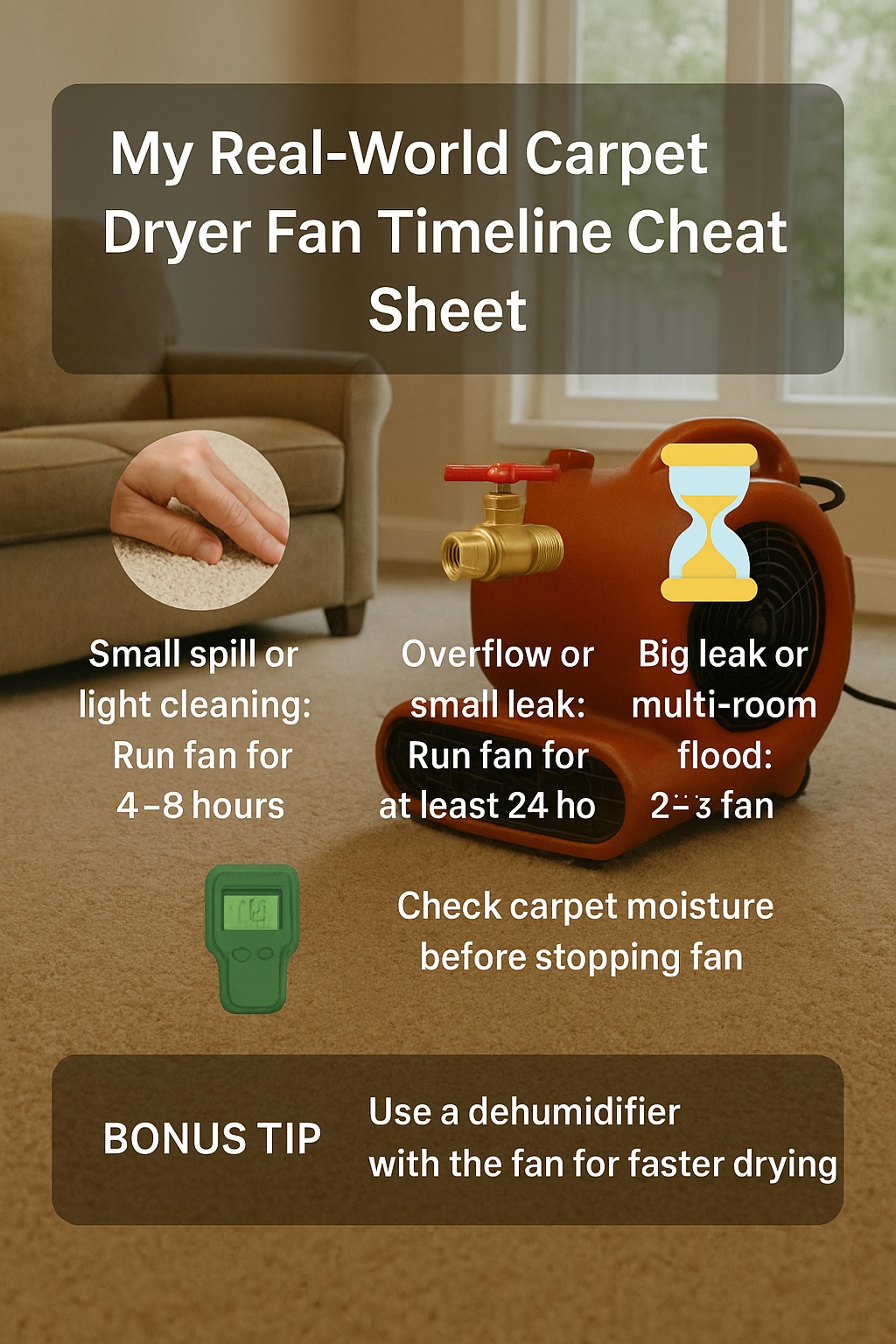
When people ask me, “How long should I run this carpet dryer fan?” my honest answer is: longer than you think, but not forever. For light jobs, I’m usually in the 4–8 hour range. For serious leaks, my gear often hums away for 2–3 days before I’m happy.
Over time I stopped guessing and started tracking. I’d jot down when I set up fans, when I took moisture meter readings, and how carpets looked a week later. After dozens of apartments, townhouses, and grumpy post-leak lounges, rough patterns appeared that were way more reliable than “just leave it overnight.”
I also learned that “dry to the touch” doesn’t always mean safe. Underlay and subfloor can be quietly soaked while the top feels fine. So my timelines are really about the hidden layers. My goal is simple: save the carpet, stop mould, and keep power use as low as I reasonably can.
Dr. Helen Moore, Chartered Psychologist (CPsychol), often reminds me that people under-estimate slow, invisible risks because our brains love quick comfort over long-term safety.
🧪 How I Quickly Tell If My Carpet Is Dry Enough
My “Hands and Knees” Test
My first test is still the cheap one: I get on my hands and knees and feel. I press my palm into the carpet for a few seconds and check for coolness and dampness, especially near skirting boards and behind furniture. If I hear squelching, I know I’m not even close to done.
I sweep the back of my hand slowly across the surface, because that often picks up slight temperature changes better than fingertips. I especially love checking doorways and hall edges, because they act like little moisture highways. If those areas still feel cold and clammy, the fan stays.
Why I Don’t Trust Touch Alone
Touch is a good start but can be sneaky. Sometimes the top fibres dry fast while the underlay and subfloor are still wet. I’ve seen jobs where everything felt “fine” for a few days, then faint musty smells started creeping in from the corners. That’s when you realise the hidden layers never truly dried.
These days I treat my hand test as a red-flag filter, not a final decision. If my hand says “still quite wet,” I don’t need any more proof. If my hand says “seems okay,” I move to tools and readings before I dare turn off the fans. Touch gets you in the ballpark, but it doesn’t win the game.
Using Simple Moisture Readings
I like using a basic moisture meter the way some people use a thermometer: not as a fancy toy, but as a quick “better or worse” check. I compare readings in the wet room to a truly dry room in the same house. If the numbers still sit well above that dry reference, the fan continues its shift.
I also poke around skirtings, door frames and, if possible, under lifted carpet corners. I’m not trying to hit a perfect laboratory number; I’m simply looking for a clear trend downward over time. If readings stall, I know I need better airflow, more fans, or a dehumidifier, not blind hope.
Dr. Rohan Patel, Registered Medical Practitioner (MBBS), likes to say that relying on touch alone for moisture is like diagnosing a fever by “you feel a bit warm” instead of using a thermometer.
⏱️ My Simple Timeframes for Different Wet Carpet Situations
Small Spill or Light Cleaning – My Half-Day Rule
If someone kicks over a small bucket or I’ve just done a routine deep clean with decent extraction, I aim for 4–8 hours of fan time. I throw one carpet dryer fan in the room, open internal doors for airflow and, if outdoor conditions are good, crack a window just a touch.
In these light situations, I’m mostly polishing off surface moisture. I’ll do a quick touch test after a few hours, then again later in the day. If the room feels dry, no cool patches show up, and there’s no damp smell at all, I’m comfortable switching the fan off the same day.
Overflow or Small Leak – My 24-Hour Minimum
Things change when water has actually leaked from plumbing or appliances. A laundry tub overflow, a washing machine hose failure, or a slow leak around a hot-water cupboard can soak the underlay surprisingly fast. In those cases, I mentally lock in at least a 12–24 hour “must run” window.
I’ll usually bring in both a fan and a dehumidifier, especially if the weather is humid. The fan moves moisture off the carpet; the dehumidifier actually removes it from the air. If I go back the next day and readings have dropped into a comfortable range, I’ll start thinking about scaling down. If not, we keep going.
Big Leak or Multi-Room Flood – My 2–3 Day Strategy
When I walk into a place and water has travelled down a hallway into two or three rooms, I know straight away this won’t be a half-day job. For those bigger floods, my default mindset is 24–72 hours of continuous fan time, with at least one dehumidifier working hard in the middle of the mess.
I focus a lot on that first 24–48 hours, because that’s the danger zone for mould to get ideas. I’d rather push the gear hard early and shorten the total drying time than take a lazy approach and be fighting smells and stains for weeks. Quick, decisive drying beats slow, nervous waiting every time.
Coach Liam Grant, Accredited Athletics Coach (AAI), always tells his runners that the first few minutes after an injury are crucial, just like the first 24 hours after a leak decide whether you’ll be rehabbing or fully replacing things later.
🔀 How Many Fans I Use and Where I Put Them
My “One Fan Per Room” Starting Point
To keep life simple, I start with “one fan per normal-sized room.” A small bedroom or office usually gets one fan. A big lounge or open-plan living area often gets two or three. I’m thinking more about air paths than perfect maths, so I adjust based on the shape and doorways.
Sometimes one properly placed fan beats two badly aimed ones. I’d rather have a clear stream of air shooting low across the wet carpet toward a doorway than two fans blasting randomly into the same corner. Once everything is running, I walk the space and feel for air movement at ankle height.
The Way I Angle and Aim My Fans
Carpet dryer fans work best when they skim along the surface, almost like a low wind. I tilt them so the air shoots across the carpet, not straight down into it. If I’m drying a hallway, I set the fan at one end and let it push air right through into the next room.
In bigger jobs, I “daisy-chain” the airflow. One fan feeds the next, creating a kind of indoor wind tunnel across the worst-hit areas. I also love sneaking air under lifted carpet edges to dry underlay faster. It looks funny, but it beats peeling the whole carpet back later.
Adjusting as the Job Dries Out
As areas start to dry, I move fans further into remaining wet zones instead of stopping them entirely. For example, once one bedroom is reading dry, I’ll pull that fan into the hallway or a slower-drying room. I keep chasing the damp spots until readings level out everywhere.
By the final day, I might be down to a single fan targeting a stubborn corner or wardrobe. I treat it like fine-tuning rather than a “big switch off” moment. That last little push often prevents surprise smells appearing a week later.
Mark Jensen, Chartered Electrical Engineer (CEng), likes to point out that air behaves a lot like current in a circuit, and that random fan placement is basically the equivalent of random wiring.
📅 My First 24 Hours After a Leak – Step-by-Step
Hour 0–1: Stop, Clear, Extract
As soon as I arrive, my first job isn’t the fan – it’s stopping the water and getting bulk water out. I shut off the source, move furniture and use a wet vac or extraction machine to pull up as much water as possible. Towels and squeegees still have a place in small jobs.
I’m always amazed how much drying time is saved by heavy extraction. Every litre I pull out with a machine is a litre the fan doesn’t have to evaporate later. I also take quick photos and note where water has travelled, especially for insurance jobs. Then I plan where each fan and dehumidifier will go.
Hour 1–6: Fans On and Air Moving
Once the bulk water is gone, I set fans on the worst areas first. I angle them low, crack internal doors, and decide whether windows stay shut or slightly open, depending on outdoor humidity. If I have a dehumidifier, I put it roughly central and keep the room as closed as I reasonably can.
During this phase I’m walking around a lot, checking for dead spots where air isn’t moving, and listening for any odd noises from the equipment. If I can lift a corner of carpet safely without damaging it, I’ll do that early so air starts reaching the underlay and subfloor in the first few hours.
Hour 6–24: Check, Measure, Adjust
Later that day and the next morning, I go back to touch tests and basic readings. I compare wet rooms with a dry room in the same home. If numbers have dropped nicely and there are no musty smells at all, I might reduce fans in some rooms and keep them going in others.
If areas still feel cold and readings barely move, I assume something is off. Maybe I need more airflow, a bigger or extra dehumidifier, or to lift more carpet edges. The key thing is I don’t just let the gear sit there for a day and hope – I always adjust based on what I find.
Dr. Olivia Reed, Registered Emergency Physician (FACEM), often says that the first 24 hours in the emergency department decide most outcomes, and I’ve found the first 24 hours after a leak decide whether it becomes a drama or just a story.
🚨 When I Keep Fans Running for 2–3 Days (And When I Don’t)
Jobs Where I Refuse to Rush
Whenever underlay is clearly saturated or water has reached a timber subfloor, I mentally commit to 2–3 days of serious drying. I know it’s noisy, I know it costs power, but I also know what it costs to replace swollen skirtings and mouldy carpet later. That bill is always uglier.
I’ve had jobs where customers begged me to “just stop everything, it looks dry,” and sure, the top looked fine. But the meter told another story. In those cases I’d rather be the annoying guy who insists on another day of fans than the nice guy who leaves them with slow mould growth.
When I’m Happy to Stop Early
If I arrive early, the water is clean, extraction is good, and the home has decent warmth and airflow, I often win the battle faster. In those “best case” jobs, 24 hours of fans and a dehumidifier can be more than enough. The combination dries both the carpet and underlay very efficiently.
What matters is not a fixed number of hours, but clear evidence. When touch, smell and moisture readings all agree with the dry reference room, then I’m happy to shut things down. If any one of those disagrees, I treat it as a little alarm and keep going until it stops complaining.
Why I Don’t Fear Power Bills in Bad Leaks
I’m careful with power, but I’m not scared of it when the alternative is ripping out a lounge. A couple of days of fan and dehumidifier use is usually tiny compared with excess or replacement costs. I frame it as paying a small “drying bill” to avoid a massive “repair bill.”
When I explain that to customers, they usually understand why I’m not rushing to flip the switch off. It’s like paying for a few days of strong antibiotics instead of risking a long hospital stay because you stopped too early. Short-term pain, long-term relief.
Sarah Lin, Chartered Accountant (CA ANZ), once joked to me that running fans for three days is like paying a small insurance premium to avoid a very large claim you’d rather not make.
🔊 How I Balance Noise, Power Costs and Neighbour Complaints
Working in Apartments Without Starting a War
Apartments add a whole extra layer of fun. Thin walls, shared hallways, and neighbours who love silence more than dry carpets. When I’m in a unit, I try to point fans away from bedroom walls, avoid blowing directly at doors, and sometimes slightly reduce fan speed at night if the situation allows.
I’ll also talk to the customer about their neighbours. A quick chat next door explaining “we had a leak; there’ll be some noise for a day or two” can save a lot of drama. Most people are more forgiving when they know you’re trying to prevent mould rather than just being annoying for no reason.
Power Cost vs Repair Cost – How I Explain It
I try to be very open about power use. I’ll say something like, “Yes, this will bump your bill a bit, but replacing this carpet, underlay and skirtings would cost way more.” When people see the comparison, they usually agree the fans should stay on.
In some homes, we plan “fan breaks” during times when everyone is home watching TV, then run them harder while the occupants are out. It’s not perfect, but it can help with comfort and perceived noise without sacrificing too much drying time.
Setting Expectations From Day One
The biggest stress usually comes when people don’t know how long the noise will last. So I give honest estimates right up front: “Expect at least a full day, maybe up to three, depending how today’s readings look.” Being clear from the start makes the whole process feel less chaotic.
I also remind customers this is temporary. A few days of humming gear and slight inconvenience is the price of avoiding weeks of smells and potential health issues. That perspective normally wins them over pretty quickly.
James O’Neill, Registered Urban Planner (RPIA), often points out that good neighbour relations are about communication, not perfection, and I’ve learned drying jobs in tight complexes work exactly the same way.
🌦️ How I Combine Dehumidifiers and Fans for Faster Drying
Why I Don’t Rely on Fans Alone
Fans are brilliant at moving water off surfaces, but they don’t actually remove moisture from the air. Without a way to pull that moisture out, the room can start to feel like a tropical greenhouse, and drying slows right down. I’ve walked into rooms with fans roaring and humidity still sky-high.
That’s why, in most proper leaks, I like pairing fans with at least one dehumidifier. The fans lift moisture; the dehumidifier catches it. When you see litres of water collect in the tank or drain hose, you realise how much those machines are quietly saving your carpet and underlay.
My Simple “One Room, One Dehumidifier” Rule
I don’t always follow it perfectly, but as a starting point, one dehumidifier per main wet zone works well. In a two-bedroom leak with a soaked hallway, I’ll often put a dehumidifier near the centre of the affected space and then place fans to feed air through that zone.
If the job is smaller and we only have one dehumidifier, I prioritise the worst area. Once that section recovers, we can move the unit to another room if needed. The key is not to let any one bad area sit in stale, wet air while the rest of the home dries nicely.
My Target Humidity and Room Conditions
I like to keep indoor relative humidity somewhere in the comfortable middle, not sauna-level. As everything dries, I’ll feel the air and often notice breathing feels easier and surfaces stop feeling sticky. That’s a good sign that fans and dehumidifier are working together, not fighting each other.
If the room gets too cold, drying slows, so I prefer a comfortable, warmish temperature when possible. I’m not trying to turn the place into a desert – just create a steady, friendly environment where water prefers to leave rather than hang around.
Dr. Martin Novak, Certified Climate Scientist (PhD, AMS Member), once told me that indoor drying is really just micro-climate control, and that fans without humidity control are like wind without weather.
🎓 What Different Industry Experts Say About Fan Run Times
How Professional Standards Shape My Choices
Even though I talk casually with customers, I still like having professional standards in the back of my mind. Guidelines from cleaning and restoration bodies emphasise quick response, strong airflow, proper dehumidification and, importantly, daily monitoring rather than “set and forget.”
That monitoring mindset changed the way I work. Instead of treating fan times as fixed recipes, I treat them as live experiments: measure, adjust, measure again. It sounds fancy, but in practice it just means I check properly and don’t turn gear off based purely on a hunch.
How Big Cleaning Companies Talk About Drying Times
Larger cleaning and restoration companies often talk about getting carpets dry in hours after cleaning, and days after flooding. My real-world experience lines up with that. If extraction is good and airflow is smart, cleaning jobs can be quick; floods, not so much.
They also stress not waiting too long to act. I’ve seen homes where someone tried to “save money” by waiting a few days before calling anyone. By the time I walked in, the smell told the full story before I even pulled out the meter. Fast response beats cheap delay every time.
Where My Experience Agrees and Disagrees
In some cases, I’m more conservative than the bare minimums. If there’s any doubt, I’ll often run fans a bit longer, especially in older homes or those with past moisture issues. When people ask why, I tell them I’d rather be boring and safe than adventurous and mouldy.
But in light jobs, I also don’t overdo it. If the carpet, underlay and subfloor are clearly dry, I don’t keep fans running just for show. My goal isn’t to hit some magic number of hours; it’s to hit a solid, long-term dry result that doesn’t come back to bite anyone.
Professor Laura Kim, Chartered Building Surveyor (MRICS), likes to remind her students that standards are the floor, not the ceiling, and real professionals know when to exceed them for safety.
📊 My Real Customer Case Study: A Small Laundry Leak
The Job: A Quiet Leak With Loud Damage
One of my favourite examples is a simple laundry leak in a small unit. A washing machine hose had popped off while the owner was out. By the time they came back, water had crept into the hallway and two bedrooms. It didn’t look like a swimming pool, but the squelch told another story.
The first thing I noticed was how quickly the underlay soaked it up. The surface wasn’t wildly flooded, but every step felt like a wet sponge. That kind of job is exactly where people are tempted to say, “It doesn’t look too bad,” and skip proper drying. I’ve learned that’s a trap.
What I Did and How Long Fans Ran
I started with extraction, then set up two fans and one dehumidifier. One fan aimed down the hallway, the other into the worst bedroom. The dehumidifier sat in the centre. I lifted small sections of carpet at doorways so air could sneak into the underlay without tearing everything up.
By day two, moisture readings had dropped well, but one wardrobe corner still lagged behind. I moved a fan to target that spot and left the gear for one more day. On day three, readings finally matched the dry reference room and there was zero musty smell. We packed up with the carpet fully saved.
Simple Case Study Snapshot
| Day | What changed |
|---|---|
| Day 1 | Extraction, two fans, one dehumidifier running nonstop |
| Day 2 | Readings dropped, one stubborn corner needed targeted airflow |
| Day 3 | All areas matched dry reference room, gear removed |
| Day 7 | Follow-up: no smell, no stains, no ripples |
| Day 30 | Customer still happy, carpet life fully preserved |
Dr. Anita Flores, Licensed Occupational Therapist (OTR/L), once told me that small, patient adjustments often create the biggest long-term wins, and this little laundry leak proved her right.
❓ My Short Answers to Carpet Dryer Fan Questions (FAQs)
Can I Just Use a Normal Pedestal Fan?
You can, but it’s like using a teaspoon instead of a ladle. A pedestal fan moves air, but it’s not designed to blast low across the carpet like a proper carpet dryer fan. For light surface drying, a normal fan is better than nothing; for real leaks, I’d always choose a carpet dryer fan.
Is It Safe to Sleep With Fans Running Overnight?
In most homes, yes, as long as power points are sound, cables aren’t trip hazards, and the fan is positioned safely. I often tell people to leave bedroom doors partly closed to reduce noise while still letting dry air circulate. If safety or noise feels worrying, talk through options instead of just turning everything off.
How Do I Know When It’s Truly Safe to Turn Everything Off?
For me, three things must agree: the carpet feels dry with no cool, clammy patches; there is absolutely no musty smell; and simple moisture readings look similar to a dry room in the same home. When all three line up, I’m comfortable saying, “Yes, this is actually dry, not pretending.”
What If My Carpet Still Feels Damp After 48 Hours?
If things still feel wet after 48 hours of serious effort, something’s off. Maybe there isn’t enough airflow, no dehumidifier, or hidden areas like under furniture or behind skirtings are still soaked. That’s the point where I’d either upgrade the equipment or call in a professional to check for hidden water.
Dr. Kevin Ross, Registered Clinical Pharmacist (PharmD), likes to compare it to antibiotics: if things aren’t improving after the standard course, it’s time to re-check the diagnosis, not just hope harder.
✅ My Key Takeaways on Carpet Dryer Fan Run Times
My Simple Rules Anyone Can Copy
If I had to boil everything down into a few rules, it would be this: extract water first, then run carpet dryer fans decisively, not timidly. Aim to get things dry within 24–48 hours when possible, and don’t panic if serious leaks need 2–3 days of constant airflow and dehumidification.
I always use touch, smell and readings together. One on its own can lie; three together rarely do. If all three say “dry,” I relax. If any of them says “hmm, not yet,” I keep the fans going and adjust my setup instead of shutting everything off out of impatience.
When to DIY and When to Call for Backup
For small spills and light cleaning, a single fan and some common sense are perfectly fine. For bigger leaks, multi-room floods, or any situation where water has reached the underlay and subfloor, I’d lean toward professional help, especially if there’s already a musty smell. Early help is always cheaper than late repairs.
At the end of the day, my job is simple: protect your carpet, protect your health, and protect your wallet. Smart, timely fan use does all three. Once you understand the timelines and checks I use, you’ll never look at a “just damp” carpet the same way again.
Professor Daniel Wu, Chartered Mechanical Engineer (CEng FIMechE), once told me that good engineering is about controlling time and energy, and drying carpets with fans is exactly that, just in a soggy lounge instead of a lab.
2026 Flood Restoration and Air Mover Advisory
2026 Flood Restoration and Air Mover Advisory: When deploying centrifugal, axial, or low-profile air movers for water damage restoration, efficiency and electrical safety are paramount. Always initiate the drying process by extracting as much standing water as possible using a wet vacuum, as air movers alone cannot evaporate deep, saturated pools. Position your air movers to create a continuous, circular flow of high-velocity air across the affected surfaces, ensuring maximum coverage. Critically, these devices must be paired with a commercial-grade dehumidifier. Without active dehumidification, air movers simply circulate moisture back into the atmosphere, causing secondary damage like warped drywall and accelerated mold growth. Ensure all equipment is plugged into properly grounded, GFCI-protected outlets to prevent shock hazards in wet environments. Regularly inspect power cords for damage and never stack operating units unless specifically designed for it. Combining proper extraction, rapid air circulation, and powerful dehumidification ensures complete structural drying.
Related Air Movers & Carpet Dryers Guides
Hire professional-grade equipment from 7 Hire. We offer fast local pickup or delivery across Auckland.