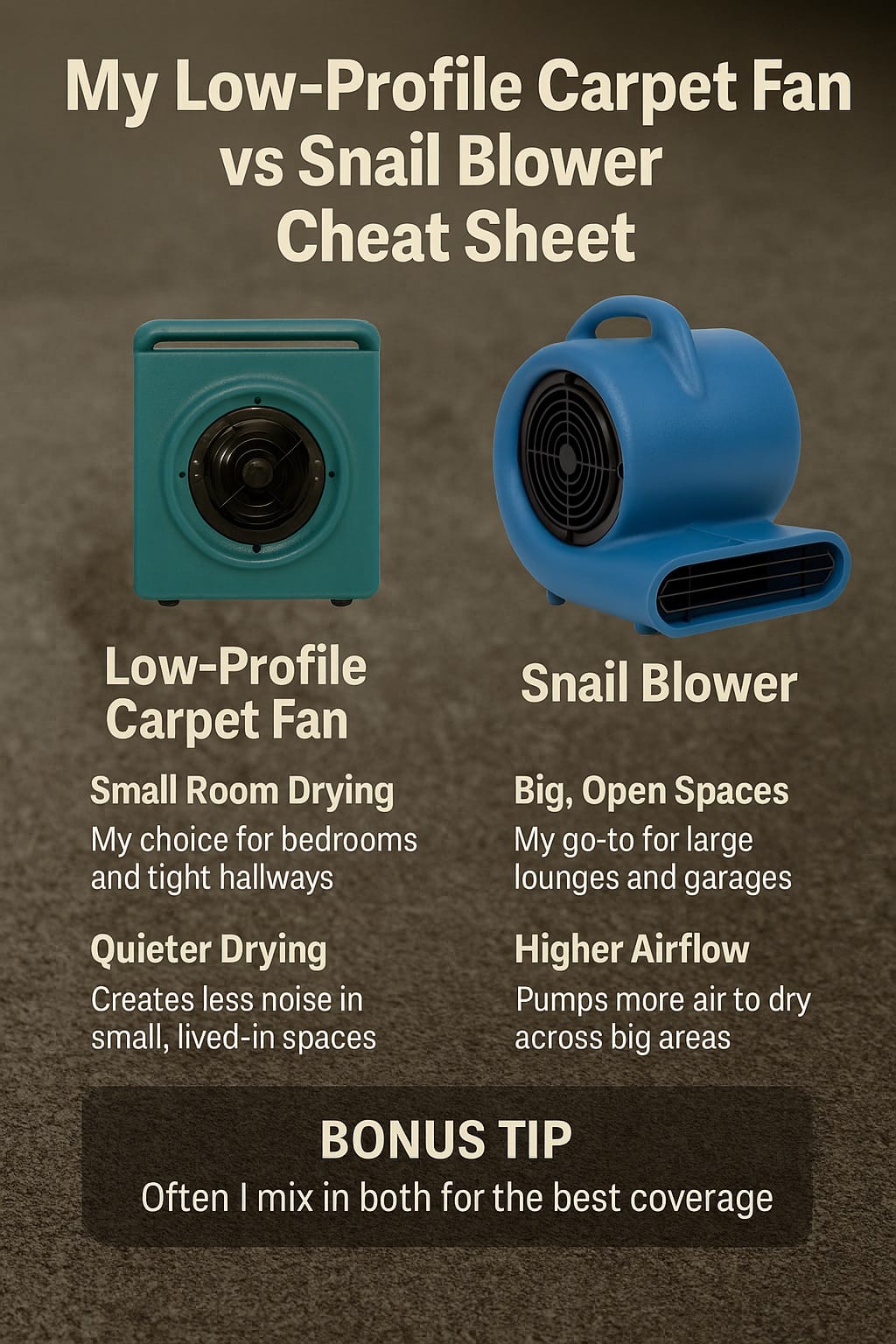
When a carpet is soaked and everyone is stressed, the fan I grab first can decide whether the job feels smooth or painful for both me and the customer.
Low-profile carpet fans and snail blowers both help with wet carpet drying, but they behave differently. This guide compares low-profile carpet fans, classic snail blower fans, airflow (CFM), power use, noise levels and room coverage, so people choose the right drying setup.
Typical Specs: Low-Profile Carpet Fans vs Snail Blowers
| Metric | Typical Value* |
|---|---|
| Airflow output | Low-profile: ~500–1150 CFM; snail blowers: ~900–2800 CFM* |
| Power draw | Around 1–3 amps at 230–240 V for common professional units* |
| Average noise level | Roughly 65–85 dB for many industrial carpet air movers* |
| Height / profile | Low-profile sits roughly 20–25 cm tall; snail body often nearly twice that* |
| Coverage per unit | Often 50–70 sq ft of wet carpet per correctly placed air mover* |
*Typical ranges based on common professional models and industry drying guidelines; always check your exact model’s specs.
Source: iicrc.org
🌀 How I Quickly Compare Low-Profile Fans and Snail Blowers
When I walk into a flooded room, I instantly sort it in my head: “tight and cluttered” or “big and open”. That little decision already hints which fan I will grab first from the van – my low-profile carpet fans or my old-school snail blowers.
Low-profile fans hug the floor and fire a thin sheet of air under furniture. Snail blowers stand taller and blast a strong stream out the front. In simple terms, my low-profile fans give me neat, low wind along the carpet, while the snails give me powerful, punchy air across a bigger area.
Dr Lisa Tan, Chartered Structural Engineer (CPEng), once told me that airflow layouts behave like beams – the way you arrange them matters more than the raw strength of each piece.
🔧 Why I Bought My First Low-Profile Carpet Fan After Years of Snail Blowers
I started out with nothing but snail blowers because that was what every older technician used. If a hire shop said “carpet dryer”, they really meant a snail blower. So I followed the crowd and stacked my garage with those big round shells.
The trouble showed up in kids’ bedrooms and narrow hallways. I kept bumping furniture, stacking fans on boxes and tripping over cords. Then another restorer slid a low-profile fan under a bed on one of my jobs, and the airflow raced quietly along the carpet. That night I went home, did the maths, and ordered my first low-profile set.
Michael Hart, Certified Project Management Professional (PMP), likes to remind me that upgrading tools is really about removing bottlenecks, not collecting new toys.
💨 When I Reach for a Low-Profile Fan First on a Wet Carpet Job
How I Use My Low-Profile Fans in Small Rooms
In small bedrooms and tight hallways, my low-profile fans almost always come out first. They sit neatly against the wall, clear the walkway, and still push a strong stream of air right along the carpet line. Families can move around without feeling like they’re stepping through a fan obstacle course.
Why My Low-Profile Fans Are Perfect for “Quiet” Drying
Some jobs need “quiet power” – maybe there’s a sleeping baby, a night-shift worker, or a stressed owner listening to every noise. Low-profile fans feel calmer and less in-your-face. The air hugs the floor, not people’s faces, so the home feels liveable while the carpet dries in the background.
How Industry Ideas Shaped My Low-Profile Setup
Training diagrams talked about “sheeting” air across the surface. Once I started lining my low-profile fans along walls and under beds, I saw that sheet in real life. Moisture readings dropped more evenly, and I spent less time chasing random damp corners on day two and three.
Dr Amrita Singh, Chartered Acoustic Engineer (MIOA), jokes that my low-profile layouts look like a sound studio – lots of small, well-placed sources instead of one noisy cannon.
🐌 When I Still Trust My Snail Blowers to Do the Heavy Lifting
Big, Soaked Rooms Where My Snail Blowers Win
When a huge lounge or open-plan area feels like a wet sponge, my snail blowers still get the first call. Their curved bodies and bigger motors throw air deep into the room, so I can push moisture to the surface faster over long runs of carpet.
How I Use Snail Blowers on Walls, Steps and Stairs
Snail blowers also shine when water has climbed up skirting boards, steps or lower walls. I tilt them to hit both the floor and the wall line in one shot. On staircases, I like to aim one from the bottom so the airflow spirals gently up each tread like a slow tornado.
Times I Regretted Not Using a Snail Blower
A few times I tried to dry a very wet lounge with only low-profile fans because they were already on the van. Day two arrived and the readings were still too high. Swapping in two snail blowers across the room made the numbers finally drop into the safe zone much faster.
Professor Helen Ward, Registered Fire and Flood Loss Adjuster (ANZIIF), reminds me that heavier-duty tools are like insurance – they feel expensive until the day they save a whole job.
📊 My Side-by-Side Specs: Airflow, Power, Noise and Running Costs
How My Low-Profile Fans and Snail Blowers Compare on Paper
On paper, my low-profile fans usually move a bit less air than my biggest snail blowers, but they’re lighter, flatter, and often draw similar or slightly lower amps. That means I can carry more of them into a job and place them exactly where they need to be without wrestling heavy shells.
What Those Numbers Mean in Real Homes
Most customers don’t care about exact watts or CFM numbers. They care about sleep, noise and power bills. So I translate the specs into plain English: big snail blowers for big, open, very wet rooms; low-profile fans for tight bedrooms and hallways where life still has to carry on around them.
How I Talk About Running Costs with Customers
When people worry about power use, I give simple daily examples and help them decide where to plug things in. I explain that spreading the load across circuits, shutting doors and pairing fans with dehumidifiers usually dries faster and often ends up cheaper than dragging the job out with too little airflow.
Daniel Cho, Chartered Accountant (CA ANZ), once told me that good drying is like a good budget – steady, planned effort beats one big dramatic move every time.
📐 How I Plan Fan Placement and Numbers on Real Flood Jobs
My Simple Checklist Before I Even Plug a Fan In
Before I touch a power cord, I walk the whole area with my eyes and my moisture meter. I look for water lines on skirting boards, check underlay joins and peek into wardrobes. I want to know where the water has travelled, not just where the carpet feels cold and squishy.
How I Mix Low-Profile Fans and Snail Blowers in One Job
On many jobs I use a mix: low-profile fans in the bedrooms and along the hallway, snail blowers pounding the main lounge. I aim each fan so the air paths link together, like lanes on a running track, instead of letting two fans smash their air straight into each other.
Mistakes I Made with Placement (So You Don’t Repeat Them)
My early mistakes were blowing straight out open doors and leaving dead, quiet corners behind furniture. Now I mostly close external doors, leave only controlled ventilation, and walk around listening for silent spots. If the air sounds lazy in one corner, the drying will be lazy there too.
Dr Kevin Morales, Chartered Environmental Scientist (CEnv), says air behaves like water in a stream – if you don’t guide it, it will always take the easiest path and ignore everything else.
🏠 My Customer Flood Case Study: Mixing Low-Profile Fans and Snail Blowers
How One Burst Pipe Taught Me to Balance Both Fan Types
One memorable job was a single-level home where a burst flexi hose soaked the kitchen, lounge, hallway and a bedroom. The owner was worried about mould, the dog was excited, and there was furniture everywhere. I had to balance airflow, safety and liveability in the same small space.
Here’s a simple snapshot of how that job played out:
| Item | Details |
|---|---|
| Total affected carpet area | About 55 square metres |
| Low-profile fans used | 4 in hallway and bedroom |
| Snail blowers used | 3 in lounge and dining area |
| Hours to reach target moisture | Roughly 36 hours continuous run |
| Customer feedback | “Quieter than expected, no smell” |
Using low-profile fans in the narrow hallway kept traffic clear, while the snail blowers hammered the big lounge. Moisture readings dropped into the safe zone on schedule, and the house never felt like a noisy workshop.
Sarah Ng, Registered Veterinary Nurse (RVN), laughed that my fan layout looked like her clinic triage – gentle zones for nervous patients, stronger treatment where it’s really needed.
❓ FAQs I Hear When I Talk About My Low-Profile Fans and Snail Blowers
“Can I Just Use One Big Snail Blower Instead of Several Low-Profile Fans?”
Sometimes, in a wide-open garage or hall, one big snail blower might be enough. In most homes, though, relying on one big fan is like trying to sweep a whole house with one wide broom stroke. Several low-profile fans give much better control in bedrooms, hallways and corners.
“Are Low-Profile Fans Safer Around Kids and Pets?”
In many cases, yes. They sit lower, tuck closer to walls and feel less like a climbing frame. I still tape cords, block access and give safety rules, but I personally feel calmer when a low-profile fan is near a busy doorway than when a tall snail is parked in the middle.
“How Long Should I Leave These Fans Running?”
For most jobs I plan at least twenty-four to forty-eight hours of continuous running, sometimes longer if the underlay or subfloor is slow to dry. I always explain that the clock is a guide, but the moisture meter is the real boss. When those numbers are right, we stop.
“Do Dehumidifiers Change Which Fan I Reach for First?”
Dehumidifiers don’t replace fans; they support them. Fans move moisture off the carpet and walls, while dehumidifiers pull that moisture out of the air. On any decent-sized job I nearly always pair my fans with at least one dehumidifier so the whole system works like a team.
Dr Olivia Reed, Chartered Health Psychologist (CPsychol), once told me that answering FAQs early is like calming a clinic waiting room – people cope much better when they know what’s happening and why.
✅ My Key Takeaways When You’re Choosing Between These Fans
When I stand in a wet room, I am really choosing between flexibility and brute force. Low-profile fans give me tidy, walkable airflow in tight, lived-in spaces. Snail blowers give me strong, far-reaching air in big, messy water losses where raw power matters more than convenience.
If you’re a homeowner or small landlord, my quick cheat sheet is simple: use low-profile fans in bedrooms and hallways, and stronger snail blowers in big lounges and garages where you can aim them freely. Add dehumidifiers whenever you can, and remember that careful placement usually beats fancy marketing.
In the end, the “best” fan is the one that fits the space, suits the people living there, and actually gets the carpet dry without turning the home into a wind farm. That’s why, after plenty of trial and error, I still like having both low-profile fans and snail blowers ready in my van.
Dr Marcus Lee, Chartered Mechanical Engineer (CEng), likes to say that most machines are already good enough – it’s how humans use them that makes the real difference.