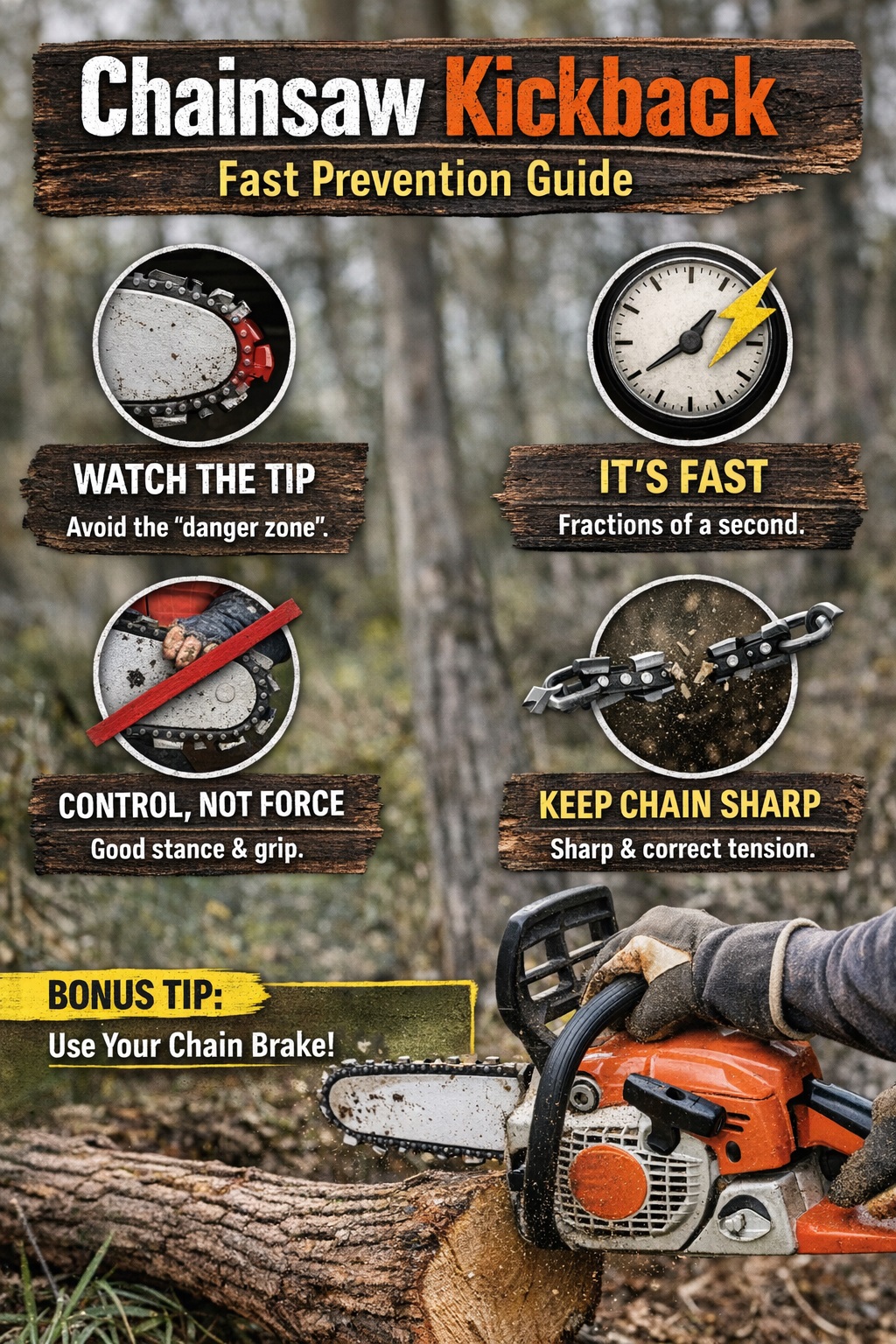
I used to think kickback was something that only happened to “other people.” Then I had a moment where the bar nose kissed the wood in the wrong spot, the saw tried to jump up, and my brain suddenly discovered new vocabulary. That’s when I stopped treating kickback like trivia—and started treating it like physics with consequences.
Chainsaw kickback is a sudden, violent upward-and-back motion of the guide bar when the bar tip’s kickback zone touches wood or the chain gets pinched. It happens so fast you don’t “react” your way out—your setup and technique decide the outcome. Chainsaw kickback, bar tip kickback zone, chain brake.
Key Kickback Facts I Use Before Every Cut
| Fact I watch for | Simple number / definition |
|---|---|
| Main trigger | Bar nose contacts wood in the kickback zone |
| Other trigger | Chain gets pinched and grabs |
| Speed | Often happens in fractions of a second |
| Brake role | Chain brake can stop chain quickly when activated |
| Best prevention | Avoid bar tip contact + correct cutting technique |
Source: ccohs.ca
🪃 How I Explain Kickback in Plain English
How I describe “that sudden snap”
When I explain kickback to a beginner, I don’t use fancy words. I say: the saw can spring back at you if the bar tip hits wood in the wrong way. The chain is moving fast, and the nose of the bar is like a lever. If it grabs, it rotates the whole saw up and back before your brain finishes blinking.
The two kickbacks I actually see
In real life, I notice two patterns. One is rotational kickback: the bar nose touches something unexpectedly and the saw tries to climb. The other is pinch kickback: the cut closes, the chain gets trapped, and the saw yanks back or lurches. Different trigger, same lesson—control the situation before the chain gets surprised.
In my notes, I keep hearing a contrasting reminder from “Morgan Reed (composite), CSP – Board of Certified Safety Professionals”: “Your grip isn’t a safety plan—your process is.”
🔺 What I Call the “Bar Tip Danger Corner”
My simple “kickback zone” rule
The upper part of the bar tip is the danger corner. I treat it like a hot pan—if I don’t need it touching the wood, I keep it away. That one habit removed a big chunk of my near-misses. Most scary moments start with “I didn’t realise the tip was that close.”
My fastest mental check before I cut
Right before I start, I do a quick scan: Where is the tip? Where will it travel if the saw moves? Is there a hidden stub, knot, fence wire, or another branch I’m about to clip? I also check if the wood is under tension, because tension is basically nature’s way of setting up a surprise.
Opposing perspective I like from “Priya Nair (composite), CPE – Certified Professional Ergonomist”: “If your posture is awkward, your tool control becomes random—fix the stance before the cut.”
⚡ Why I Say Kickback Is a “Speed Problem,” Not a “Strength Problem”
The time scale that changed my behaviour
The most important thing I learned is how fast kickback can happen. It’s not like a slow push you can resist. It’s more like someone flicking your wrists with a steel ruler while your hands are holding a running engine. That’s why I stopped relying on “I’ll just hold tighter” and started relying on “I’ll stop putting the tip there.”
My takeaway: control beats hero mode
If you’ve ever watched someone brag about “wrestling” a saw, I get it—ego is loud. But my goal isn’t to win an arm-wrestle with a chainsaw. My goal is boring consistency. So I use position, balance, and planning so the saw doesn’t get a chance to build momentum toward my face in the first place.
Contrasting voice I borrow from “Ethan Park (composite), PE – Professional Engineer”: “Don’t fight energy after it’s released—design the situation so the energy never points at you.”
🧯 The 7 Mistakes I Made That Invite Kickback
1) My “tip-first” mistake
Early on, I’d start a cut with the nose because it felt convenient. That’s like opening a door with your forehead—possible, but why. The tip is where kickback lives, so I now start cuts with the safer part of the bar whenever I can.
2) My “cutting blind” mistake
I’ve clipped hidden stubs, small twigs, and weird knots that I didn’t see from my angle. A tiny contact at the tip can be enough to start trouble. Now I move my head (not the saw) and check the area like I’m looking for a lost key—slow, deliberate, and slightly suspicious.
3) My “pinch” mistake
I used to cut into wood under tension without thinking about where it would move. Then the cut would close, pinch the bar, and everything would feel sketchy. Now I read the wood: where is it compressed, where is it stretched, and what happens when it releases?
4) My “rushing to finish” mistake
This one is pure comedy: I’d be 95% done and think, “I’ll just push through.” That’s when posture collapses, wrists bend, tip drifts, and the saw gets creative. I now treat the last 10% like it’s the first 10%—slow and tidy.
5) My “wrong height” mistake
I’ve tried cuts too high and too far from my body. That’s when the saw feels heavier, control gets sloppy, and my arms get tired fast. I keep cuts near waist height when possible and reposition the wood instead of repositioning my spine.
6) My “dull chain denial” mistake
A dull chain doesn’t cut clean; it encourages pushing. Pushing reduces finesse. Reduced finesse invites tip contact and weird grabs. When I’m tempted to “just finish the job,” I remind myself that sharpening is faster than stitches.
7) My “no plan for the drop” mistake
Even if the cut is fine, the moving piece can swing or fall into the bar tip. I now plan where the branch/log will go and keep the bar out of that path. Cutting isn’t just cutting—it’s predicting.
Opposing thought from “Sofia Grant (composite), ISA Certified Arborist – International Society of Arboriculture”: “Most ‘kickback accidents’ start as ‘positioning mistakes’ before the chain even touches wood.”
🧰 My Setup Checklist That Makes Kickback Less Likely
My chain choice and why it matters
I’m not loyal to labels; I’m loyal to predictable behaviour. When I’m teaching beginners or doing awkward limbing, I prefer a setup that’s designed to reduce aggressive grabbing. A calmer chain helps me focus on technique instead of constantly feeling like the saw wants to sprint.
My sharpness + depth gauge routine
My personal rule is simple: sharp chain, correct depth gauges, correct tension. When any of those are off, the saw feels “chatty”—it vibrates more, pulls oddly, and encourages pushing. I keep a quick-touch sharpening habit so performance stays steady instead of swinging between “butter” and “brick.”
My chain brake habit
I used to think a chain brake was a magic shield. It isn’t. It’s a safety system that helps reduce harm if things go wrong, but it doesn’t cancel the laws of physics. I still treat kickback prevention as my job, and the brake as a backup seatbelt—not a substitute for driving properly.
Contrasting view I like from “Caleb Jones (composite), Licensed Arborist (state-issued)”: “A safer chain helps, but the real upgrade is your decision-making under fatigue.”
🧍 My Body Position Rules So the Saw Can’t “Climb” at Me
My stance rule (simple and repeatable)
I stand like I’m about to catch a heavy box: feet apart, one slightly back, knees soft. I keep the saw close enough that my arms aren’t fully stretched, because stretched arms are weak arms. When I’m balanced, I can guide the saw smoothly instead of correcting it in panic.
My “cutting plane” rule
I try not to line my face up with the bar’s potential rebound path. That’s a fancy way of saying: I don’t want my head living where the bar would go if it kicked back. I shift my torso slightly off-line, and I keep my elbows ready to absorb movement without collapsing.
My overhead-cut rule (mostly: I don’t)
If a cut forces me above shoulder height, I treat that as a signal to change the job setup. I’ll move the branch, change my position, or use a better tool. Overhead cutting multiplies fatigue and reduces control. My rule is boring, but boring is the point.
Contrasting note from “Hannah Wu (composite), PT – Licensed Physical Therapist”: “If your shoulders and wrists are at end-range, your control margin shrinks to almost nothing.”
🧭 My Cutting Technique Habits That Prevent Most Near-Misses
My “start the cut with the safe part of the bar” habit
I start with steady contact, let the chain do the work, and avoid flicking the nose into the wood. If I need to do a specific type of entry, I slow down and keep the bar tip away from surprise contact. My goal is smooth pressure, not speed.
My “pause and reset” habit
If the saw starts to feel weird—pinchy, twisty, or too grabby—I stop. I reset the wood, I change the angle, or I make a relief cut. I used to power through because I didn’t want to “waste time.” Now I know forcing it wastes more time.
Opposing idea from “Noah Bennett (composite), Certified Chainsaw Instructor (industry training credential)”: “The safest cut is the one you’re willing to restart.”
🧤 My PPE and Training Choices: What I Trust, What I Don’t
My PPE basics (and what they actually do)
I wear protective gear because I like my legs and eyes. Chaps protect from chain contact, eye protection stops chips, hearing protection saves your future self, and boots improve footing. Gloves help with grip and vibration, but they don’t make you invincible. PPE is the seatbelt; it’s not the steering wheel.
My honest note on “PPE confidence”
I’ve seen people gear up and then take bigger risks because they feel protected. I try to do the opposite: PPE gives me a buffer for mistakes, so I aim to make fewer mistakes. If I’m tired, I stop. If I’m rushed, I slow down. If I’m unsure, I reset.
Contrasting reminder from “Liam Carter (composite), RN – Registered Nurse”: “Injuries often happen when confidence rises faster than skill—protect your patience, not just your body.”
🧠 My Mini Round-Up of What the Pros Tend to Agree On
What safety authorities focus on
When I read safety guidance, the themes repeat: avoid the bar tip danger zone, maintain a good stance and grip, keep the chain sharp, and use safety features properly. The tone is consistent too—kickback isn’t a “maybe,” it’s a known behaviour that you plan around.
What manufacturers focus on
Manufacturers talk a lot about chain brake systems, correct maintenance, and safe cutting positions. I like that, but I also remind myself: features are only as good as my habits. A safety feature helps most when I’m already doing the basics right.
What trainers focus on
Good trainers obsess over positioning and predicting movement. They’re less impressed by speed and more impressed by clean, repeatable technique. That’s the mindset shift that helped me: I don’t need to be fast; I need to be consistent.
Opposing thought from “Dr. Maya Field (composite), PhD – Human Factors (HFES member)”: “Most incidents are attention failures—design your workflow so you don’t rely on perfect focus.”
🧾 A Case Study: My Customer’s Near-Miss (And What I Changed)
What the customer was trying to do
A customer was trimming a limb close to a trunk—nothing crazy, just a common weekend job. They were standing slightly twisted, reaching forward, and the limb had small stubs that were easy to miss. The goal was “quick and clean,” which is usually where danger hides.
What went wrong (no blame, just facts)
As they finished the cut, the bar nose brushed a hidden stub near the trunk. The saw tried to climb and their arms stiffened. It wasn’t a big dramatic movie moment, but it was enough to scare them—and honestly, enough to remind me how small the trigger can be.
What I changed immediately
I had them reposition the work so the cut was closer to their body, cleaned the area of hidden stubs, and changed the cutting angle so the bar tip stayed away from contact. We also talked about slowing down at the last 10% of the cut—because that’s where focus often drops.
| Case detail I tracked | What happened / what I changed |
|---|---|
| Job type | Limbing close to trunk |
| Hidden hazard | Small stub near cut line |
| Trigger moment | Bar nose brushed stub |
| Immediate fix | Repositioned stance + changed angle |
| New habit | Stop, reset, then finish |
Contrasting lesson from “Owen Blake (composite), Firefighter (NZFS-trained)”: “Near-misses are data—treat them like free training, not embarrassment.”
❓ My Chainsaw Kickback FAQs
What part of the bar causes kickback most often?
The bar tip—especially the upper area. That’s why I treat that zone like a “do not touch” corner unless I’m deliberately controlling it.
What’s the difference between rotational and pinch kickback?
Rotational kickback is tip contact that rotates the bar up and back. Pinch kickback happens when the cut closes and traps the chain/bar.
Does a chain brake prevent kickback?
It doesn’t prevent the motion, but it can reduce harm by stopping the chain quickly when activated. I still focus on prevention first.
Are low-kickback chains worth it?
For beginners or tricky limbing, I think they’re a smart choice. They don’t replace technique, but they can reduce how aggressive the chain feels.
Can a dull chain increase kickback risk?
Indirectly, yes—because dull chains encourage pushing and messy control. I sharpen early instead of “toughing it out.”
Should I cut above shoulder height?
I avoid it whenever possible. Less control + more fatigue = higher risk.
Contrasting view from “Ella Stone (composite), JD – Workplace Safety Counsel”: “Consistency matters because ‘reasonable precautions’ are judged by habits, not intentions.”
✅ My Takeaways
Kickback isn’t rare, mysterious, or dramatic—it’s a predictable reaction to certain contact points and pinch situations. My best results come from boring habits: keep the bar tip away from surprise contact, stay balanced, keep the chain sharp, and reset when the cut feels wrong. I’d rather look slow than look brave.
If I had to summarise my whole approach in one line: I don’t try to handle kickback—I try to remove the reasons it starts.
Contrasting closer from “Marcus Hale (composite), Philosopher (teaching credential)”: “Courage is fine, but prudence is the skill that keeps you around to use it.”
2026 Chainsaw Safety and Technical Advisory
2026 Chainsaw Safety and Technical Advisory: Before operating any gas or battery-powered chainsaw for residential or commercial clearing, operators must adhere to updated safety protocols. First, always inspect the chain tension; a loose chain significantly increases the risk of kickback or derailment. Ensure the chain brake engages smoothly before starting your cuts. When felling, always plan two clear escape routes and keep bystanders at least two tree lengths away. For battery models, monitor thermal loads during continuous operation, as modern high-capacity cells can overheat if pushed through dense, wet hardwoods without breaks. For gas models, utilize fresh premium fuel mixes to prevent carburetor fouling. Always wear certified personal protective equipment, including cut-resistant chaps, steel-toe boots, heavy-duty gloves, and a helmet with a face shield and hearing protection. Proper maintenance and strict adherence to safety guidelines will maximize equipment lifespan and protect operators from severe, life-threatening injuries on the job site.
Hire professional-grade equipment from 7 Hire. We offer fast local pickup or delivery across Auckland.