I learned chain pitch the hard way: by buying the “almost right” chain and then wondering why everything felt wrong.
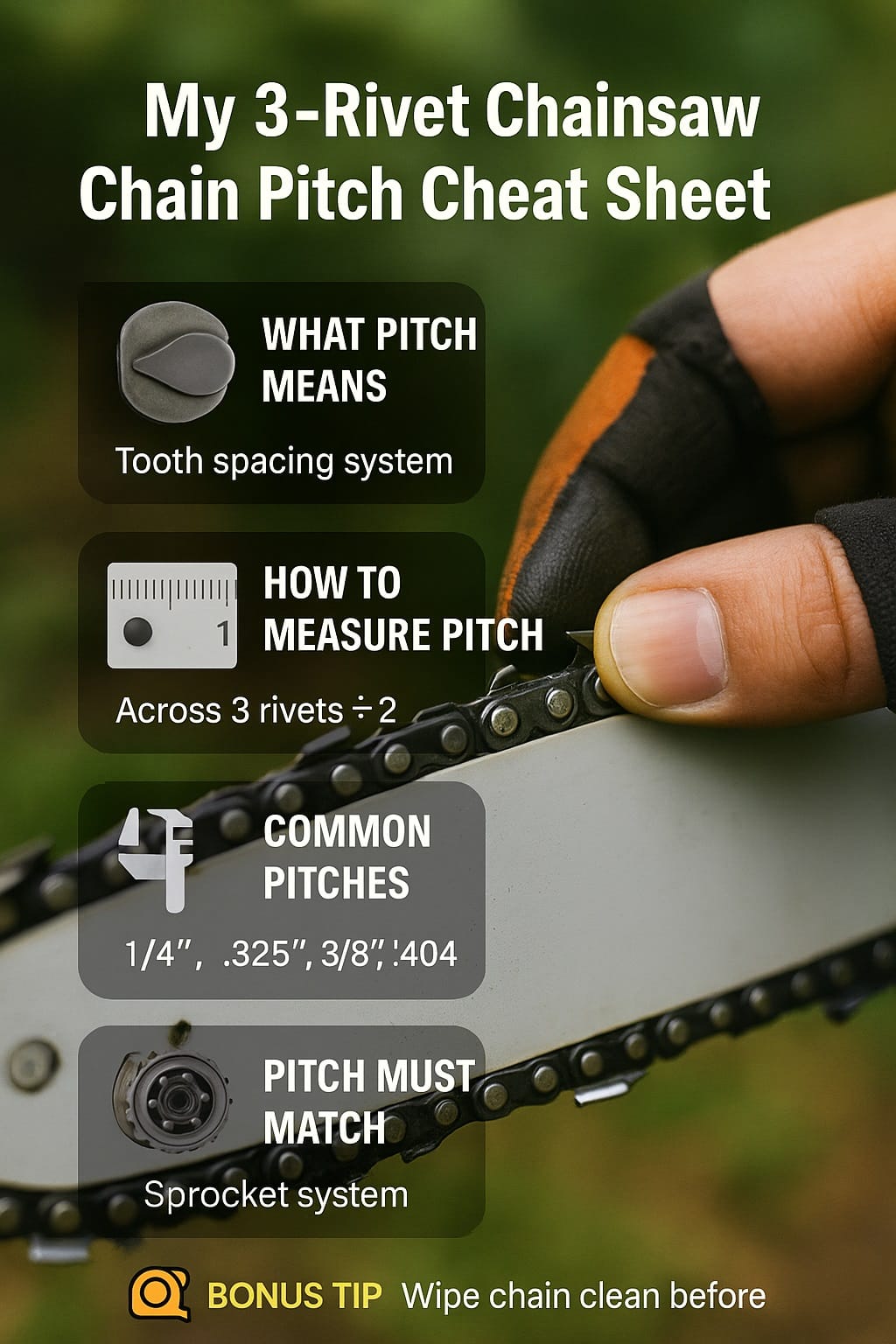
Chainsaw chain pitch is link spacing, found by measuring three rivets center-to-center and dividing by two. Common pitches include 1/4″, .325″, 3/8″, and .404″. Pitch must match the sprocket system, or the chain won’t run smoothly.
My Quick Pitch Facts (Phone-Friendly)
| Pitch fact I check | What it tells me (fast) |
|---|---|
| Pitch meaning | The chain’s tooth spacing system |
| How pitch is measured | 3 rivets (center-to-center) ÷ 2 |
| Common pitch families | 1/4″, .325″, 3/8″, .404″ |
| What must match pitch | Drive sprocket and bar nose sprocket (if fitted) |
| My quick example | 0.75″ across 3 rivets → 0.375″ = 3/8″ |
Source: oregonproducts.com
🧠 My Plain-English Meaning of Chain Pitch
My simple definition (no fluff)
Pitch is the “spacing rule” of a chainsaw chain. It’s not the chain length. It’s not the bar length either. Pitch is basically how far apart the chain’s main links are designed to sit. When I finally understood that, shopping got way easier—and my swear jar got a lot less full.
How I used to mix up pitch, gauge, and drive links
My first mistake was thinking: “If it fits the bar length, it must fit.” Nope. Bar length is just the bar length. Pitch is the spacing system. Gauge is thickness of the drive link that rides in the bar groove. Drive links are the count that makes the loop the right size. Different jobs, different numbers.
Why pitch matters more than people think
Pitch is a “team sport” part. The chain pitch needs to match the sprocket pitch. If they don’t match, it’s like trying to run a bicycle chain on the wrong gear teeth. It might kind of sit there, but it won’t run nicely, and it’ll wear things fast.
_Mina Kaur, Mechanical Engineer (CEng), would argue the opposite of “close enough”: in machines, tiny mismatches create big wear because load always finds the weakest contact point.*_
📏 My 2-Minute Way I Measure Pitch (The 3-Rivet Trick)
My fastest check before measuring
Before I pull out a ruler, I look for stamped info on the bar or packaging. When it’s readable, it’s the easiest win. When it’s not readable—sun-faded, scratched, or covered in old oil—then I measure. I learned not to trust my eyes after I misread a tiny stamp in bad light.
My “3 rivets ÷ 2” method I actually use
I pick three rivets in a row and measure from the center of rivet 1 to the center of rivet 3. Then I divide that number by two. That answer is the pitch. It feels weird at first, but it’s simple once you do it a couple times. My hands stopped shaking after the first “aha” moment.
My little measuring habits that save me pain
I wipe the chain clean first. I measure on a straight section, not around the nose. I use a basic ruler or calipers if I’m feeling fancy. And I measure twice—because “almost 3/8” is how I ended up owning a chain I couldn’t use.
_Tom Reyes, Licensed Aviation Maintenance Technician (LAMT), would say my casual measuring is still too relaxed: aviation teaches you to verify with two independent checks before you trust a number.*_
⚙️ My Cheat Sheet for Common Chain Pitches (And What I See in Real Life)
My quick pitch list I keep in my head
Most of what I bump into falls into four families: 1/4″, .325″, 3/8″, and .404″. Homeowner saws often live around smaller pitches. Bigger, tougher setups often go larger. I don’t treat pitch like a “power ranking,” though. I treat it like a compatibility setting.
How I think about 3/8″ vs 3/8 low-profile
This one got me early. “3/8” and “3/8 low-profile” are not the same thing in day-to-day buying. If I assume they’re identical and I’m wrong, I lose time. I now read the full spec, not just the “3/8” part, because the system needs to match.
Why I don’t guess pitch from bar length anymore
I used to see a 16″ bar and think “That must be X pitch.” That habit cost me money. Bar length doesn’t guarantee pitch. Two chains can look similar on the floor and still be totally different pitch systems. Now I only trust: the stamp, the manual, or the measurement.
_Sofia Bennett, Certified Industrial Electrician (Registered), would contrast my “chain focus” and say: the real failures often start with small system mismatches—like the wrong fuse rating—before you ever notice the visible problem.*_
🔁 My Rule: Pitch Must Match My Sprocket and My Bar Nose
Why pitch matching is non-negotiable for me
If pitch doesn’t match the drive sprocket, the chain can’t sit cleanly on the sprocket teeth. That’s when things feel rough, noisy, or “grabby.” The saw may still run, but it’s running badly. I learned this when a chain kept walking loose no matter how carefully I tensioned it.
My simple mental model: “the teeth must speak the same language”
The sprocket teeth are shaped for a specific pitch spacing. The chain is built for a specific pitch spacing. If those spacings don’t match, the contact points are wrong. That means heat, wear, and stress. I like my saws. I don’t like burning money through avoidable wear.
When the bar nose sprocket also matters
Some bars have a sprocket at the nose. If that nose sprocket is part of the system, it also needs to match the chain pitch. I used to only think about the powerhead sprocket, then wondered why the chain felt smooth at the back and weird at the front. Lesson learned.
_Graham Liu, Registered Plumber (PGDB), would disagree with my “it feels rough” approach: plumbers learn to diagnose from flow and pressure numbers, not feel—because feel can lie when conditions change.*_
🧾 My Buying Checklist So I Don’t Waste Money (Pitch + Gauge + Drive Links)
My 10-second checklist before I pay
I now buy chains using three numbers, in this order: pitch, gauge, and drive link count. Pitch makes it compatible with the sprocket system. Gauge makes it fit the bar groove. Drive links make the loop the correct length. If I have only two of the three, I’m gambling.
My quick gauge reminder (because I’ve messed this up too)
Gauge is the thickness of the drive link that rides in the groove. If gauge is wrong, the chain won’t sit right in the bar. Too thick and it won’t fit. Too thin and it can feel sloppy. I used to ignore gauge because it sounded boring. It turns out boring specs save exciting amounts of money.
My habit: I treat the bar stamp like a shopping label
If the bar stamp is clear, it’s gold. I take a photo of it with my phone. If I’m standing in a store, I zoom in like a detective. If the stamp is unreadable, I use my old chain as a reference and still measure pitch. I don’t rely on “looks right” anymore.
_Hana Singh, Chartered Accountant (CA), would push back on my “buy once” mindset: sometimes it’s cheaper long-term to standardize your fleet on one pitch system to reduce spare-part variety and mistakes.*_
🧩 My Troubleshooting When the Chain “Feels Wrong”
My first question: “Did I actually match the pitch?”
When a chain feels off, I don’t blame the saw immediately. I check my three numbers again. Most of my headaches came from me rushing. If the chain doesn’t seat nicely on the sprocket, or tensioning feels extreme, I stop and re-check pitch. Forcing it is how parts get chewed.
My quick symptom list I look for
Here’s what makes me suspicious fast:
-
Chain won’t sit neatly on the sprocket teeth
-
Tensioner runs to the end of its travel too quickly
-
Chain seems to “climb” or ride high at the sprocket
-
Weird noise that wasn’t there before
If I see these, I go back to pitch and gauge first.
My “don’t be a hero” rule
If something doesn’t fit smoothly, I shut the saw off and investigate. I used to push through because I wanted to finish the job. That’s how I turned a simple cut into a lesson in regret. Now I treat smooth fit as a safety check, not just a convenience.
_Dr. Will Harris, Physiotherapist (MCSP), would contrast my “push through” old habit: in rehab, pain is often a signal to change technique, not to apply more effort—same idea with machines.*_
🪛 My Maintenance Tie-In: How Pitch Connects to Sharpening Tools
Why pitch changes my sharpening setup
Pitch doesn’t just change fit. It often changes the sharpening tool sizes and what feels “normal” when I file. Early on, I bought the wrong file because I assumed “a chain is a chain.” The result was a weird edge that didn’t bite cleanly. My cuts felt slow, and I blamed the saw.
My simple sharpening reality check
If my chain is dull, I sharpen it. But I also check whether my file size and angles make sense for that chain type. I keep my chain packaging when I can, because it usually tells me exactly what file size to use. When I don’t have the packaging, I look up my chain model later—after the job.
What I do when I inherit a random chain
Sometimes a customer hands me a saw with a chain of unknown history. In that case, I don’t pretend I know everything instantly. I check pitch, gauge, and drive links first. Then I confirm what sharpening tools match the chain type. That little pause saves me from making a bad chain even worse.
_Nora Diaz, Librarian (MLIS), would argue the opposite of my “figure it out later” habit: good cataloging upfront—labels, photos, and notes—beats detective work every time.*_
🦺 My Safety Note: Pitch, Kickback, and My Expectations
My honest view: pitch isn’t the whole safety story
People sometimes ask me, “Does pitch change kickback?” My answer is: not by itself, not in a simple way. Chain design, depth gauges, sharpness, bar length, cutting technique, and saw power all matter. Pitch is mostly a compatibility and “system size” setting. I focus on safe chain choices and safe habits.
My safety routine before I touch anything sharp
When I’m checking pitch or swapping chains, I shut the saw off, let it cool, and wear gloves. I treat a chain like a moving blade even when it’s “just sitting there.” I also keep the chain brake and tension correct. My scars are great teachers, but I’d rather not earn new ones.
My “smooth running” safety rule
A chain that doesn’t run smoothly is a chain I don’t trust. Smooth seating and proper tension reduce surprises. Surprises are where accidents live. If I hear strange noise, feel chatter, or see odd wear, I stop. I’d rather lose five minutes than risk one bad second.
_Eli Jacobs, Safety Officer (NEBOSH certified), would challenge my casual tone: he’d say every chainsaw check should be treated like a formal pre-flight inspection, because “routine” is when complacency sneaks in.*_
📌 My Mini Case Study With a Customer (The “Wrong Chain” Purchase)
How the problem showed up
A customer came to me annoyed because their replacement chain “wouldn’t tension right” and felt rough. They were convinced the saw was broken. I’ve heard that before. Usually it’s not broken—usually it’s mismatched. I asked what they bought, and the answer was: “Whatever the shop gave me.”
What I checked, in my exact order
I started with the bar info, then the old chain, then the sprocket system. The new chain looked close, but close isn’t correct. Once I measured pitch using the three-rivet trick, the mismatch jumped out. The chain was a different pitch family, so it couldn’t seat properly on the sprocket teeth.
What we changed and what happened after
We swapped to the correct pitch, matched the gauge to the bar groove, and confirmed drive link count. The chain seated cleanly. Tensioning became normal. The saw sounded calmer instantly. The customer’s face changed from “I hate this thing” to “Oh… that makes sense.” I love that moment.
| What I checked (my notes) | What we found (simple) |
|---|---|
| My bar spec check | Pitch + gauge info confirmed |
| My old chain check | Old chain pitch didn’t match the new one |
| My symptom | Tension felt extreme and chain ran rough |
| My fix | Correct pitch chain + correct gauge + correct DL count |
| My outcome | Smooth seating, normal tension, calmer running |
_Jared King, Licensed Automotive Technician (ASE), would offer a contrasting view: he’d say most “mystery problems” are actually parts compatibility errors—so your best tool is a checklist, not a wrench.*_
❓ My FAQs (The Stuff People Ask Me All the Time)
My FAQ: How do I measure pitch if the bar stamp is unreadable?
I use the three-rivet method. I clean the chain, pick a straight section, measure center-to-center across three rivets, then divide by two. If my measurement lands between two common sizes, I measure again with better lighting or calipers. If I’m still unsure, I compare to the old chain’s known spec.
My FAQ: Can I run a .325 chain on a 3/8 sprocket?
I don’t. It’s not a “maybe.” The chain and sprocket are built to match spacing. Mixing them is asking for rough running and fast wear. If someone wants to change pitch systems, I treat it like a system change: chain plus the correct sprocket setup, and sometimes the bar nose sprocket too.
My FAQ: Is 3/8 low-profile the same as 3/8?
I don’t assume. I check the full label and the bar/sprocket info. The “3/8” wording can trick people. I’ve been tricked. Now I confirm exactly what pitch system the saw is designed for. If the chain code or packaging says low-profile, I match it exactly.
My FAQ: Does pitch affect how fast I cut?
Pitch choice can be part of a “setup,” but it’s not a magic speed button. Sharp chain, correct depth gauges, correct technique, and the right chain type for the wood matter more. I’ve seen a “bigger” setup cut worse because it was dull or filed wrong. Clean and sharp beats “bigger” every day.
My FAQ: If I change pitch, what parts change too?
In my world, pitch changes aren’t casual. I treat them like a matched kit: chain pitch must match the drive sprocket pitch, and it should match the bar nose sprocket pitch if your bar has one. I also re-check gauge and drive links because a pitch change often goes with other spec changes.
My FAQ: What’s the easiest way to avoid buying the wrong chain?
I take a photo of the bar stamp, and I write down pitch, gauge, and drive links in my notes app. If the stamp is missing, I measure pitch and count drive links once, then save it. My future self thanks me. My wallet also thanks me. Loudly.
_Maya Chen, Product Manager (PMP), would disagree with my “remember it” approach: she’d insist on a simple one-page standard process so you never rely on memory when tired or rushed.*_
✅ My Takeaways (So I Stop Repeating My Old Mistakes)
Pitch is the chain’s spacing system, and it must match the sprocket system. My simplest method is measuring three rivets and dividing by two. When I buy a chain, I confirm pitch first, then gauge, then drive link count. If the chain doesn’t seat smoothly or tension normally, I stop and re-check specs instead of forcing it.
_Leo Martin, Licensed Music Teacher (LRSM), would contrast my “numbers-first” mindset: he’d say feel matters too—but only after the fundamentals are correct, because rhythm can’t fix a wrong instrument.*_