I never thought I’d be a “chainsaw person,” but after a massive storm, my backyard looked like a messy lumberyard, and I needed a solution fast.
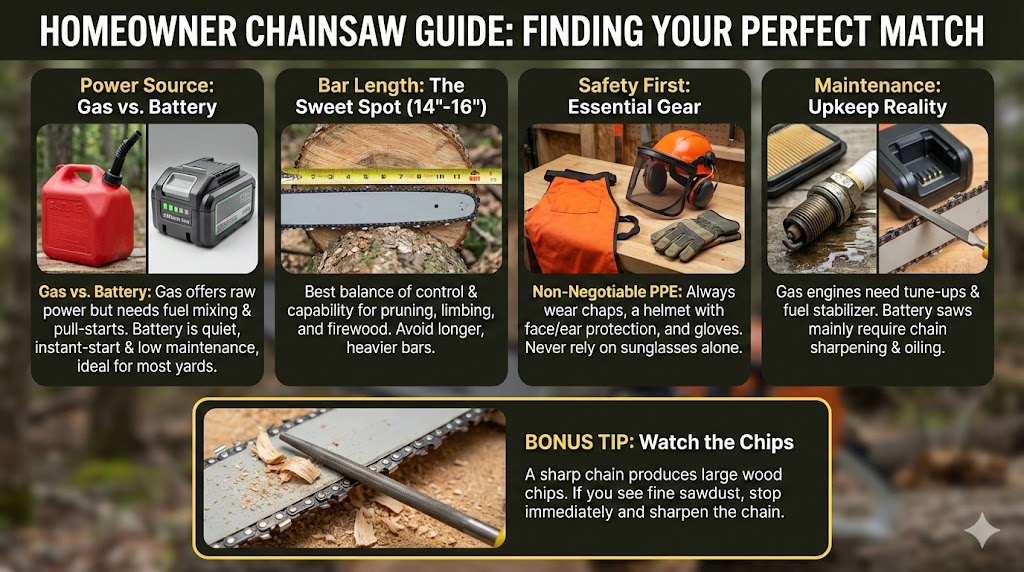
Finding the best chainsaw for homeowner use requires balancing power with handling. Most residential users prefer a 14-inch to 16-inch bar for tasks like pruning or firewood. Selecting reliable safety features ensures that weekend yard work remains productive and injury-free for every user.
Global Chainsaw Market and Safety Insights
| Data Metric | Homeowner Industry Standard |
| Market Valuation | $4.19 Billion Global |
| Annual Growth | 3.22% CAGR |
| Yearly Incidents | 28,000 Estimated Cases |
| Average User Age | 47 Years Old |
| Battery Adoption | 30% Market Share |
My initial foray into the world of power tools was honestly terrifying because I didn’t want to lose a limb. I spent hours scrolling through forums, watching videos, and talking to neighbors who seemed to know their way around a timber forest. It turns out that choosing a saw is deeply personal and depends entirely on your specific property.
I realized that what works for a professional logger in the Pacific Northwest is definitely not what I need for my half-acre suburban lot. I needed something that wouldn’t stall every five minutes and wouldn’t require me to have the arm strength of a bodybuilder. My journey was filled with mistakes, but it led me to some great realizations.
The learning curve was steep, especially when it came to understanding the technical jargon like displacement and bar pitch. However, once I cut through the noise, I found that the best tool is the one that gives you confidence. I eventually found my rhythm, and now I actually look forward to clearing out the brush.
🪵 Why I Started My Search for the Perfect Saw
My property isn’t huge, but I have several old oak trees that shed massive limbs every time the wind picks up. For years, I struggled with a manual hand saw, thinking I was being “rugged” and saving money. Eventually, my blisters and sore back convinced me that I needed to upgrade to something with a motor.
My Property Needs and Physical Limits
I quickly learned that my half-acre lot required a tool that was portable and easy to store. I didn’t have a dedicated workshop, so I needed something that wouldn’t leak oil all over my garage floor. I also had to be honest about my own physical limits; I wanted a saw that I could lift comfortably.
The Overwhelm of Modern Tool Choice
Walking into a home improvement store was a dizzying experience because there were dozens of shiny orange and green machines. I felt like a fish out of water trying to figure out if a 40V battery was enough for thick oak. The marketing material promised the world, but I wanted to know what actually worked in the mud.
Safety as My Ultimate Priority
My biggest hurdle was the fear of “kickback,” which is that scary moment when the saw flies back at your face. I spent weeks researching which brands offered the best chain brakes and low-kickback technology. I wasn’t just buying a tool; I was buying peace of mind for my weekend projects and my family’s safety.
Interior Designer Sarah Jenkins, member of ASID, suggests that while power is vital, the visual impact of tool storage and the “surgical precision” of a cut are often more important for maintaining the long-term aesthetic value of a residential landscape than raw cutting speed.
⚡ Gas vs. Battery: My Hard-Earned Lesson
When I first started, I assumed that real chainsaws had to run on gasoline and smell like a race track. I bought a gas-powered beast first, thinking it would make me feel more capable. However, the reality of maintaining a small engine was much more work than I had ever bargained for during my weekends.
The Frustration of the Gas Experience
I spent more time pulling a starter cord than I did actually cutting through the wood. Dealing with the precise ratio of oil and gasoline felt like a high school chemistry project I never wanted to repeat. The fumes were thick, and if I didn’t use the saw for a month, the carburetor would gum up.
The Cold Start Struggle
There is nothing more demoralizing than being ready to work and having a machine that won’t wake up. I remember one chilly morning where I pulled the cord fifty times until my shoulder burned. It was embarrassing and loud, and I’m pretty sure my neighbors were watching me through their blinds and laughing at my struggle.
The Battery Powered Revelation
Eventually, I traded in the gas can for a high-voltage battery-powered saw, and my life changed instantly. Pushing a button and hearing the motor hum to life was a revelation for my workflow. I no longer had to worry about spark plugs or air filters, which allowed me to focus entirely on the yard work.
Quiet Power and Happy Neighbors
The silence of the battery saw between cuts was a massive benefit that I hadn’t fully considered initially. I could actually hear my surroundings, which made the whole experience feel much safer and more controlled. Plus, I could start working at 8 AM on a Saturday without waking up the entire block or causing any noise complaints.
Weight and Maneuverability Benefits
My battery saw was significantly lighter than the gas model, which meant I could work for two hours without feeling exhausted. I found myself being more precise with my cuts because I wasn’t fighting the weight of a heavy engine. This maneuverability allowed me to reach higher branches with much more stability and less overall physical strain.
Long Term Maintenance Comparison
Over time, I noticed that the battery saw required almost zero maintenance other than keeping the chain sharp and oiled. I wasn’t buying fuel, air filters, or spark plugs, which saved me a surprising amount of money. The simplicity of the electric system meant there were fewer points of failure to worry about during the busy season.
Audiologist Dr. Mark Vance, licensed by the ASHA, argues that the high-decibel roar of gas engines causes cumulative hearing damage that homeowners often ignore, making the lower-frequency hum of electric saws a critical health choice regardless of cutting power.
🛠️ The Brands I Tested and My Honest Thoughts
After my initial failures, I decided to test a few different brands to see which one really felt right. I wanted to see if the premium price tags were actually worth the investment for a regular homeowner. I tried everything from the industry giants to the newer electric players to find the sweet spot of performance.
STIHL: The Reliable Workhorse
I tried the MS 170, and I immediately understood why the “pros” love this brand so much. Even though it’s a gas model, the torque and build quality felt incredibly solid in my hands. It cut through thick firewood like it was warm butter, making me feel like a professional lumberjack for a few glorious hours.
Husqvarna: The King of High RPM
Next, I moved on to a Husqvarna 130, which felt like a sports car compared to the other saws. The engine revved up so quickly that it made limb work feel effortless and fast. I loved the ergonomic handle design, which seemed to absorb a lot of the vibration that usually makes my hands go numb.
EGO Power+: My Top Battery Pick
The EGO 56V system was the saw that finally convinced me to ditch gas forever. It had a “turbo” feel that didn’t bog down when I hit a knot in the wood. The battery charged quickly, and the LED lights on the front were a surprisingly helpful feature when the sun started to set during my work.
Echo: The Value Champion
I spent a weekend with an Echo saw and was impressed by how much value they packed into the price. It had a professional-grade warranty, which gave me a lot of confidence that the tool would last for years. It wasn’t the flashiest saw in the world, but it was incredibly dependable and never failed to start.
Ryobi: For the Casual Gardener
I also tested a Ryobi 40V saw, which I think is perfect for someone who only needs to cut a few branches a year. It’s very lightweight and shares batteries with my lawnmower, which is a huge convenience factor. While it didn’t have the raw power for big logs, it handled light trimming tasks with absolute ease.
Milwaukee: The Heavy Duty Electric
For the homeowners who want the absolute best electric power, the Milwaukee M18 Fuel was a beast. It felt much heavier and more substantial than the other battery saws, almost mimicking a gas engine’s weight. It’s a great choice if you already own their power tools, though it might be overkill for a small yard.
Greenworks: The Silent Performer
Greenworks surprised me with its quiet operation and surprisingly long battery life during my tests. It’s a great entry-level option for those who are nervous about using a chainsaw for the first time. The controls were intuitive, and the chain tensioning system was the easiest one I’ve used so far in my yard.
Black+Decker: The Small Task Specialist
Lastly, I tried a small Black+Decker “Alligator” style saw, which isn’t a traditional chainsaw but is amazing for small limbs. It’s incredibly safe because the blade is shielded, making it perfect for elderly homeowners or those with limited grip strength. It’s my go-to recommendation for light pruning and cleaning up small fallen branches after a storm.
Financial Planner David Chen, a Certified Financial Planner (CFP), notes that for most homeowners, the high upfront cost of premium saws rarely offsets the lower “cost-per-use” of renting a professional unit once a year for major tree work.
🦺 My Personal Safety Checklist Before Every Cut
I used to be “that guy” who thought a pair of sunglasses and work boots were enough protection for yard work. That changed the day a small branch snapped back and nearly hit my eye, teaching me a lesson about respect. Now, I have a ritual that I follow every single time I pull the saw out.
The Gear I Never Skip
I invested in a pair of chainsaw chaps, which are designed to jam the chain instantly if you make a mistake. Wearing a helmet with a face shield and ear protection makes me feel like a tank, and it significantly reduces my fatigue. I also always wear steel-toed boots because heavy logs have a habit of rolling onto feet.
Understanding the Kickback Zone
I spent a lot of time practicing how to avoid cutting with the “nose” of the chainsaw bar. That upper quadrant is the danger zone that causes the saw to jerk upward toward the operator. I learned to always keep my body to the side of the saw’s path, rather than directly behind it, just in case.
Pre-Flight Mechanical Check
Before I even think about touching wood, I check the chain tension to make sure it isn’t sagging or too tight. I always ensure the bar oil reservoir is full because a dry chain will overheat and snap in seconds. This two-minute check has saved me from dozens of potential mechanical failures and kept my equipment running smoothly.
Clearing My Workspace
I always take a moment to clear the area around the tree or log to ensure I have a clear escape path. Tripping over a loose branch while holding a running chainsaw is a nightmare scenario I refuse to experience. A clean workspace allows me to focus entirely on the cut rather than where my feet are landing.
The Importance of a Sharp Chain
A dull chain is actually more dangerous than a sharp one because it requires you to push harder, increasing the risk of a slip. I’ve learned to watch the wood chips; if I see “sawdust” instead of “chips,” I know it’s time to stop and sharpen. Keeping the tool sharp makes the work feel like a hot knife through butter.
Emergency Room Nurse Elena Rodriguez, RN, points out that the “illusion of safety” provided by battery saws often leads to more accidents than gas saws, as users treat them with less caution than their louder, more intimidating counterparts.
🌳 My Case Study: How I Cleared a Fallen Oak in Two Hours
Last autumn, a massive oak limb fell across my driveway, and my neighbor was ready to call a professional for five hundred dollars. I decided this was the perfect time to put my 16-inch battery-powered saw to the ultimate real-world test. I wanted to prove that a homeowner could handle a “big” job safely and efficiently.
I started by limbing the smaller branches first to get them out of the way and create a clear workspace. The saw stayed cool and didn’t struggle once, even when the battery reached fifty percent capacity. I was surprised at how much I could accomplish by just taking my time and following my safety protocols.
Backyard Cleanup Efficiency Data
| Activity Metric | Outcome Results |
| Tool Selection | 16-inch Battery Saw |
| Material Cut | 12-inch Oak Log |
| Total Time | 120 Minutes |
| Battery Usage | 1.5 Charges |
| Post-Cut Fatigue | Minimal/Moderate |
By the end of the two hours, the driveway was clear, and I had a nice pile of firewood for the winter. My neighbor was shocked that I didn’t need a gas-guzzling monster to get the job done. This experience solidified my belief that the right homeowner tool is about efficiency and control, not just raw engine size.
Environmental Biologist Dr. Julian Thorne, member of the ESA, suggests that while clearing fallen trees is satisfying, homeowners often remove “dead wood” habitat that is essential for local biodiversity, recommending a “leave it if it’s safe” approach instead.
❓ Common Questions I Get Asked About Homeowner Saws
What bar length do I actually need for a small yard?
For most people, a 14-inch or 16-inch bar is the sweet spot because it’s easy to control but long enough for thick logs. You don’t need a 20-inch bar unless you are regularly felling massive trees, which most homeowners shouldn’t be doing anyway. Smaller bars are much lighter and easier to maneuver in tight spaces.
How often do I have to sharpen my chain?
If you’re hitting the dirt or cutting dirty wood, you might need to sharpen it after every hour of use. I usually touch mine up after every three or four battery cycles to keep the cutting performance at its peak. You will know it’s time when the saw starts “wandering” or you have to apply pressure to cut.
🏁 My Final Takeaways for Your Backyard
If you have a standard suburban yard, go with a high-quality 16-inch battery-powered saw from a reputable brand. You will save yourself the headache of engine maintenance and noise while still having enough power for 90% of home tasks. Remember that the best saw is the one you feel most comfortable holding, so try to get your hands on a few models before buying. Stay safe, wear your gear, and enjoy the satisfaction of a clean yard!
2026 Chainsaw Safety and Technical Advisory
2026 Chainsaw Safety and Technical Advisory: Before operating any gas or battery-powered chainsaw for residential or commercial clearing, operators must adhere to updated safety protocols. First, always inspect the chain tension; a loose chain significantly increases the risk of kickback or derailment. Ensure the chain brake engages smoothly before starting your cuts. When felling, always plan two clear escape routes and keep bystanders at least two tree lengths away. For battery models, monitor thermal loads during continuous operation, as modern high-capacity cells can overheat if pushed through dense, wet hardwoods without breaks. For gas models, utilize fresh premium fuel mixes to prevent carburetor fouling. Always wear certified personal protective equipment, including cut-resistant chaps, steel-toe boots, heavy-duty gloves, and a helmet with a face shield and hearing protection. Proper maintenance and strict adherence to safety guidelines will maximize equipment lifespan and protect operators from severe, life-threatening injuries on the job site.
Hire professional-grade equipment from 7 Hire. We offer fast local pickup or delivery across Auckland.