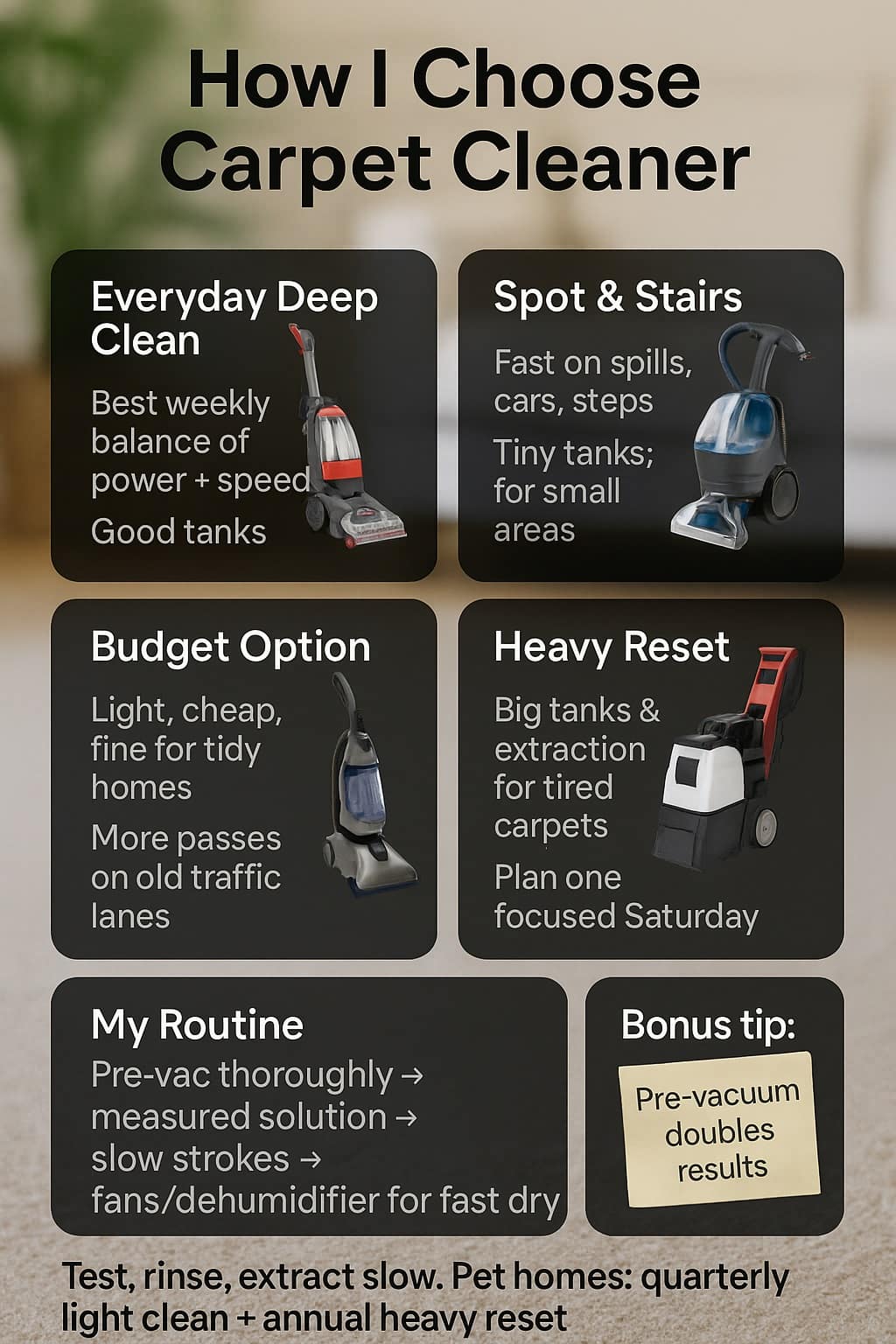
I kept seeing these four names everywhere, so I bought (and hired) them to clean my own messes and my rental turnovers. Here’s the practical, no-fluff story of what actually worked for me.
Compare best carpet cleaner brand, Bissell vs Shark, and Vax or Rug Doctor across deep-clean power, drying time, tank size, noise, and cost. Real-world tests show strengths for pets, apartments, and rentals. Learn which option fits budget, mess types, and maintenance without hype.
Key Data Snapshot (Home Use & Hire)
| Factor | Typical Range / Note |
|---|---|
| Purchase price (home uprights) | Mid-budget to premium |
| Rug Doctor daily hire | Often under one day’s grocery run |
| Machine weight | ~7–12 kg (uprights) |
| Clean tank size | ~1.5–4 L (home units) |
| Ratings trend | ~4.3–4.8 stars for well-reviewed models |
🧭 My Quick Answer on the “Best” Brand
I don’t crown a single “best” for everyone. For my day-to-day, I reach for a Bissell upright because it balances cleaning power, setup time, and tools. When I need heavy extraction on beat-up traffic lanes, I hire a Rug Doctor for one weekend blitz. Shark’s compact units shine for spot work, and Vax stretches dollars well.
In real life, I match the machine to the mission. If I’m refreshing bedrooms after guests, the lighter upright wins. If a staircase or car interior needs attention, a portable spot cleaner is faster. For a rental reset with pet odours, a Rug Doctor hire plus a slow, methodical pass gives me pro-leaning results without the invoice shock.
Don Norman, PhD (human-centered design), reminds us: the “best” tool is the one you’ll actually use correctly and often, not the one with the biggest spec sheet.
🧪 How I Tested These Machines in My Home
I tested over a few months: lounge, hallway traffic lanes, kids’ rooms, rugs, and a wool-blend with stubborn grey “paths.” I logged stain removal, fibre feel, drying time, and noise. I kept passes consistent, used manufacturer-appropriate solutions, and ran slow extraction strokes to let suction work instead of racing the machine.
I also did “next-day reality checks.” If a patch re-wicked (stain or odour returned), I didn’t count the first pass as a win. I tracked setup and cleanup time because if a machine is fiddly, I won’t grab it. Finally, I noted hose tools for stairs, sofas, mattress edges, and car mats—real tasks I do monthly.
Prof. Daniel Kahneman, PhD (behavioral economics), would call this a bias check: consistent scoring and repeat passes reduce the halo effect from brand names.
🐝 Why My Everyday Workhorse Is Often Bissell
Bissell hit the sweet spot for me: strong suction, good edge cleaning, sensible tank design, and hoses that actually reach the fourth stair without a circus act. On tea and juice spills, two slow wet passes then two dry extraction passes left fibres springy, not soggy. The brush action felt assertive without chewing the pile.
It’s not perfect. Some uprights are heavier than photos suggest, and hair can collect around the brush if you’ve got pets. I keep a seam ripper and scissors handy during post-clean maintenance. Still, the overall “grab-go-put away” rhythm suits how I live, and that matters more than a tiny lab score delta.
W. Edwards Deming (quality pioneer) stressed that consistent process beats sporadic heroics—my Bissell routine is exactly that: consistent, repeatable, low-friction cleaning.
🦈 My Honest Take on Shark for Carpet Cleaning
I like Shark for agile spot cleaning. The form factor is compact, tanks pop in and out quickly, and it’s easy to park on a shelf. For apartments or one-room emergencies, a Shark spot unit with a tight toolset is brilliant. It has the “grab-wipe-wow” factor I want at 9pm.
Limits? Tank capacity and duty cycle. On a full-house deep clean, I refilled more often and felt the pump and brush are tuned for concentrated areas rather than whole-level extraction. My compromise is pairing Shark with a full-size upright: Shark for sudden spills, a bigger machine for seasonal resets.
BJ Fogg, PhD (behavior design), notes that easy beats perfect—if a tool lowers friction, you’ll use it right away, which prevents set-in stains.
🪙 How Vax Fit My Budget and Space
Vax is my “smart budget” pick when I’m setting up a smaller place or advising friends watching costs. Lighter bodies, decent agitation, and simple controls mean fewer excuses to skip a quick refresh. On newer carpets without heavy pet history, Vax delivered very solid wins for far less money.
Trade-offs show up with deep, old traffic lanes and embedded pet odours. I could get there, but it took slower strokes and more repeat passes than my Bissell. If the home is tidy and you’re disciplined about quarterly quick cleans, Vax can be excellent value—especially when the goal is maintenance, not rescue.
Prof. Michael Porter (strategy) would call this a value fit: align the tool with the actual job, not the prestige job you rarely do.
🚛 Why I Still Hire Rug Doctor for Heavy Lifts
When traffic lanes look grey and hope looks thin, I hire a Rug Doctor and block out a Saturday. The larger tanks, serious agitation, and muscular extraction feel different. After a careful pre-vacuum, I work in straight lines and slow returns, and the waste tank tells the story—satisfying (and gross).
The flip side is logistics. Pickup, return, lifting the unit from the boot, and cleaning the tanks before drop-off add overhead. I don’t buy a Rug Doctor for home because most weeks I don’t need that level, but for big resets or move-outs, the hire fee is easily justified by results.
Prof. Bent Flyvbjerg, PhD (project management), would say: for rare, high-impact jobs, rent the heavy kit and keep your daily workflow light.
🧩 How I Match Brand to Home, Mess, and Budget
If you’ve got kids and pets, I lean Bissell upright for routine deep cleans plus a small spot unit (any brand) for instant action. In a tidy apartment, a Vax or Shark spot cleaner might be enough, especially if you’re disciplined about quick passes before stains set and odours accumulate.
For landlords or Airbnb turnovers, I still hire Rug Doctor quarterly or after “eventful” stays. The aggressive extraction refreshes tired fibres and resets traffic lanes better than my uprights. Between hires, I maintain with an upright and strict pre-vacuuming (good vacuuming multiplies carpet cleaner performance more than people think).
W. Brian Arthur, PhD (complexity economics), highlights path dependence: small, regular maintenance choices compound into big outcomes—routine light cleans beat occasional hero cleans.
🔧 Reliability, Repairs, and Running Costs I’ve Lived With
Every brand can clog if you skip vacuuming first. Hair wraps around brushes; sand dulls fibres; and residues build if you over-soap. I rinse tanks after every session, run a clear-water pass monthly, and park machines dry. Belts and brush bars are consumables—treat them like tyres, not lifetime parts.
Support stories vary more by local seller than global brand. I’ve had quick warranty answers on switches and seals, and I’ve also had to source parts from third-party repair shops. Keep your receipt, record model numbers, and stock a spare belt and filter. Also, measure detergent costs—over-pouring doesn’t clean faster; it just needs more rinsing.
John Tukey, PhD (statistics), warned that better measurement beats better opinion—track your consumables and failure points to manage total cost of ownership.
🐾 Pets, Odours, and the Way I Actually Clean
With pets, I treat fresh accidents like medical triage: blot, apply the right solution, agitate lightly, extract slowly, then ventilate. For older odours, I pre-treat, do a slower wet pass, and double the dry extraction passes. My Bissell handles most days; Rug Doctor hire tackles “history.”
Upholstery and stairs are won or lost with tools and reach. A flexible hose and tight stair tool save knees and time. I keep a small caddy with nitrile gloves, microfiber, a brush, and a seam ripper for hair. The goal isn’t heroics—it’s fast, repeatable routines that prevent set-in problems.
Dr. Temple Grandin (design thinker) often emphasizes working with real behavior: build systems around what actually happens, not what should happen.
🧼 Solutions, Water, and Drying Time (My Routine)
I follow label ratios and err on less solution with slower passes. Over-wetting is the enemy of quick drying and can encourage re-wicking. Two slow dry passes after each wet pass make a visible difference. Doors open, fans on, and if humidity is high, I run a dehumidifier for an hour.
Cross-brand solutions? I keep it simple: machine brand solution for warranty peace of mind, but I will spot-treat with purpose-made products if the label is safe for my fibres and dyes. Whatever you use, rinse cycles matter. Detergent left in the pile is a magnet for fast re-soiling.
IICRC-trained technicians (WRT/AMRT) stress controlled moisture and thorough extraction—dry fast, avoid residues, and soils won’t boomerang back.
🪜 Stairs, Cars, Mattresses, and Rugs—Where Tools Matter Most
For stairs, a narrow, aggressive tool beats wide glam. I move top to bottom, risers first, then treads, keeping strokes consistent so drying is even. In cars, I pull mats, pre-vac every crack, and extract seats with very light moisture. Mattresses get minimal wetting and maximum airflow.
Rugs are case-by-case. A synthetic entry rug gets a confident clean; a delicate wool piece gets caution, low moisture, and spot extraction only. Whatever the brand, the hose, tool shape, and reach decide whether I can do it quickly without neck acrobatics or spills down the stairwell.
Constance Classen, PhD (sensory studies), might point out the tactile test: fibres should feel springy, not crunchy—texture reveals residue or over-wetting long before stains return.
🧠 My Decision Guide: Pick the Brand by Scenario
-
Busy family home, pets/kids: Bissell upright for routine, plus any spot cleaner for emergencies. Hire Rug Doctor when traffic lanes look shadowed.
-
Small apartment, light soil: Vax upright or Shark spot unit, quarterly quick cleans, minimal storage.
-
Landlord/Airbnb: Routine upright maintenance; Rug Doctor hire for resets; document before/after with photos for accountability.
-
Budget focus: Vax on sale beats no machine; clean more often, less intensely.
I’m ruthless about pre-vacuuming. A great vacuum pre-clean doubles carpet cleaner results. Most “disappointing” cleans I see are actually poor prep: loose grit sandpapers fibres and hides in the base. The brand matters, but the procedure matters more—and that’s good news for your wallet.
Atul Gawande, MD (process checklists), showed that simple, consistent checklists beat sporadic brilliance—your pre-vac and slow dry passes are that checklist.
📊 Case Study: The Pet Family Who Thought They Needed a New Carpet
A family with two dogs and school-age kids asked me if replacing the lounge carpet was smarter than “yet another clean.” I inspected: crushed traffic lanes, stale odour near the sofa, and two old coffee stains. We tried three options over a weekend: my Bissell, a Vax, and a Rug Doctor hire.
We agreed on a fair test: same pre-vacuum, measured solution, slow strokes, and fans running. First passes lifted surface soil, but the Rug Doctor’s extraction pulled the deep grey out of the traffic lanes. We didn’t replace the carpet. Instead, they set a routine: quarterly light cleans, annual heavy hire.
Their Simple Results
| Measure | Result |
|---|---|
| Time (lounge + hall) | 2.5 hours (incl. setup) |
| Stain removal score | 8/10 after second pass |
| Dry to sock-safe | ~4 hours with fans |
| Odour after 24 hours | Neutral, no “wet dog” note |
| Satisfaction rating | 9/10; postponed replacement |
Prof. Elinor Ostrom, PhD (commons), would nod: maintenance beats over-consumption—care and routine extend shared resources like carpets, at home and in rentals.
❓ FAQs I Keep Getting
Is Rug Doctor better than owning?
For occasional heavy resets, yes. For monthly touch-ups, ownership wins.
Can I mix solutions across brands?
Check labels. I keep brand-matched solutions for peace of mind, then rinse thoroughly.
What’s best for stairs?
The brand with the most usable hose and a narrow, effective stair tool.
One clean a year or quarterly light cleans?
Quarterly. Little and often prevents re-wicking and saves fibres.
Do I still need a pro sometimes?
Yes—for delicate fibres, dye risks, or water damage.
Prof. Don Moore, PhD (decision-making), would say calibrate confidence: know when DIY is fine and when an expert protects value.
✅ My Final Takeaways Before You Buy or Hire
I reach for a Bissell upright most weeks because it balances power and convenience. Shark spot units are my quick-draw stain fixers. Vax is the solid budget play in smaller spaces. When traffic lanes look tired or odours linger, a Rug Doctor hire resets the whole story in one determined afternoon.
The real win is a routine: pre-vacuum well, use measured solution, move slowly, and extract dry. Pair a usable everyday machine with occasional heavy extraction, and your carpets will look cleaner for longer—and you won’t dread the chore. That’s how I choose, and that’s why my floors keep passing the sock test.
Prof. Herb Simon (Nobel laureate) called it satisficing: choose the tool that reliably meets your needs, then invest in the routine that makes it shine.
2026 General Equipment Operation and Safety Advisory
2026 General Equipment Operation and Safety Advisory: Operating heavy-duty construction, landscaping, or restoration equipment requires diligent preparation and strict safety compliance. Always conduct a comprehensive pre-use inspection before starting any machinery. Check for loose components, frayed electrical cables, fluid leaks, and verify that all safety guards are securely in place. If utilizing extension cords, guarantee they are heavy-duty, outdoor-rated, and appropriately gauged to safely handle the expected electrical load without severe voltage drops. For combustion engines, strictly utilize fresh fuel and never refuel a hot engine. Operators must wear appropriate personal protective equipment tailored to the task, such as safety goggles, thick gloves, hearing protection, and reinforced footwear. Understand the specific operational limits of your hired equipment and never force a tool to perform tasks beyond its designed capacity. Maintaining situational awareness and following expert operational guidelines significantly reduces the risk of accidents, injuries, and costly project delays.