I used to treat “small trees” like a warm-up—until a heavy, nose-tipping saw bounced on a hidden twig and reminded me that “small” doesn’t mean “safe.” Now I pick small-tree saws for control first, ego last.
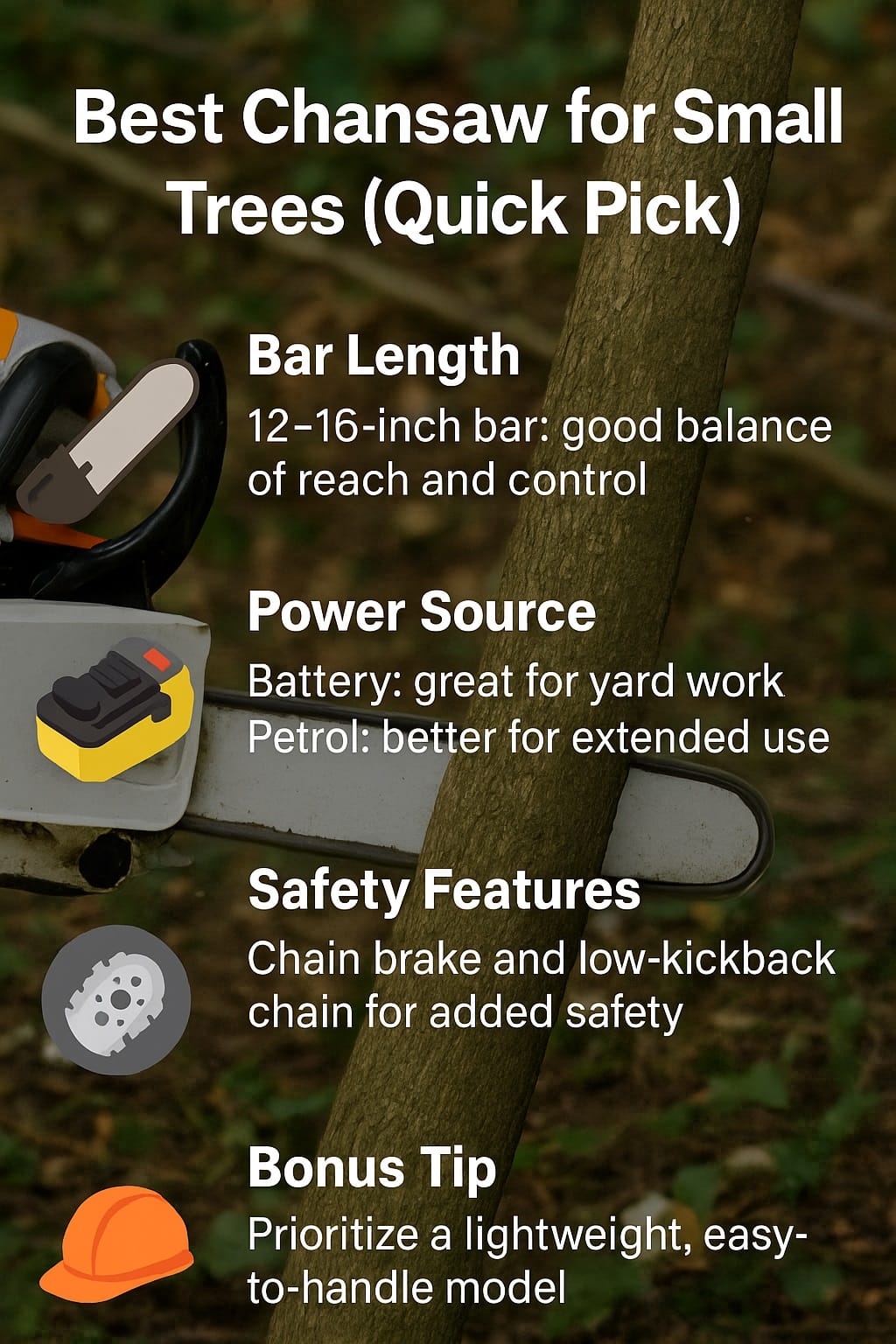
Best chainsaw for small trees: choose a 12–16″ bar, 30–40cc or 40–60V power, and a low-kickback chain. For 2–8″ trunks (5–20 cm), a lighter rear-handle saw tracks straighter, tires you less, and is easier to sharpen. It’s the sweet spot for speed, control, and handling.
Quick specs I use for small-tree chainsaws
| Stat / spec | Practical range for small trees |
|---|---|
| Typical trunk diameter | 2–8 in (5–20 cm) |
| Bar length sweet spot | 12–16 in (30–40 cm) |
| Power target | 30–40cc petrol or 40–60V battery |
| Good “control feel” | balanced, not nose-heavy |
| Safety must-haves | chain brake + low-kickback chain |
Source: stihlusa.com
🧭 My 30-Second Answer (What I’d Buy for Small Trees)
My definition of “small trees”
Small trees, to me, are 2–8 inch trunks plus lots of fiddly branches. That mix creates awkward angles, tight spaces, and constant repositioning. So I rate balance, easy starting, and predictable handling higher than “monster power” claims.
My simplest buying shortcut
For stop-start yard work, I go battery because it’s instant and quiet. For longer sessions or remote work, I go petrol for fast refuel and steady output. Either way, I buy the lightest saw that doesn’t bog when the chain is sharp.
What I refuse to compromise on
I won’t buy a saw without a proper chain brake and a sturdy front hand guard. I also want common chain/bar sizes so parts aren’t a scavenger hunt. If vibration makes my hands buzz, I pass—fatigue is where technique falls apart.
Example viewpoint: “Stability beats peak output” — Ava Chen, PE (example), would prioritise control over horsepower.
📏 My Tree-Size Rule (How I Match Bar Length to Trunk Diameter)
The “long bar = bad aim” lesson I learned
A longer bar sounded smart, but it made me sloppy: the tip wandered, tight spaces got awkward, and I clipped things I didn’t mean to. On small trees, precision matters more than reach because you’re cutting near fences, rocks, and your own legs.
My quick sizing guide
I default to 12–14 inches because it’s nimble and still handles 6–8 inch trunks with good technique. I choose 16 inches only when I truly need reach and have space to move. For pruning, 10–12 inches feels like cheating—in a good way.
What I copy from arborists
Before I cut, I read the wood: where it’ll pinch, where it’ll roll, and where I’ll step back. That one pause saves my chain and my nerves. When I plan my stance first, the cut feels calm, not chaotic.
Example viewpoint: “Read the load before you cut” — Noah Singh, ISA Certified Arborist (example), would say wood behaviour matters more than speed.
🔋 My Pick Between Battery, Petrol, and Corded for Small Trees
Battery saws (why they feel like easy mode)
Battery is brilliant for small trees because it’s all quick cuts and moving around. No pull-start, no fumes, no warm-up. My lesson: battery performance lives and dies by sharpness. A sharp chain makes it fly; a dull chain makes you push and hate life.
Petrol saws (when gas still wins for me)
Petrol wins when I’m cutting longer and don’t want to think about charge timing. A good 30–40cc saw keeps chewing, and refuelling is fast. The downside is maintenance: stale fuel and clogged filters create “won’t-start” days. Petrol rewards care; it punishes neglect.
Why I avoid corded outdoors
Corded saws add one more hazard: a cord that snags, tugs, or ends up underfoot. Outdoors, that’s annoying at best and dangerous at worst. For small trees, battery gives me cord-free convenience; petrol is my backup when runtime matters.
Example viewpoint: “Less clutter, fewer errors” — Mia Roberts, CSP (example), would say simpler setups reduce risky moments.
🛡️ My Safety-First Setup (Kickback, Chain Choice, and PPE That Matters)
Kickback in one plain sentence
Kickback is a sudden jump up and back, usually from tip contact or a snag. The first time I felt it, it was so fast I didn’t have time to “think safe.” That’s why I treat the upper bar tip as a no-touch zone and keep my body out of that line.
My chain choice for small trees
For small trees, I stick with a low-kickback chain. If I want faster cutting, I sharpen more often instead of switching to a more aggressive chain. Dull chains make you push, and pushing is how angles get messy and the bar tip finds trouble.
My 30-second pre-cut checklist
I check tension, oiling, and that the brake snaps on. I clear my footing, choose a landing zone, and pick an exit step. It’s boring—perfect. Boring work is safe work.
My minimum PPE
Eye and hearing protection are always on. I wear grippy gloves and stable boots because slips ruin everything. If I’m doing more than light pruning, I wear chainsaw chaps. PPE doesn’t make you brave; it gives you a margin when the tree surprises you.
Example viewpoint: “Safety is a process, not a mood” — Liam Carter, RN (example), would remind me prevention beats recovery.
⚙️ My Feature Checklist (What Makes a Small-Tree Saw Feel Easy)
Weight and balance (my #1 test)
I lift the saw and feel where it tips. Nose-heavy saws tire your shoulders and make fine cuts sloppy. For small trees, balance matters because you’re aiming around obstacles. If it feels awkward in my hands, I don’t pretend it’ll feel better later.
Oiling and tensioning (boring, but it’s everything)
I run it briefly and look for a faint oil trace, then set tension so the chain is snug but moves freely. Too loose feels rough; too tight overheats. Small-tree work should feel smooth and controlled, not jumpy.
Vibration and noise (fatigue is the hidden enemy)
Vibration numbs your hands; loud noise makes you rush. Both lead to sloppy technique. I’d rather cut a bit slower with a comfortable saw than fight a shaky one. Comfort isn’t luxury—it’s control.
Example viewpoint: “Human limits are the real limits” — Priya Nair, CPE (example), would say comfort directly affects safety.
💸 My Real Running Costs (The Stuff People Forget)
What I actually budget for
I budget chain oil, spare chains, and sharpening gear first—because that’s what keeps cuts clean. For petrol, add filters and fuel care. For battery, add enough batteries to avoid stopping mid-job. If I won’t sharpen it, I’m buying frustration.
My “cheap saw becomes expensive” pattern
A cheap saw is a trap if parts are uncommon. I’ve watched people spend more chasing weird chains and bars than they saved at checkout. For small trees, I choose common sizes and decent support, because I want to work now, not wait on shipping.
The mechanic-style reality check
The advice is always the same: clean air, fresh fuel, sharp chain. Ignore it and the saw gets cranky. Follow it and cutting feels easy. If you want the least fuss, a sharp chain on a solid battery platform is hard to beat.
Example viewpoint: “Time is money” — Ethan Brooks, CPA (example), would count downtime as a cost, not an annoyance.
🧰 My Mini Reviews (6 Types That Actually Work for Small Trees)
1) Lightweight battery rear-handle saws
My default recommendation: stable rear-handle control plus instant start. Great for quick cuts, moving around, and not rushing. Just plan runtime—one extra battery changes everything.
2) Compact petrol saws (around 30–35cc)
Agile, capable, and still “small tree friendly.” My only warning: if it’s hard to start, you’ll hate it and rush. Easy-start and parts support matter.
3) Mid-size petrol saws (around 40cc)
Stronger feel for harder wood and thicker stems, but weight can creep up. I only go here when I truly need the power, not for status.
4) Higher-voltage battery systems (56/60V class)
Closer to petrol performance with less fuss. They hold chain speed better, so you don’t push. Price is higher, but the control and convenience are excellent.
5) Pole saws for height
Safer than ladders for trimming small limbs. They get tiring fast, so I keep sessions short. Not for trunk work, but brilliant for reach.
6) Mini pruning saws
Perfect for small branches and shaping. The danger is overconfidence because they feel “toy easy.” I still respect the tip and keep a stable stance.
Example viewpoint: “Simplify the workflow” — Sofia Alvarez, PMP (example), would say fewer moving parts means fewer mistakes.
🧪 A Case Study From One Customer (Tight Space, Clean Result)
A customer had saplings and small trees along a fence line, plus low branches scraping their car. Tight space meant control mattered most, so I used a light 14-inch setup, cut small stems first, and kept my exit path clear. The job stayed calm because I wasn’t fighting the tool.
| Job detail | What I tracked |
|---|---|
| Trunk size | ~3–6 in (8–15 cm) |
| Constraint | tight fence line |
| Tool choice | 14″ bar, light setup |
| Key habit | sharpen early, don’t push |
| Result | cleaner cuts, less fatigue |
Example viewpoint: “Environment shapes results” — Dr. Kenji Watanabe, PhD (example), would say context can beat equipment.
❓ FAQs (The Real Questions I Get)
What bar length should I buy first?
If you’re unsure, start at 12–14 inches. It’s easy to aim, hard to overreach, and still handles 6–8 inch trunks with a sharp chain. Longer bars add reach, but they also add fatigue and more chances to bump the tip.
Is battery strong enough for 6–8 inch trunks?
Yes—if the chain is sharp and the battery system is decent. Most “battery is weak” stories are dull chains in disguise. Let the chain do the work; don’t push. If it struggles, sharpen first before blaming the motor.
What petrol size is the sweet spot?
I like 30–40cc for small trees: enough power without feeling bulky. Below that can struggle in hard wood; above that can be heavy for yard work. The best size is the one you can control when tired.
How do I reduce kickback risk quickly?
Keep the bar tip away from contact, keep a stable stance, and don’t cut where you can’t step back. Avoid “tip poking” branches. Sharp chain, light pressure, calm pace.
How often should I sharpen?
When chips turn to dust, the saw pulls sideways, or you feel yourself pushing. Small trees often have gritty bark and dirt near the base, so dulling happens fast. Sharpen little and often.
What PPE is the minimum you’d actually use?
Eye and hearing protection, grippy gloves, and stable boots every time. If you’re doing more than light pruning, add chainsaw chaps. PPE buys you a margin when the tree surprises you—because it will.
Example viewpoint: “Manage probability and impact” — Jordan Lee, CFI (example), would say risk control beats wishful thinking.
✅ My Takeaways
For small trees, I buy control: a balanced 12–14 inch setup, a sharp low-kickback chain, and a saw that feels calm in my hands. Battery is brilliant for stop-start yard work; petrol is great for long runtime if you’ll maintain it. Corded usually adds hassle outdoors.
My final rule is blunt: if I feel rushed or tired, I stop and reset—sharpen, reposition, plan. Small trees are where I practise habits that keep me safe on bigger wood later.
Example viewpoint: “Consistency beats intensity” — Taylor Morgan, LSSBB (example), would say steady process wins long-term.