Stair carpet is where I see the most dirt, the fastest wear, and the biggest cleaning mistakes.
Carpeted stairs collect gritty soil, hair and spills on each step, so using a carpet cleaner for stairs helps remove hidden dirt from treads, risers and edges and keeps the stair carpet safer, brighter and less slippery for everyday use.
| Stair cleaning metric | Typical value / range |
|---|---|
| Steps in a standard staircase | 12–16 |
| Slow vacuum passes per step | 3–4 |
| Time to deep clean 12–16 steps | 25–40 minutes |
| Average drying time with airflow | 4–6 hours |
| Full deep clean frequency | Every 6–12 months |
🚶 Why My Stairs Need a Special Carpet Cleaning Plan
How I Noticed My Stair Carpet Wearing Out Faster
The first time I compared my stairs to my lounge, I was shocked. The stair treads were darker, flatter, and the front edges looked almost greasy. I realised every footstep lands on the same narrow strip, so the pile crushes faster and holds on to more oily soil and grit.
Why I Treat Treads, Risers and Edges Differently
When I clean rooms, I can glide in long straight lines. On stairs, every tread, riser and edge is its own little job. The nosing collects shoe marks. The riser catches drips. The corners trap dust bunnies. Once I started treating each part separately, my results jumped up a level.
Why Stairs Can Be a Slip Risk If I Clean Them Wrong
On flat carpet, a slightly damp patch is annoying. On stairs, it can be dangerous. If I overwet the stair treads or leave cleaning residue behind, shoes can slide instead of grip. That’s why I always plan stairs as a “high-risk” area and focus on controlled moisture, not just appearance.
Dr Alex Reid, Chartered Safety Engineer, argues that on stairs it can be safer to leave light soil than to overwet steps and increase slip risk.
🧰 How I Choose the Right Carpet Cleaner for My Stairs
How I Decide Between Upright, Spot Cleaner and Pro Machine
I’ve tried dragging a full upright up the stairs. Never again. It’s heavy, clumsy and hard on my back. These days I use either a compact spot machine with a stair tool, or my professional extractor with a long hose. I want power at the base, and only a light tool in my hands.
Why Hose Length, Weight and Tool Size Really Matter
On paper, machines all sound similar. On stairs, the details make or break the job. I want a hose long enough to reach the top without moving the base unit every few steps. The stair tool needs to be narrow enough to fit each tread and light enough that my wrist doesn’t burn.
How I Match Cleaning Solutions to My Stair Carpet
Stair carpet often has more wear and weakened fibres, so I’m careful with chemistry. On wool, I keep the pH gentler and rinse more thoroughly. On synthetic fibres, I can use slightly stronger pre-sprays. I always do a quick test in a hidden corner before trusting anything on the main steps.
Sarah Long, IICRC-Certified Carpet Cleaner, warns that using “one bottle for everything” ignores fibre type and can shorten stair carpet life significantly.
🧹 How I Prepare My Stairs Before I Use My Carpet Cleaner
How I Inspect My Stairs So Nothing Breaks
Before I touch the machine, I walk the stairs slowly. I check for loose metal trims, cracked noses, loose railings and frayed edges. If something moves under my foot, it will definitely move under a wet cleaning tool. I’d rather point out a repair than rip something off mid-clean.
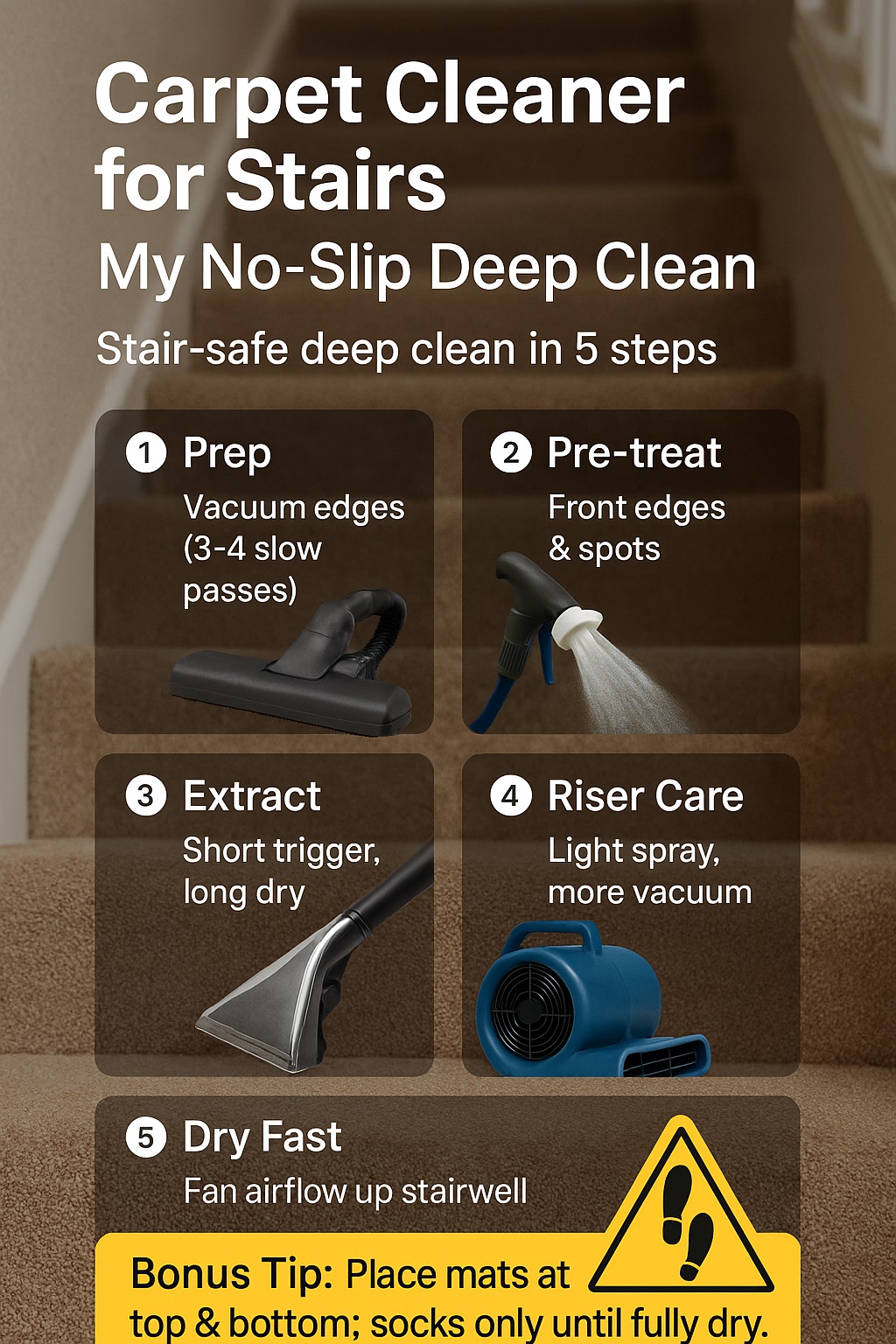
How I Vacuum My Stairs Like a Pro Before Wet Cleaning
If I only change one thing for a customer, it’s dry soil removal. I use a crevice tool along each edge, then a turbo or standard head on every tread and riser. I make slow overlapping passes. When I empty the vacuum after a “clean” staircase, the canister tells the real story.
How I Pre-Treat Stains and Problem Areas
The front edge of each tread is usually the worst. I pre-spray those areas and any obvious stains before I start extraction. Sticky marks, snack spills and pet spots get their own treatment. By the time I reach them with the stair tool, the chemicals have already loosened most of the soil for me.
Dr Nina Clarke, Building Materials Scientist, notes that removing dry grit first can extend carpet life more than any fancy machine because grit acts like sandpaper on fibres.
🚿 My Step-by-Step Method to Deep Clean Carpeted Stairs
How I Plan My Cleaning Route From Top to Bottom
I usually start at the top and work down, stepping onto dry or nearly dry areas. I keep the machine at the bottom landing so the weight stays off the stairs. I run the hose up, clean two or three steps at a time, then move myself down carefully so I never stand on freshly cleaned treads.
How I Use My Stair Tool on Treads, Risers and Edges
On each tread, I pull the stair tool towards me in slow, overlapping strokes. I press just enough to keep the head sealed but not crushed. I do separate passes along the front edge and into the corners. On risers, I keep the spray lighter and focus more on vacuum passes to avoid runs and drips.
How I Control Moisture So I Don’t Overwet
My rule is simple: as wet as necessary, as dry as possible. I keep the trigger time short and follow immediately with extra dry passes. If the carpet feels spongy, I know I’ve used too much solution. When I get it right, the stair carpet feels damp, not soaked, and bounces back quickly.
Mark Evans, Water Damage Restoration Technician, argues that on stairs, airflow and extraction are more important than high water volume for a safe, effective clean.
🧪 How I Tackle Tough Stains on My Stair Carpet
How I Deal With Pet Urine on Stair Treads
Pet accidents on stairs are tricky because gravity pulls the urine downwards into the backing. I first locate the worst spots with my nose and a moisture meter if needed. I apply a dedicated urine treatment, let it dwell, then flush and extract slowly. I warn customers that smell can improve a lot, but not always disappear.
How I Treat Coffee, Tea and Soft Drink Spills
Drink spills love to run down risers and into edges. I start by blotting, not scrubbing, even if the stain is old. Then I use a tannin or general spot remover and gently work it in with a soft brush. Only once I see improvement do I follow with the stair tool and a thorough rinse.
How I Handle Dark Edge Lines and “Permanent” Marks
Those dark lines along the edge of each tread come from air movement and filtration, not just dirty shoes. They’re often the hardest marks to remove. I pre-treat them, agitate with a small brush, and extract several times. Sometimes they fade nicely. Sometimes they only improve slightly and I explain why to the customer.
Dr Helen Moore, Textile Chemist, cautions that aggressive scrubbing of filtration lines can cause fuzzing and damage, even if it seems to lighten the stain faster in the moment.
💨 How I Dry My Stairs Fast and Keep Them Safe
How I Set Up Airflow So Stairs Dry Evenly
As soon as I finish the first few steps, I’m already thinking about drying. I set a fan at the bottom, angled up the stairwell, or place a small air mover at the top blowing down. The goal is a steady stream of air across every tread, not a hurricane that blows dust everywhere.
How I Explain Drying Times Clearly to Customers
Customers always ask, “When can we use the stairs?” I give two simple stages: socks only once the carpet feels just slightly cool and damp, and shoes later when it feels dry and fluffy. I remind them not to place plastic or rubber mats back until everything is completely dry to avoid yellowing.
How I Avoid Wick-Back and New Stains Appearing
Sometimes a stain looks gone when it’s wet, then creeps back as the stair dries. To reduce this, I do more dry passes, use less solution, and sometimes place a clean towel under pressure on a problem area. That helps absorb any remaining residue pulled up during drying.
Dr Leo Grant, Indoor Air Quality Consultant, points out that quick drying not only prevents wick-back but also reduces the time for odours and microbes to develop in damp stair carpet.
♻️ How I Keep My Stair Carpet Cleaner for Longer
How I Set a Simple Weekly Stair Routine
I’ve learned that five minutes a week beats a massive rescue job every year. I run a vacuum over each step, paying attention to the front edges, and pick up any bits stuck in corners. It’s quick, almost mindless, and it prevents that heavy “grey stripe” from building up on the treads.
How I Use Mats and House Rules to Protect Stairs
I like small mats at the bottom and top of the stairs to catch soil before it hits the carpet. I also ask family and guests to avoid wearing outdoor shoes on the stairs. It feels strict at first, but everyone gets used to it, and the carpet looks fresher for years.
When I Recommend Carpet Protector on Stair Treads
On pale or expensive stair carpet, I sometimes apply a protector after cleaning. It doesn’t make the stairs “stain proof”, but it gives me more time to blot spills before they soak in. I explain that it needs redoing every so often, especially on the front edge where footsteps land.
Emily Ross, Flooring Maintenance Consultant, believes that consistent dry vacuuming has a bigger impact on carpet life than any protector, but agrees that protector helps with day-to-day stain resistance.
🤝 How I Choose Between DIY Stair Cleaning and Hiring a Pro
When a Small DIY Machine Is Enough
If the stairs only look lightly dull, a good vacuum and a small hire machine with a stair tool can work well. I tell people to go slow, use as little water as possible, and focus on extra dry passes. For simple maintenance cleans, DIY can be a smart and affordable choice.
When I Recommend Bringing in a Professional
If I see strong odours, old pet accidents, heavy filtration lines, or loose noses, I lean towards a professional clean. I have stronger extractors, better spotting products, and training that helps me avoid damage. In some cases, I even suggest fixing loose trims before cleaning to avoid accidents.
Questions I’d Ask Any Stair Carpet Cleaner
If I were the customer, I’d ask three things: what training the cleaner has, what process they use on stairs, and how they control drying time. Clear answers tell me they know what they’re doing. Vague “we just shampoo it” answers would push me to keep looking.
James Patel, Property Manager and Licensed Real Estate Agent, argues that professionally maintained stair carpet can add more value to a home’s feel than upgrading minor fixtures like door handles.
📊 How I Helped One Family Rescue Their Dirty Stair Carpet (Case Study)
How I Assessed Their Stair Problem
A family asked me to look at their light-coloured stair carpet. The treads were grey, there were sticky snack spills, and their small dog had had a few accidents near the top. They thought the whole staircase needed replacing. I suggested we try one thorough deep clean before making that decision.
What I Did Step by Step
I started with a careful inspection, then a slow deep vacuum on every tread and riser. I pre-treated the front edges, urine spots and snack stains. Using my stair tool, I cleaned from top to bottom with controlled moisture and extra dry passes. I set an air mover at the bottom to push air up the stairs.
The Results in Simple Numbers
| Job detail | Result |
|---|---|
| Number of steps cleaned | 14 |
| Total cleaning time | 35 minutes |
| Approximate drying time | 5 hours |
| Visible soil reduction | From “heavy” to “light” |
| Stains fully removed vs improved | 7 removed / 3 improved |
The family decided to delay replacing the carpet and booked a maintenance clean for the next year instead.
Laura Kim, Chartered Accountant, likes to compare case data like this against replacement costs and often finds that proper cleaning offers a far better return on investment.
❓ My Carpet Cleaner for Stairs FAQs
How Often Should I Clean My Stair Carpet?
In most busy homes, I suggest a deep clean every 6–12 months, depending on pets, kids and shoe rules. If the front edges look grey or feel sticky, it’s time. Regular vacuuming in between keeps that deep clean easier and cheaper because there’s less soil to pull out.
Can I Use the Same Machine for Rooms and Stairs?
Yes, as long as it has a proper stair or upholstery tool and a long enough hose. I keep the main unit on a flat surface and only take the light tool onto the stairs. If a machine doesn’t have a small hand tool, I don’t use it on stairs at all.
How Long Until We Can Walk on the Stairs Again?
With good airflow, most staircases are “sock friendly” within a few hours. I still ask people to go slowly and avoid twisting movements while the carpet is damp. Shoes and heavy items should wait until the fibres feel dry and springy again, usually by the end of the day.
Can Cleaning Fix Flattened Stair Treads?
Cleaning can lift the pile slightly and remove the dull, dirty look, but it can’t rebuild worn fibres. If the carpet is badly crushed in the centre of each tread, cleaning will make it cleaner and fresher, but it may still look a bit flat compared to new carpet.
Is Hot Water Extraction Safe for Wool Stair Carpet?
Used correctly, yes. On wool, I use lower pH products, moderate heat, and thorough rinsing. I also avoid overwetting and do extra dry passes. The danger isn’t the method itself, but the person using it without understanding wool’s limits and the stair’s construction.
Dr Olivia Hart, Building Services Engineer, suggests that homeowners focus their budget on safe, thorough cleaning of high-traffic areas like stairs before spending on decorative upgrades elsewhere.
✅ My Key Takeaways for Cleaning Carpeted Stairs
What I Want You to Remember
Stairs punish carpet faster than any other area in the house. When I treat each tread, riser and edge as its own small job, I get better results with less effort. Good vacuuming, smart pre-treatment, controlled moisture, and strong drying are the four pillars of my stair-cleaning routine.
How I Keep My Own Stairs Looking Good All Year
At home, I vacuum my stairs weekly, spot clean spills straight away, and do a full deep clean once or twice a year. I protect the front edges with simple habits, like no outdoor shoes on the stairs. Little routines, done often, keep my staircase safe, clean, and a lot cheaper than replacing the carpet.
Dr Robert Lane, Behavioural Psychologist, argues that small, consistent habits beat occasional big efforts in almost every area of life, including cleaning and home maintenance.
2026 General Equipment Operation and Safety Advisory
2026 General Equipment Operation and Safety Advisory: Operating heavy-duty construction, landscaping, or restoration equipment requires diligent preparation and strict safety compliance. Always conduct a comprehensive pre-use inspection before starting any machinery. Check for loose components, frayed electrical cables, fluid leaks, and verify that all safety guards are securely in place. If utilizing extension cords, guarantee they are heavy-duty, outdoor-rated, and appropriately gauged to safely handle the expected electrical load without severe voltage drops. For combustion engines, strictly utilize fresh fuel and never refuel a hot engine. Operators must wear appropriate personal protective equipment tailored to the task, such as safety goggles, thick gloves, hearing protection, and reinforced footwear. Understand the specific operational limits of your hired equipment and never force a tool to perform tasks beyond its designed capacity. Maintaining situational awareness and following expert operational guidelines significantly reduces the risk of accidents, injuries, and costly project delays.
Hire professional-grade equipment from 7 Hire. We offer fast local pickup or delivery across Auckland.