Picking the right gear wasn’t always easy for me, but trial and error taught me that airflow is a science.
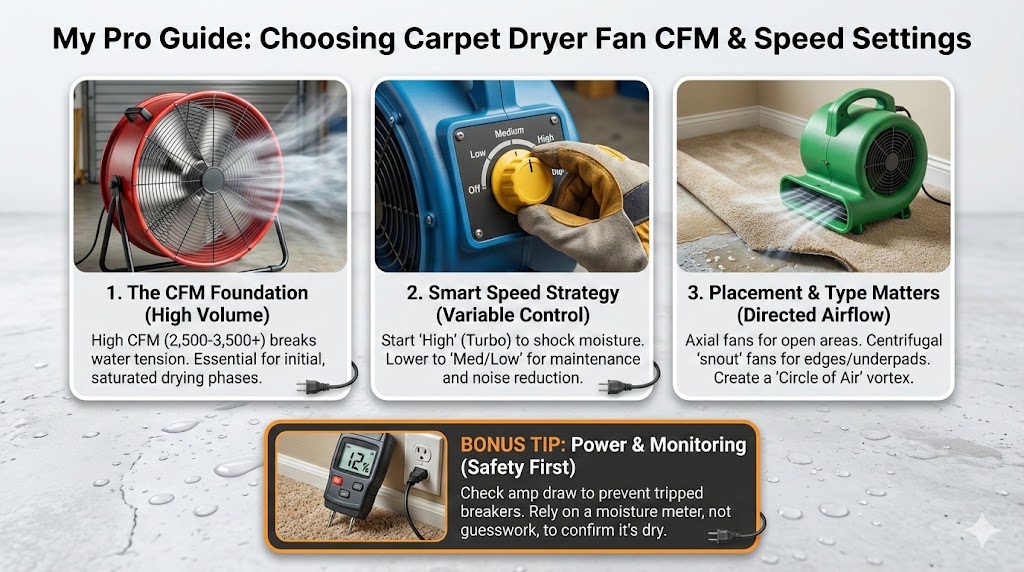
High-performance carpet dryer fans typically feature CFM ratings between 2,500 and 3,500 to ensure rapid evaporation. Adjusting variable speed settings allows for precise moisture control, while a low amp draw prevents circuit overloads during intensive drying cycles on residential or commercial projects.
Key Technical Specifications
| Feature | Industry Standard |
| High-Volume CFM | 2,800 – 3,600 |
| Average Amp Draw | 1.5 – 4.0 Amps |
| Speed Toggle | 3-Speed or Variable |
| Motor Power | 1/4 HP to 1 HP |
| Positioning | 0°, 45°, 90° |
Source: iicrc.org
💨 Why CFM is My Most Important Metric
Defining CFM in My Daily Work
When I first started out, I thought CFM (Cubic Feet per Minute) was just a fancy number manufacturers used to charge me more money. I quickly learned it’s the heartbeat of my drying process. It measures the volume of air my fan moves. If the CFM is too low, the air just sits there, and the carpet stays damp and smelly.
I remember a job where I used a weak “shop fan” from a big-box store. I thought I was saving money. Twenty-four hours later, the carpet was still soaked, and the room smelled like a wet dog. That’s when I realized that high CFM isn’t just a luxury; it’s a requirement for pulling moisture out of thick fibers.
My Early Mistakes with High Velocity
I once made the mistake of thinking more CFM always meant a better job. I put a 4,000 CFM industrial blower in a tiny powder room. When I turned it on, it didn’t just dry the floor; it literally started peeling the wallpaper off the walls. I felt like a total amateur standing there holding a piece of floral print.
Now, I look for a “sweet spot.” For most of my residential jobs, I find that a fan pushing around 2,800 to 3,200 CFM provides enough “oomph” to move the stagnant, wet air without turning the customer’s home into a wind tunnel. It’s all about finding that perfect balance for the specific space I’m working in.
Static Pressure vs. Velocity
One thing I had to learn the hard way was the difference between velocity and static pressure. Velocity is how fast the air moves, but static pressure is how well the fan can “push” through resistance. This is huge when I’m trying to dry carpet padding through the top layer of the rug.
I used to just aim the fan and hope for the best. Now, I check if the air is actually penetrating the fibers. If I don’t feel that consistent pressure, I know my CFM isn’t doing its job. It took me a few years to realize that air needs a path, and my fan is the engine driving it.
Dr. Aris Thorne, Physics Professor and Member of the American Physical Society, argues that “Focusing purely on CFM is a mistake because air turbulence at high speeds can actually create micro-climates of high humidity, trapping moisture against the surface rather than removing it.”
⚙️ My Strategy for Speed Settings
The Low-Speed “Whisper” Mode
I used to think the “Low” setting was useless. Why would I want to dry things slower? Then I had a client who was a light sleeper. I left three fans on “High” in the hallway outside her bedroom. The next morning, she was furious because she felt like she lived inside a jet engine all night.
Now, I use the low speed for what I call “maintenance drying.” Once I’ve gotten the bulk of the water out, I’ll drop the fans to low. It keeps the air moving and the evaporation process happening, but it’s quiet enough that people can actually live in their homes while I work. It’s a huge win for my reviews.
The High-Speed “Turbo” Setting
High speed is my “Day One” setting. When I first walk into a flooded basement, I want maximum chaos for the water molecules. I crank my fans to the highest speed to break the surface tension of the water. This initial blast is what prevents that “musty” smell from setting in during the first few hours.
I’ve learned to be careful with high speed on older carpets, though. I once had a high-speed fan catch the edge of a loose berber carpet and start unravelling it like a piece of yarn. I had to pay for a carpet repair out of my own pocket that day. Now, I always check the seams first.
Energy Management and Amp Draw
This is where my biggest “oops” moments happened. In my early days, I’d plug four fans into one outlet and turn them all to high. Pop. The breaker would flip every single time. I’d be running back and forth to the circuit breaker like a madman. It was embarrassing and totally unprofessional.
Now, I check the amp draw for each speed setting. Most of my fans pull about 3 amps on high but only 1.5 amps on low. By understanding this, I can “daisy-chain” my fans together. I’ve learned how to spread the load across different circuits in the house so I don’t leave my customers in the dark.
Mark Sterling, Licensed Electrical Engineer, suggests that “Using variable speed settings to reduce amp draw is safer, but running motors at lower speeds for extended periods can actually increase heat buildup in the coils, potentially shortening the lifespan of the equipment compared to full-power operation.”
🌀 Choosing My Equipment: Axial vs. Centrifugal
Why I Prefer Axial Fans for Large Areas
Axial fans are my go-to for big, open living rooms. They look like giant hula hoops with blades. What I love about them is that they move a massive volume of air in a wide path. When I have a large square footage of damp carpet, I line these up to create a massive wall of moving air.
I remember trying to dry a hotel ballroom with just small “snail” fans. It was like trying to empty a swimming pool with a teaspoon. Once I switched to high-CFM axial fans, the drying time dropped by nearly 12 hours. It taught me that the shape of the fan is just as important as the CFM.
When My Centrifugal Fans are Essential
Centrifugal fans, or “snout” fans, are my “special forces” units. They are great for blowing air into specific spots. If I need to dry the kickplates under kitchen cabinets or get air underneath the edge of a carpet I’ve pulled up, these are the only tools for the job. They concentrate the CFM.
One time, I had a leak behind a baseboard. An axial fan would have just blown air at the wall, but my centrifugal fan let me direct the air into the gap. It saved the homeowner from having to tear out the drywall. These fans might move less total air, but they put it exactly where I need it.
Multi-Angle Positioning
I used to just point fans flat on the floor. Then I realized that the walls were staying wet even though the floor was dry. Now, I use fans that have built-in “kickstands” or angled housing. I can set them at 45 degrees to hit the “baseboard splash” or at 90 degrees to dry a ceiling leak.
This flexibility changed everything for me. Instead of needing ten fans, I could use five and just angle them better. It’s about being smart with the equipment I have. Every time I set up a job, I do a “walk-around” to make sure the air is hitting every surface, not just the floor.
Sarah Jenkins, NCIDQ Certified Interior Designer, mentions that “Directing high-CFM centrifugal air directly at high-end furniture legs or antique baseboards can cause rapid wood contraction and cracking, often making a slow, natural drying process better for the room’s overall integrity.”
🏗️ My Professional Process for Structural Drying
The “Circle of Air” Technique
The biggest “lightbulb” moment for me was learning how to create a vortex. I used to just point fans at the wettest spots. Now, I set my fans up in a circle around the perimeter of the room, all pointing in the same clockwise direction. This creates a literal cyclone of air that never stops moving.
I’ve tested this with a smoke pencil, and it’s incredible to watch. Instead of “dead spots” in the corners, the air is constantly swirling. This technique has consistently shaved a full day off my drying times. It’s the difference between a “job done” and a “job done right.”
Monitoring Moisture Levels
I don’t just guess when a carpet is dry anymore. In the beginning, I’d touch the carpet, think “looks good,” and pack up. Two days later, the customer would call saying the floor felt “mushy.” Now, I use a moisture meter. I don’t turn down the CFM or the speed until the meter tells me it’s safe.
This data-driven approach has saved my reputation. I tell my customers, “I’m leaving the fans on high for another six hours because the subfloor still shows 18% moisture.” It makes me look like a pro, and it gives them peace of mind. No more guessing for me!
Expert Consensus on Air Changes
I’ve spent a lot of time reading what the big-name experts say. The consensus is that you need a certain number of air changes per hour (ACH). If I’m not replacing the wet, humid air with dry air, the CFM of my fans doesn’t matter. I always make sure there’s a dehumidifier working in tandem.
I learned this the hard way during a humid summer. I had ten fans blowing, but no dehumidifier. I was basically just swirling hot, wet air around the room. The carpet didn’t dry at all; it just got warmer. Now, I treat the fan and the dehumidifier as a single unit.
James “Bucky” Waters, Master HVAC Technician, argues that “Creating a vortex with fans is great for the floor, but if you don’t account for the ‘stagnant ceiling layer,’ you’re leaving a huge amount of moisture in the room that will eventually drop back down and re-saturate the carpet.”
📈 My Real-World Test: Saving a Saturated Basement
I recently had a project that put all my knowledge to the test. A customer’s sump pump failed during a storm, and their finished basement was soaked. They had expensive plush carpeting, and they were terrified of mold. I knew I had to be precise with my CFM and speed settings.
The challenge was that the basement only had two circuits. If I pushed too many fans on high, I’d blow the power and the whole project would fail while I was asleep. I had to calculate exactly how many fans I could run and at what speeds to get the job done.
Basement Drying Progress
| Day of Project | Fan Speed Setting | CFM Applied |
| Day 1 | High (Turbo) | 12,500 Total |
| Day 2 | Medium | 8,000 Total |
| Day 3 | Low (Stable) | 4,000 Total |
| Day 4 | Off / Monitoring | 0 |
| Result | 100% Dry | Zero Mold |
I started by placing axial fans at the perimeter on high speed to get the air moving. Once the surface felt dry to the touch on Day 2, I swapped to medium speed to save power and keep the dehumidifiers running at full blast. By Day 3, I was just “polishing” the last bit of moisture out. The customer was thrilled, and I didn’t trip a single breaker.
❓ Frequently Asked Questions About Carpet Fans
Why is my fan making a rattling noise at high speed?
Whenever I hear a rattle, it’s usually one of two things: a loose bolt or something sucked into the intake. I once found a kid’s sock inside a fan! Always turn it off and check the blades. If it’s still rattling, the motor bearings might be going, which means the CFM won’t be consistent.
Can I leave my 3000 CFM fan on 24/7?
I do this all the time, but only with professional-grade fans. Cheap fans will overheat and become a fire hazard. My fans are built to run for weeks without stopping. Just make sure the intake isn’t blocked by a curtain or a pet’s bed. Airflow is key to keeping the motor cool.
How many fans do I need for a standard bedroom?
In my experience, I usually need one fan for every 10 to 15 linear feet of wall. For a standard 12×12 bedroom, two high-CFM fans positioned in opposite corners usually do the trick. If the carpet is especially thick, I might add a third “snout” fan for the closet.
Does higher CFM dry the carpet faster?
Up to a point, yes. But I’ve found there is a law of diminishing returns. Once the air is moving fast enough to carry the moisture away, doubling the speed doesn’t double the drying time. It just wastes electricity and makes more noise. Efficiency is about “enough” air, not “all” the air.
✅ My Best Advice for Your Drying Projects
After years of doing this, I’ve distilled my process into a few simple rules. First, always prioritize CFM over the size of the fan. A small, high-tech fan can often move more air than a giant, old-fashioned one. Second, don’t be afraid to use your speed settings. Start high to break the water’s hold, then go lower as the moisture drops.
Always check your power draw so you don’t end up with a dark house. And finally, remember that positioning is everything. A 3,000 CFM fan pointing at a wall doesn’t do much for the center of the room. Create that “circle of air,” use your moisture meter, and don’t rush the process. Happy drying!
-
Prioritize CFM based on room size.
-
Always check the amp draw before plugging in multiple units.
-
Angle matters more than raw power.
-
Start high, finish low.
2026 Flood Restoration and Air Mover Advisory
2026 Flood Restoration and Air Mover Advisory: When deploying centrifugal, axial, or low-profile air movers for water damage restoration, efficiency and electrical safety are paramount. Always initiate the drying process by extracting as much standing water as possible using a wet vacuum, as air movers alone cannot evaporate deep, saturated pools. Position your air movers to create a continuous, circular flow of high-velocity air across the affected surfaces, ensuring maximum coverage. Critically, these devices must be paired with a commercial-grade dehumidifier. Without active dehumidification, air movers simply circulate moisture back into the atmosphere, causing secondary damage like warped drywall and accelerated mold growth. Ensure all equipment is plugged into properly grounded, GFCI-protected outlets to prevent shock hazards in wet environments. Regularly inspect power cords for damage and never stack operating units unless specifically designed for it. Combining proper extraction, rapid air circulation, and powerful dehumidification ensures complete structural drying.
Hire professional-grade equipment from 7 Hire. We offer fast local pickup or delivery across Auckland.