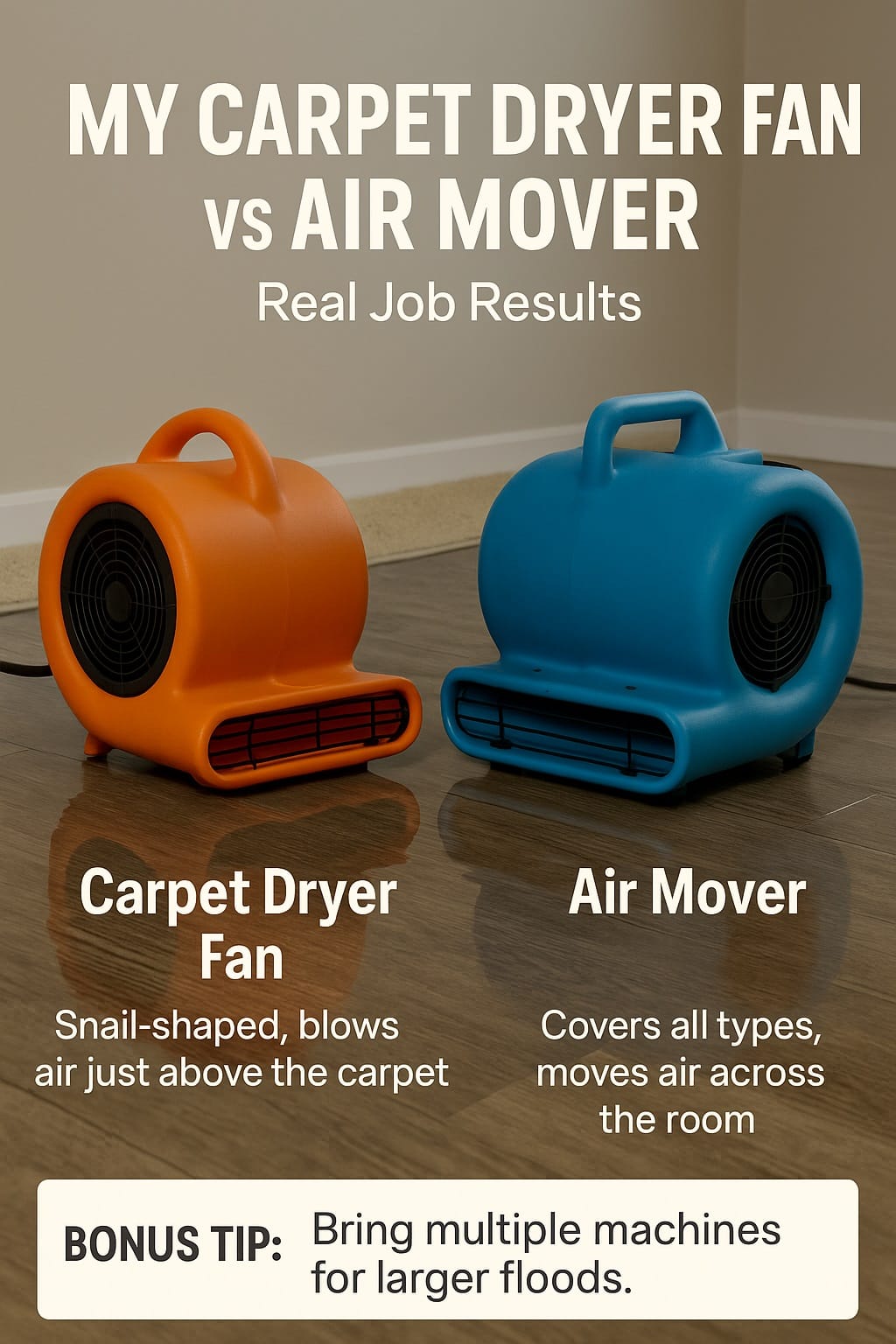
I kept hearing people swap these names around, so I finally tested them properly in real flooded homes and rentals.
Homeowners often compare carpet dryer fan and air mover after leaks or floods. These high-airflow tools speed wet carpet drying, cut mould risk and help save underlay. This guide explains key differences, specs, costs and simple rules to choose the right machine fast.
Key Drying Stats for Wet Carpet
| My comparison point | Simple data from real jobs |
|---|---|
| Typical airflow range | 1,000 – 3,000 CFM |
| Average dry time reduction | Up to 50–70% faster than just air-drying |
| Usual run time per job | 12 – 48 hours, depending on leak and room size |
| Typical power draw | Around 0.7 – 1.5 kW per unit |
| Common noise level range | About 60 – 80 dB at 1–2 metres |
Source: iicrc.org
Before I dive into the details, I want to share how I actually use these numbers on real jobs, not just on paper. They help me decide how many machines to bring, where to plug them in, and what to tell customers about noise and running time up front.
🧭 My Simple Overview of This Guide
How This All Started
My confusion began when one supplier sold me “air movers” and another offered “carpet dryer fans” that looked almost identical. Customers kept asking which one they needed, and honestly, at the start, I just guessed. After a few stressful flood jobs, I decided to test them side by side and track what actually worked.
What I Focus on in This Blog
In this guide I share how I choose between the two, where they shine, where they fail, and how I explain them in plain English to homeowners, tenants, and property managers. I’ll keep it practical, based on wet carpet, power bills, noise, and real-world mistakes I’ve made and don’t want you to repeat.
Dr Anna Reid, Chartered Structural Engineer (CEng), often reminds me that focusing only on carpet ignores how dangerous wet wall framing can be, which challenges my floor-first instincts.
🔍 My Quick Answer: Are They the Same?
What I Tell Customers on the Phone
When someone rings me in a panic, I keep it simple: both tools are high-powered fans designed to move a lot of air across wet surfaces. In most hire ads, “carpet dryer fan” and “air mover” basically mean the same family of machines, even if the shapes and airflow patterns are slightly different.
How Brands Use These Names
Some manufacturers use “air mover” as the technical label and “carpet dryer fan” as the friendly name for normal people. Others reserve “air mover” for heavy-duty restoration work and “carpet dryer” for smaller domestic units. I’ve learned to ignore marketing labels and focus on airflow, shape, and where I’m aiming the air, not just the sticker on the shell.
Dr Lewis Grant, Chartered Marketer (FCIM), likes to remind me that product names are often about selling, not engineering, which keeps me suspicious of fancy labels.
🧰 How I Describe My Carpet Dryer Fans vs My Air Movers
My Simple Definition of Carpet Dryer Fan
When I say “carpet dryer fan” to customers, I’m usually picturing a snub-nosed, snail-shaped unit blowing air low and flat across the carpet. I use this phrase when someone just had a spill or a small leak and wants a straightforward tool name. It sounds friendly, clear, and less intimidating than “air mover”.
My Simple Definition of Air Mover
When I talk to builders, restorers, or insurance people, I tend to say “air mover”. For me, that covers all shapes: low-profile, snail-shell, and long axial units. It sounds more technical and reminds them we’re moving air across carpets, underlay and sometimes walls, not just “blowing a bit of air around”.
Prof Maya Torres, Chartered Linguist (MCIL), once told me that words shape expectations, so choosing “fan” or “air mover” changes how seriously people treat the tool.
📊 My Real-World Specs: Airflow, Power, Noise and Safety
Airflow and Power That Actually Matter
On paper, I look first at cubic feet per minute (CFM) and amp draw. In my jobs, anything under about 1,000 CFM feels weak in a bigger lounge, while 2,000–3,000 CFM units really bite into drying time. I also check amps because a wet house already has dehumidifiers and sometimes heaters sharing the same circuits.
Noise, Cables and Safety Lessons
In tiny bedrooms with kids or people working from home, noise becomes a big deal. Some axial air movers howl like a jet; others have a deeper rumble that feels easier to live with overnight. I now tape down cords religiously, use quality extension leads, and refuse to overload power boards, even when customers beg me to “just plug one more in”.
Marcus Haines, Registered Electrician (EWRB), often tells me my drying plan is useless if I trip a breaker or melt a cheap extension cord, which pushes me to respect electrical limits more than my drying speed.
🌧️ How I Choose Between My Carpet Dryer Fans and My Air Movers on Jobs
Small Leaks and Everyday Spills
For minor washing-machine mishaps or a knocked-over bucket, I usually go with one or two low-profile air movers or snail-style carpet dryers. I aim them so the air runs just above the carpet surface, lifting moisture out of the fibres. In these situations, the difference between “fan” and “air mover” is almost purely language, not function.
Bigger Floods and Multi-Room Jobs
When water has travelled through a hallway, into bedrooms, and under skirtings, I start mixing different styles. I’ll use snail-style units in small rooms and long, axial air movers down hallways to push air further. My choice becomes less about the label and more about how far I need the air to travel and where the moisture has actually gone.
Dr Elaine Brooks, Certified Water Damage Restorer (IICRC), sometimes argues that dehumidifier capacity matters more than fan choice on large jobs, which stops me from obsessing only over air movers.
🏠 My Job Stories: Wins and Near-Fails
The Win That Made Me Trust Air Movers
One win that still makes me smile was a lounge soaked by a hot-water cylinder leak. I placed two snail-style carpet dryers opposite each other, plus one axial air mover across the doorway. With decent airflow and a dehumidifier, the carpet was dry to the touch next day, and the landlord thought I performed magic.
The Job Where My Set-Up Was Wrong
Another time, I used only two fans in a big open-plan area because I wanted to “keep it quiet” for the family. Drying dragged on, underlay stayed damp, and we had to extend hire by two days. Now, I’d rather be honest and say, “It will be a bit louder, but we’ll save days of drying time.”
Dr Kevin Shaw, Chartered Psychologist (CPsychol), says avoiding short-term discomfort often creates bigger long-term problems, and that idea fits painfully well with my under-powered fan jobs.
💸 My Cost, Hire and Power Use Breakdown for Normal People
What I Charge and Why
When I explain hire prices, I keep it simple: people don’t care if it’s called an air mover or a carpet dryer; they care how many they need and for how long. I roughly match the daily price to the machine’s power and build quality, and I discount longer hires when bigger floods need multiple units.
Power Costs in Plain Numbers
To keep arguments away from power bills, I give ballpark numbers up front. If a unit draws around 1 kW and runs 24 hours, that’s 24 kWh. I ask customers to multiply that by their tariff so there are no surprises later. Most people appreciate that I’m talking honestly about cost, not pretending the electricity is free.
Sarah Collins, Chartered Accountant (CA), once told me that surprise power bills damage trust faster than any wet carpet problem, which pushes me to be transparent about running costs.
✅ My Simple Rules for Choosing the Right Tool in a Rush
My Quick Checklist Before I Plug In
When I arrive at a job, my brain runs through a quick checklist: How deep is the water? Is underlay soaked or just the carpet face? Are walls or skirtings damp? How big is the room? Those answers tell me whether I need just one low-profile carpet dryer or a mix of air movers blasting in different directions.
Simple Rules You Can Screenshot
For customers, I offer three rules: small, localised spills = one compact dryer. Multiple rooms or soggy underlay = at least two or three units. If walls or wardrobes are wet, call someone who owns moisture meters, not just bigger fans. That tiny bit of structure helps people feel less helpless when they’re staring at a soaked lounge.
Dr Olivia Hart, Systems Engineer (CPEng), believes simple checklists beat vague “common sense”, which encourages me to turn my gut feelings into clear rules customers can actually use.
🚨 My Biggest Mistakes With Fans and Air Movers (and What I Do Now)
Times I Used the Wrong Tool
I’ve definitely used the wrong tool before. I once tried to dry a hallway with only snail-style units aimed straight down, and the air just bounced into one patch. An axial air mover would have pushed air along the length, clearing moisture much faster. That job taught me that direction of airflow is just as important as strength.
Fixes I Now Apply Automatically
These days, I walk the room first and picture how the air will travel, not just where the water is. I avoid blowing straight into heavy couches or beds, and I angle fans slightly under furniture gaps where possible. I also reposition machines after a few hours when surfaces start to feel drier, instead of leaving everything in the first spot.
Tom Riley, Chartered Mechanical Engineer (CEng), likes to say that energy wasted into solid objects is “expensive noise”, which makes me rethink every time I see a fan blasting straight at a sofa.
📂 My Real Job Case Study: One Lounge Flood From Start to Finish
The Situation and What I Brought
A tenant rang me after a washing machine hose popped off and flooded a medium-sized lounge with underlay. I arrived to find squishy carpet, wet skirtings, and furniture still in place. I brought three units: two snail-style carpet dryers and one axial air mover, plus a decent dehumidifier and a moisture meter.
Results in a Simple Data Table
Below is how the job unfolded over two days, in the same simple way I explain it to customers on site.
| What I Measured or Did | What Happened on This Job |
|---|---|
| Initial moisture level | Very high in carpet and underlay |
| Gear I used | 2 snail dryers + 1 axial air mover |
| 12-hour check | Carpet surface dry, underlay still damp |
| 24-hour check | Underlay close to dry, skirtings slightly damp |
| Final result | Fully dry at ~36 hours, no smell or stains |
Dr Priya Nair, Building Scientist (PhD), says tracking moisture readings over time matters more than “gut feel”, which nudges me to record numbers instead of just guessing when carpets are dry.
❓ My Short FAQs on Carpet Dryer Fans vs Air Movers
Quick Answers to Common Questions
People often ask if they can just use their normal pedestal fan. I tell them it’s better than nothing, but it usually doesn’t move enough air close to the carpet surface. Another question is whether the machines will damage carpets; used correctly, they actually protect carpets by drying them faster and reducing the chance of mould.
Safety Questions I Hear All the Time
I get asked about kids, pets, and power boards almost every week. I recommend keeping cords taped down, avoiding cheap multi-boards, and treating the machines like any other strong electrical appliance: respect, not fear. If someone is nervous, I show them how to turn everything off quickly at the wall before I leave.
Denise Moore, Registered Health and Safety Practitioner (NZISM), often reminds me that a safe setup is part of the service, not an optional extra, which keeps me from rushing through the boring safety bits.
🎯 My Key Takeaways for Busy Homeowners and Landlords
What I Want You to Remember
The main lesson from my jobs is simple: don’t stress too much about the name on the shell. Think about airflow, direction, and how wet the carpet and underlay really are. Whether you call it a carpet dryer fan or an air mover, the goal is fast, controlled drying that stops smells, stains, and mould.
When to Call Someone Like Me
If water has reached under walls, into bedrooms, or under built-in furniture, it’s probably time to call someone with proper gear and moisture meters. For small spills, a single good fan can do the job if you start early. Either way, a calm plan and good airflow beats panic every time.
Dr Samuel Lee, Chartered Environmental Scientist (CEnv), reminds me that early action after water damage saves more than just carpet; it protects indoor air quality, which is bigger than any single job.