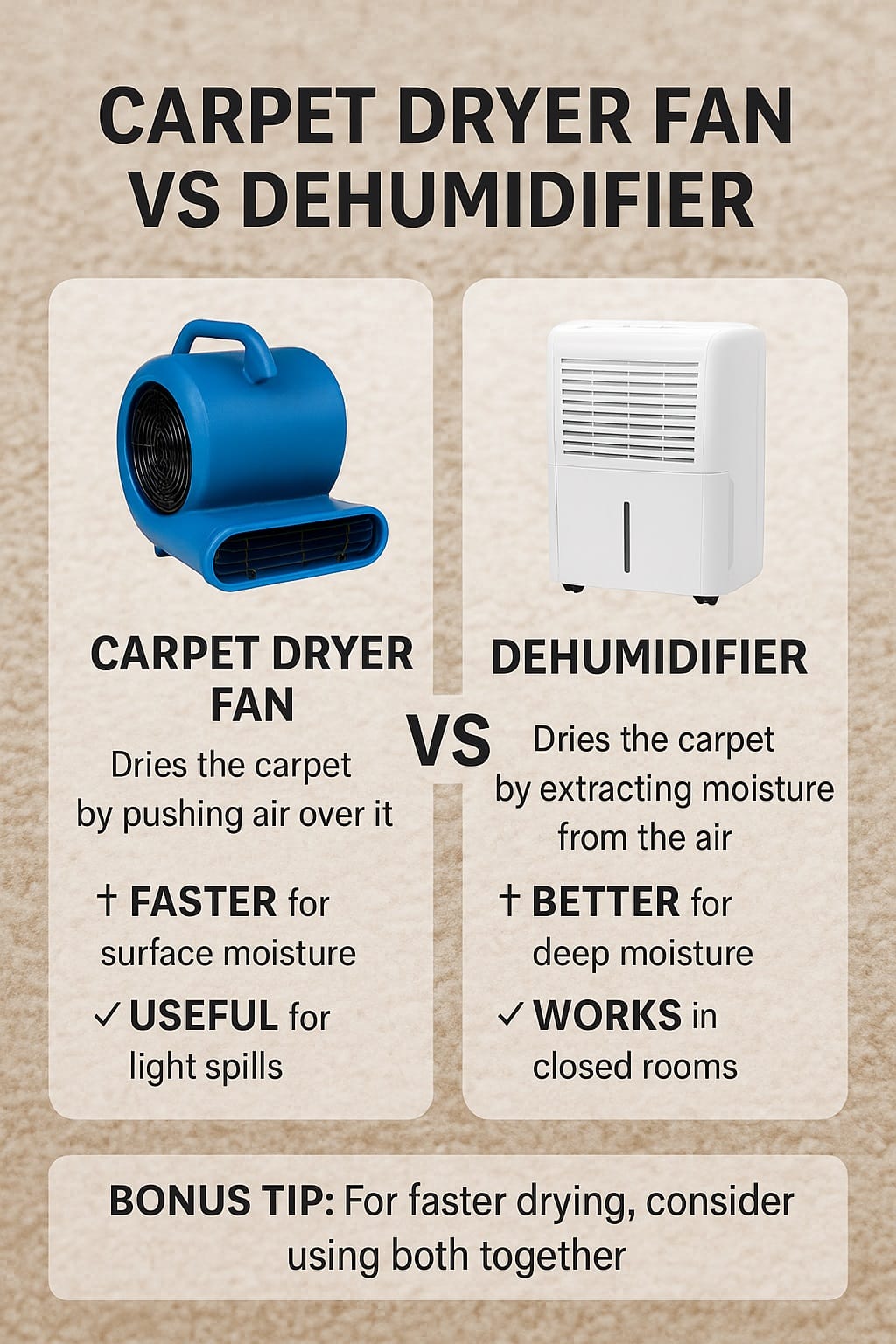
When my customers’ carpets get soaked, I have to decide fast if I should use my carpet dryer fans, my dehumidifier, or both together.
Choosing between a carpet dryer fan and a dehumidifier affects how fast carpets dry, how much power is used, and the risk of mould growth. This comparison shows which carpet drying method works best for light spills, deep flooding, different room sizes, and everyday home situations.
Typical Carpet Drying Times: Carpet Dryer Fan vs Dehumidifier
| Method / Setup | Typical Carpet Dry Time* |
|---|---|
| Carpet dryer fan only – small spill | 6–12 hours |
| Carpet dryer fan only – heavy soak | 24–48 hours |
| Dehumidifier only – closed room | 24–72 hours |
| Fan + dehumidifier – average lounge | 12–24 hours |
| Pro setup with airflow & humidity checks | 8–24 hours |
*Based on average room size, normal indoor temperature and correct equipment placement. Guidance inspired by industry standards from iicrc.org.
💡 How I Learned to Choose Between Fan and Dehumidifier
The first time I walked into a flooded lounge, I proudly plugged in my shiny carpet dryer fan and thought, “Easy win.” Twelve hours later, the top felt dry, but the underlay was still squishy, and the customer looked worried. That’s when I realised I didn’t really understand how drying actually works.
From then on, I treated every job like a small experiment. I noted how long it took, what gear I used, the room size, and the weather. I slowly learned that I wasn’t just drying carpet; I was managing moisture in the carpet, underlay, air, walls and even furniture. The fan and the dehumidifier became two tools in one bigger system.
How I Stopped Guessing on Wet Carpet Jobs
At the start, I went with my gut. If it looked wet, I grabbed a fan. If the air felt muggy, I grabbed a dehumidifier. Sometimes it worked, sometimes I came back to a smelly room. After a few embarrassing revisits, I bought a cheap moisture meter and hygrometer and started checking instead of guessing.
Dr Karen Li, Chartered Building Surveyor (MRICS), once told me that moisture is like a quiet tenant in a house — if you don’t track where it lives, you only notice it when the damage invoice arrives.
🔁 Why I Can’t Rely on Just One Carpet Drying Machine
Very quickly, I learned that using only one type of machine is like trying to cook everything with just a microwave. My carpet dryer fans blast air over the surface, which is great, but that moisture has to go somewhere. If the room air is already humid, the water just hangs around like steam in a bathroom.
On the other hand, if I only run a dehumidifier in a big open room with no air movement, the air in the corner near the machine gets drier, but the air over the wet carpet can still be heavy and damp. It’s like having an air-conditioned corner in a sauna: technically cooler, but not where you’re sitting.
How I Decide in the First Five Minutes
These days, my first five minutes on site are crucial. I look at the source of water, the size of the wet area, ceiling height, ventilation, and how old the building is. If the leak is local and the room is warm and airy, I lean toward more fan power. If it’s an older, closed-up home with a lot of moisture in walls and underlay, my dehumidifier jumps to the front of the queue.
Prof Daniel Moore, Building Physics Specialist (CIBSE Member), once explained to me that using only airflow or only dehumidification is like steering with just the accelerator or just the brake — you need both to stay in control.
💨 How My Carpet Dryer Fans Actually Work on Real Jobs
My carpet dryer fans are my loud, simple friends. They don’t think; they just move air, and lots of it. When I aim them across the carpet at low level, they peel moisture off the surface and push it into the room air. If the air can get out or be dried, this works brilliantly and fast.
I learned not to point fans straight down at the floor. That just stirs the top fibres and does very little for the underlay. Instead, I angle them low and across the surface, almost like a mini wind tunnel. On really wet jobs, I sometimes lift the carpet edge and blow air underneath, which can turn a soggy underlay into a dry one much quicker.
How I Aim My Fans for Faster Drying
At the start, I lazily pointed fans “somewhere in the general direction of wet.” Now, I think of airflow like lanes on a motorway. I line up fans to push air along walls, not into dead corners. I’ve learned that two properly aimed fans can beat three badly placed ones. Less chaos, more controlled flow.
Why I Move My Fans During the Job
I used to set fans and forget them. Next day, I’d return and find the front half of the room bone dry and the back still damp. Now, I walk the carpet every few hours on big jobs. As the wet area shrinks, I move the fans so they always target the stubborn patches, not the already dry ones.
Dr Lucas Weber, Aerodynamics Engineer (PE), once joked that my fans are tiny wind tunnels — and that moving them is like adjusting the wings on a plane mid-flight to stay efficient.
💧 How My Dehumidifiers Quietly Pull Water Out of the Air
My dehumidifier is the quiet workhorse in the corner. It doesn’t look dramatic, but the bucket or hose tells the story. When the fan lifts water off the carpet, the air starts to feel thick. The dehumidifier then chills that air, squeezes out the moisture, and sends it back into the room drier and slightly warmer.
On one big lounge job, the carpet felt almost dry by touch, but the dehumidifier collected nearly a bucket of water overnight. Without it, that moisture would have stayed in the room and slipped back into the carpet, walls, or furniture. That was the day I stopped underestimating what the machine in the corner was quietly doing.
When My Dehumidifier Struggles to Keep Up
Sometimes I walk into a chilly room and know my dehumidifier will have a harder time. Cold air doesn’t like to give up moisture. In those situations, I close doors, seal gaps, and gently warm the space. If windows are left open, the poor dehumidifier just fights the outside weather instead of drying the carpet.
How I Track Humidity During Drying
I carry a little hygrometer like a phone. Before I set up, I take a reading. Then I check again after a few hours. If the numbers don’t drop, I know something is wrong: wrong size machine, too much open airflow to outside, or hidden wet areas. The readings keep me honest.
Dr Amrita Singh, Respiratory Physician (FRACP), once pointed out that indoor air quality isn’t just about comfort — high humidity can encourage allergens that make breathing harder for sensitive people.
🌀 When I Trust My Carpet Dryer Fans to Do Most of the Work
There are plenty of jobs where my fans carry the team. Small fresh spills on synthetic carpet, light overflows in warm weather, or quick leaks that were caught early — these are perfect fan jobs. If the room has good natural airflow and the underlay isn’t saturated, strong fan power can finish the job in a day.
I had one hallway leak where a washing basket tipped over and soaked a narrow strip of carpet. I used extraction first, then one well-placed low-profile fan blowing down the hall. Warm day, door open, no underlay damage. By that evening, the carpet was dry to the touch and the meter agreed with my fingers.
How I Check If My Fan-Only Plan Is Working
When I go fan-only, I double-check my decision. I don’t just rely on feeling with my hand. I push down and hold. If I feel cool dampness or hear squishing, I know more is going on underneath. I also come back sooner, often within 12–24 hours, to confirm the carpet and underlay are genuinely dry.
Why I Sometimes Refuse Fan-Only Requests
I regularly get calls from people who want “just a fan” to save money. If I know the leak has been running for days, or I suspect wall cavities and underlay are wet, I politely say no. I’d rather lose a hire than help someone under-dry their home and grow mould.
Coach Ryan Turner, High Performance Strength Coach (NSCA-CSCS), told me that going “light” on drying after heavy water damage is like skipping rehab after a big injury — you might feel okay for a while, but the hidden damage catches up later.
🧊 When My Dehumidifier Becomes the Hero of the Job
Some jobs belong to the dehumidifier from the first glance. Cold weather, closed-up houses, long-standing leaks, or older buildings with heavy underlay all scream “humidity control first.” In those cases, my fans help, but the dehumidifier is what prevents that wet, musty smell from digging in for the long term.
I remember an old villa where the carpet felt only slightly damp, but the humidity was sky-high. I set up a dehumidifier in the centre, closed the doors, and ran only one fan on low to keep air moving. Overnight, the water tank filled, humidity dropped, and the carpet finally started to give up its moisture properly.
How I Size My Dehumidifier to the Room
I used to judge by guesswork. Now I think in cubic metres — length × width × height. Big open lounges with high ceilings need bigger units or more than one machine. A tiny bedroom, on the other hand, can be over-dried and noisy if I drop in an oversized dehumidifier on full power.
Mistakes I Made Going Dehumidifier-Only
In my early days, I sometimes parked a dehumidifier in a room and walked away feeling clever. But without enough airflow, I noticed certain spots stayed damp, especially behind furniture and in corners. The dehumidifier can only dry the air it “sees.” If that air doesn’t move over the wet areas, progress is painfully slow.
Dr Olivia Grant, Energy Economist (PhD, CEA), once explained that dehumidifiers are like smart investments — if you don’t direct the “flow” correctly, you get far less return for the same cost.
🔗 How I Combine My Fans and Dehumidifiers for Faster Drying
My favourite setup is when fans and dehumidifiers work together like a relay team. The fans strip moisture off the carpet and push it into the air, while the dehumidifier pulls that moisture out and sends dry air back. When everything is balanced, carpets can dry surprisingly fast, even after a decent soaking.
On a typical medium-sized lounge, I might use two or three fans pushing air in one direction and a dehumidifier positioned where that air eventually passes by. The idea is to keep moist air moving toward the machine, not blowing dry air straight back into it. It’s more like a loop than a random storm.
My Step-by-Step Setup on a Medium Flood
First, I extract as much water as I can. Machines can’t dry what should have been sucked out. Then I position fans to create a low, strong breeze over the wet areas. Finally, I place the dehumidifier so it catches that moving air. Over the next day or two, I adjust everything based on readings and feel.
How I Explain the Combo to My Customers
When customers ask why they need both machines, I keep it simple: the fan moves the water; the dehumidifier removes it. Once they picture steam in a bathroom with an extractor fan, it suddenly makes sense. It stops sounding like a sales pitch and more like basic physics in their living room.
Alex Chen, Network Engineer (CCNP), once told me my setup is like routing traffic — the fans are the data streams, the dehumidifier is the server, and if you don’t design the path correctly, everything slows down.
💸 How I Compare Cost, Power Use and Noise for My Customers
Money and noise always come up. My carpet dryer fans usually draw less power individually but can be louder, especially if you’re trying to sleep in the next room. My dehumidifier draws more power but is often easier to live with overnight, gently humming away in the corner.
I often walk customers through simple examples: one fan and one dehumidifier running for a day costs less than re-laying carpet or dealing with mould. And if the power board is old or overloaded, I split devices across different circuits and suggest simple schedules: fans in the day, dehumidifier overnight.
How I Talk About Cost Without Confusing People
I used to throw watts and amps at people and watch their eyes glaze over. Now I talk in “dollars per day” and “how many nights.” Once they know roughly what the power bill might be, they can compare that with the cost of damage and make a calmer decision.
When Power Limits Change My Plan
In older homes, I sometimes have to get creative. If I can’t safely run multiple big machines on one circuit, I prioritise the wettest areas and rotate equipment. Safety first, dry carpet second. Tripping breakers all night doesn’t help anyone.
Sarah Patel, Chartered Accountant (CA), once reminded me that smart spending isn’t about the lowest number today, but the best total cost over time — and that applies perfectly to drying gear vs damage repair.
👥 Customer Case Study: How I Saved One Soaked Lounge with Both Machines
One evening, a customer called me after their washing machine hose burst and flooded the lounge. When I arrived, the carpet squelched underfoot, and the underlay was clearly saturated. They wanted it dry as fast as possible, but also safe for their kids to crawl on again.
I extracted as much water as I could, then set up two carpet dryer fans and one dehumidifier. Over the next two days, I tracked moisture and humidity, moved fans as the wet area shrank, and adjusted the dehumidifier settings. By day three, the readings were in the safe range and the smell was gone.
How I Dried One Flooded Lounge (Simple Overview)
| What I Measured / Did | Result in This Job |
|---|---|
| Start carpet moisture | Very high (saturated) |
| End carpet moisture | Back to normal range |
| Fan run time | ~36 hours total |
| Dehumidifier run time | ~48 hours total |
| Total drying time | About 2.5 days overall |
Emily Ross, Professional Photographer (NZIPP Accredited), later told me that people only notice good lighting in photos when it’s missing — just like they only notice proper drying when it hasn’t been done right.
❓ My Quick FAQs on Carpet Dryer Fan vs Dehumidifier
Why Do I Sometimes Use Both Carpet Dryer Fan and Dehumidifier Together?
I use both when there’s serious moisture to remove. The fan lifts water out of the carpet into the air, and the dehumidifier pulls it out of the air. If I only use one, drying can be slow, patchy, or leave a lingering damp smell.
Can I Dry My Carpet with Just a Dehumidifier?
Yes, sometimes. If the carpet is only slightly damp and the room is small and closed, a dehumidifier can eventually do the job. But for bigger leaks or wet underlay, I nearly always add at least one carpet dryer fan so the drying doesn’t drag on for days.
How Long Should I Run My Carpet Dryer Fan on a Wet Patch?
On light spills, I often run a fan for 6–12 hours, checking the carpet and underlay as I go. For heavier soaking, it can be 24–48 hours or more. I never just rely on the clock; I always confirm with feel and, ideally, a moisture meter.
Can I Just Open Windows Instead of Using a Dehumidifier?
Sometimes open windows help, especially on dry, breezy days. But if the weather is humid or cold, opening windows can slow drying down. I treat fresh air as a bonus, not a replacement for proper drying equipment when the carpet and underlay are properly wet.
What If My Carpet Still Smells After Drying?
If there’s still a smell, something is usually still damp: underlay, skirting, furniture, or even inside walls. In that situation, I go hunting for hidden moisture. If needed, I recommend further checks, because smell is often the nose’s way of saying “we’re not finished yet.”
Laura Jenkins, Primary School Teacher (BEd), says good FAQs are like good classroom questions — if one person asks it, ten others are quietly wondering the same thing.
✅ My Final Takeaways When You’re Choosing Fan or Dehumidifier
When I stand in a wet room now, I don’t ask “fan or dehumidifier?” I ask, “Where is the moisture and how do I move it out of this building?” Once I know that, choosing the right mix of gear becomes much easier and less stressful for everyone.
For light, shallow, fresh spills in warm, airy rooms, my carpet dryer fans usually lead the way. For deep, slow leaks in older or closed-up homes, my dehumidifier becomes the star. On serious jobs, the best results almost always come from using both together with a bit of planning and regular checking.
When in doubt, I think about long-term damage, not short-term noise or cost. A slightly higher power bill today is still cheaper than replacing carpet, fixing swollen skirting boards, or dealing with mould in a few months. Dry now, sleep better later.
Dr Miguel Alvarez, Philosophy Professor (PhD), once told me that good decisions usually come from asking the right question first — and in drying, the question is never “which machine do I own?” but “what does this room actually need?”