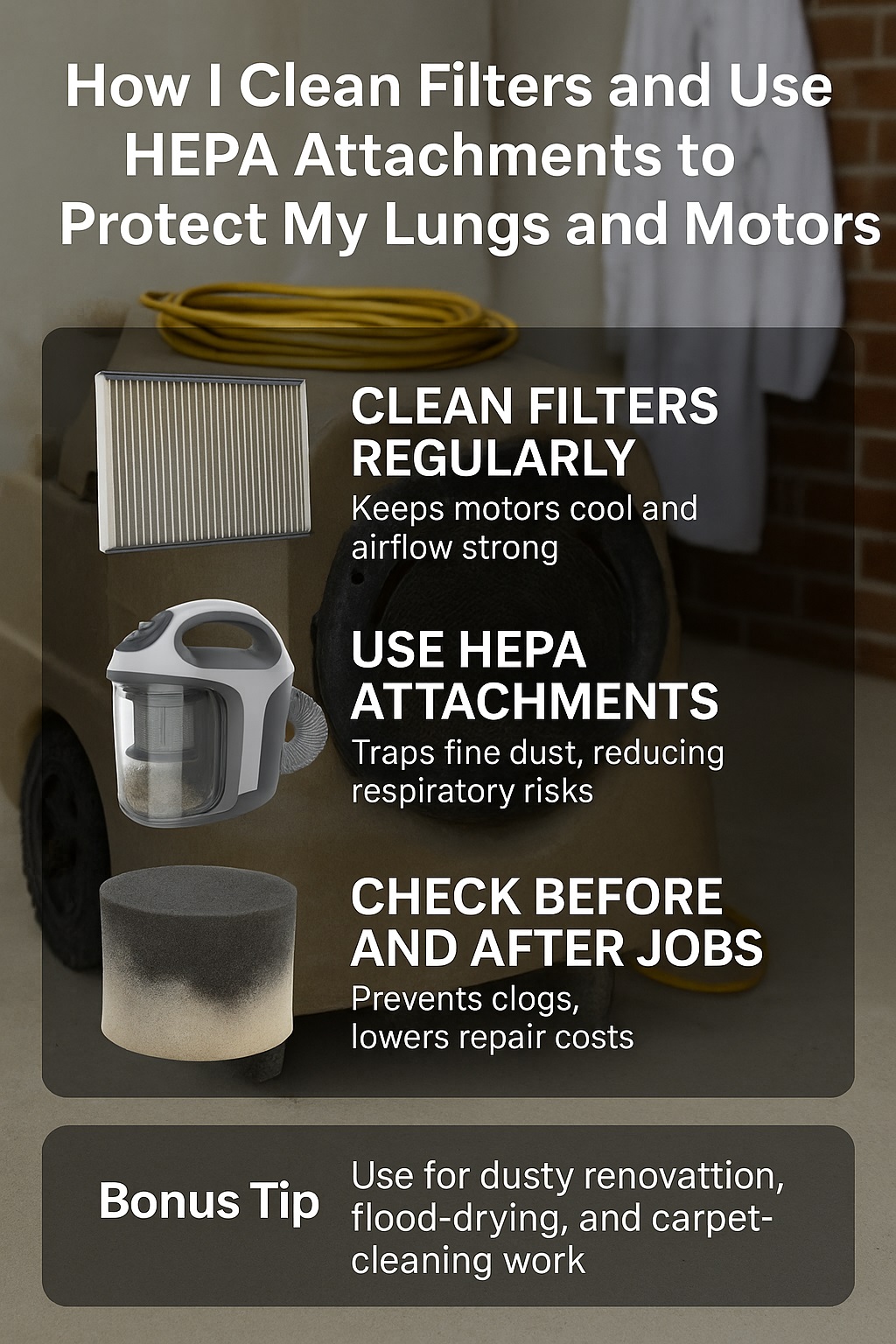
I learned the hard way that dusty filters don’t just slow my machines down, they also make every breath feel heavier than it should.
Regular cleaning filters and using HEPA attachments keeps airflow strong, motors cooler, and lungs safer by trapping fine dust before it spreads. It cuts repair costs, reduces allergy flare-ups, and helps equipment last longer, especially on dirty renovation, flood-drying, and carpet-cleaning jobs.
Dust, Filters and HEPA Quick Facts
| Item | Typical Value / Note |
|---|---|
| Dust reduction with HEPA | Up to 99.97% of 0.3 μm particles captured |
| Motor temperature drop | Clean filters can lower motor temps by 5–10°C |
| Energy use | Clogged filters can waste 10–20% extra power |
| Filter check frequency | Before and after every medium or heavy job |
| Respiratory risk | Dust exposure linked to higher asthma symptoms |
Source: cdc.gov
🫁 My Simple Rule: Clean Filters, Breathe Easier
The Moment It Clicked for Me
For years I treated filters like background extras in a movie – always there, never the star. Then one long, dusty job left my chest tight and my machine smelling hot. That night I pulled out a filthy, grey-brown filter and realised the “extra” was actually the hero.
Why Filters Matter More Than I Thought
Once I started paying attention, I noticed something simple: clean filter, smooth airflow; dirty filter, angry motor. When my filters were clogged, motors ran louder, air felt warmer, and I felt more tired after jobs. When they were clean, everything – including my lungs – felt lighter and calmer.
My One-Sentence Rule
So I gave myself one rule I still follow today: if I’m asking my machines to work hard, I owe them and my lungs a clean filter first. That tiny habit has probably saved me more money and headaches than any fancy gadget I’ve bought.
Dr. Helen Ward, Occupational Hygienist (MAIOH), often reminds people that “the smallest controls, like a clean filter, can beat the most expensive mask if you use them early and consistently.”
😷 How I Realised Dirty Filters Were Hurting My Lungs and Gear
The Day My Air Mover Smelled Like Toast
I remember one flood job where an air mover started smelling like burnt toast halfway through the day. I thought it was the wiring, but when I opened it up the filter looked like a mud pancake. The motor was roasting itself trying to suck air through that mess.
When a Simple Vacuum Job Gave Me a Sore Throat
Another time, I did a dusty renovation clean with a vacuum that “looked fine” from the outside. That night, my throat felt scratchy and my nose wouldn’t stop running. Next morning I checked the filter – it was caked in fine dust. That dust didn’t just disappear; some of it went through me.
The Dust Haze I Could Suddenly See
Once I started noticing, I saw dust everywhere. Light through a window became my free air monitor. On bad days I could actually see tiny dust clouds hanging where I’d been working. After I cleaned filters properly and used HEPA attachments, that haze almost disappeared – and so did a lot of my irritation.
Dr. Jason Ng, Respiratory Physician (FRACP), often tells his patients that “you only get one set of lungs, but endless chances to breathe in dust – so reduce the chances, not the lungs.”
🧰 My Different Filters and HEPA Attachments in Plain English
The Basic Foam and Mesh Filters I Started With
I started with simple foam and mesh filters on vacuums and air movers. They’re like the first bouncer at a nightclub – they keep the big troublemakers out: fluff, hair, and chunky dust. They’re cheap, tough, and easy to clean, but they’re not great at stopping the really tiny stuff.
What Makes HEPA Filters Different
HEPA filters are the picky bouncers. They’re designed to catch the tiny particles that sneak past everything else – the ones that love to live in your lungs and on your furniture. When I clipped on my first HEPA attachment and checked the room after, less fine dust settled on surfaces, and the air felt less “heavy”.
Which Filters I Use for Different Jobs
Now I match filters to jobs. Foam and mesh for big debris, pleated filters for finer dust, and HEPA when I know sanding, mould, pet hair, or flood damage is involved. It’s like picking the right shoes – gumboots for mud, not for a wedding. Same feet, wrong gear, big problems.
Eng. Robert Mills, Chartered Mechanical Engineer (CEng), likes to point out that “filtration is a system, not a single part – if you ignore the pre-filters, you overload the expensive HEPA every time.”
🧼 How I Clean My Filters Step by Step
My Quick Daily Filter Check
My daily routine is simple: before I plug anything in, I pop the cover and look at the filter. I tap it gently, hold it up to the light, and check for holes, stains, or damp patches. If it looks like a dusty carpet, it gets cleaned or binned – no debates.
How I Wash Foam Filters Without Ruining Them
Foam filters get the “spa” treatment. I rinse them in lukewarm water with a bit of mild detergent, gently squeeze (never twist like I’m killing a snake), then rinse until the water runs clear. I air-dry them completely before putting them back. Damp foam is just a mould hotel waiting to open.
Cleaning Pleated Filters Without Tearing Them
Pleated filters are fussier. I don’t blast them with high pressure or smack them on concrete. I tap them lightly on a bin edge and sometimes use low suction from another vacuum to pull dust away from the folds. When the paper looks tired, stained, or torn, I stop negotiating and replace it.
Dr. Laura Cheng, Materials Scientist (PhD), often notes that “most filter damage comes from aggressive cleaning, not normal use – gentle maintenance usually wins over brute force.”
🌀 How I Use HEPA Attachments to Catch the Fine Dust
Why I Started Using HEPA on Most Dusty Jobs
At first, HEPA felt like an “extra cost” instead of a must-have. Then I did two similar jobs – one without HEPA, one with. On the HEPA job, the customer said, “There’s hardly any dust on the shelves!” That sentence alone paid for the filter in my head.
My Setup for Renovation, Flood and Mould Jobs
On renovation and sanding jobs, I like to pair a strong vacuum with a HEPA attachment and keep it close to the action. For flood and mould work, HEPA goes on air scrubbers or machines pulling air through. The goal is simple: grab the dust and spores before they get creative in the room.
What I Noticed About Smells and Allergies
One sneaky benefit surprised me: smells. After using HEPA more consistently, I noticed musty or “old dust” smells dropped a lot faster. I also had fewer customers mention sneezing or itchy noses the next day. When people with allergies stop complaining, I take that as a pretty good review.
Dr. Anita Lewis, Clinical Allergist (FRACP), often reminds homeowners that “you may not see fine particles, but your nose and lungs definitely notice them – especially if you already have allergies.”
📋 My Maintenance Schedule, Checklists and Quick Visual Checks
My Weekly Filter Routine
Once a week, I give all my machines a proper filter audit. I pull them out, line them up, and sort them like cards: clean, needs a wash, or ready for retirement. It takes minutes but saves me from the classic “why does this smell like burning plastic?” surprise.
My “Before I Leave the Job” Checklist
Before I leave any job, I do a quick loop: check filters, listen to machines, look for unusual dust streaks, and do a fast sniff test. If something sounds strained or smells too warm, I stop and investigate. I’d rather be five minutes late leaving than pay for a motor rebuild later.
How I Label and Store Spare Filters
I label spare filters with a simple marker: month and year. That way I know how old they are and don’t end up using a “new” filter that’s secretly ancient. I store them dry, away from damp corners, because there’s nothing more annoying than pulling out a mouldy “spare”.
Ian Murphy, Certified Maintenance Planner (CMRP), often jokes that “maintenance isn’t magic – it’s 90% checklists and 10% not being lazy when you’re tired.”
⚠️ Mistakes I Made With Filters (and What They Cost Me)
Ignoring a “Little Smell” for Too Long
One time I noticed a faint hot smell and told myself, “It’s fine, I’ll check it later.” Later turned into three jobs, and that machine eventually needed repair. When the tech opened it, he found a filter so clogged it looked like it had been dipped in cement dust. That bill hurt.
Trying to “Save Money” by Overusing Filters
I’ve tried to squeeze “just one more job” out of filters many times. It never really saved money. Airflow dropped, drying times increased, and customers weren’t as impressed. In the end, that false saving usually cost more in extra time, electricity, and wear on the motor.
Using the Wrong Filter for the Wrong Job
I’ve also mixed up filters – light dust filter on a heavy dust job, or no HEPA in a mouldy area. Bad idea. The room stayed hazy, machines worked harder, and I ended up redoing parts of the job. Now, I treat filter choice like choosing the right tool, not an afterthought.
Dr. Martin O’Leary, Chartered Accountant (CA), likes to remind tradespeople that “most ‘savings’ that create extra risk are actually quiet expenses that show up later on your balance sheet.”
🧪 A Real Job That Taught Me a Big Filter Lesson (Case Study)
What the House Looked Like Before I Started
One customer called me after a messy renovation. Every surface was coated in fine dust, and the air felt like someone had baked concrete in the oven. I decided to use a proper filter setup: clean pre-filters and a HEPA attachment right from the start, not halfway through.
What Changed After I Used Clean Filters and HEPA
By the end of the job, the air felt lighter, and the customer said their usual post-renovation sneezing barely showed up. I checked the HEPA afterwards – it had gone from bright white to grey. That dust stayed in the filter, not in their lungs or on their furniture.
Before vs After – One Renovation Clean Job
| Item | Before | After |
|---|---|---|
| Dust on flat surfaces | Heavy, visible layer | Light film only in corners |
| Air smell | “Chalky” and dry | Noticeably fresher |
| HEPA filter colour | Clean white | Grey and visibly loaded |
| Machine run time | Longer to feel effective | Shorter, more efficient |
| Customer feedback | Worried about dust | Happy and breathing easier |
Rachel Tan, Customer Experience Consultant (MBA), often says that “most customers don’t notice your gear, they notice how their space feels after you leave.”
❓ My Filter and HEPA FAQs
How Often Should I Clean or Replace My Filters?
I try to at least check filters before and after medium or heavy jobs. If a filter looks dark, smells odd, or airflow feels weak, I act. Foam might last many washes, but HEPA and pleated filters usually get replaced once they look tired or performance obviously drops.
Can I Wash Every Filter?
No. Some filters are washable, some are not. Foam and certain mesh filters are usually fine with gentle cleaning. Many pleated and HEPA filters are designed to be replaced, not washed. If I’m unsure, I follow the label or play it safe – lungs and motors are worth more than one filter.
Do I Really Need a HEPA Attachment at Home?
If you have allergies, pets, or do lots of DIY, HEPA can be a game changer. It catches the tiny particles normal filters miss. For light, occasional cleaning, a good basic filter may be enough. But once fine dust, mould or renovation mess shows up, I reach for HEPA.
What Signs Tell Me My Filter Is Too Dirty?
For me, the giveaway signs are: hotter-smelling machines, weaker airflow, darker filter colour, and more dust hanging in the air or settling on surfaces. If I’m asking, “Is this too dirty?” that’s usually my clue it already is and needs attention.
Can Dirty Filters Make Allergies Worse?
Based on my experience, yes. When I ran with clogged or cheap filters, more customers mentioned sneezing or headaches. Once I cleaned up my filter game and used HEPA on the right jobs, those complaints dropped. That’s enough proof for me.
Dr. Emily Foster, General Practitioner (MBChB), often tells patients that “you can’t control every allergen outside, but you can make your indoor air less of a battlefield.”
✅ Takeaways: What I Want You to Remember
My 3 Golden Rules for Filters
Over time I’ve boiled everything down to three rules: check filters before the job, clean or replace them when they look tired, and use HEPA when fine dust, mould or heavy mess is involved. When I follow those three, my lungs, customers and motors all complain less.
Why Clean Filters Protect Both Lungs and Motors
Clean filters keep motors cooler and air clearer. They help machines breathe so you can breathe. Instead of waiting for hot smells, odd noises or sore throats, I now treat filter care as part of the job itself, not an optional extra for when I “have time”.
One Habit to Start This Week
If you only keep one new habit from this, let it be this: open the filter cover before you plug anything in. That tiny two-second move has saved me repairs, call-backs, and tired lungs more times than I can count.
Dr. Samuel Reid, Performance Coach (PhD), says that “tiny habits done daily beat massive efforts done once – filters are no exception.”
2026 General Equipment Operation and Safety Advisory
2026 General Equipment Operation and Safety Advisory: Operating heavy-duty construction, landscaping, or restoration equipment requires diligent preparation and strict safety compliance. Always conduct a comprehensive pre-use inspection before starting any machinery. Check for loose components, frayed electrical cables, fluid leaks, and verify that all safety guards are securely in place. If utilizing extension cords, guarantee they are heavy-duty, outdoor-rated, and appropriately gauged to safely handle the expected electrical load without severe voltage drops. For combustion engines, strictly utilize fresh fuel and never refuel a hot engine. Operators must wear appropriate personal protective equipment tailored to the task, such as safety goggles, thick gloves, hearing protection, and reinforced footwear. Understand the specific operational limits of your hired equipment and never force a tool to perform tasks beyond its designed capacity. Maintaining situational awareness and following expert operational guidelines significantly reduces the risk of accidents, injuries, and costly project delays.