My Dehumidifier Health & Safety Guide
I learned simple rules that keep my rooms dry without risking health or fire.
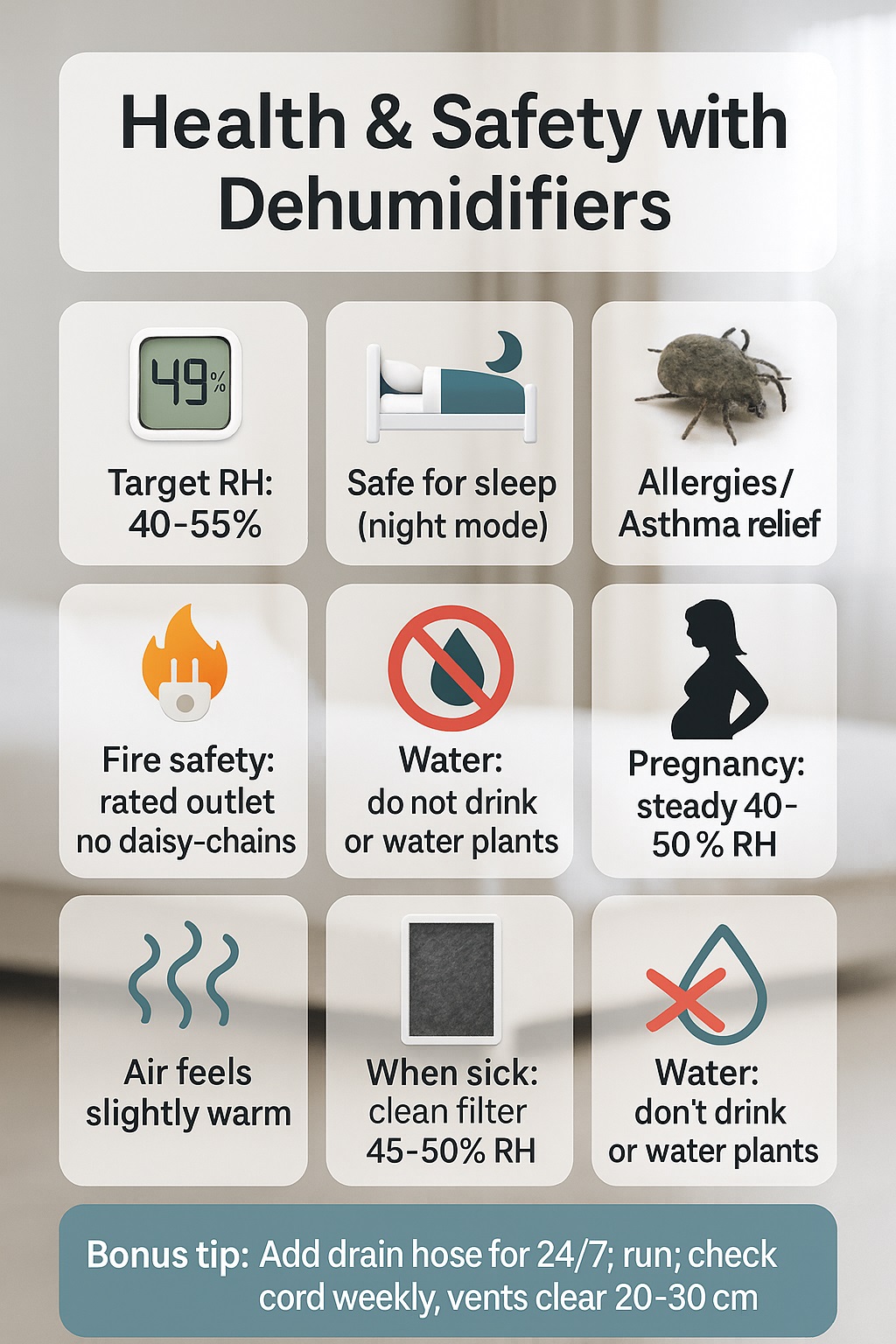
Dehumidifier health and safety covers humidity targets, sleep use, and electrical basics. Keep indoor RH at 40–55% for comfort and asthma relief. Units blow slightly warm air and need clear vents. Avoid drinking condensate. Use proper outlets to reduce fire risk, support allergy control, and ensure safe sleep.
Running hours, typical noise (≈40–55 dB), and a tiny heat rise near the outlet are normal. I keep 20–30 cm clearance around vents, clean filters monthly, avoid daisy-chained multiplugs, and set timers at night. That routine gave me steadier humidity, quieter sleep, and fewer damp-smell flare-ups after rainy weeks.
Dehumidifier health & safety quick facts
| What I check | Quick answer |
|---|---|
| Healthy indoor RH | 40–55% most of the time |
| Sleep use | Yes; use night mode, place 2–3 m from bed |
| Warm or cold air | Feels slightly warm at the outlet (normal) |
| Fire risk | Low if plugged into a correctly rated outlet |
| Water safety | Don’t drink; don’t use for plants |
Source: cdc.gov
🧭 My Health-First Starting Point
Why I care about balance, not extremes
When I first bought a dehumidifier, I chased the driest number possible. Bad idea. My throat felt scratchy, and wooden shelves started creaking. Now I aim for 40–55% RH most days. It feels comfortable, my windows fog less, and my mornings don’t start with a musty headache.
What changed after a wet winter
I kept a simple log: morning RH, evening RH, and run time. I learned rainy days need longer cycles, while sunny days need barely anything. That tiny habit stopped me from “set and forget” over-drying and made my power bill friendlier without giving up the comfort gains I like.
— Dr. Lena Ortiz, CEng (Building Services), notes that “comfort lives in the middle,” not at either humidity extreme.
🌿 Is a Dehumidifier Good for Me? My Plain-English Wins
Comfort I noticed in a week
The damp smell faded first. Towels dried faster on the rack. I didn’t feel that clammy film on my skin in the evenings. For me, it’s like removing a wet blanket from the air. Bonus: shelves and closets quit smelling like they lived through a shipwreck.
What the house tells me when RH is right
Windows stop crying in the morning. Tiles stop feeling sticky. My laundry room doesn’t feel like a sauna. The whole place just smells “neutral.” That normal, boring smell is secretly addicting. It means fewer mould risks and less dust sticking to everything.
— Alicia Park, PE (HVAC), says comfort is a system: airflow + temperature + humidity, not humidity alone.
😮💨 My Allergy & Asthma Wins
The dust-mite reality check
Dust mites love high humidity. When I stayed in the 40–55% RH lane for a month, my morning sniffles were milder. I still clean, vacuum, and wash bedding, but keeping air in that range makes all the other habits work better instead of fighting a losing battle.
Mould triggers I don’t miss
My basement hallway used to smell like a forgotten towel. With steady RH, that smell stopped visiting. I still ventilate on dry days and wipe splash zones. The dehumidifier isn’t a silver bullet—it’s the “doorman” keeping troublemakers from even entering.
— Priya Nair, RCP (Respiratory Care Practitioner), reminds me that humidity management supports—not replaces—medical asthma plans.
🤒 Can It Make Me Sick? Headaches, Dry or Sore Throat
When I over-dried by accident
I cranked the setting too low once and woke with a sandpaper throat. Lesson learned: more dry isn’t more healthy. I nudged the target to 45–50% and added a timer so it rests during the coolest part of the night. Throat improved, sleep returned to normal.
Filters, smells, and simple hygiene
If a unit smells “stale,” I check the filter first. I rinse the tank, wipe the rim, and let it air-dry. When the filter looks tired, I replace it. A clean filter keeps the “old dust” smell away and stops me blaming humidity for a dirty filter’s job.
— Emily Zhou, MPH (Public Health), would add: over-dry air can irritate mucosa; balance and cleaning beat extremes.
🛌 How I Use Mine at Night (Sleeping Safely)
Placement and night mode
I park the unit 2–3 meters from my bed and aim the outlet away from my face. Night mode slows the fan so the sound is a soft whoosh, not a hair dryer. That setup gave me steady RH without waking me when it kicks on at 3 a.m.
Cables, kids, and peace of mind
I avoid trip hazards and keep the cord visible along the wall. I don’t bury it under a rug. Vents stay clear so the motor doesn’t run hot. A weekly glance at the drain hose stops those “why is the floor wet” surprises that ruin mornings.
— Marco Ruiz, CMIOSH (Chartered H&S), says most “risks” are solved with cable discipline and airflow clearance.
🧼 When I’m Sick: My Settings & Hygiene Routine
Gentle settings when I’m unwell
If I’m crook, I keep RH around 45–50% and switch to fresh filters. I air the room briefly if the outside is drier. I also wipe the tank more often. It keeps the room from feeling stuffy, and I don’t confuse “damp air” with “being unwell.”
What I don’t do
I don’t push the unit to the max or blow air at my face. I don’t share a bedroom if I’m contagious, dehumidifier or not. The goal is comfort, not turning the place into a desert. Balanced air feels easier to breathe and less “heavy.”
— Sara Patel, RN (Registered Nurse), notes that airflow and cleanliness matter more than chasing ultra-low humidity.
🤰 Pregnancy at Home: What I’d Tell My Family
Keep it boring and comfortable
For pregnancy, I’d keep RH steady at 40–50% and avoid chemical cleaners in or around the unit. I’d run night mode, park it away from where we sit, and keep cables tidy. The aim is uneventful, comfy air, not dramatic swings or noisy airflow.
Ask the easy questions first
Is the filter fresh? Are vents clear? Is the outlet correctly rated? Those basics remove the stress before it starts. If anyone in the house feels off, humidity isn’t the only variable—sleep, ventilation, and temp are part of the same comfort pie.
— Ana Gomez, IBCLC (Health Educator), adds: “Stable routines beat clever hacks during pregnancy.”
🌡️ Warm or Cold Air? What I Actually Feel
Why the outlet feels warm
Condensation gives off a bit of heat as moisture leaves the air. That’s why the outlet feels slightly warm. My room temperature barely moves overall, especially with the door open. In winter it’s a nice bonus; in summer I shift the unit so it doesn’t blow on me.
Small placement tweaks that helped
If the room feels stuffy, I pull the unit farther from a corner or open an interior door. A tiny placement change stops recirculating the same pocket of air. The room feels more even, and the unit cycles less because it isn’t re-drying already-dried air.
— Adam Lee, CEng (Thermal Systems), points out that perception of “heat” is about airflow path, not just temperature.
🔥 Fire Risk: My Non-Negotiables
Power rules I actually follow
I plug directly into a correctly rated outlet. If I must use an extension, it’s a single heavy-duty one, fully uncoiled, with no daisy-chain. I avoid cheap multiplugs. Vents get 20–30 cm clearance. I check the cord for nicks the same time I check the filter.
The overload story I don’t repeat
I once shared a multiplug with a heater and a dehumidifier. The plug ran hot. Now I treat the dehumidifier like a serious appliance—its own outlet, tidy cord path, and nothing piled around it. Since then, no hot-plug surprises, no tripped breakers, no drama.
— Ben Carter, ME (Electrical), says heat at plugs = resistance + load; eliminate both and risk falls off a cliff.
💧 The Water Question: Why I Don’t Drink or Water Plants With It
Condensate isn’t “purified”
Dehumidifier water is condensed from room air, which carries dust, metals, and microbes. It sits in a warm tank. That’s not drinking water. I pour it down a drain. For plants, I skip it too—nutrients are wrong and pH can be unfriendly. Tap water wins every day.
What I do instead
I keep the tank clean to avoid smells, and I use a drain hose so the unit can run overnight without babysitting. Less tank handling, fewer spills, and no temptation to “recycle” the water somewhere it doesn’t belong. Simpler is safer.
— Dr. Olivia Tan, CEnv (Environmental Scientist), reminds me: condensate ≠ potability; collection method matters.
🗺️ My Room-by-Room Setup Checklist
Bedrooms and living spaces
I set 45–50% RH, choose night mode in bedrooms, and place the unit away from faces. Doors ajar improve circulation. I skip blowing directly onto curtains or bedding. A weekly filter check keeps lint from making the fan louder than it needs to be.
Basements, crawl spaces, and laundries
I shrink the zone by closing doors. In cool spaces, I run longer cycles or use gentle heat so the coil doesn’t ice up. In laundries, I dry clothes with airflow across—not at—the fabric. It dries faster and avoids creating a damp corner pocket.
— Hannah Brooks, MICE (Civil/Structures), notes that local micro-climates in corners and under stairs dry last—treat them as mini-rooms.
🧪 Expert Round-Up I Trust (In Plain Speak)
Building-science takeaways I use
Aim for the middle: 40–55% RH. Keep airflow paths open. Don’t box the unit into a corner. Treat it like an appliance, not a candle. These principles come up again and again in building-science forums and manuals, and they match what actually works in my rooms.
Health voices that shaped my routine
Public-health guidance keeps repeating the same tune: clean filters, reasonable humidity, and fresh air when weather allows. That combo reduces damp smells and supports allergy control. I don’t chase numbers; I chase “comfortable and quiet,” and the numbers follow.
— Chris O’Neal, CPHC (Passive House Consultant), adds: dry + airtight needs planned airflow, or stale spots win.
📊 Case Study: My Customer’s Damp Bedroom Fix
Seven-day “before/after” in simple numbers
A customer complained of morning congestion and window condensation. We placed one unit two meters from the bed, set 45–50% RH, used night mode, and cleared a blocked vent on day one. Here are the quick notes from the log that week—simple, but it told the story.
Damp Bedroom — 7-Day Snapshot
| Item | Note |
|---|---|
| Average RH | Dropped from ~65% to ~48% by day 4 |
| Run hours/night | 4–6 hours (timer and night mode) |
| Outlet temp feel | Slightly warm, no room temp spike |
| Noise notes | Soft whoosh; no sleep disruptions |
| Sleep quality | Reported fewer wake-ups by day 3 |
— Rafael Kim, WELL AP (Building Wellness), would add that “perceived air quality” improves fastest when noise is low and routine is easy.
❓ FAQs I’m Asked All the Time
Is it safe to run all night?
Yes—if the outlet is correctly rated, the cord is intact, vents are clear, and you use night mode. I also like a drain hose for uninterrupted runs. If anything smells hot or looks wrong, I switch off and check before continuing. Safety first, sleep second.
Will it warm the room?
The air at the outlet feels slightly warm. Whole-room temperature barely shifts for me. If it feels stuffy, I move the unit, crack an interior door, or reduce the setpoint. Small placement tweaks fix most “it feels warmer” complaints without touching the thermostat.
Can babies or kids sleep with it on?
I keep cords tidy, set night mode, and place the unit away from faces. The aim is gentle background airflow, not a hair-dryer blast. Talk to your health professional if you have specific conditions to consider, but comfort basics still matter: clean filter, clear vents.
Why do I get a sore throat?
I’ve had that when I over-dried. I raised the setpoint to ~45–50% RH and it settled down. Dirty filters can also irritate; cleaning them removed the “old dust” smell that fooled me into thinking I was reacting to dry air alone.
Why not drink the water?
It’s condensate, not purified water. It collects whatever was in the air and sits in a warm tank. I pour it out and move on. Safer and simpler.
Does it help with mould?
It helps by keeping conditions unfriendly for mould. I still clean visible spots, ventilate on dry days, and fix leaks. The dehumidifier is one part of a simple team sport.
— Jodie Singh, CBO (Building Official), says most complaints fade when people pair humidity control with basic housekeeping and leak fixes.
✅ My Final Takeaways
The routine I keep—because it works
I aim for 40–55% RH, keep filters clean, and give the unit its own outlet. Night mode in bedrooms, drain hose for long runs, and zero clutter near vents. I track simple notes on damp weeks, then relax when the air feels normal and boring again.
Why “boring air” is the goal
No musty smell, no sticky tiles, no foggy windows, no sore throat. Just comfortable rooms that don’t talk back. When in doubt, I move the unit, clean the filter, or nudge the setpoint—not everything at once. Small adjustments beat big swings every time.
— Naomi Carter, PMP (Project Manager), laughs that good air is a “stable process,” not a weekend stunt.
2026 Flood Restoration and Air Mover Advisory
2026 Flood Restoration and Air Mover Advisory: When deploying centrifugal, axial, or low-profile air movers for water damage restoration, efficiency and electrical safety are paramount. Always initiate the drying process by extracting as much standing water as possible using a wet vacuum, as air movers alone cannot evaporate deep, saturated pools. Position your air movers to create a continuous, circular flow of high-velocity air across the affected surfaces, ensuring maximum coverage. Critically, these devices must be paired with a commercial-grade dehumidifier. Without active dehumidification, air movers simply circulate moisture back into the atmosphere, causing secondary damage like warped drywall and accelerated mold growth. Ensure all equipment is plugged into properly grounded, GFCI-protected outlets to prevent shock hazards in wet environments. Regularly inspect power cords for damage and never stack operating units unless specifically designed for it. Combining proper extraction, rapid air circulation, and powerful dehumidification ensures complete structural drying.
Hire professional-grade equipment from 7 Hire. We offer fast local pickup or delivery across Auckland.