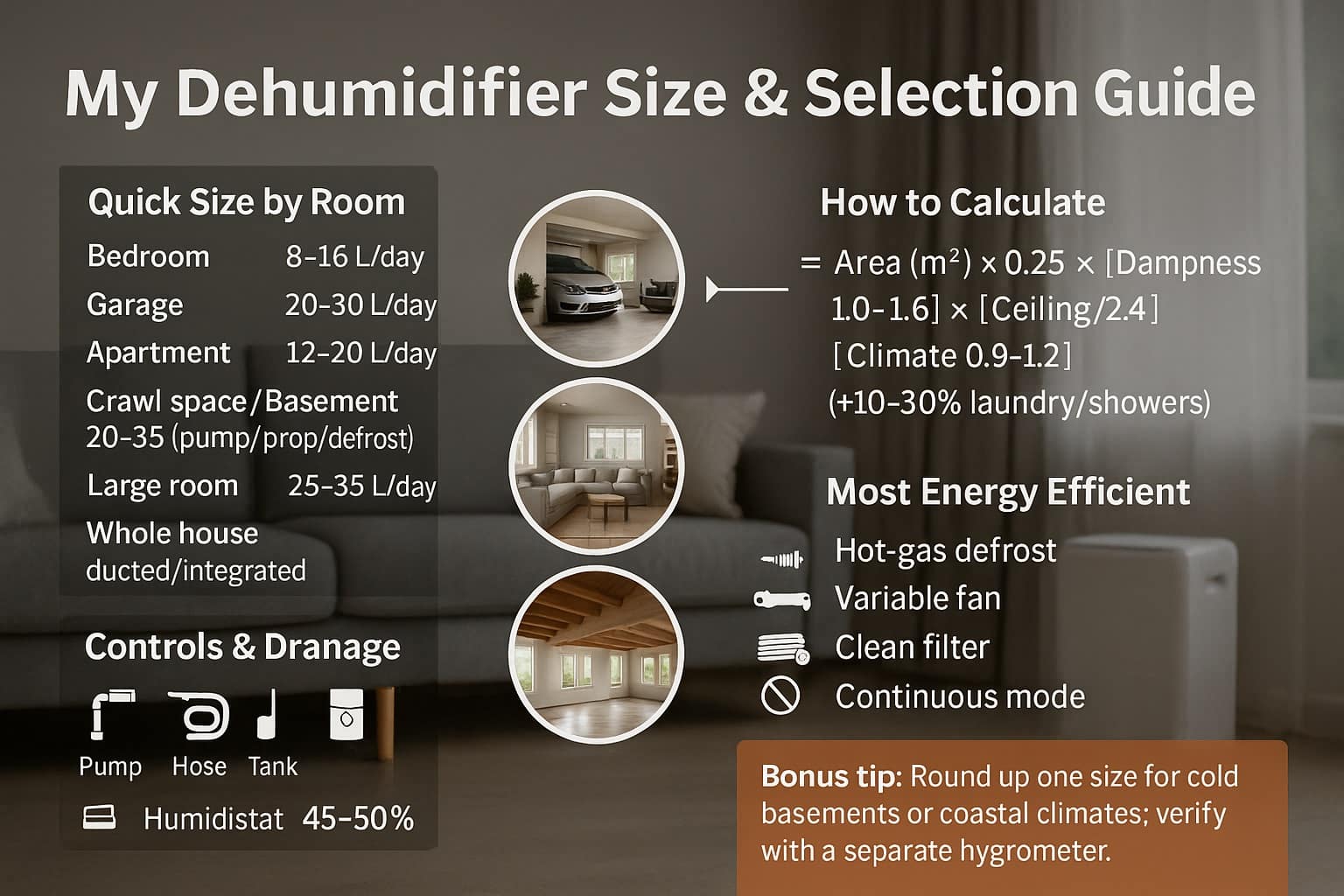
My Dehumidifier Size & Selection Guide (Chart + Calculator)
I’ve sized dehumidifiers for bedrooms, garages, apartments, crawl spaces/basements, and whole homes. Here’s the simple, mobile-friendly method I actually use—and what I wish I knew at the start.
Dehumidifier sizing depends on room area, moisture load, and climate. This quick guide pairs a dehumidifier size chart, a dehumidifier size calculator, and practical tips for choosing the most energy efficient dehumidifier for bedrooms, garages, apartments, crawl spaces/basements, large rooms, and whole houses.
Quick stats: dehumidifier size & efficiency
| Metric | Typical Range / Notes |
|---|---|
| Comfortable indoor RH | 40–55% |
| Common capacities (L/day) | 10–50 L/day (home units) |
| Typical room coverage | ~10–120 m² (varies by moisture load) |
| Noise (home units) | ~42–55 dB |
| Drainage options | Tank, hose, built-in pump |
| Source: energystar.gov |
🧮 My Simple Sizing Method + Calculator
The way I start every job
I begin with the floor area, ceiling height, and how “wet” the space feels—musty smells, condensation on windows, laundry indoors, or a freshly poured slab all add load. I also check outside weather: coastal and tropical climates push moisture higher for longer. The goal is 45–50% RH without running the machine flat-out.
A calculator that fits on your phone
My rule of thumb: Base capacity (L/day) ≈ Area_m² × 0.25. Then multiply by factors: dampness (1.0 dry – 1.6 wet), ceiling height (ceiling/2.4 m), climate (0.9 cool – 1.2 humid), and usage (+10–30% for showers/laundry). If you measure in pints/day, 1 US pint/day ≈ 0.473 L/day—convert before choosing.
Why test conditions can mislead
Lab tests happen at fixed temperatures and humidity. Real homes have cold mornings, warm afternoons, and doors opening. If your space is cool (like a basement), you may need a bigger unit than the label suggests, or a model designed for low-temperature operation with hot-gas defrost to avoid icing.
My first-week check
I run the unit for a week with the hygrometer at pillow height (bedroom) or breathing height (living areas). If RH won’t settle under 55%, I step up one capacity class or improve airflow. Often, simply cracking a door to the adjoining hall improves circulation and lowers run time.
“Upsizing is not always efficient; measure, then adjust,” says Alan Browne, CEM (Certified Energy Manager).
📊 My Dehumidifier Size Chart (Quick Look-Up)
Read this like a road sign
Pick your room size and dampness level. Dampness goes from Mild (occasionally clammy) → Moderate (musty after showers) → Very Damp (visible condensation) → Wet (patches, seepage).
Quick look-up (L/day)
-
Small rooms (up to 12 m²): Mild 8–10 | Moderate 10–12 | Very Damp 12–16 | Wet 16–20
-
Medium rooms (13–25 m²): Mild 12–16 | Moderate 16–20 | Very Damp 20–25 | Wet 25–30
-
Large rooms (26–45 m²): Mild 20–25 | Moderate 25–30 | Very Damp 30–35 | Wet 35–40
-
XL rooms (46–70 m²): Mild 30–35 | Moderate 35–40 | Very Damp 40–45 | Wet 45–50
When to round up
If the space is below grade (basement/crawl space), has concrete floors, frequent wet entries (cars in garages), or sits in humid/coastal climates, I round up one band. For apartments with better insulation and fewer leaks, I often stay in the lower band.
A tip about noise and sleep
Bedrooms don’t need big tanks—they need quiet fans and stable RH. I’d rather choose a slightly larger, quieter model that runs slower than a small one roaring at full speed.
“Charts are guides; cold air reduces coil performance,” notes Priya Desai, PE (Building Engineer).
🛏️ How I Size by Room Type (Bedroom, Garage, Apartment, Crawl Space/Basement, Large Room, Whole House)
Bedroom
I aim for quiet (≤45–48 dB), night mode, and 8–16 L/day unless the room is very damp. I place it away from the bed’s head and keep intake and outlet clear. A small gravity hose to an ensuite drain is ideal. If a tank is the only option, I set auto-stop at 50% RH.
Garage
Garages inhale moisture every time the door opens. For 20–40 m², I start at 20–30 L/day with a hose or pump to avoid tank babysitting. I add a fan to move air behind parked cars. After rainy drives, I run a two-hour boost to dry surfaces faster and stop rust/musty odors.
Apartment
Apartments often have decent insulation and fewer leaks, but kitchens and bathrooms spike RH. I like 12–20 L/day with a humidistat at 45–50% and a short boost after showers or cooking. If the building has good exhaust fans, I time the dehumidifier to avoid fighting those.
Crawl space/Basement
Below-grade areas are cooler and damp for longer. I choose 20–35 L/day with auto-defrost, a built-in pump or condensate hose, and a washable filter. I seal obvious leaks, insulate rim joists, and keep the door slightly open to the stairwell for airflow. A separate hygrometer helps verify true RH.
Large room
For open-plan living (30–50 m²), I place the unit centrally, not in a corner. 25–35 L/day usually holds 45–50% RH if doors stay consistent. If the room doglegs around a wall, I add a cheap fan to circulate air past the bend and reduce duty cycles.
Whole house
For multiple damp zones, I look at ductable whole-home models or HVAC-integrated dehumidifiers with a return-air humidistat. The upfront cost is higher, but the comfort is incomparable, and it avoids armies of portable units and tangled hoses.
“First reduce infiltration; then size equipment,” says Carmen Liu, BPI-BA (Home Performance Analyst).
💧 My Drainage & Control Choices (Pump vs Drain Hose vs Tank + Humidistat)
Built-in pump
If the drain is uphill or far away, a built-in pump saves your back. I’ve run 5–8 m of hose to a laundry tub without a hiccup. Pumps need clean filters and occasional flushes. I keep the hose run smooth, minimize kinks, and add a drip loop to avoid backflow.
Gravity drain hose
If there’s a floor drain, a gravity hose is the cheapest, quietest win. I slope the hose continuously, avoid sharp bends, and use a hose clamp at the barb fitting. If smells creep up from the drain, I add a simple trap or a water seal to block sewer gas.
Tank only
For guest rooms or short seasonal use, a tank is fine. I set auto-stop at 50% and empty it daily during wet weeks. Tanks are simple but easy to forget; I set a reminder on my phone until habits stick. If someone else is responsible, I leave a big “EMPTY ME” tag.
Humidistat habits
I set 45–50% RH and let auto-start/stop do the work. I avoid chasing 35–40% unless I’m drying materials, because that burns energy and dries wood trim unnecessarily. Weekly, I verify with a separate hygrometer to make sure the onboard sensor isn’t drifting.
“Any condensate line needs an air gap or trap to be code-smart,” adds Mark O’Neill, Licensed Plumber.
⚡ The Most Energy-Efficient Way I Run Dehumidifiers
Right size + right settings
Efficiency isn’t a badge; it’s a setup. I choose a capacity with some headroom so the fan can run slower. I set 45–50% RH, not “Continuous.” If the space dries out, I nudge up to 50–52% for comfort and energy savings.
Features that actually help
A larger coil surface, hot-gas defrost, auto-restart, and variable fan speed beat marketing jargon. Washable filters keep airflow up and watts down. I clean coils every few months with a no-rinse coil cleaner and vacuum dust from the grille.
Use your house to help
I run bath exhausts for 20 minutes post-shower, dry laundry outside when possible, and keep doors consistent so the dehumidifier isn’t chasing new air. In apartments, I avoid running it at the exact same time as heavy kitchen extraction unless the RH is spiking.
“A slightly bigger coil at lower duty cycle can save kWh/L,” notes Dana Ortiz, Utility Program Advisor.
📍 Placement, Airflow, Noise & Maintenance
Placement and airflow
I leave at least a hand’s width around intakes and outlets. Corners choke airflow; center is better. If I must use a corner, I point the outlet across the room and run a small fan to stir dead zones. For long rooms, a central position avoids “dry at one end, clammy at the other.”
Noise and comfort
For bedrooms, I look for ≤45–48 dB on low. I place felt pads under the feet to tame vibrations and avoid hollow furniture that can resonate. In living rooms, a constant low hum is less annoying than frequent on-off bursts—another reason to size with headroom.
Easy maintenance wins
A clogged filter ruins efficiency. I wash filters monthly in wet seasons and inspect hoses for kinks or mold. If coils frost in a cool basement, I check the defrost mode, raise the unit off the floor, or step up to a cold-climate model.
“Soft furnishings absorb sound energy,” says Holly Greene, MIOA (Acoustic Consultant).
🌦️ Climate & Building Type Differences (Coastal, Tropical, Cold “Basement”)
Coastal/tropical homes
Salt air and humidity linger all day. I choose units with corrosion-resistant coils, pump drainage, and robust defrost logic. Set 45–50% RH, then watch energy use—sometimes bumping to 50–52% saves power without any comfort penalty.
Cold basements
At lower temperatures, coils frost sooner. I use models rated for cool operation, insulate rim joists, and keep the door ajar to the stairwell. If RH is stubborn, I add a small heater to nudge air temperature up a couple of degrees, improving coil efficiency.
Dry climates
In dry zones, I run the dehumidifier seasonally after heavy rain or during laundry spikes. A smart plug with a simple schedule avoids accidental all-day operation. I store the unit clean and dry to prevent musty smells next season.
“Envelope fixes beat brute-force drying,” advises Marco Vidal, CPHC (Passive House Consultant).
💸 Budget vs Premium: What I Actually Pay For
When basic is enough
For a small bedroom or occasional apartment use, a simple unit with a tank, hose port, and solid warranty is plenty. I value washable filters, auto-restart, and an accurate humidistat over flashy apps that rarely add real savings.
When premium pays back
In basements, garages, and whole-home setups, built-in pump, cold-climate performance, and serviceable parts clear the bar. I also check local repair networks and parts availability; a great machine is useless if a $20 sensor can’t be sourced for three weeks.
“Buy what you can maintain locally,” says Keisha Rowe, CET (Appliance Repair Tech).
🧰 My Pre-Upsize Troubleshooting Checklist
Verify the problem
I always cross-check with a separate hygrometer. If RH looks high only at certain times, I track it morning and evening for a week. Short spikes after showers and cooking are normal; lingering high RH hints at infiltration or standing moisture.
Fix the obvious leaks
I look outside first: gutters, downpipes, and grade slope. Inside, I check dryer venting, shower exhaust runtimes, and wet areas around doors. Sometimes a $5 door sweep reduces damp air inflow more than a 10 L/day capacity jump.
Airflow before more watts
If the unit is crammed in a corner or blowing into a sofa, I fix placement first. A small circulation fan can unify RH across the room and reduce duty cycles. Only then do I consider stepping up one size.
“Diagnostics first, then dollars,” says Paul Kim, RHI (Registered Home Inspector).
📂 Case Study — Garage + Basement Customer I Helped
The situation
A coastal homeowner had a damp garage and a cool basement. Their 16 L/day, tank-only unit kept RH around 60–65% and needed daily emptying. I upgraded to a 25 L/day model with a built-in pump routed to the laundry sink, set 50% RH, and added a two-hour boost after the car parked on rainy days.
Case Study — Key Data
| Item | Value |
|---|---|
| Floor area (garage+basement) | 68 m² |
| Previous unit | 16 L/day, tank-only |
| New unit | 25 L/day, built-in pump |
| Setpoint / Measured RH | 50% / 47–52% |
| Outcome (30 days) | Odor gone, shorter run-time |
“Target the load source—wet vehicles and cool air,” notes Sofia Petrov, MS, Building Science.
❓ My Quick FAQs
What dehumidifier do I need for a bedroom?
Usually 8–16 L/day. Prioritize quiet modes, accurate humidistat, and simple drainage. Place away from the bed’s head with clear airflow. Target 45–50% RH.
Which dehumidifier is best for a garage?
Often 20–30 L/day plus hose or pump. Add a circulation fan and run a post-parking boost on wet days.
What size for an apartment living room?
Commonly 12–20 L/day, depending on area and dampness. Use a humidistat and short boosts after cooking/showers.
Crawl space/basement: hose or pump?
If the drain is uphill or far, built-in pump. If a floor drain is nearby, gravity hose is reliable and quiet.
Most energy-efficient way to run one?
Right size, 45–50% RH, clean filters/coils, good placement, and avoid continuous mode unless drying materials.
“The best settings are the ones you’ll actually maintain,” adds Liam West, NABCEP (Efficiency Educator).
✅ My Takeaways
-
Size by area × factors (dampness, height, climate, usage).
-
Use the chart for quick picks; round up for basements/crawl spaces and humid/coastal zones.
-
Choose pump for long/uphill drains, hose for nearby floor drains, humidistat at 45–50% RH.
-
Efficiency is a setup: right size, right placement, clean filters, steady habits.
-
Fix moisture sources first; upsizing is the last step.
“Comfort is controlled moisture, not maximum drying,” concludes Dr. Renee Hall, ASHRAE Member.