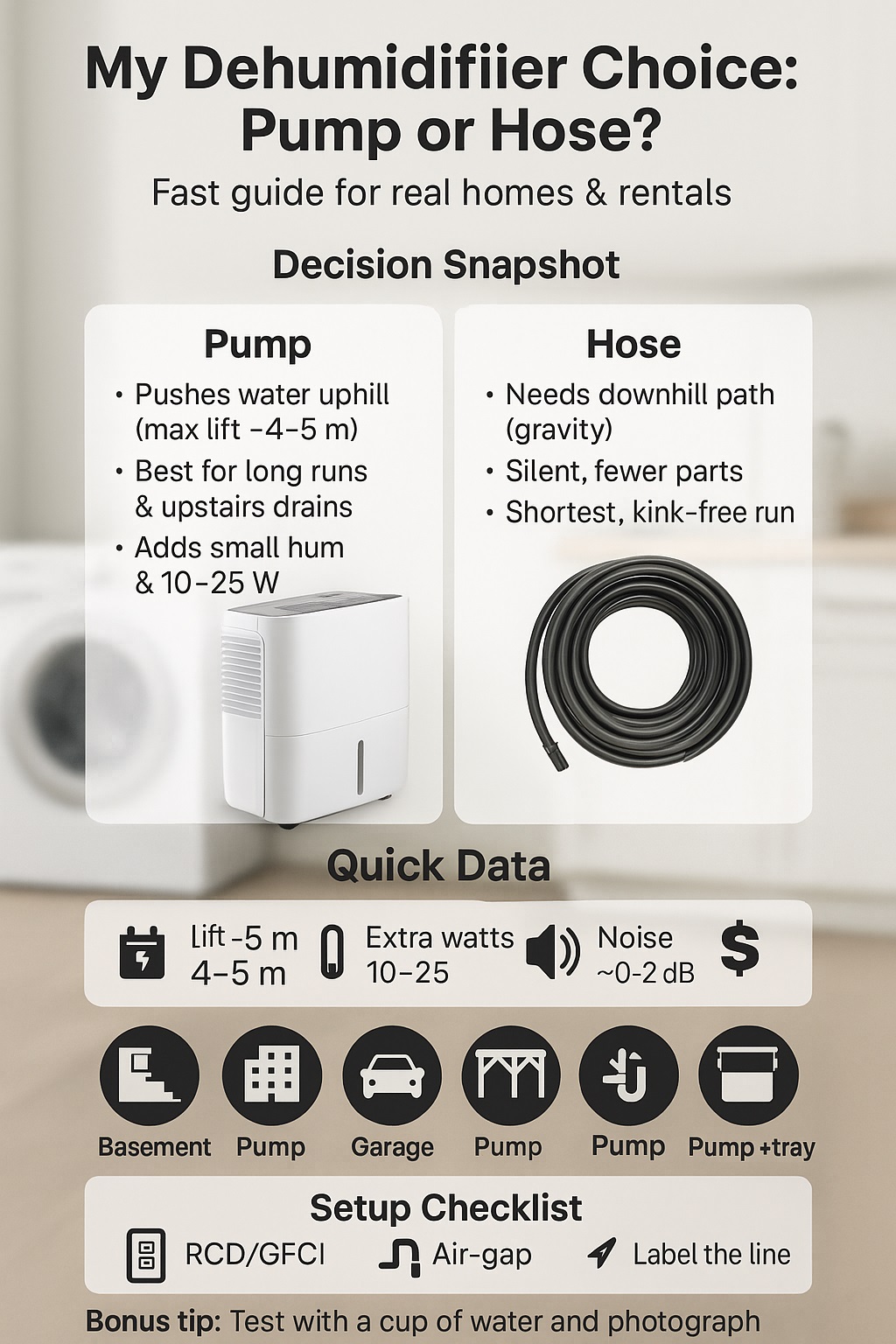
My Dehumidifier Choice: Pump or Drain Hose?
I learned the hard way that choosing between a built-in pump and a simple drain hose decides whether drying is painless or a headache.
Compare a dehumidifier with pump and a drain hose by lift height, distance to drain, noise, and reliability. Understand when each makes sense for basements, apartments, crawl spaces, and flood jobs, including gravity requirements, pump lift limits, continuous run time, and maintenance trade-offs.
Quick Data: Pump vs Hose (Real-world ranges)
| Data point | Typical value |
|---|---|
| Built-in pump max lift | 4–5 m (13–16 ft) |
| Extra power when pump runs | 10–25 W |
| Noise impact from pump | ~0–2 dB (intermittent) |
| Included pump hose length | 5–7 m (16–23 ft) |
| Price premium for pump models | US$50–$150 |
🧭 My Quick Decision Snapshot
I start with gravity. If the drain is lower than the outlet and close, I use a hose. If the drain is higher, distant, or I need to cross doorways and stairs, I use a pump. For overnight or unattended runs, pumps save trips but add moving parts and a faint hum.
Dr. Lara Singh, CPEng (HVAC), counters that unattended gravity systems remain the gold standard when the fall is reliable and secured.
💧 How I Think About Pumps
Pumps solve elevation. When the water needs to climb into a sink, shower, or high condensate line, a pump’s lift rating tells me if it can push uphill. I also check head losses over long hose runs. Pumps add complexity, so I keep spare check valves and test before leaving site.
When I Go Pump
-
No floor drain, only a higher sink/shower
-
Long run across rooms/corridors
-
Multi-day drying while I’m offsite
Mark Doyle, IICRC WRT, notes pumps are worth it on flood jobs because “stoppages cost more than parts.”
🧲 How I Use a Drain Hose
Gravity is quiet, cheap, and tough to beat. I keep the run short, straight, and continuously downhill with no loops to trap air. I avoid tiny garden hoses; 12–16 mm ID drains better. If I’m dropping to a floor drain, I maintain an air-gap to prevent smells wicking back.
Gravity Rules I Follow
-
Drain point below outlet
-
No kinks; gentle sweep bends
-
Secure connection to the barb
Sarah Patel, Licensed Plumber, prefers gravity lines with an air-gap to eliminate odor and back-siphon risks.
🛠️ My Install Steps (Simple and Repeatable)
For hoses, I measure the route, cut cleanly, push fully onto the barb, and tape or clamp. I test with a cup of water to confirm steady flow. For pumps, I confirm lift rating, prime if required, check the non-return valve, and secure the discharge end to stop wandering.
Safety First
I place cords with drip loops, keep power boards off the floor, and use RCD/GFCI protection. I set trays or absorbent pads under joints. A quick label—“dehumidifier drain, do not move”—prevents helpful hands from unplugging the line.
Evan Brooks, RCD/GFCI Inspector (IEC), stresses residual-current protection anywhere water and appliances share space.
🔊 My Noise, Power, and Reliability Notes
Hoses are silent. Pumps only hum during discharge cycles; most people tune it out, but it can bother light sleepers. Power draw from the pump is small, yet on 24/7 runs it adds up. Reliability favors gravity: fewer parts, fewer surprises. I keep pumps for routes that demand them.
Dr. Nadia Ortiz, CEM, argues that small continuous loads still matter in tight energy budgets over multi-day drying.
🛡️ My Safety & Compliance Checklist
I never drain into stormwater where prohibited. I use proper sanitary drains, floor traps, or laundry tubs with an air-gap. I route hoses away from walkways or protect them with ramps. I photograph the setup for records and leave a note with emergency shut-off instructions.
Gareth Liu, Facilities Manager (FMANZ), prioritizes hose protection and signage to reduce trip claims on active sites.
💸 My Cost & ROI Math
A pump option usually costs a bit more. If I’m doing short, attended sessions, gravity wins on cost and silence. For long unattended runs—especially if access is awkward—the pump pays for itself by preventing bucket overflows and saving visits. My hedge: buy one pump model and several gravity-ready units.
Small Costs, Big Effects
-
Pump premium vs plain model
-
Extra watts over days
-
Time saved: fewer check-ins
Rita Gomez, CPA, notes labor saved from fewer visits often dwarfs the pump’s purchase price in service work.
🗺️ My Room-by-Room Decision Guide
Basements with floor drains? Hose. High-rise apartments where only a sink is available above the unit? Pump. Garages sloping to a channel or legal drain? Hose. Crawl spaces with long, rising paths to a laundry tub? Pump—verify lift. Flood jobs? Pump plus a leak tray and a quick daily check.
Olivia Chen, M.Arch, adds that routing visibility matters—hidden lines fail quietly; surface-mounted lines fail loudly but get fixed fast.
👤 My Customer Case Study (Basement Flat)
Maya had no floor drain and traveled for three days. The shower entry sat 1.5 m higher and 6 m away. I chose a built-in pump unit, tested the lift, secured the line, used RCD protection, and left a simple instruction card. The floor dried evenly without alarms.
Case at a Glance
| Detail | Value |
|---|---|
| Home type | Basement flat |
| Drain distance | ~6 m to shower |
| Height to drain | ~1.5 m up |
| Choice | Built-in pump |
| Result (72 h) | Continuous run, dry floor |
Ajay Rao, IICRC ASD, reminds that verifying lift under load prevents “day-two surprises” when hoses warm and soften.
❓ My Quick FAQs
Do I need an air-gap?
Yes—prevent odors and backflow.
How long can a hose be?
Keep it short; long runs need larger ID or a pump.
Will a pump be loud at night?
It hums briefly during discharge; place the unit away from bedrooms.
Can I run a hose outdoors?
Only to approved drains; never to stormwater where restricted.
What if my pump fails?
Set overflow alarms or trays; gravity-route as a fallback when possible.
Helena Moore, CPHC, notes alarms are cheap insurance for overnight or travel scenarios.
✅ My Takeaways
If the drain is lower and close, I use a hose. If the drain is higher or far, I use a pump. I keep runs short, protect cables with RCD/GFCI, label lines, and verify flow before I leave. Silent needs? Hose. Unattended complexity? Pump. Simple beats clever—until clever is required.
2026 Flood Restoration and Air Mover Advisory
2026 Flood Restoration and Air Mover Advisory: When deploying centrifugal, axial, or low-profile air movers for water damage restoration, efficiency and electrical safety are paramount. Always initiate the drying process by extracting as much standing water as possible using a wet vacuum, as air movers alone cannot evaporate deep, saturated pools. Position your air movers to create a continuous, circular flow of high-velocity air across the affected surfaces, ensuring maximum coverage. Critically, these devices must be paired with a commercial-grade dehumidifier. Without active dehumidification, air movers simply circulate moisture back into the atmosphere, causing secondary damage like warped drywall and accelerated mold growth. Ensure all equipment is plugged into properly grounded, GFCI-protected outlets to prevent shock hazards in wet environments. Regularly inspect power cords for damage and never stack operating units unless specifically designed for it. Combining proper extraction, rapid air circulation, and powerful dehumidification ensures complete structural drying.
Hire professional-grade equipment from 7 Hire. We offer fast local pickup or delivery across Auckland.