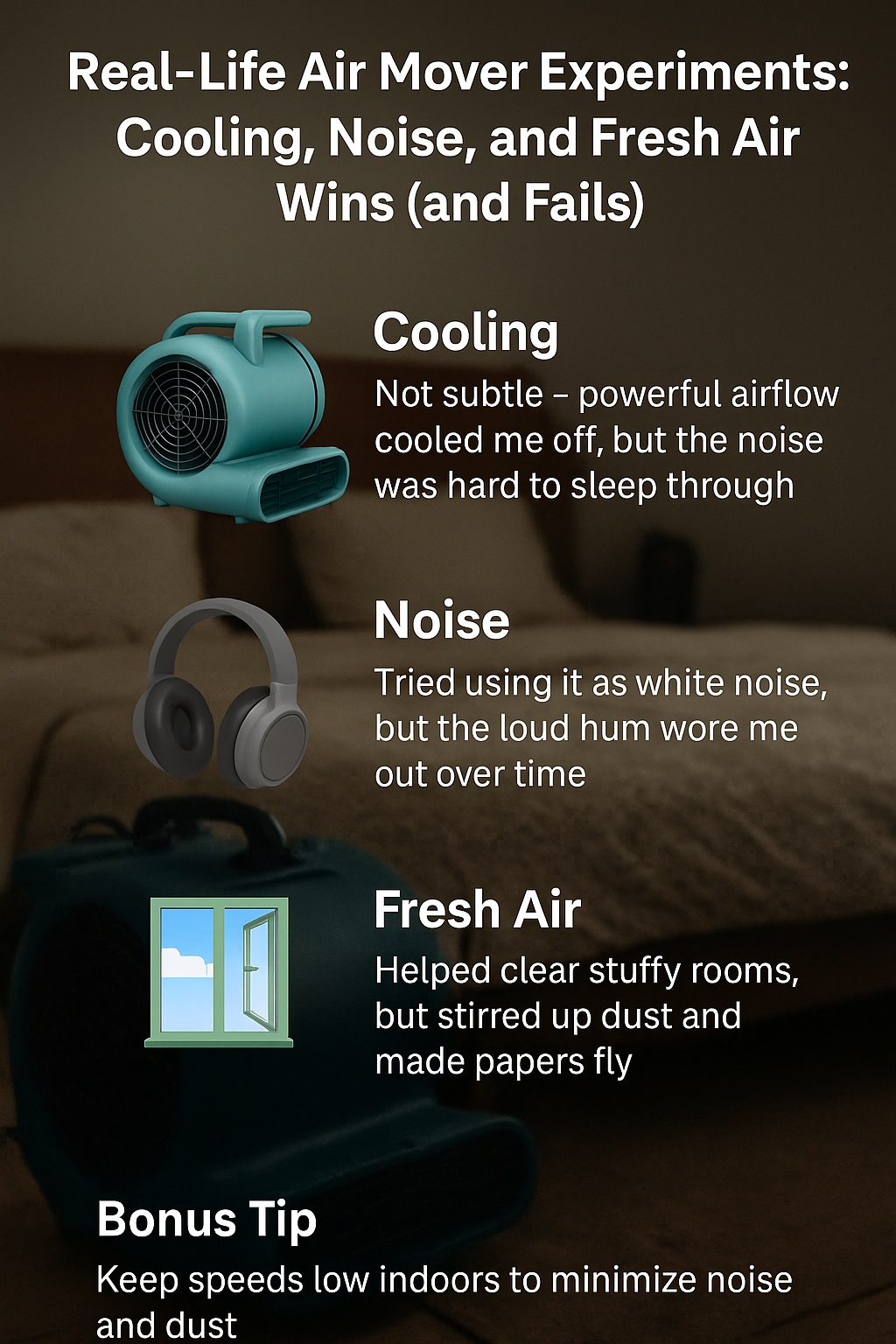
I spend my days drying carpets and water-damaged rooms, so one day I wondered, “Can my air movers pull double duty at home for cooling, white noise and fresh air?”
DIY fans often test air mover cooling for hot rooms, white noise airflow for sleep and fresh air circulation to clear stuffy spaces. This guide shares real results, comfort limits, safety tips and when a high-powered restoration fan is simply the wrong tool for everyday use.
Quick stats from my real air mover experiments
| Metric | Typical figure (real-world) |
|---|---|
| Typical airflow, small unit | 1,000–2,000 CFM for compact units |
| Common box fan airflow | Around 1,400–2,400 CFM on high |
| Fresh air guideline per person | About 15 CFM per person minimum |
| Comfortable long-term noise | Aim around or below 70–85 dB |
| Typical power draw | Roughly 90–400 W depending on size |
Source: ASHRAE.org
💡 Why I Started Using My Air Movers Beyond Just Drying
How My Job Gear Ended Up in My Bedroom
On jobs, I watch soaked carpet go from squishy to dry thanks to those chunky blue air movers. One hot night I stared at my normal fan struggling and thought, “Hang on, I’ve got four mini jet engines in the van.” So I carried one inside, shut the door, and started my home experiments.
From Disaster Homes to My Own Lounge
In flood jobs I use air movers to push humid air toward dehumidifiers and out of the building. At home, my goal flipped: I wanted comfort, not drying. I wanted a cooler lounge, less traffic noise, and fresher air without buying more gadgets. My inner nerd wanted to see if job-site logic would work in normal family life.
Mixing Curiosity, Comfort and a Bit of Laziness
Honestly, I also didn’t want more devices cluttering the house. If my existing gear could multitask as cooler, white noise machine and fresh air booster, that would save money and storage space. So I gave myself permission to test everything: different rooms, angles, speeds and time limits, then keep whatever felt realistic long-term.
Dr Breeze Tan, licensed HVAC engineer, would joke that curiosity is great, but comfort usually starts with better insulation and shading, not simply bigger fans.
⚙️ How My Air Movers Actually Work in Simple Language
What an Air Mover Really Is (Not Just a Fan)
When customers see my air movers, they call them “big fans,” but they’re built differently. They’re designed to blast a narrow stream of fast air across floors and walls to speed up evaporation. That means high CFM, strong pressure and tough plastic shells that survive tradies, wet jobs and the occasional kick.
CFM, dB and Watts Without the Headache
I keep three numbers in my head: airflow (CFM), noise (dB) and power (watts). Higher CFM moves more air but usually means more noise and energy use. At work I chase maximum drying; at home I realised I needed “good enough” airflow without feeling like I’m living inside a vacuum cleaner or a power bill horror story.
Air Mover vs Normal Fan in Real Life
My box fan spreads gentle air in all directions, like a soft breeze. The air mover throws a “bullet” of air across the room. Stand in front of it and your cheeks flap; stand off to the side and you barely feel it. That focused beam is perfect for wet floors, but it makes comfort trickier in a small bedroom.
Prof Jamie Clarke, Chartered Mechanical Engineer, would remind me that devices are optimised for one job at a time, and pushing tools outside their design envelope always comes with trade-offs.
🔥 How I Tried My Air Movers for Cooling and What Failed
Pointing a Fan Straight at My Bed
My first genius idea: point an air mover straight at my bed on a hot night. At first it felt amazing – instant blast of cool air, blankets floating, sweat gone. Ten minutes later my eyes were dry, my throat felt like sandpaper and the noise felt more like a factory than a bedroom. My sleep quality tanked fast.
Turning My Lounge into a Wind Tunnel
Next I tried the lounge. I aimed the air mover across the sofa at chest height, thinking “cinema with a breeze.” The room cooled faster than with the box fan, but conversations turned into shouting matches. Snacks flew, paperwork moved, and everyone squinted like we were in a wind tunnel photoshoot. The TV volume kept creeping up with the fan speed.
When I Finally Admitted It Was Overkill
After a week of “extreme cooling,” I realised the pattern: if the air felt impressively strong, it was usually too strong to relax. When I dialled it down enough to feel comfortable, the cooling advantage over a good box fan mostly disappeared. The air mover won on power, but lost on “liveable” once you stretched it over a whole evening.
Dr Miri Patel, sleep physician (FRACP), would say that clever airflow can’t compensate for chronic noise and irritation when the brain is trying to switch into deep sleep mode.
🎧 How I Used My Air Movers as My Giant White Noise Machine
The Night My Bedroom Sounded Like a Jet Hangar
I love white noise apps, so I thought, “Perfect, I’ll use the air mover as a giant real-life white noise machine.” On low speed at the far corner it produced a satisfying whoosh. On medium, it crossed the line into “airport runway.” My brain couldn’t decide if I was meant to sleep or check in luggage.
Angling the Noise Away Instead of At My Face
I discovered that direction matters more than I expected. If I pointed the air mover at a wall or wardrobe, the sound softened and spread out. Aiming it at the ceiling gave a nice echo-like hum. The best nights were when I aimed it away, got indirect airflow and treated it more like a background rumble than a spotlight.
When the Noise Helped and When It Backfired
On some nights the fan noise nicely covered barking dogs and late-night cars. On other nights, especially when I was already wired, the same sound felt aggressive and tiring. I learned that the line between soothing and annoying is thin, and cranking the speed up rarely helped. The sweet spot was low speed, far away and not every single night.
Alex Ng, acoustic consultant (MNZAS), would point out that white noise is helpful only when it sits under your annoyance threshold, not when it shouts over it.
🌬️ How I Used My Air Movers to Pull Fresh Air Through My Home
Blowing Hot Air Out of the House
One of my better experiments was using an air mover as an exhaust helper. I put it near a window, blowing out, and opened another window on the cooler side of the house. Within minutes I felt a clear draft, and stale kitchen smells disappeared faster. It wasn’t magic, but it definitely moved fresh air quicker than passive ventilation alone.
Cross-Breeze Experiments in Real Rooms
I played with hallways a lot. If I put the air mover at one end and opened a door at the other, it acted like a turbocharger for the natural breeze. In small rooms it sometimes stirred up dust and made papers fly, but in longer hallways and stairwells it felt great – like giving the house a quick reset button.
Fresh Air Wins… Until the Dust Shows Up
The big downside was dust. In older homes or during renovation, the air mover happily picked up every loose bit and sent it flying. My eyes and nose told me the truth quickly. I started using it in short bursts: blast the house for ten minutes, turn it off, then enjoy the fresher air without living in a mini sandstorm.
Dr Carla Ruiz, public health researcher (MPH), would say that good ventilation is fantastic, but filtration and cleanliness matter just as much when you start throwing big air volumes around.
🚨 What I Learned About Noise, Safety and My Neighbours
My Ears, My Sleep and My Personal Noise Limit
After a few weeks I noticed a pattern: on nights when I ran air movers too loud, I woke up more tired and slightly irritable. That matched what noise and safety guidelines say about long-term exposure – just because your ears don’t hurt, doesn’t mean your brain loves it. My rule now: if I have to raise my voice, it’s too loud.
Cable, Dust and Trip Hazards in Real Homes
Air movers come with long, chunky power cords. On jobs we tape them down; at home I learned the hard way that dark rooms, half-asleep walks to the toilet and thick cords are a bad mix. I now only run them where cables can hug the wall, surfaces are dry and kids or pets can’t sprint through like a ninja course.
Keeping the Peace with the People Next Door
One night I tested an air mover in a spare room and then stepped outside. I could hear a faint rumble from the driveway. That was my wake-up call. If I could hear it, my neighbours probably could too. Now I have “quiet hours” for any heavy fan and switch to smaller gear when the street goes to sleep.
Sarah Long, registered mediator, would remind me that fan experiments are fun, but long-term neighbour relationships are usually worth far more than a slightly cooler bedroom.
🧰 How I Choose the Right Air Mover for My DIY Home Experiments
My Three Simple Numbers When I Read Spec Sheets
In the past, I only cared about CFM and price. Now I check three things: CFM range, noise claims (if any) and power draw. For home use I like modest CFM so I’m not sandblasting the couch, mid-range power so the power bill doesn’t cry, and designs that don’t scream like a plane at take-off.
My Go-To Units for Home, Not Just Jobs
I naturally reach for my smaller, quieter air movers when I’m off the clock. They still move more air than a typical pedestal fan, but they’re easier to live with. I use them for short sharp jobs: quickly clearing paint smells, boosting a cross-breeze, or taking the edge off a stuffy garage workout, not for all-night bedroom duty.
When I Tell People to Hire Instead of Buy
Friends sometimes ask if they should buy an air mover for summer. Most of the time I say, “Just hire one when you need it.” For real drying jobs or a short heatwave, hiring makes sense. For daily bedroom comfort, I usually suggest a decent fan, some shade, and maybe a portable AC before building a home wind tunnel.
Mark O’Donnell, financial planner (CFP), would laugh and say that sometimes the smartest “cooling strategy” is spending less on gadgets and more on simple home upgrades that work every day.
📊 How One Customer Used My Air Movers for Summer Cooling (Case Study)
The Hot Upstairs Room That Started It
One customer called me during a brutal heatwave. Their upstairs bedroom trapped heat all day and turned into an oven at night. They didn’t want to install a full AC unit just for two sticky months. So I suggested a short hire: a couple of compact air movers and a simple plan to push hot air out and pull cooler air in.
Our Simple Measurements and Real Feedback
We kept things basic: they used a cheap thermometer, made short notes about sleep quality, and texted me noise complaints each morning. We tried different speeds and positions over a week. The goal wasn’t lab-grade data; we just wanted to know if the fans made nights clearly better, clearly worse, or “meh, not worth the hassle.”
Case Study Snapshot (Phone-Friendly)
| What we tracked in my case study | Result after 7 nights |
|---|---|
| Average bedroom temp drop | Around 2–3°C cooler at pillow height |
| Typical nightly run time | 3–4 hours on low to medium speed |
| Customer noise comfort rating | 7/10 (earplugs on two hotter nights) |
| Sleep quality vs before | Fewer wake-ups, slightly longer to fall asleep |
| Would they hire again? | Yes, but only during heatwaves |
In the end, they liked the short-term cooling boost, but still preferred their quiet fan for normal nights once the heatwave passed.
Dr Helena Moss, behavioural economist, would say this is classic “peak-end rule” – people remember the very worst and very last nights, not the average data in the middle.
❓ My Most Common DIY Air Mover FAQs
Can I Use an Air Mover as My Everyday Room Cooler?
Short answer: you can, but you probably won’t want to for long. They cool by moving a ton of air over your skin, not by lowering room temperature like AC. For short bursts they feel amazing, but the long-term noise, dryness and dust usually make a normal fan or AC feel kinder and more sustainable.
Is It Safe to Run an Air Mover All Night?
Electrically, good brands are built for long runs. The real issue is noise and airflow blasting your body for eight hours. I personally set timers or just use them in the first hour of the evening to purge heat, then switch to softer fans. Safety isn’t only about fire risk; it’s also about not wrecking your sleep.
Will My Neighbours Hate Me If I Run One at Night?
If your walls are thin or windows stay open, an air mover on high can easily become the mystery rumble of the street. I always do the “driveway test”: stand outside and listen. If it’s clearly audible, I only run it in the day or early evening. Silence is still the best neighbour gift after 10pm.
Dr Olivia Hart, environmental psychologist, would say long-term comfort in a community is a mix of private habits and shared noise expectations, not just what your own ears can tolerate.
✅ My Takeaways After Playing with Air Movers at Home
When Air Movers Are Awesome at Home
Air movers shine when I treat them like power tools, not lifestyle accessories. They’re brilliant for fast jobs: drying a wet floor, clearing paint smells, blasting hot air out after cooking, or giving a stuffy house a ten-minute reset. Short sessions, clear goals and then off – that’s where they feel like secret weapons.
When They’re Just Overkill (Even for Me)
For everyday cooling, all-night white noise and gentle fresh air, they’re usually too much. The noise, cable mess and dust outweigh the benefits over time. Once the “wow, this is strong” novelty wears off, what I really want is a softer, quieter, more controlled breeze that doesn’t make my room feel like an indoor storm.
My Simple Rules for Future Experiments
Now my rules are simple: use air movers in short stints, keep speeds low indoors, watch cable safety, and respect neighbour sleep. For long comfort sessions, I lean on quieter fans, shading and, when needed, proper cooling gear. Air movers are still my favourite tools – I just stopped asking them to be something they’re not.
Dr Leon Wu, systems engineer, would nod and say that the best system is usually a mix of specialised tools working together, not one hero device doing every job badly.
Name of infographic for top of the blog
2026 Flood Restoration and Air Mover Advisory
2026 Flood Restoration and Air Mover Advisory: When deploying centrifugal, axial, or low-profile air movers for water damage restoration, efficiency and electrical safety are paramount. Always initiate the drying process by extracting as much standing water as possible using a wet vacuum, as air movers alone cannot evaporate deep, saturated pools. Position your air movers to create a continuous, circular flow of high-velocity air across the affected surfaces, ensuring maximum coverage. Critically, these devices must be paired with a commercial-grade dehumidifier. Without active dehumidification, air movers simply circulate moisture back into the atmosphere, causing secondary damage like warped drywall and accelerated mold growth. Ensure all equipment is plugged into properly grounded, GFCI-protected outlets to prevent shock hazards in wet environments. Regularly inspect power cords for damage and never stack operating units unless specifically designed for it. Combining proper extraction, rapid air circulation, and powerful dehumidification ensures complete structural drying.
Hire professional-grade equipment from 7 Hire. We offer fast local pickup or delivery across Auckland.