Living in a small apartment taught me very quickly that drying wet carpet is not just about speed – it’s about keeping the peace.
Drying carpet in a small apartment means balancing fast carpet drying time, low apartment noise levels and safe indoor humidity so floors dry before mould starts, without upsetting neighbours or breaking building rules.
Key stats for quiet carpet drying in small apartments
| Item | Typical value |
|---|---|
| Recommended drying time after clean water spill | Within 24–48 hours |
| Safe window before mould risk increases | Aim to be dry within 24–48 hours after getting wet |
| Typical portable carpet dryer noise | Around 60–70 dB at 1 m |
| Target indoor humidity during drying | 40–60% relative humidity |
| Common small room size in apartments | 8–15 m² (bedroom or lounge) |
Source: epa.gov
🎧 My Quiet Carpet Drying Reality in Small Apartments
My first “too loud” carpet drying job
My first apartment drying job was a disaster. I cranked a powerful carpet dryer to max, shut the door, and thought I was a genius. Ten minutes later, the neighbour banged on the wall, then the tenant texted me in a panic about complaints. The carpet dried fast, but the relationship didn’t.
Why I changed how I think about drying
That day flipped my thinking. Before, I only cared about how quickly I could get the carpet from soaked to safe. Now I see three equal goals: dry fast enough to avoid mould, protect the building from damage, and keep everyone in the building reasonably happy. Speed alone is not a win if the whole floor hates me.
Apartments are their own special problem
In houses, I can often get away with louder gear. In small apartments, sound travels through thin walls, shared hallways and stairwells. Even the lift lobby can act like a loudspeaker. I learned to look not just at the wet carpet, but at who lives next door, above and below, and what their life might be like.
Dr Karen Liu, Chartered Psychologist (BPS), often reminds me that neighbours judge the whole process more on how peaceful it feels than on how fast the carpet dries.
🧭 How I Decide the Best Drying Plan in a Tiny Room
Checking the water, not just the wet patch
My first step is always to figure out what kind of water I’m dealing with. If it’s clean tap water from a leaking hose, I can focus more on quiet, steady drying. If it’s dirty or from a bathroom, I prioritise rapid extraction, safety and sometimes disposal of materials, even if it means a bit more noise.
Reading the room like a map
In a small bedroom or lounge, I walk the edges and imagine airflow like arrows on a map. I notice room size, ceiling height, and how “closed in” it feels. A tiny room with a low ceiling and no balcony door needs a different plan than an open-plan lounge with sliding doors and high ceilings.
Balancing noise, power and building rules
Then I match the drying plan to building realities. Some buildings have strict quiet hours after 8 pm. Others have older wiring that doesn’t love two big machines on the same circuit. I’ve learned to pick between “short, stronger drying” during the day and “long, gentle drying” overnight.
Lauren Price, Certified Water Restoration Technician (IICRC), often reminds me that water category and building materials should drive the plan first, even if neighbour comfort has to come second.
🧰 My Low-Noise Gear for Drying Carpet Without Drama
Why I don’t always use the loudest fan
Early on, I loved the biggest, fastest fans. They looked impressive and sounded “powerful”. In apartments, that’s a mistake. Now I often choose compact air movers or axial fans on lower settings. They still move air across the carpet, but the sound is more of a hum than a jet engine.
How I mix fans and dehumidifiers
These days, I treat dehumidifiers as my quiet partner. In a small room, I’ll set one reliable dehumidifier to run continuously and use just one or two carefully positioned fans. The fans keep air moving; the dehumidifier quietly pulls moisture from the air. It’s less dramatic, but tenants can actually live with it.
Making the equipment less annoying
I’ve learned simple tricks to reduce perceived noise. I avoid pointing fans directly at doors or hard walls. I sometimes angle a fan slightly into a couch or bed base so the fabric softens the sound. And I always check that vibration isn’t making a wardrobe, door or window rattle like a drum.
Tom Reid, Acoustic Consultant (MIOA), would say that controlling reflections and vibration is often more important than chasing a few extra decibels on a spec sheet.
🌬️ How I Control Airflow and Noise So Neighbours Stay Happy
Building quiet airflow paths
When I set up airflow in a small unit, I imagine air doing a smooth lap of the room instead of crashing around. I aim the fan so air skims low across the carpet, up a wall, and gently exits through a window gap or doorway. The more “curved” the airflow, the softer it feels and sounds.
Using doors and furniture like sound shields
Doors and furniture are my best low-tech tools. A door half-closed can block direct fan noise to the hallway but still allow air to slip underneath. A wardrobe, couch, or mattress can block sound to a shared wall. I treat them like movable sound shields while still keeping the airflow path clear.
Day vs night mode
Most of the time, I run fans faster in the daytime, when people expect more noise. After dinner, I knock the speeds down a notch if I can, and rely more on the dehumidifier. In really sensitive buildings, I sometimes set a timer so the loudest gear takes breaks during bedtime hours.
Sarah Coleman, Building Manager (Strata Community Association), often reminds me that residents forgive short bursts of noise in the day, but rarely forgive long, steady noise at night.
🔎 What I Check for: Moisture, Mould and Hidden Damage
My simple moisture checks
I always start by feeling the carpet with my hand, but I don’t stop there. I use a moisture meter on the underlay near edges and corners, and I check skirting boards and lower walls. Small rooms hide water in sneaky spots, especially behind beds, couches and wardrobes pushed against walls.
Watching the 24–48 hour clock
In my head, there’s a quiet clock counting from the moment the water hit the floor. I aim to have carpet and underlay dry within about 24–48 hours. That doesn’t mean everything has to be perfect instantly, but I want moisture moving in the right direction, not sitting still and warming up.
Smell and touch still matter
Technology helps, but my nose and hands still matter. A slightly sour smell, even with good moisture readings, tells me I need more airflow in a corner or wardrobe. If skirting boards feel cool and damp compared with other walls, I’ll adjust fan angles or lift edges of carpet to get air underneath.
Dr Mark Elliot, Environmental Health Specialist (CEnvH), would argue that odour and occupant comfort are sometimes the earliest warning signs, even before meters show a problem.
🕒 How I Time Drying Sessions and Talk to Neighbours
Planning around building rhythms
Every building has a rhythm. In some apartments, mornings are busy but evenings are quiet. In others, night-shift workers sleep during the day. I always ask the tenant about neighbours’ routines. Then I plan loud tasks like heavy extraction or furniture shifting when they’re least likely to disturb anyone.
My go-to script for neighbours
If I know drying will take longer than a few hours, I like to visit or leave a short note for nearby neighbours. I keep it simple: explain there was a leak, I’m drying the carpet to prevent mould, and I’ll keep the noise as low and short as I reasonably can. Being proactive usually calms worries.
When complaints still happen
Even with planning, someone will still complain sometimes. When that happens, I listen first, then offer options: reduce fan speed slightly, move equipment a bit, or shift noisy tasks to a different window of time. Most people just want to feel heard and reassured that the noise won’t go on forever.
James Foster, Mediator (Resolution Institute), often points out that people complain less when they feel involved in the plan, even if the actual noise level doesn’t change much.
✅ My Step-by-Step Quiet Drying Process for Small Rooms
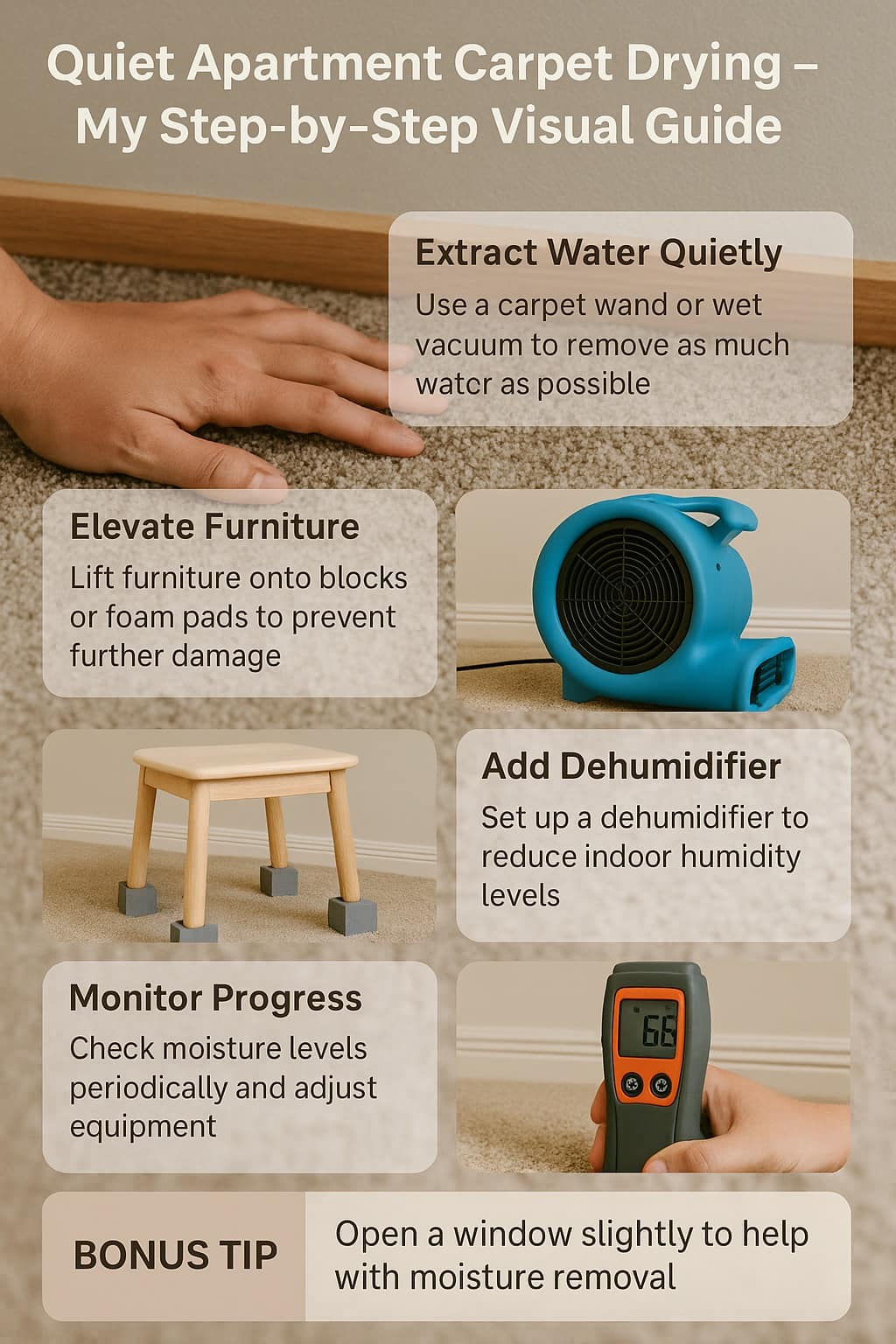
Step 1: Get rid of as much water as I can
First, I quietly extract as much water as possible. I use a carpet wand or a wet vacuum with a focus on efficiency, not showing off. Every litre removed with suction is a litre I don’t have to evaporate later, which means less time with noisy fans running in a tiny space.
Step 2: Move and protect furniture
Then I slide or lift furniture onto blocks or foam pads, keeping it off wet carpet. In small rooms, I often shuffle pieces to one side, dry that half, then swap. I’m careful not to scrape heavy items across the floor, because vibration plus dragging can make the noise seem much worse.
Step 3: Set up airflow and dehumidifier
After that, I set up one or two fans aimed low along the carpet and position a dehumidifier where air can circulate around it. I tape down cords where people walk. I check that doors aren’t rattling, and I do a quick noise test by standing outside in the hallway to hear what neighbours hear.
Dr Helena Ortiz, Process Engineer (IChemE), would say that small, repeatable steps done well often beat complicated setups that look clever but are hard to control.
🧠 How Industry Experts Shape the Way I Dry Carpet
Standards give me a backbone
I don’t guess my way through water damage jobs. Industry standards and guidelines give me a backbone: rough drying times, target moisture readings, and good safety practices. I might adapt them for apartment life, but I respect the technical reasons behind them, especially when it comes to health and building materials.
Translating technical language into normal speech
Most tenants don’t want to hear about categories, classes or technical moisture levels. They just want to know, “Is it going to smell?” and “Is it safe to stay here?” My job is to translate nerdy standards into simple explanations and clear decisions that make sense in a studio, one-bedroom, or small family unit.
Balancing theory and real-world life
Theory might say “more airflow, more better”. Real life says, “my neighbour’s baby is sleeping”. So I treat standards as a compass, not a prison. I keep the health and safety basics non-negotiable, then I adjust speed, timing and equipment choice to fit the people who actually live in the building.
Prof Alan Briggs, Building Science Researcher (CIBSE), often notes that good practice should guide the work, but real occupants and their lifestyles must shape the final plan.
📊 My Real-Life Case Study: Drying a Wet Apartment Lounge Quietly
The washing machine leak in a small lounge
One of my favourite case studies is a washing machine leak in a small apartment lounge. The water ran under the machine, across the carpet and towards a shared wall. The tenant was calm, but the neighbour on the other side was sensitive to noise and worked night shifts. No pressure.
What I actually did
I extracted the water thoroughly, then used a single low-profile fan and one dehumidifier. I ran the fan on a higher speed for a few daytime hours, then switched it to a quieter setting overnight. I kept the door half open towards the balcony so moisture could escape without blasting the hallway.
Case study snapshot – quiet lounge drying
| Item | Result |
|---|---|
| Room size | 11 m² lounge, low ceiling |
| Starting carpet moisture | Very wet at surface and underlay |
| Drying setup | 1 fan + 1 dehumidifier |
| Total active drying time | About 36 hours |
| Neighbour feedback | “I noticed it, but it wasn’t too bad.” |
What I loved was that the carpet dried safely, the tenant was happy, and the neighbour only mentioned the noise once, in a relaxed way, instead of raising a complaint.
Emma Jang, Chartered Building Surveyor (RICS), would argue that documenting cases like this is as important as doing them, because records protect everyone if questions come up later.
❓ My FAQs About Drying Carpet Quietly in Apartments
Can I stay in the apartment while the carpet is drying?
Most of the time, yes. I try to set up equipment so you can still move around safely and sleep in another room if possible. If there’s heavy contamination or serious mould, that’s a different story, and I’ll explain options clearly so you can decide what feels safe for you.
How long should I expect fans and dehumidifiers to run?
For clean water in a small room, I typically see 24–48 hours of drying. Sometimes I’ll turn equipment off and recheck later. If readings are still high, I’ll restart with a quieter setup or adjust angles. I’d rather run a bit longer on low than blast everyone for a short time on high.
Is a normal household fan enough in a tiny flat?
A household fan is better than nothing, especially if you combine it with good ventilation. But it usually can’t pull moisture out of the air like a dehumidifier can. I like to think of household fans as “helpers”, not the main tool, especially when underlay and walls have also absorbed water.
What if my neighbour complains about noise?
If you can, talk to them before they complain. Explain what happened, how long it will roughly take, and that you’re trying to keep it as quiet as you can. If they still complain, offer small compromises like adjusting fan speed or timing. Most people relax when they know there’s an end in sight.
Dr Olivia Grant, Public Health Physician (FRACP), reminds me that a calm conversation between neighbours can sometimes reduce stress more than any piece of equipment ever will.
📌 My Key Takeaways for Quiet Carpet Drying in Small Spaces
My simple rules for drying without drama
Over time, I’ve boiled my approach down to a few simple rules. First, get as much water out as early as you can. Second, design airflow for the room, not for your ego. Third, protect people’s sleep and sanity as much as you protect their carpet. And fourth, measure – don’t just guess.
Why this matters long after the carpet is dry
A quiet, well-managed drying job doesn’t just save carpet. It protects relationships with neighbours, landlords, and building managers. It also reduces the stress for the person actually living in the apartment, who already feels embarrassed by the leak. Good drying is about people just as much as it is about moisture.
My final encouragement
If you’re staring at a wet patch in your tiny lounge or bedroom, don’t panic. Think about the water, the room, the neighbours and your sleep. Start small, move air gently, and if you need help, look for someone who understands both drying science and apartment reality. Your carpet – and your neighbours – will thank you.
Dr Priya Nair, Behavioural Economist (ABE), would say that people remember how a problem felt emotionally more than the technical details, so calm, quiet drying often wins in the long run.