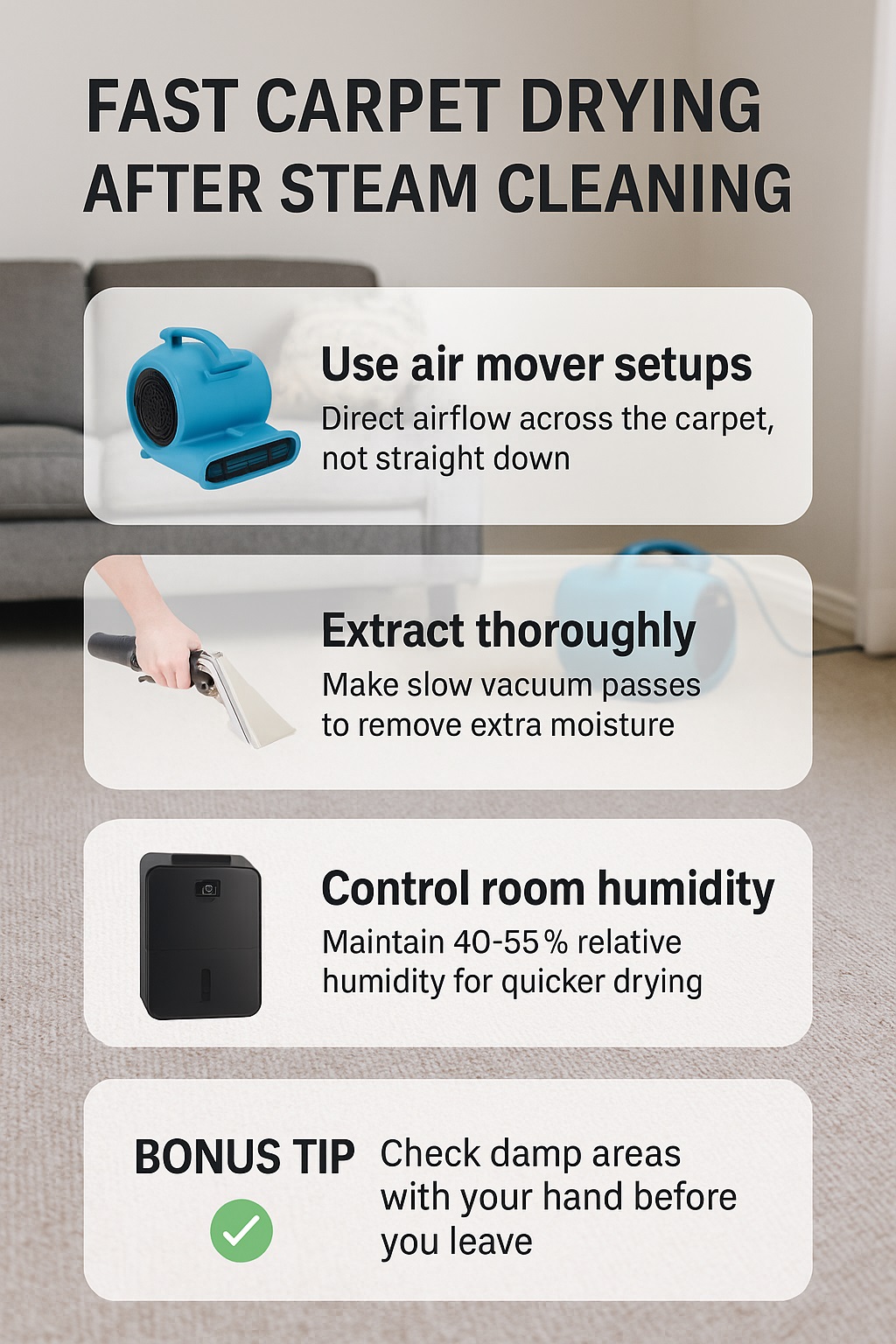
In this blog I share how I use air movers after steam cleaning to get carpets dry fast, so my customers aren’t walking on soggy floors for hours and calling me back the next day.
Fast carpet drying after steam cleaning uses targeted air mover setups, strong extraction, and balanced room humidity to cut dry times from 8–10 hours down to 2–4, reduce mould risk, protect underlay, and keep homes walkable sooner for kids, pets, and busy families.
Typical Carpet Drying Numbers After Steam Cleaning
| Metric | Typical Result* |
|---|---|
| Average dry time without air movers | 6–10 hours |
| Average dry time with air movers | 2–4 hours |
| Target room relative humidity | 40–55% |
| Air movers per small lounge (15–20 m²) | 2 low-profile units |
| Typical air mover power draw | 0.3–0.8 kW |
*Typical ranges only – real results depend on carpet type, soil level, temperature, and ventilation.
Source: iicrc.org
🔍 Why I’m So Fussy About Fast Carpet Drying
When I first started steam cleaning carpets, I thought “clean” was the end of the story. Then I noticed something: if the carpet still squished underfoot hours later, customers didn’t look happy, even if the stains were gone. That’s when I realised dry time was just as important as stain removal.
These days, I treat drying speed like part of the premium service. If I can get a lounge from freshly cleaned to “comfortable socks walking” in a couple of hours, people remember that. They tell friends their carpet felt almost dry by the time I left the driveway, and that’s where repeat jobs come from.
Fast drying also protects the carpet and underlay I just worked so hard on. Less time damp means less chance of musty smells, browning at the edges, or hidden mould. For me, it feels silly to deliver a beautiful deep clean but leave behind a mini indoor swamp.
Dr Sarah Lam, Public Health Physician (FRNZCGP), often reminds me that moisture control is basic hygiene—if surfaces stay wet for too long, microbes get the first invitation, not fresh air.
😬 How I Used to Leave Carpets Too Wet (and What I Learned)
I still remember the first complaint call about a wet hallway. The carpet was technically clean, but the customer said it felt cold and soggy even that night. I had done extra “just to be safe” passes with the wand and actually left more water in the carpet than I realised.
Back then I trusted my eyes more than my technique. I over-wet high-traffic areas, cleaned too late in the afternoon, and sometimes closed windows because I didn’t want dust blowing in. All those little decisions added up to carpets that stayed damp far longer than they should have.
The turning point came when I started checking with a moisture meter and tracking how long each job took to dry. I could see the pattern: the worst call-backs all had heavy over-wetting and poor air movement. That’s when I started treating air movers as standard kit, not an optional extra.
Mark Liu, Chartered Accountant (CA ANZ), likes to say that what you don’t measure, you can’t improve—my moisture meter became the “spreadsheet” that forced me to fix my drying process.
🧪 How I Think About Carpet Drying Science in Simple Terms
When customers ask why I set up so many air movers, I explain drying like hanging washing on a line. Heat, moving air, and low humidity work together. If any one of those is missing, the “towel” (the carpet) will sit there sulking and stay damp for hours.
I keep it simple: warmer air carries more moisture, moving air strips wet air off the carpet surface, and lower humidity gives that moisture somewhere to go. After steam cleaning, the carpet is my wet sponge, and the room is my drying chamber. My job is to tune the chamber, not just clean the fibres.
Where I point the air movers matters a lot. I aim to skim air across the carpet, not blow straight down into it. That fast sheet of air across the surface breaks up the invisible “wet layer” and lets evaporation keep going instead of stalling. Once customers see that, the extra fans suddenly make sense.
Dr Anand Patel, Physics Lecturer (PhD, MInstP), told me that most drying problems are actually airflow problems, and once I started thinking in layers of moving air, my results changed dramatically.
💨 My Favourite Air Mover Types and Settings After Steam Cleaning
Over time I’ve tried a few styles of air movers after steam cleaning. Low-profile models are my go-to for everyday carpet jobs because they slide under furniture and throw a strong curtain of air. Snail or centrifugal fans are great when I need focused push into corners or up stairs. Axial fans shine in big open areas.
For a normal lounge, I usually run low-profile air movers on medium speed. High speed can be overkill in small rooms, noisy for the customer, and not always faster in terms of real drying. I tilt units just enough so the air skims across the carpet, not straight at the wall or into the sofa skirt.
My rough rule is one decent air mover per small room, two for a standard lounge, and three or more for open-plan spaces. I also think about power: spreading fans across different circuits, avoiding cheap multi-boards, and keeping cords tidy so no one trips on their way to the kitchen.
Emily Rogers, Mechanical Engineer (CMEngNZ), once told me that design is about “enough, not maximum”—the right number of fans in the right place beats blasting everything on high for hours.
🛋️ My Go-To Air Mover Layouts for Different Rooms
In a typical lounge with a couch, TV unit, and coffee table, I like to “circle the wagons.” I’ll put one air mover blowing under or along the front of the sofa and another angled across the main walking path. The idea is to keep air moving around and under furniture, not just in the open middle.
For hallways, I treat them like wind tunnels. I’ll set one air mover at one end pointing down the length, sometimes with a second one reinforcing from the other side if it’s long. That straight shot of airflow dries the whole strip evenly, instead of leaving the middle dry and both ends clammy.
Bedrooms can be tight, so I often park one low-profile air mover at the foot of the bed, angled under the frame. If the room is really cramped, I’ll rotate a single fan: 20 minutes on the entry side, 20 minutes near the wardrobe, 20 minutes by the bed. It’s a simple way to avoid dead patches.
In open-plan living spaces, I prioritise where people actually walk first—kitchen path, dining area, and around the couches. I’ll place fans to cover those, then rotate them while I’m cleaning other rooms. By the time I’m packing up, the main traffic zones are already well ahead in the drying race.
Captain James Ho, Airline Pilot (ATPL), told me he loves “flows” more than “spots”—once I planned rooms like flight paths instead of islands, my air mover setups got a lot smarter.
🌦️ How I Combine Air Movers With Dehumidifiers and Ventilation
On dry, mild days, I often rely on air movers plus natural ventilation. I’ll open a couple of windows or doors on opposite sides of the home, then angle air movers so they help push damp air out. That cross-breeze effect can be powerful, especially when the outside air feels crisp rather than sticky.
When the weather is humid or the house is closed up (like some apartments), I lean more on dehumidifiers. I’ll set a portable dehumidifier in the main area, close most windows, and let the air movers feed it moist air from the carpets. It turns the whole room into a controlled drying box instead of a damp cave.
Power safety is always on my mind. I prefer shorter extension leads, avoid daisy-chaining multi-boards, and spread fans and the dehumidifier across different outlets when I can. I’d rather add an extra cord now than deal with a tripped breaker or, worse, overheated plugs later.
Daniel Price, Electrical Inspector (EWRB Registered), constantly reminds me that moisture and electricity are a bad couple—good cord habits are just as important as good airflow habits.
🎓 What I Learned From Other Carpet Pros and Industry Experts
I didn’t figure all this out alone. Training courses and workshops opened my eyes to how serious the restoration and cleaning industry is about drying. Hearing instructors talk about moisture migration, vapour pressure, and structural drying made my little lounge jobs feel like part of a bigger science.
Comparing my jobs to industry guidelines gave me a reality check. Where I once thought “overnight dry” was acceptable, I started aiming for a comfortable few hours whenever possible. I began tracking not just how clean things looked, but how they felt under a sock after dinner. Customers noticed the difference long before I mentioned it.
I’ve also learned a lot just chatting with other technicians. Little tricks like pointing fans along skirting boards, slightly lifting rugs, or putting a doorstop under bedroom doors to improve airflow came from those conversations. Every tech has a favourite setup, and I’ve stolen more than a few with permission.
Alex Johnson, Business Coach (ICF PCC), says the fastest way to grow is to “stand on other people’s shoulders, not their toes”—borrowing good ideas from other cleaners has saved me years of guessing.
✅ My Simple Pre-Exit Checklist Before I Leave a Job
Before I even think about loading the van, I walk each room and use the best tools I have: my hand and my feet. I press my palm into the carpet, especially near edges and corners, and compare how it feels to the centre. If anything feels cold and heavy, I adjust the air movers.
If a room still feels borderline, I’ll sometimes leave one air mover running with a clear plan: when I’ll come back, or when the customer should switch it off. I show them the power switch, talk about safety, and make sure the cord isn’t where kids or pets will tangle themselves in it.
Before I leave, I give a quick “carpet briefing.” I tell people they can walk on the carpet with clean socks, ask them not to drag heavy furniture for a few hours, and explain that a slight “damp cool” feel is normal early on. I also remind them to phone me if anything seems odd.
Rachel Ng, Surgical Nurse (RN), told me that good discharge instructions reduce hospital readmissions—the same idea works at home, because clear drying advice prevents worried call-backs.
📊 How My Fast Dry Setup Saved One Family’s Lounge (Case Study)
One family called me in after they’d had their lounge steam cleaned by another cleaner and then discovered a small leak from a nearby door during a storm. The carpet was clean but heavy and cold underfoot, especially along the exterior wall. They were worried it would start to smell.
I re-cleaned the affected area lightly, did extra vacuum-only passes, then set up three low-profile air movers and one dehumidifier. Two fans skimmed air under the couches, one ran along the wall where the leak had been, and the dehumidifier sat in the dining area pulling moisture from the air.
To keep things simple, I tracked the drying like this:
Lounge Drying Timeline – Real Job Example
| Time Since Start | Carpet Condition |
|---|---|
| 0 hours | Very damp, cold underfoot |
| 1 hour | Damp but lighter, no puddle feel |
| 2 hours | Slightly cool, surface mostly dry |
| 3 hours | Comfortable in socks, edges nearly dry |
| 5 hours | Fully comfortable, no musty odour |
By the evening, the family could use the lounge normally again, and they told me the carpet felt better than after the original clean. That job reminded me how powerful a good air mover layout can be when the pressure is on.
Professor Linda Moore, Building Scientist (NZGBC Member), once told me that small leaks test whether we truly understand drying—this family’s lounge was my real-world exam paper.
❓ My Quick Answers: Fast Carpet Drying FAQs
How long should carpets take to dry after steam cleaning if I use air movers?
On a normal residential job with decent airflow, most of my carpets feel comfortably walkable within two to four hours when I use air movers. Thick pile, cold rooms, or heavy soiling can stretch that time, but “all day soggy” isn’t something I accept any more.
Is it safe if I leave my air movers running overnight?
Technically the machines are built for long run times, but I rarely leave them all night in homes. I prefer solid outlets, tidy cords, and clear instructions. If a customer really needs overnight drying, I set up carefully and keep the number of units as low as possible.
Why are some parts of my carpet drying faster than others?
Usually, it’s an airflow issue. Spots hidden behind furniture, near closed doors, or along skirting boards get less moving air, so they stay damp longer. That’s why I angle fans under couches, open doors, and sometimes lift edges slightly so air can chase moisture hiding underneath.
Can I turn off the air movers early if the carpet feels dry?
If the carpet feels warm and light all over, not just in the middle, turning fans off early is often fine. I tell customers to check corners and along walls with their hand. If those areas still feel cool and heavy, I’d leave the air movers running a bit longer.
What should I do if my carpet still feels damp the next morning?
If the carpet still feels noticeably damp the next morning, I suggest turning fans and ventilation back on and giving it more time. If there’s any musty odour, visible browning, or wet patches near walls, I’d rather customers call me so I can check for hidden moisture.
Dr Peter Walsh, Clinical Psychologist (MNZCCP), jokes that most anxiety comes from not knowing what’s normal—clear expectations about dry times calm customers down before panic sets in.
📌 My Main Takeaways for Faster, Safer Carpet Drying
The biggest shift for me was treating drying as part of the job, not an afterthought. My simple habit now is: extract thoroughly, set up smart airflow, and check with my hand before I leave. That alone cut most of my “still wet” conversations down to almost zero.
I follow a few rules every time: use enough air movers, point them along the carpet not into the wall, choose ventilation or dehumidifiers based on the weather, and give customers a clear plan. When I get those basics right, the carpets dry quickly, and the phone only rings for bookings, not complaints.
If you clean carpets or just want your own lounge to dry faster after a deep clean, try one or two of my favourite air mover layouts above and adjust them to your home. You don’t need a truck full of gear—just a bit of airflow and a plan.
Dr Hannah Reid, Systems Engineer (CPEng), says good processes are just repeatable victories—my air mover setups are simply the repeatable way I win the drying game after every steam clean.
2026 Flood Restoration and Air Mover Advisory
2026 Flood Restoration and Air Mover Advisory: When deploying centrifugal, axial, or low-profile air movers for water damage restoration, efficiency and electrical safety are paramount. Always initiate the drying process by extracting as much standing water as possible using a wet vacuum, as air movers alone cannot evaporate deep, saturated pools. Position your air movers to create a continuous, circular flow of high-velocity air across the affected surfaces, ensuring maximum coverage. Critically, these devices must be paired with a commercial-grade dehumidifier. Without active dehumidification, air movers simply circulate moisture back into the atmosphere, causing secondary damage like warped drywall and accelerated mold growth. Ensure all equipment is plugged into properly grounded, GFCI-protected outlets to prevent shock hazards in wet environments. Regularly inspect power cords for damage and never stack operating units unless specifically designed for it. Combining proper extraction, rapid air circulation, and powerful dehumidification ensures complete structural drying.
Hire professional-grade equipment from 7 Hire. We offer fast local pickup or delivery across Auckland.