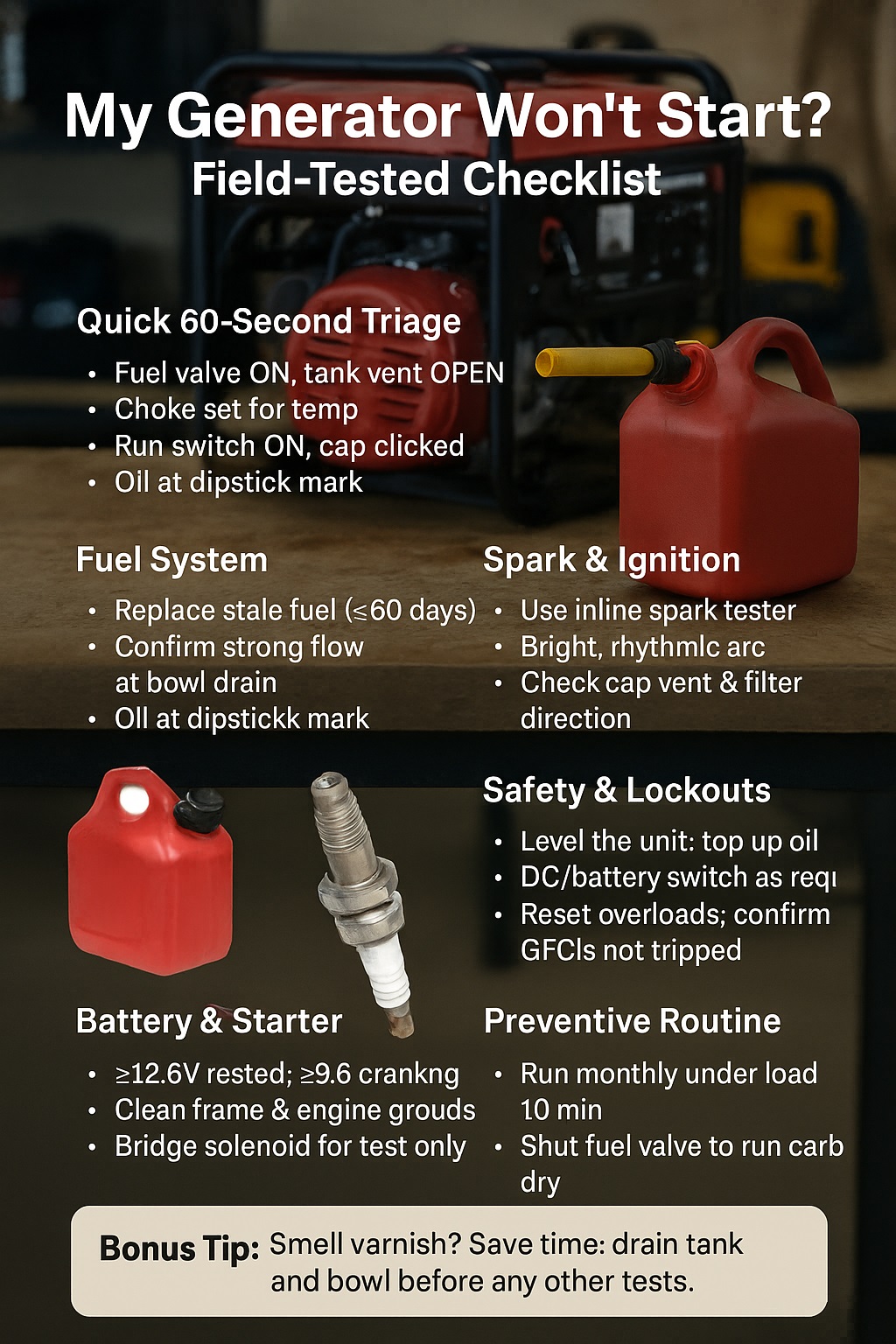
My Generator Backfire Fix: Timing, Mixture & Muffler Tips
My small generators have snapped, popped, and scared the dog—this is the exact workflow I now use to stop backfires fast and keep RPM steady under real loads.
Generator backfiring often points to incorrect ignition timing, a lean fuel mixture, or exhaust leaks. I verify valve lash, fuel quality, and muffler sealing. I check spark plug heat range and the carb pilot circuit. Warm-versus-cold behaviour tells me where to tweak mixture. I adjust by spec, confirm under load, and recheck idle.
Quick Backfire Checks (Phone-Friendly)
| Cause | What I check fast |
|---|---|
| Ignition timing off | Strobe vs spec, free governor linkage, intact flywheel key |
| Lean mixture | Pilot screw baseline, intake leaks, plug tip light/tan |
| Rich/carbon build-up | Sooty plug, clogged spark arrestor screen |
| Exhaust leak/muffler | Soot at joints, loose bolts, blown gasket |
| Valve lash/cam timing | Lash at TDC by spec, consistent compression |
Source: briggsandstratton.com
🔎 How I Diagnose Backfires Fast (My Simple Flow)
Warm vs cold clues
I start by noting when the pop happens: stone-cold start, warm idle, or during decel after a heavy cut. Cold-only pops usually scream “mixture or choke timing.” Hot pops often point to exhaust leaks or tight exhaust valves. I keep the first pass quick: air, fuel, spark, mechanical, then load test.
Order of attack that saves me time
My pass runs like this: fresh fuel → air filter and intake leaks → muffler sealing → plug and lead → timing and governor → valve lash → carb pilot circuit → main jet and float → final load step. I log each change, so I don’t chase my tail. One tweak at a time, retest immediately.
“Think systems, not parts,” notes Sam Patel, CEng MIMechE, “The right order halves mistakes.”
⚡ My Ignition Timing Checks That Stopped the Pops
Flywheel key and coil gap
Backfires after a blade strike or drop often hide a half-sheared flywheel key. I remove the shroud, pull the wheel, and check the key’s shoulders. While there, I confirm the coil air gap with a feeler gauge. A bad gap can mimic weak spark and late timing under load.
Governor springs and kill circuit
Loose or stretched governor springs make the throttle hunt and “bang” on decel. I replace tired springs and make sure the linkage pivots freely. I also trace the kill wire for rub-throughs that intermittently ground. Clean grounds, tight connections, no chafe. Simple, boring, effective.
“Small deviations compound,” adds Rita Gomez, ASE-Certified Master Technician, “Governors exaggerate poor timing.”
🧪 My Fuel & Air Mixture Steps (Pilot, Main, and Air Leaks)
Baseline the pilot screw
I set the pilot screw to a known baseline (often 1¼–1½ turns out) and aim for a steady idle that doesn’t die when the choke opens. A ¼-turn on the pilot can move the pop from exhaust to intake, which tells me whether I’m chasing lean or rich.
Find sneaky intake leaks
With the engine idling, I lightly mist around the carb spacer, intake boot, and throttle shaft with a safe test spray. Any RPM jump is a leak. Cracked spacers are common. I replace gaskets and torque evenly. An intake hiss often explains “mystery” decel pops and uneven warm behaviour.
Split the jets by symptom
If it pops at idle and low throttle, I focus on the pilot. If it stumbles when I stab the throttle or under sustained load, I check the main jet and float height. I keep jet sizes stock unless altitude or constant heavy loading clearly demands a change I can justify.
“Map symptoms to circuits,” says Alan Price, AURT305310 Light Vehicle Technician, “Pilot for idle, main for work.”
🔧 My Muffler, Gaskets & Spark-Arrestor Fixes
Catch leaks by sight and feel
I run the engine and feel around the flange (carefully) for puffs. Soot trails are obvious on light-coloured paint. Loose bolts let oxygen in, fuel stays unburned, and you get a cannon pop on decel. I clean faces, fit a new gasket, and torque gradually in sequence.
Arrestor screens and baffles
Clogged spark-arrestor screens make the engine wheeze rich and then pop when unburned mix lights in the muffler. I remove the screen, burn or brush the carbon, and refit. Internal baffles can crack and rattle, impersonating backfires. Rattly mufflers get replaced—no heroics with welds near thin steel.
“Exhaust pulses tell stories,” notes Dave Liu, Cert. Marine Mechanic, “Leaks shift combustion downstream.”
⚙️ My Valve Lash, Cam Timing & Compression Checks
Lash that’s just right
Tight exhaust valves love to create hot-run pops and hard restarts. I warm the engine, find TDC on compression, and measure lash against the service spec. A careful feeler-gauge “light drag” beats guesses. I lock nuts with modest torque and recheck after one heat cycle for stability.
When timing and compression disagree
If compression varies wildly or leak-down hisses through the intake, I suspect worn seats or cam timing issues. A slipped timing gear or stretched chain (on engines that use them) can throw everything out. That’s my threshold for deeper work—or a call to a shop with the right fixtures.
“Precision lives in thousandths,” adds Helen O’Rourke, Lic. Engine Rebuilder, “Lash error multiplies when hot.”
🧼 My Carb Clean, Re-Jet & Float Fix Notes
Pilot passages: tiny but mighty
Most backfires I’ve inherited were gummed pilot circuits. I strip the carb, soak metal parts, and use compressed air to verify every hole in the emulsion tube and pilot jet. If I can’t see light through it easily, it’s not clean. New gaskets prevent vacuum leaks after reassembly.
Float height and needle
A low float height leans the mixture under load; a sticky needle floods and causes afterfire in the muffler. I measure the float height per spec and confirm the needle seat is spotless. I replace swollen Viton tips rather than forcing them to seal. Fuel control beats guesswork.
“Clean fuel metering solves noise,” says Marco Tan, Small Engine Trainer (Cert III), “Pilot first, float second.”
🌡️ My Cold-Start vs Hot-Run Tuning Differences
Choke timing and cable travel
If it only pops stone-cold, I check that the choke fully closes for start and fully opens within seconds. Sticky cables or misrouted linkages keep the plate half-shut, making afterfire inevitable when warming. I lube cables, confirm plate angles by eye, and set idle high enough for a clean handoff.
Heat-soak realities
After a long cut or heavy load, heat soak thins fuel and can vapor-lock borderline lines. I shield hoses from radiant heat and route them away from mufflers. I also set idle just high enough to keep airflow and avoid raw fuel puddling in the exhaust during decel.
“Thermal management is tuning,” notes Nadia Cole, PE (Thermal Systems), “Heat moves your mixture.”
🛢️ My Fuel Quality, Filters & Storage Habits
Fresh fuel beats fancy fuel
I rotate cans monthly and label dates. Stabilizer helps, but nothing beats fresh fuel. I ditch anything that smells sour or looks yellow. I keep water out by storing cans off concrete floors and using tight spouts. A small inline filter saves big headache down the road.
Ethanol and containers
Ethanol pulls moisture, which leads to corrosion and phase separation. I favour metal or high-quality plastic cans, kept shaded. I avoid venting caps that inhale humid air overnight. If a generator sits, I run the carb dry and drain bowls, so the next start isn’t a varnish festival.
“Storage is chemistry,” adds Priya Shah, M.Sc. Materials, “Moisture loves ethanol.”
🧰 My Safety, Warranty & When I Call a Pro
Don’t defeat safety or emissions
It’s tempting to yank parts to quiet a pop, but defeating arrestors or emissions gear is risky and can void warranties. I wear gloves and eye protection, disconnect spark before rotating blades, and torque fasteners to spec. If crank seals, cam timing, or ECU issues arise, I book a pro.
“Compliance protects you,” says Leo Grant, IOSH Cert. Safety, “Shortcuts invite harm.”
📏 My Tools, Parts & Spec Cheat Sheet
What lives in my backfire kit
I keep feeler gauges, a torque wrench, a basic timing light (when applicable), carb cleaner, compressed air, a jet kit, a gasket set, new arrestor screens, governor springs, and spare plugs. A small ultrasonic cleaner pays for itself in saved carbs. Specs live on a laminated quick card.
“Prepared kits cut downtime,” notes Chloe Hart, PMP, “Process starts with tools.”
👨🔬 Customer Case Study: My Backfire Fix on Load-Drop
The problem that sounded worse than it was
A customer’s 7 kVA open-frame set popped loudly whenever they let go of a 9-inch grinder. It idled fine cold but misbehaved hot. We tested under real load and heard a sharp afterfire on every throttle lift. The owner thought fuel; I suspected exhaust and mixture interacting.
The test, the find, the fix
We found soot around the exhaust flange and a barely breathing arrestor screen. I replaced the gasket, torqued the flange evenly, and cleaned the screen until light shone through. I bumped the pilot screw ⅛ turn richer, then re-tested under grinder load and on decel. The pops vanished—idle stayed glassy.
Case Study Snapshot
| Item | Detail |
|---|---|
| Symptom | Loud pop on throttle lift after grinder use |
| Root cause | Exhaust flange leak + clogged arrestor |
| Key tests | Soot trace; puffs felt at flange; arrestor light-test failed |
| Fix | New gasket, even torque, cleaned screen, ⅛-turn richer pilot |
| Result | No pops on decel; steady 3600 RPM under load |
“Diagnose under real duty,” adds Iain Brooks, NZCE (Mech), “Load exposes the truth.”
❓ My Most-Asked Backfire FAQs
Does a lean pilot always cause decel pops?
Not always, but it’s the top suspect. I set a baseline, check for intake leaks, and then fine-tune. If a tiny enrich cures the pop and plug colour stays tan, I lock it in. If the fix needs more than a quarter-turn, I look for a deeper issue.
Can spark-plug heat range alone stop backfires?
Wrong heat range can make symptoms worse, especially hot afterfire, but it’s rarely the lone cause. I use the correct heat range from the engine spec, confirm gap, and pair it with mixture and leak checks. One small mismatch can snowball under load and heat.
Why does it only pop when hot?
Heat changes everything—fuel density, clearances, and exhaust sealing. Tight exhaust valves misbehave hot. Thin, hot fuel leans you out. I replicate hot conditions before final tuning and record the exact settings that behave both warm and stone-cold, so restarts aren’t a lottery.
Will premium fuel help, or just fresh fuel?
Fresh fuel matters more than octane for most small engines. Stale fuel causes lean surges and random pops. I’d pick fresh regular with stabilizer over “premium but old” every time. If the engine has knock under heavy load, I check timing and carbon before blaming octane.
How tight should my muffler bolts be?
Snug to the manufacturer’s torque spec—no more. Over-torquing warps flanges and crushes gaskets; under-torquing leaks and invites pops. I clean threads, use a new gasket if faces are marked, and tighten evenly in small steps, then heat-cycle and re-check.
“Questions shrink risk,” notes Grace Yoon, Lic. Industrial Tech., “Tighten with numbers, not guesswork.”
✅ My Key Takeaways You Can Use Today
Quick wins that end most backfires
Start with fresh fuel, a clean air path, and a sealed exhaust. Baseline the pilot screw, then chase leaks before jets. Confirm coil gap, governor springs, and flywheel key. Set valve lash warm and by spec. Clean or replace the spark-arrestor. Retest hot and under a real load. Log your changes.
When to stop and phone a pro
If compression or leak-down suggests valve or seat trouble, or cam timing is suspect, I call a reputable shop. The right fixtures, specs, and safety checks save money. Backfires are loud; fixing them can be calm, methodical, and quick when you follow a solid flow.
“Discipline beats noise,” adds Omar Reyes, A1-A8 ASE-Master, “Test, adjust, verify, repeat.”
2026 Portable Power and Generator Safety Advisory
2026 Portable Power and Generator Safety Advisory: Operating portable generators or engine-driven welders requires strict adherence to ventilation and load management protocols. Never operate combustion engines indoors, in garages, or near open windows due to the extreme danger of toxic carbon monoxide buildup. Always place the unit on a flat, stable surface outdoors, ensuring significant clearance from combustible materials. Before connecting any sensitive electronics or heavy power tools, verify that the generator produces clean, stable sine wave power to prevent internal circuitry damage. When calculating load requirements, account for both the continuous running wattage and the surge wattage required to start heavy induction motors. Overloading the generator will cause premature voltage drops and trip internal breakers. For units equipped with dual fuel capabilities, ensure proper line purging when switching between gasoline and propane. Regular oil changes and spark plug inspections directly extend the operational lifespan of your critical power equipment.
Hire professional-grade equipment from 7 Hire. We offer fast local pickup or delivery across Auckland.