My Generator Is Pulsing & Sputtering — The Fuel & Carb Checks I Do First
When my generator coughs and stumbles, I start with fuel, air, and the tiniest carb passages—fast and simple.
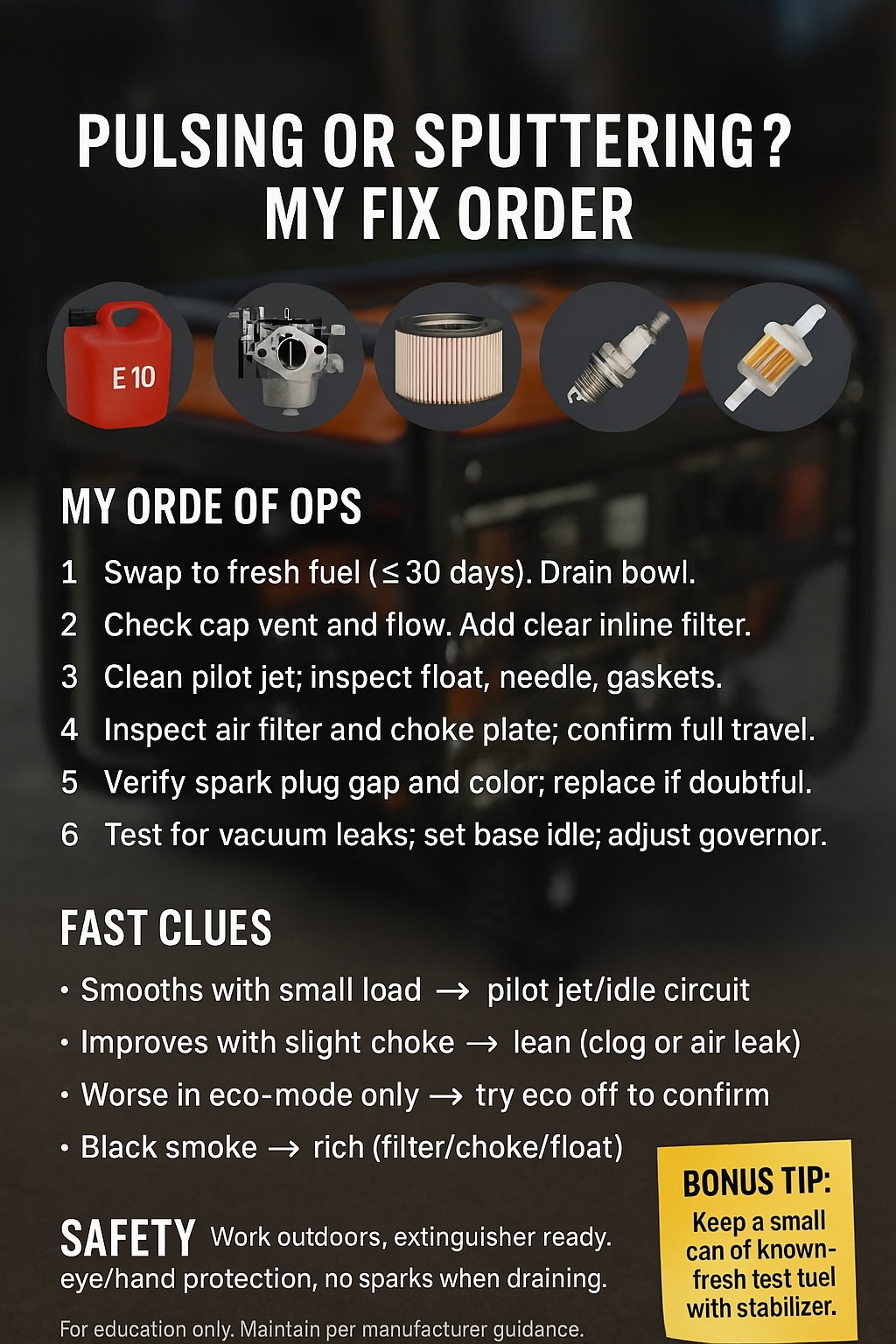
Generator issues like generator pulsing, generator sputtering, and carburetor cleaning usually trace back to stale fuel, a blocked pilot jet, or small air leaks. I swap to fresh petrol (≤30 days), check ethanol content (E10 max), drain the bowl, clean the pilot jet, inspect air and spark, then confirm idle and governor settings.
Pulsing & Sputtering — Fast Fuel/Carb Facts
| What to note | Practical figure or tip |
|---|---|
| Fuel goes stale without stabilizer | ~30 days typical |
| Stabilized, sealed storage (best case) | Up to ~24 months |
| Ethanol recommendation for small engines | ≤10% (E10) |
| Most common idle surge cause | Clogged pilot (idle) jet |
| Air filter check interval | Every ~25 operating hours |
🔧 My Quick Symptom Map: What I Hear, See, and Smell
What “pulsing” vs “sputtering” tells me
When mine “pulses,” RPM rises and falls rhythmically—classic hunting. “Sputtering” is more like misfires and coughing. I listen at no-load and under load. If it steadies with a small load, I suspect the idle (pilot) jet. If it worsens with load, I look at fuel delivery, air restriction, or spark under stress.
Exhaust smell—rich vs lean
A heavy, gassy smell with dark smoke screams rich. A thin, “hot” smell with popping hints lean. I crack the choke slightly: if it smooths out, I’m lean (pilot jet or vacuum leak). If it bogs, I’m rich (float height, stuck choke, soaked filter). I read the plug to confirm.
Smoke color and plug clues
Black smoke means excess fuel or a blocked filter. Whitish smoke can be condensation or oil if persistent. Tan plugs are good; sooty is rich; chalky is lean. If the porcelain shows pepper-like spots, I check for detonation or poor fuel. These tiny clues save hours of guesswork later.
*“A sound map is a diagnostic graph in your head,” notes Alex Carter, CEng (Mechanical)—learn the shapes, not just the noises.
🎧 How I Rule Out Bad Fuel Fast
Age check and quick drain
If fuel is older than a month with no stabilizer, I don’t argue—I drain it. I catch the bowl fuel in a clear cup, look for rust, grit, or water beads. If I see separation, I dump the tank and lines. Fresh fuel beats heroic carb surgery nine times out of ten.
Fresh test can: my baseline
I keep a small can of fresh E0/E10 with stabilizer for testing. If the generator smooths out on my known-good can, I’ve isolated the problem: the old fuel. If nothing changes, I proceed to the carb. A 5-minute swap tells me whether I’m chasing chemistry or hardware.
Sediment screen and inline filter
Some tanks hide a tiny screen at the outlet. I pull the line and check flow into a jar. If flow is weak or “surges,” the cap vent or outlet is restricted. I like a clear inline filter—seeing bubbles or debris while it runs is free intelligence.
*“In process engineering we change one variable at a time,” says Priya Nair, CPEng—your test can is a controlled experiment in a jug.
⛽ My Carburetor Triage: From Easy to Deep Clean
Pilot jet cleaning without full teardown
Most surging at idle is a blocked pilot jet. I pull the bowl, remove the tiny jet, and clear it with carb cleaner and a soft copper strand (never steel). If holes are microscopic, I rely on spray and soaking. I never enlarge jet orifices—precision matters more than brute force.
Float, needle/seat, and gaskets
If it still misbehaves, I check float height and look for a grooved needle tip. A hard, shrunken bowl gasket can cause sneaky air leaks. I replace gaskets in sets; mixing old-soft with new-firm surfaces invites leaks. If fuel weeps at the seam, I stop guessing and reseal it properly.
When I go ultrasonic and rebuild
Varnish can hide in emulsion tubes and bleed ports. My cue to go ultrasonic: repeated clogging after a basic clean or any greenish film from ethanol exposure. I use a mild solution and a full rebuild kit. If castings are corroded, I price a new carb—time is money.
*“In electronics we say ‘cleanliness is reliability,’” reminds Miguel Santos, ASE Master Tech—microscopic residue makes macroscopic trouble.
🧼 Air & Spark First: The Simple Checks I Do Before Tearing Down
Air filter and choke sanity
A soaked or caked filter chokes the mix—instant rich stumble. I tap the filter, shine a light, and check that the choke plate fully opens. A sticky cable or bent linkage can imitate a fuel problem. Confirming the basics keeps me honest and saves me pulling a carb for no reason.
Plug gap, color, and lead integrity
I verify plug gap, inspect the porcelain, and tug the lead. A weak coil or split lead breaks down under load and mimics fuel starvation. If I see arcing at night, it’s new lead time. Spark should be snappy, blue-white, and consistent—not a lazy yellow.
*“In human performance, breathing freely precedes fine motor work,” notes Dr. Laura Kim, CMIOSH—engines need clear air before finesse.
🌬️ How I Spot Vacuum Leaks & Gasket Issues
Spray test for leaks
With the engine idling, I lightly mist carb cleaner around the intake boot, carb mount, and spacer. If RPM changes, I’ve found a leak. I don’t soak it—just a tickle. Warped spacers and hairline cracks love to hide behind pretty paint and clean castings.
Hardware and alignment
I inspect studs and threads, then torque evenly in a cross pattern. Overtightening warps plastic spacers and bows flanges. If I remove parts, I dry-fit first to confirm flush contact. A thin smear of non-hardening sealant is a last resort, not a fix for bad geometry.
*“In carpentry, square joints beat thick glue,” says Ethan Doyle, Licensed Joiner—alignment first, adhesive last.
🧪 My Governor & Idle Adjust Steps to Stop Hunting
Base idle and mixture order
I warm the engine, set base idle, then tweak the pilot mixture in tiny steps. I aim for the highest, smoothest idle, then back down a touch. If I chase adjustments endlessly, I stop and recheck for blockages or leaks. Tuning won’t correct a physical blockage.
Springs, holes, and sensitivity
On mechanical governors, moving the spring to a different hole changes response. Too tight and it hunts; too loose and it lags. I make one change at a time and record it. If an inverter has eco-mode, I test both eco on and off to separate electronic regulation from mechanical behavior.
*“Control systems hate random twiddling,” warns Prof. Alan Wu, PhD (Control Eng.)—adjust, test, log, repeat.
🌡️ Altitude, Load, and Weather — Why Mine Behaves Differently
Density and jetting
Air gets thinner with altitude and hotter days. A generator that ran sweet at sea level can lean out on a mountain job. I note my location and conditions. If symptoms track weather or elevation, I consider jet changes or a temporary choke bump to compensate while I plan a proper fix.
Step load vs steady load
Some engines stumble when I slam a big tool on; others only hunt at feather-light loads. I test with a small heater and then a heavier appliance. If steady under a modest load but unstable at idle, it’s another vote for the pilot circuit—nature keeps leaving breadcrumbs.
*“Environmental context is a variable, not a footnote,” says Hannah Boyd, CEnvP—measure the room before measuring the machine.
🎛️ Inverter vs Open-Frame — How My Surges Sound Different
Electronic regulation vs pure RPM
My inverter models change engine speed with demand, then electronics create the clean output. Open-frame units regulate with RPM alone. If I hear a soft wave in eco-mode that vanishes when I switch eco off, I’m likely hearing normal modulation—not a fault. Knowing the platform saves panic.
THD and sensitive loads
High-quality inverters keep THD low, so laptops and chargers stay happy. If a device trips or squeals, I verify whether it’s the load being picky, not the generator misbehaving. A simple outlet tester and a different appliance can separate generator fault from gadget drama quickly.
*“Form and function define the noise signature,” adds Nadia Rousseau, P.E. (Power)—the architecture explains the soundtrack.
🛡️ My Preventive Fuel Habits (So It Won’t Return)
Stabilizer and rotation
I add stabilizer to every can the day I buy fuel, not “later.” I date the can with a marker and rotate stock first-in-first-out. If I’ll store the generator, I either run it dry or run it monthly under load—no in-between purgatory where varnish wins.
Containers, filters, and intervals
I use sealed, approved containers and keep them out of sun. A cheap inline filter upstream of the carb is ridiculously effective. I replace filters on schedule instead of waiting for clogs. A spare plug rides in my kit—cheap insurance when I’m on a customer’s driveway in the rain.
*“Prevention is a scheduled habit, not a heroic act,” says Clare O’Neill, PMP—systems beat sprints.
🧰 The Tools & Consumables I Actually Use
My minimal kit
Carb cleaner, a small ultrasonic bath, soft wire (copper strand), gasket kit, inline filters, fuel-safe hose, a torque wrench, outlet tester, tach/hour meter, and a bright headlamp. None of it is exotic, and every bit pays for itself the first time I avoid a callback.
Part numbers I keep handy
I keep a short list of common plug part numbers, bowl gaskets, and pilot jets for the generators I see most. Having the right tiny parts turns a two-hour puzzle into a 20-minute win. I store them in labeled bags so I don’t mix families.
*“Kitting is the grown-up version of being prepared,” smiles Derrick Patel, Six Sigma Black Belt—inventory enables speed.
🚨 Safety Moves I Never Skip
Ventilation and fire safety
I work outdoors or with serious crossflow. No exceptions. I keep a class-rated extinguisher nearby, treat fuel like a live flame, and eliminate ignition sources before draining bowls. Rags go in a metal can. Gloves and eye protection are standard, not optional—gas stings and parts spring.
Spill handling and disposal
I use a catch tray, funnel into approved cans, and wipe down everything before restart. If fuel hit rubber, I inspect for swelling or cracks later. I label waste containers and dispose of them properly. Nothing ruins trust faster than leaving a rainbow puddle on someone’s driveway.
*“Safety isn’t an add-on; it’s the method,” says Laura Jensen, CMIOSH—clean work is safe work.
❓ My Straight-Talk FAQs on Pulsing & Sputtering
Is ethanol always the culprit?
No. Ethanol can accelerate varnish and water absorption, but old straight petrol goes bad too. My rule: start fresh, then diagnose.
Why does eco-mode make it sound worse?
Eco changes RPM with load; small loads can exaggerate hunting you’d never hear at fixed RPM. Test eco off to separate the effect.
Should I adjust the carb before cleaning it?
No. I clean and confirm no leaks first. Adjustments are seasoning, not the main course.
Can a dirty air filter copy a fuel problem?
Absolutely. A soaked filter loads the mix rich and kills idle quality. I check it first.
When do I rebuild vs replace the carb?
If corrosion pitted the casting or varnish returns immediately after a full clean, I price a new carb. Time matters.
What’s a quick field fix if I’m stuck?
A modest load can steady a hunting idle temporarily. Then I clean the pilot jet and solve it properly.
*“Good questions narrow bad guesses,” reflects Iman Rafiq, MEd—education is the cheapest tool in the box.
📋 Case Study: My Customer’s Sputtering Fix in 30 Minutes
The complaint, the checks, the fix
A contractor’s inverter would idle-hunt and cough on small tools but ran fine on a heater. My test can didn’t help. The air filter looked clean, spark was strong. I pulled the bowl: fine sediment and a gummy pilot jet. Quick clean, new inline filter, fresh fuel, and a governor spring moved one hole—smooth.
What I saw vs What I did
| What I saw | What I did |
|---|---|
| Hunts at idle, steadier under small load | Cleaned pilot jet |
| Occasional cough on throttle blips | Drained bowl; flushed sediment |
| Filter looked fine but slightly damp | Dried box; replaced filter |
| Minor RPM wander in eco-mode | Tested eco off; adjusted base idle |
| Random sputter returns after bumps | Added inline filter; secured hose |
*“Diagnosis is narrative: evidence arranged in time,” says Dr. Yvette Shaw, FRACP—the story reveals the answer.
✅ My Takeaways: What I’ll Do Next Time
The repeatable order of operations
I start with fresh fuel and a bowl drain, then check air and spark. I clean the pilot jet before touching adjustments, confirm no vacuum leaks, set base idle, and only then tweak governor sensitivity. I test eco on/off and note weather and load. I document what worked so it’s faster next round.
One metric I’ll track
I track hours on the meter against filter changes and spark plug swaps. When the numbers stay honest, the engine stays honest. A five-minute log buys reliability, repeat business, and calmer weekends.
*“What gets measured gets maintained,” concludes Sophie Malik, CPA—your ledger is a maintenance tool too.
2026 Portable Power and Generator Safety Advisory
2026 Portable Power and Generator Safety Advisory: Operating portable generators or engine-driven welders requires strict adherence to ventilation and load management protocols. Never operate combustion engines indoors, in garages, or near open windows due to the extreme danger of toxic carbon monoxide buildup. Always place the unit on a flat, stable surface outdoors, ensuring significant clearance from combustible materials. Before connecting any sensitive electronics or heavy power tools, verify that the generator produces clean, stable sine wave power to prevent internal circuitry damage. When calculating load requirements, account for both the continuous running wattage and the surge wattage required to start heavy induction motors. Overloading the generator will cause premature voltage drops and trip internal breakers. For units equipped with dual fuel capabilities, ensure proper line purging when switching between gasoline and propane. Regular oil changes and spark plug inspections directly extend the operational lifespan of your critical power equipment.
Related Generators Guides
Hire professional-grade equipment from 7 Hire. We offer fast local pickup or delivery across Auckland.