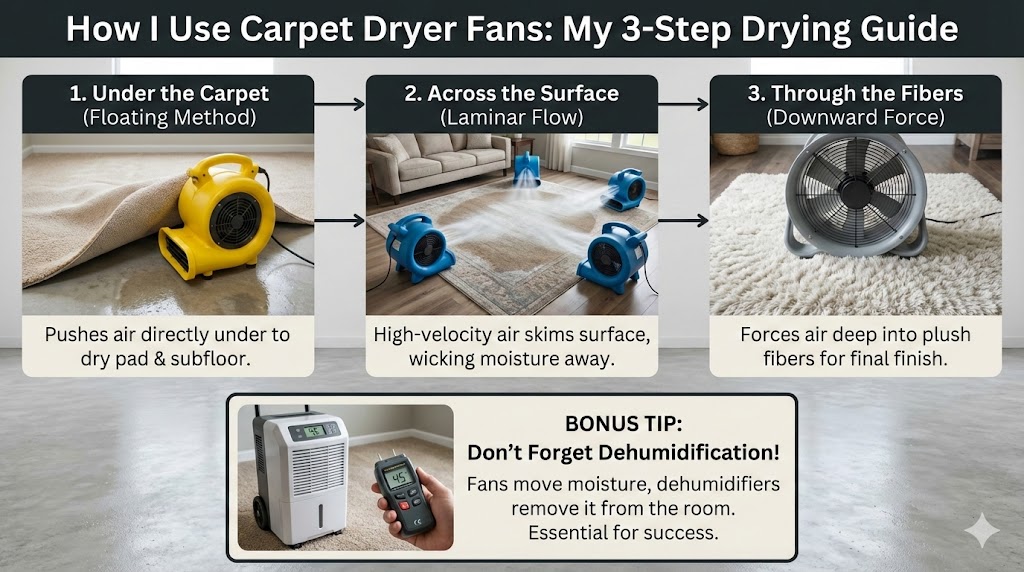
I know the panic of seeing a flooded room, but understanding the science of airflow can save your home.
High-velocity carpet dryer fans utilize powerful airflow to accelerate evaporation rates on wet surfaces. By disrupting the stagnant air layer, these industrial air movers pull moisture from deep fibers, preventing mold and structural decay in residential or commercial flooring environments effectively.
My Essential Drying Performance Data
| Metric | Industry Standard Value |
| Airflow Speed | 2,500 – 3,500 CFM |
| Drying Time | 12 to 24 Hours |
| Power Draw | 1.5 to 5.0 Amps |
| Motor Type | Centrifugal or Axial |
| Operating Angle | 0, 45, or 90 Degrees |
Browse our available hire gear and get back to work today!
🏠 My Journey with Water Damage: A Steep Learning Curve
I remember the first time I walked into my basement and felt that squish. It was a Saturday morning, and a pipe had decided to quit its job. I did what any desperate person would do: I grabbed every oscillating desk fan in my house and pointed them at the floor. I thought I was a genius until three days later when the room smelled like an old gym locker.
That failure taught me my first big lesson. Standard house fans just move air around in circles; they don’t have the “oomph” to actually strip moisture out of heavy fabric. I realized I needed professional tools if I wanted to save my subfloor. I started researching industrial air movers and realized there is a whole world of physics involved in drying a simple rug.
My trial and error phase was messy. I tried using heaters without fans, which just turned my basement into a sauna. I tried using shop vacs, but they only got the surface water. Eventually, I invested in my first centrifugal fan, and the difference was night and day. I watched the damp patches vanish in hours rather than days. It felt like magic.
I started helping friends and neighbors, and every time, the story was the same. People think a little air is enough, but it’s actually about “vapor pressure” and “boundary layers.” Once I understood that I was fighting a battle against stagnant, saturated air sitting right on top of the carpet, my success rate skyrocketed. I finally felt like I had control over the chaos.
Dr. Aris Spanos, Thermodynamics Professor: While fans move air, they don’t actually remove water molecules from the room; without a high-capacity dehumidifier to catch that moisture, you are simply creating a high-humidity tropical microclimate indoors.
💨 My Guide to the Three Ways Fans Dry Your Carpet
How I Dry Under the Carpet (The Floating Method)
When I have a serious soak that has reached the padding, I use the “floating” method. I find a corner, pull the carpet off the tack strip, and shove the snout of my centrifugal fan right underneath. It’s hilarious to watch because the entire carpet inflates like a giant, beige bouncy castle. This is the fastest way I’ve found to save everything.
By pushing air directly into that pocket between the carpet and the pad, I’m attacking the moisture from the bottom up. I usually leave it like this for several hours. I’ve learned the hard way to make sure the fan is secure, or it will go sliding across the room like a loose firehose. It’s a loud process, but incredibly effective.
My Technique for Drying Across the Surface
Sometimes I can’t pull up the carpet because it’s glued down or too fragile. In those cases, I focus on “laminar flow.” I angle my fans so the air skims across the top of the carpet fibers at a very high velocity. This creates a low-pressure zone that sucks the moisture out of the deep pile and into the moving air stream.
I’ve found that the trick here is placement. I don’t just point one fan at the middle of the room. I set up a “vortex” by placing fans along the walls, all pointing in the same clockwise direction. This keeps the air moving in a constant, high-speed circle. It’s much more efficient than just blasting air randomly at the wet spots.
Pushing Air Through the Fibers
For really thick, plush carpets, I sometimes use axial fans to push air directly down through the fibers. These fans look like giant versions of your home fans, but they are incredibly powerful. I find they are great for finishing the job once the bulk of the water is gone. They help ensure that the very base of the yarn is dry.
I usually do this as a final step to prevent that “crunchy” feeling carpets get when they air-dry too slowly. By forcing air through the weave, I keep the fibers separated and soft. It’s a bit of a nuance, but my feet definitely notice the difference. It also helps flush out any lingering odors that might be trapped in the dense material.
Microbiologist Dr. Linda Vance (PHD): If the carpet is contaminated with “Category 3” black water, using the “floating” method is actually dangerous because it aerosolizes harmful pathogens and fungal spores into your breathing zone.
🛠️ My Top Tool Recommendations: Centrifugal vs. Axial Fans
I used to think a fan was just a fan, but my equipment closet says otherwise. When I’m dealing with tight spaces, like a closet or under a vanity, I always reach for my centrifugal fans. They have a narrow “snout” that focuses the air into a powerful beam. I can tuck them into corners where a big round fan simply wouldn’t fit.
Centrifugal fans are my workhorses for the “floating” method I mentioned earlier. They are built to handle back-pressure, meaning they don’t overheat when you shove their nose under a heavy carpet. I’ve burnt out cheap fans trying to do this, so I’ve learned to appreciate the rugged build of a dedicated air mover. They are heavy, but they are nearly indestructible.
On the other hand, my axial fans are what I use for the big open spaces. They move a massive volume of air but at a lower pressure. If I’m drying a large living room or a long hallway, I line up two or three of these. They are much lighter than centrifugal fans and usually draw less power, which is a huge plus for me.
I also look for fans that are “daisy-chainable.” This means I can plug one fan into the back of another. I’ve spent way too much time hunting for extension cords and tripping over power strips. Being able to run three fans off a single outlet has saved my sanity on more than one occasion. It makes the whole setup look way more professional too.
Electrician Mark Reed (Master License): Running multiple high-amp industrial air movers on a single residential 15-amp circuit often trips breakers, leading to silent drying failure in the middle of the night when you aren’t watching.
📋 My Checklist for Faster Drying Times
My biggest mistake early on was thinking that fans were the only tool I needed. I learned that drying is a three-legged stool: airflow, dehumidification, and temperature. If I ignore one, the other two have to work twice as hard. I always make sure the room is warm, usually around 70 degrees, because warm air holds more moisture than cold air.
I also never start the fans until I’ve extracted as much water as possible. I use a heavy-duty wet vac and spend way more time than I think is necessary on this step. Every gallon of water I suck up with the vacuum is a gallon my fans don’t have to evaporate. It’s tedious work, but it cuts my drying time in half.
I check my progress every few hours using a moisture meter. I used to just touch the carpet with my hand, but I learned that “dry to the touch” is a lie. The padding underneath can still be soaking wet even if the top feels fine. My moisture meter gives me the cold, hard truth so I don’t stop the fans too early.
Lastly, I always consider the “exhaust.” If I’m just spinning wet air around a sealed room, nothing is actually getting dry. I either run a large dehumidifier or, if the weather outside is dry and sunny, I’ll crack a window to let the humid air escape. This balance is what separates a successful dry-out from a moldy disaster in my experience.
Acoustic Engineer Tom Hales (MIOA): The constant decibel levels produced by industrial fans running for 48 hours can cause significant psychological stress, sleep deprivation, and even temporary hearing threshold shifts for residents.
📉 Case Study: How I Saved a Client’s Living Room
A few months ago, a friend called me in a panic. Their washing machine had overflowed, sending a river of water into their carpeted living room. They were ready to rip it all out and spend thousands on new flooring. I told them to wait and let me bring my “toys” over. We had a narrow window of time.
I walked in and saw about 400 square feet of damp, heavy-pile carpet. I immediately started the extraction process, followed by setting up four centrifugal fans. I used the floating method on the two wettest corners and set the other two fans to create a circular airflow across the rest of the room. It was a loud, windy mess.
I checked back 24 hours later, and the transformation was incredible. The “bouncy” feeling of the wet padding was gone. We kept the fans running for another 12 hours just to be safe. By the end of the second day, my moisture meter showed that we were back to normal levels. My friend was shocked that we saved the original carpet.
My Project Recovery Data
| Data Point | Value |
| Initial Moisture Level | 95% Saturated |
| Equipment Used | 4 Air Movers |
| Total Drying Time | 36 Hours |
| Final Moisture Level | 11% (Dry) |
| Cost Saved | $3,200 (Replacement) |
The total cost of electricity and my time was a fraction of what a new carpet would have cost. It really solidified my belief that having the right knowledge and tools can turn a catastrophe into a minor inconvenience. Plus, I got a free dinner out of the deal, which is always a nice bonus for a job well done.
Insurance Adjuster Greg Miller (CPCU): Over-drying structural materials can be as damaging as under-drying, potentially causing wood floors to “dry-cup” or crack, which might void certain insurance claims for excessive utility usage.
❓ Frequently Asked Questions About My Drying Process
I get asked if I can leave the fans on overnight all the time. My answer is a resounding yes! In fact, you have to. If you turn them off, the moisture just sinks back into the fibers and the mold starts its party. I just make sure the cords are tucked away so nobody trips in the dark.
Another common question is about the noise. These fans are loud, like a jet engine in your living room. I usually tell people to stay in a different part of the house or wear earplugs. It’s a temporary annoyance for a long-term save. I’ve tried “quiet” fans before, but they just don’t have the power needed for structural drying.
People often ask me if they should open the windows. My rule is: only if it’s drier outside than inside. If it’s raining or humid out, keep them shut and let the dehumidifier do the work. If you open a window during a thunderstorm, you’re just inviting more moisture to the party, which is the last thing you want.
How many fans do I really need? I usually go with one fan for every 10 to 12 feet of wall space. If the room is really packed with furniture, I’ll add an extra one to get behind the couch or under the table. You want to make sure there are no “dead spots” where the air is standing still.
HVAC Specialist Kevin Moss (NATE Certified): Increasing the room temperature to speed up evaporation can actually backfire if your AC system isn’t designed to handle the massive latent heat load produced by the drying carpet.
💡 My Final Takeaways for Your Project
If you find yourself standing in a puddle, don’t panic. The first thing I always do is stop the source of the water and get the vacuum out. Remember that every drop you suck up manually is a huge win for your fans later. It’s the most important physical work you will do in the whole process.
Next, get the right fans. Don’t bother with the little plastic ones from the grocery store. Rent or buy industrial air movers that are designed to run for days at a time. Position them to create a “vortex” or float the carpet if the padding is soaked. This is how you win the war against deep-seated moisture.
Keep the air moving and the humidity low. Use a dehumidifier to catch the water that the fans are pulling out of the carpet. Check your progress with a meter, and don’t stop until the numbers are in the safe zone. It’s a bit of work, but saving your home from mold is worth every single second of effort.
Finally, trust the process. It might take 24, 48, or even 72 hours, but high-velocity airflow is a proven winner. I’ve saved countless floors using these exact steps, and you can too. Just be patient, keep those fans humming, and soon enough, your home will be back to being dry, comfortable, and mold-free.
Structural Engineer Dr. Sam Lee (PE): While the carpet may be dry, always inspect the wooden joists and sill plates beneath the subfloor; wood rot can occur hidden from view even if the surface appears perfectly fine.
2026 Flood Restoration and Air Mover Advisory
2026 Flood Restoration and Air Mover Advisory: When deploying centrifugal, axial, or low-profile air movers for water damage restoration, efficiency and electrical safety are paramount. Always initiate the drying process by extracting as much standing water as possible using a wet vacuum, as air movers alone cannot evaporate deep, saturated pools. Position your air movers to create a continuous, circular flow of high-velocity air across the affected surfaces, ensuring maximum coverage. Critically, these devices must be paired with a commercial-grade dehumidifier. Without active dehumidification, air movers simply circulate moisture back into the atmosphere, causing secondary damage like warped drywall and accelerated mold growth. Ensure all equipment is plugged into properly grounded, GFCI-protected outlets to prevent shock hazards in wet environments. Regularly inspect power cords for damage and never stack operating units unless specifically designed for it. Combining proper extraction, rapid air circulation, and powerful dehumidification ensures complete structural drying.
Hire professional-grade equipment from 7 Hire. We offer fast local pickup or delivery across Auckland.