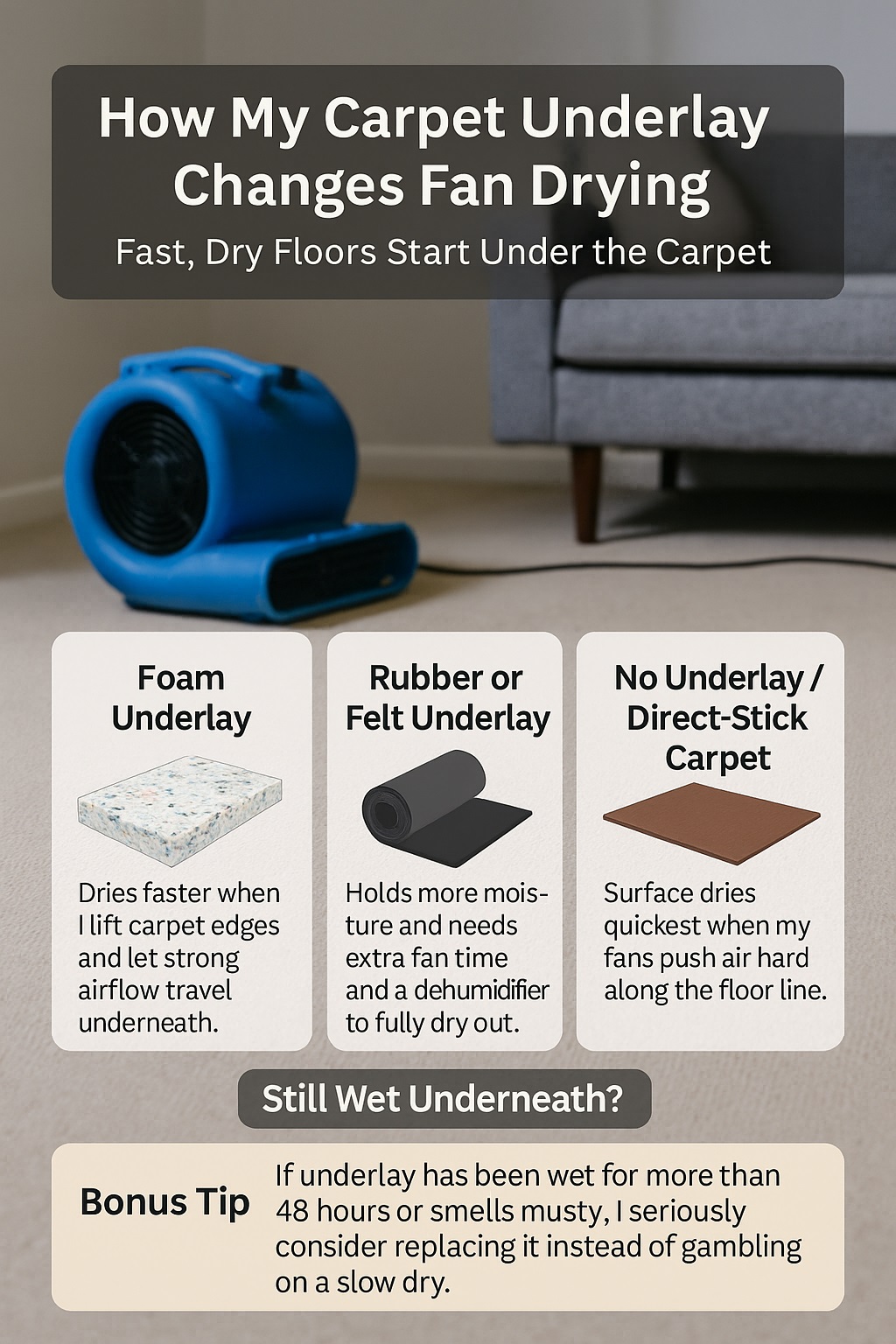
I used to think drying carpets was all about how many fans I could cram into a room. Then I met carpet underlay.
The type of carpet underlay under a room quietly controls how fast fan drying works after leaks, spills or washing machine overflows, and whether wet flooring dries in hours or stays damp long enough to cause lingering smells, mould growth and hidden damage.
Typical Drying Factors I See with Carpet Underlay
| Factor | Typical real-world range I see |
|---|---|
| Safe drying window for clean-water leaks | Often 24–48 hours with strong airflow |
| Mould risk if underlay stays wet | Rises sharply after about 48–72 hours |
| Common underlay thickness | Roughly 7–12 mm in many homes |
| Extra fan time when underlay is saturated | Frequently 12–24 hours more than drying carpet only |
| Rooms where underlay slows drying most | Closed bedrooms and lounges with thick, soft carpet |
Source: carpet-rug.org
🧱 Why My Carpet Underlay Makes Fan Drying So Different
How I Found Out Underlay Was the “Hidden Problem”
On my early jobs, I’d run fans for a day, feel the carpet, and proudly tell the customer, “All dry!” Then I bought a moisture meter. Bad news. The carpet read dry, but the underlay underneath was still soaked. That was the day I stopped trusting my hands and started lifting corners.
What My Underlay Actually Does Under the Carpet
In everyday life, I love underlay. It makes the floor softer, warmer and quieter. But when things get wet, that same nice, spongy layer turns into a giant hidden sponge. The top fibres might feel dry, while the underlay quietly holds litres of water and fights against my fans.
Why My Fans Can’t Ignore Underlay Type
These days, the first thing I think about isn’t “How many fans?” but “What underlay am I standing on?” Foam, rubber and felt underlays all behave differently. Some drain and dry quickly, others hang onto moisture and need more lifting, more airflow and more patience from both me and the customer.
Dr Lisa Grant, Chartered Structural Engineer (CEng), often tells her clients that the stuff they don’t see in a building is usually what controls how well it survives a disaster, not the fancy finishes on top.
💧 How I Think About Underlay, Moisture and Airflow
My Simple “Sponge Sandwich” Analogy
When I explain this to customers, I call their floor a sponge sandwich. The carpet is the top slice, the underlay is the sponge, and the subfloor is the bottom slice. Fans mostly blow over the top slice. If I don’t help air reach the sponge, the middle stays wet and problems start later.
How My Fans Push Air Through Layers
My carpet dryer fans aren’t magic; they’re just very stubborn wind. I picture the air skimming over the carpet face, then sneaking underneath wherever I’ve lifted a corner or created a gap. My job is to open up enough pathways so the air can travel across the underlay instead of just roaring in one spot.
Why My Underlay Thickness and Density Matter to Me
The thicker and denser the underlay, the more “cushion” it gives the feet and the more resistance it gives the moisture. In winter, thick underlay in a closed room can feel like a slow cooker for damp air. I’ve learned to add more airflow and sometimes extra dehumidifiers in those plush, cosy bedrooms.
Dr Mark Hsu, Building Physicist (PhD, MEngNZ), likes to remind people that air always follows the easiest path, so you either design the path you want or live with the path you get.
🌬️ How My Fans Behave on Different Underlay Types
My Everyday Foam Underlay Jobs
Most homes I walk into have foam underlay. After a clean-water leak, I usually find that if I lift the carpet edges, get good cross-flow and drop humidity, foam underlay behaves quite well. When it’s only lightly wet, my fans can sometimes bring it back in roughly the same time as the carpet.
When My Rubber or Felt Underlay Fights Back
Rubber and dense felt underlays are a different story. They often feel heavy and stubborn, and they can hold moisture in odd pockets. I’ve had jobs where one corner reads dry but the middle is still high. On those jobs, I tighten fan spacing, lift larger sections, and keep a very close eye on readings.
My Jobs with No Underlay or Direct-Stick Carpet
Direct-stick carpet feels like a holiday compared with soggy underlay jobs. When the carpet is glued straight to the floor, airflow and heat move more efficiently. My fans seem to get “more result” per hour. The mistake I made early on was treating those jobs as slow-drying and leaving equipment longer than needed.
What I Learned from Special Underlays
Every now and then I meet special underlays with plastic films, foil, or “acoustic” labels. They’re great for comfort and noise, but some can slow down evaporation or trap moisture between layers. On those jobs, I’m extra careful with lifting, checking under the films and deciding whether drying or replacing is the safer option.
Amelia Ford, Acoustic Engineer (MIOA), often jokes that anything designed to block sound will usually slow air and moisture too, because silence and stillness are close cousins.
📊 Why My Meter Readings Matter More Than Dry-Looking Carpet
The Time My Eyes Lied but My Meter Told the Truth
One job that sticks in my mind was a tidy lounge where the carpet felt perfect after a day of fans. No smell, no visible marks. I nearly packed up. Then my meter hit “high” in the middle of the room. We lifted the carpet and found a surprisingly wet underlay that would have turned musty within days.
How I Use Moisture Meters on Carpet and Underlay
Now, I always start in a dry area to get a reference reading. Then I check the carpet face in the wet zone, then the underlay, and sometimes the subfloor. If the carpet is “green” but the underlay is still “red”, I explain the difference to the customer so they understand why my fans are staying.
My Rules Before I Let Fans Go Home
Before I pull equipment out, I want three green lights: good meter readings, a neutral smell and comfortable humidity in the room. I’ve learned that skipping even one of those checks is like leaving a banana in a hot car; it seems okay for a while, then suddenly everything smells wrong.
Dr Priya Nair, Clinical Microbiologist (FRCPA), often warns that mould problems usually start in places we never bothered to measure, not on the obvious surfaces we casually touched.
🔁 How I Change My Fan Layout When Underlay Is Involved
My Basic Layout for Standard Underlay Leaks
On simple clean-water jobs with foam underlay, I start with a fairly “chilled” layout. I space my fans so their air patterns overlap like dominoes, usually pointing along the longest wall. I lift the carpet edges where needed, make sure doors are slightly open, and let the air travel through the room like a mini wind tunnel.
My “Aggressive” Setup for Saturated Underlay
When I find underlay that squelches under my fingers, I go into aggressive mode. I lift more of the carpet perimeter, tighten fan spacing, and sometimes add one more fan than feels comfortable for conversation. Yes, it’s noisy and breezy, but it strips out moisture faster and often saves the underlay instead of replacing it.
How I Work Around Heavy Furniture and Awkward Rooms
Real homes aren’t empty boxes. I often walk into bedrooms packed with beds, drawers and toys. Instead of giving up, I use furniture as wind guides. I angle fans so air wraps around beds, flows under them and exits via the doorway, turning the clutter into a kind of obstacle course for moisture to escape through.
What I Tell Customers About Underlay and Fan Time
I’ve learned to be upfront: “Your carpet face might feel dry in a day, but your underlay might need longer.” When people know the underlay is the slow part, they’re less likely to pull plugs early. Clear expectations reduce tension, especially when power bills and noise start to become part of the conversation.
Captain James Rowe, Airline Pilot (ATPL), once told me he never rushes a pre-flight checklist because the hidden systems cause most trouble, not the wings everyone can see.
🧩 When My Underlay Can Be Saved vs When I Replace It
My Clean vs Dirty Water Rule
The first question I ask myself is, “What type of water caused this?” If it’s clean tap water from a burst hose, I’m usually comfortable drying the underlay if we act quickly. If it’s toilet water, outside flooding or anything questionable, I lean hard toward removing and replacing underlay for health reasons.
My Time Window for Safe Drying
The second question is, “How long has this been wet?” If I arrive within 24 hours, I’m optimistic. Between 24 and 48 hours, I treat it as a race. After that, especially in warm conditions, I often see early mould or odour, and I talk seriously with customers about replacing underlay rather than gambling on a slow dry.
My Checks for Damage and Delamination
Sometimes, even clean water and a quick response aren’t enough. I’ve peeled back carpet and found underlay crumbling or carpet backing starting to delaminate. In those cases, it makes little sense to spend extra time and power drying something that’s already damaged. Replacing underlay gives a fresh start and often improves the feel underfoot.
Helen Morris, Chartered Loss Adjuster (FCILA), says that in property claims, a smaller, well-justified replacement early often saves more money and stress than a long, uncertain salvage attempt.
🧪 My Real-World Case Study: Underlay That Looked Fine but Stayed Wet
Quick Story of One Customer Job
One morning, I got called to a lounge where a flexible hose under the sink had burst overnight. The carpet felt cold but not squishy, so it didn’t look too bad. Once I started checking, the underlay told a very different story, especially through the middle of the room and near the hallway.
Case Study: How My Underlay Changed Drying Time
| Factor | Details from one real job |
|---|---|
| Room type | Medium lounge with foam underlay |
| Water source & category | Burst flexi hose, clean tap water |
| Underlay condition at start | Saturated through most of the centre area |
| Fan & dehumidifier setup | 3 carpet dryer fans + 1 medium dehumidifier |
| Time until underlay was “dry” | About 40 hours to match a dry reference room |
What This Case Taught Me About Underlay
The biggest lesson for me was that “feels okay” is not a drying certificate. The customer was surprised when I recommended another day of fans just for the underlay, but once I showed the meter readings, it made sense. That job changed how I explain underlay to almost every new caller.
Coach Daniel Price, High Performance Sports Coach (ASCA Level 3), says athletes often think they’re recovered when they “feel fine”, but the data usually shows a different story under the surface.
❓ My Most-Asked Questions About Underlay and Fan Drying (FAQs)
Can My Carpet Underlay Dry Without Lifting the Carpet?
Sometimes, yes, especially with small leaks and light foam underlay, but I’ve seen plenty of “looks fine” jobs turn smelly later. When moisture is deep or spread wide, lifting at least some edges makes a huge difference. I treat lifting as cheap insurance against hidden damp spots and future mould.
How Long Should I Run Fans If Only the Underlay Got Wet?
If only the underlay is wet, I usually expect at least an extra half-day compared with drying just the carpet. But I never rely on a fixed number of hours. I always follow my meter readings and room conditions, not just the clock, because every house, leak and underlay combo behaves differently.
Will Thick, Plush Underlay Always Take Longer to Dry?
Thick, plush underlay doesn’t automatically mean disaster, but it does stack the deck. More thickness means more material to dry, and often more resistance to airflow. That’s why I’m more aggressive with lifting, spacing fans and running dehumidifiers longer when I walk into those luxurious, bouncy rooms.
Is It Cheaper to Replace Underlay Than to Keep Drying It?
Sometimes, yes. If the underlay is badly saturated, old or already damaged, drying it can cost more in power, time and risk than simply replacing it while the carpet is up. I always walk customers through both options so they can compare effort, cost and long-term peace of mind.
Can I Just Use My Household Fan Instead of Proper Carpet Dryers?
Household pedestal fans are great for comfort, but they don’t move air like a proper carpet dryer. On big wet areas, they often just cool the room and push a gentle breeze around. My professional fans focus airflow along the floor, where the carpet and underlay actually need help.
Leah Wong, UX Designer (MPS, IXDA), often says that tools built for comfort rarely work well for emergency tasks, because the design goals are totally different.
✅ My Key Takeaways on Underlay and Fan Drying
What I Want You to Remember
When I walk into a wet room now, I don’t just see carpet; I see the underlay underneath and imagine how it’s holding water. Underlay type, thickness and age all change how long my fans need to run.
If you ever face a leak, remember these simple points from my jobs:
-
Underlay is usually the slowest part to dry, not the carpet face.
-
Moisture meters and lifted corners tell the real story, not just touch.
-
Clean water + quick action = better chances of saving underlay.
-
Dirty water, long delays or damage often mean replacement is smarter.
-
The right fan layout can turn your underlay from a hidden sponge into a success story.
Nutritionist Carla James (NZRN, BSc) likes to say that what you can’t see in a diet often matters more than what’s on the plate; for me, it’s exactly the same with underlay under a wet carpet.
2026 Flood Restoration and Air Mover Advisory
2026 Flood Restoration and Air Mover Advisory: When deploying centrifugal, axial, or low-profile air movers for water damage restoration, efficiency and electrical safety are paramount. Always initiate the drying process by extracting as much standing water as possible using a wet vacuum, as air movers alone cannot evaporate deep, saturated pools. Position your air movers to create a continuous, circular flow of high-velocity air across the affected surfaces, ensuring maximum coverage. Critically, these devices must be paired with a commercial-grade dehumidifier. Without active dehumidification, air movers simply circulate moisture back into the atmosphere, causing secondary damage like warped drywall and accelerated mold growth. Ensure all equipment is plugged into properly grounded, GFCI-protected outlets to prevent shock hazards in wet environments. Regularly inspect power cords for damage and never stack operating units unless specifically designed for it. Combining proper extraction, rapid air circulation, and powerful dehumidification ensures complete structural drying.
Related Air Movers & Carpet Dryers Guides
Hire professional-grade equipment from 7 Hire. We offer fast local pickup or delivery across Auckland.