When I first started doing water damage jobs, all the formulas felt like punishment for skipping maths class at school.
Simple air mover calculator rules help size equipment using room volume, wet surfaces, and target air changes per hour. With quick checks for air mover placement, I can avoid overloading power, reduce noise, and still dry carpets, walls, and subfloors safely at home.
Drying Room Sizing Stats (Simple View)
| Factor | Typical Drying Guideline (Homes) |
|---|---|
| Target air changes per hour | 4–8 ACH light water damage |
| Heavy water damage | 8–12 ACH |
| Air mover spacing (floors) | 3–4 m apart along walls |
| Air mover spacing (walls) | 1–2 m apart on wet walls |
| Dehu support ratio | 1 dehu per 3–5 air movers |
Source: iicrc.org
Browse our available hire gear and get back to work today!
🧮 My Simple Way to Calculate Air Movers (Without a Maths Degree)
Why I Needed a Simple System
On real jobs I don’t have time for spreadsheets. I’m usually standing in a cold, wet lounge with a worried owner and a full van. Early on I tried copying textbook formulas and just confused myself. So I built a simple three-step method I can run in my head.
My Three-Check Method
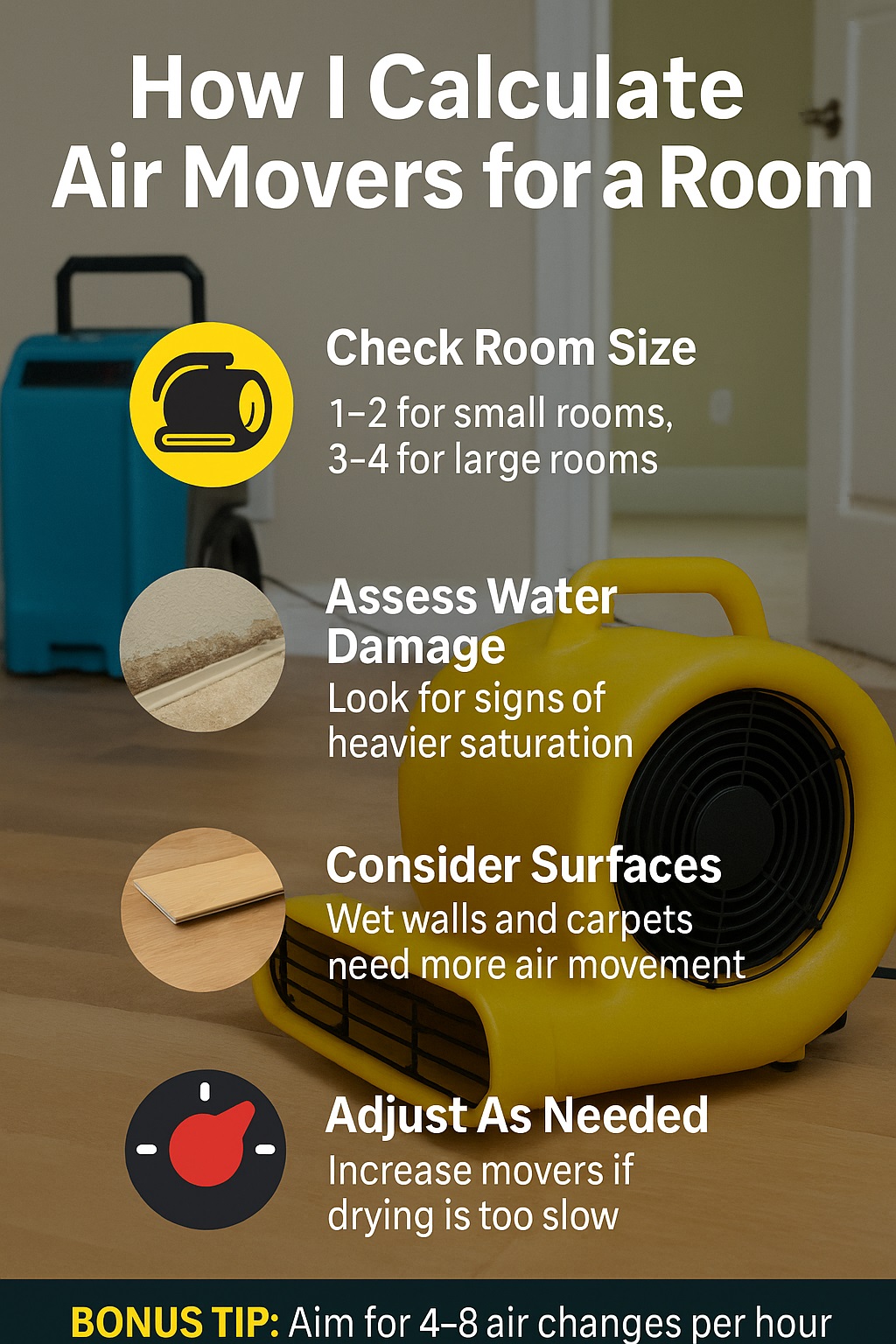
First, I check room size: small, medium, or big. Second, I check how wet it is: damp, soaked, or standing water. Third, I look at surfaces: carpet only, or walls and skirts as well. From those three things I choose a starting number, then adjust by one air mover up or down.
When I Still Use a Calculator
For normal homes, my gut rules work fine. But in tall rooms, big halls, or funky shapes, I still pull out a basic volume check: length × width × height. I don’t chase perfect air changes; I just check whether my first guess is clearly too low or too high.
Dr Alan Reeves, Chartered Professional Engineer (CPEng), often reminds me that field shortcuts are great, but full airflow calculations still matter when you’re drying complex commercial spaces.
📏 My Room-Size Rules: Small, Medium, and Big Spaces
Small Rooms: Bedrooms, Studies, Hallways
For a standard bedroom or study, I usually start with one air mover. If the room has clear floors and not many obstacles, one unit aimed along the wall is enough. I only add a second if I see wet walls, heavy underlay, or awkward furniture creating dead corners.
Medium Rooms: Normal Lounges and Dining Areas
In a medium lounge or dining room, I normally start with two or three units. If it’s an average family lounge, two air movers on opposite walls, forming a loop, works well. I go to three if there’s an L-shape, lots of couches, or one wall is badly soaked.
Big or Open-Plan Areas
Open-plan living, kitchen, and dining areas can chew through gear. I divide the space into zones in my head, like two smaller rooms stuck together. Each zone gets its own air mover count. I’d rather set four air movers in a clean pattern than seven thrown in randomly.
Chartered surveyor Emma Clarke, MRICS, often points out that defining “zones” is a classic property trick that also helps avoid under-treating large, irregular spaces.
🌊 How Wet Is It Really? Adjusting by Water and Materials
Light Damp, Soaked, or Standing Water
If the carpet just feels cool and slightly damp, I prioritise extraction and start with the lower end of my air mover range. When underlay squelches or I see clear water marks on walls, I bump the number up. If there was standing water, I assume more air movers and longer run time.
Carpet, Concrete, Timber, and Plasterboard
Carpet on concrete usually dries slower than carpet on timber because the slab stays cold. So I give concrete slabs more airflow or more time. Timber floors can warp, so I’m more careful but still keep good airflow. Plasterboard that’s wet at the bottom of the wall nearly always earns extra units.
Hidden Wet Spots
Built-in wardrobes, low windows, and stair edges hide moisture. I’ve had “dry” jobs where one stubborn corner refused to drop on the meter until I moved one air mover closer. Now, if I suspect hidden damp, I simply add one unit targeted at that zone and re-check the next day.
Building scientist Dr Louise Patel, PhD, likes to remind me that moisture inside materials behaves very differently from surface damp, which is why meters and patient re-checks beat pure guesswork.
📐 My Favourite Shortcut: Perimeter Method vs Square Metres
Perimeter Method: Follow the Walls
My favourite trick is the perimeter walk. I literally walk around the walls and imagine placing air movers every few metres. In a simple lounge, that might be one in each corner. In a long, narrow room, it might be three spaced along one side. It takes seconds and feels natural.
Square Metre Method: When I Want to Double-Check
Sometimes I sanity-check with a rough area rule in my head: small rooms, one unit; medium rooms, two or three; larger open-plan areas, four or more. I don’t obsess over exact m². It’s more of a “does this feel roughly right?” check before I plug everything in.
Blending Both in Real Jobs
Most days I blend the two: perimeter for placement, area for count. If the room looks under-covered, I add one air mover to the least-ventilated side. If it looks like a wind tunnel, I remove one and see if the readings still drop. Simple, flexible, and easy to teach.
Architect Daniel Ng, NZIA, often points out that using both shape and floor area echoes how designers think about rooms, not just how engineers size systems.
💨 Airflow Patterns: How I Aim My Air Movers
Straight-Line vs Loop Airflow
If every air mover blasts straight at the middle, they just crash into each other. I aim for a loop or “racetrack” pattern, where air travels around the room, not just across it. One unit pushes along the wall, the next picks it up and keeps the air moving in a circle.
Avoiding Dead Zones
Corners behind big couches, door backs, and under low windows often stay wet while the rest of the room looks fine. I now assume those spots will be trouble. I either aim one unit slightly into that corner or add a small extra air mover just for that mini zone.
Height, Stairs, and Split Levels
In split-level lounges or near stairs, air loves to escape up. I may angle one air mover slightly upward to push air across a mezzanine or landing, then catch it with another unit higher up. It looks odd, but the readings drop faster when the air loop includes all levels.
Mechanical engineer Sarah Lopez, PE, likes to remind me that visualising air as “water flowing in a loop” helps non-engineers intuitively design better airflow patterns.
💧 Matching Air Movers With Dehumidifiers
My Basic Ratio
If I only use air movers, I’m just chasing wet air in circles. I aim for a simple ratio: roughly three to five air movers per dehumidifier in a normal home setup. If I notice humidity staying high, I add a dehumidifier before adding more air movers.
Watching Humidity and Temperature
I use cheap hygrometers and built-in displays to keep an eye on conditions. If relative humidity stalls above comfortable levels, I know evaporation is outrunning moisture removal. Warm rooms with good dehumidification dry much faster than cold rooms with endless fans. Sometimes one more dehumidifier beats three extra air movers.
When I Cut Back Air Movers
In smaller rooms I’ve seen overkill: heaps of air movers, one small dehumidifier, and very slow progress. Now I’d rather run fewer fans at sensible angles and a properly sized dry unit. If the room feels like a pointless hurricane, I’m usually wasting power and not gaining much drying speed.
HVAC consultant Mark Jensen, MCIBSE, often argues that controlling moisture removal capacity is more important than simply throwing extra airflow at a wet room.
🔌 Power, Noise, and Safety: My Real-World Limits
Power Circuits and Breakers
In real homes, the switchboard is the boss. I mentally add up the draw of each air mover and dehumidifier. I try to spread plugs across different rooms and circuits, especially older houses. A tripped breaker at midnight is a great way to make everyone hate the job.
Noise Levels for Bedrooms and Apartments
Some jobs are in apartments or kids’ rooms where noise is a big deal. In those cases, I sometimes choose fewer, quieter air movers and accept slightly longer drying times. I explain this clearly to the customer so they understand I’m balancing comfort, sleep, and drying performance.
Cables, Kids, and Pets
I also think about trip hazards. Long cables across narrow hallways are accidents waiting to happen. I reroute cords along walls, tape them where needed, or remove one air mover if the risk is too high. A slightly longer drying time is better than a twisted ankle or damaged lead.
Health and safety advisor Priya Nair, GradIOSH, often reminds me that an “almost perfect” drying plan that people can live with is safer than an “ideal” one nobody can move around in.
📊 My Quick Reference Cheat Sheet
Simple Room Examples
If I walk into a small bedroom, I start with one air mover along the wall and a dehumidifier somewhere central in the flat. Medium lounge? Usually two or three units forming a loop. Large open-plan area? I picture two zones, each with their own fans feeding back to the same drying hub.
When I Add One More
I add one extra air mover if I see wet walls, big furniture blocking air, cold concrete slabs, or readings barely dropping between visits. One extra fan, placed smartly, usually beats doubling everything. If the meter shows good progress, I don’t overcomplicate it just to “look busy.”
When I Remove One
If the room feels like a jet engine, or if people can’t sleep, I try removing one unit from the least important corner and re-check readings next day. If moisture levels still fall nicely, that fan was probably overkill. Comfort and safety matter just as much as chasing perfect numbers.
Productivity coach James Ford, ICF-ACC, likes to say that the best checklists are short enough to remember, which is exactly how I treat my air mover cheat sheet.
🧑🔧 Case Study: How I Worked Out Air Movers for a Soaked Lounge
The Call-Out
One evening I got called to a lounge where a washing machine hose had burst and run for about an hour. The carpet was soaked, underlay squelched, and one internal wall had visible water marks up to the skirting. The homeowner just wanted a quick, clear plan.
My Setup Plan
The room was a medium-sized lounge opening slightly into a hallway. Using my simple rules, I chose three air movers: two along the longest wall, one aimed across the entrance area. I paired them with a solid dehumidifier running in the middle of the living space for the whole zone.
Adjustments and Results
On day two, my moisture meter showed one stubborn corner near the internal wall still slow to dry. I moved one air mover closer and angled it right along that wall. After another day, carpet and wall both dropped into a safe range and the owner was happy.
Customer Setup Snapshot
| Detail | Job Snapshot |
|---|---|
| Room size | Medium lounge, partial hallway |
| Air movers used | 3 units |
| Dehumidifiers used | 1 medium-capacity unit |
| Drying time | About 3 days active running |
| Final readings | Within safe range on meter checks |
Project manager Olivia Green, PMP, often highlights that simple “plan → check → adjust” cycles beat trying to design the perfect job on the first visit.
❓ FAQs: My Straight Answers About Air Mover Numbers
How Many Air Movers Do I Need for a Bedroom?
For a normal bedroom, I start with one air mover and one dehumidifier somewhere in the home. If the carpet is heavily soaked or a wall is clearly wet, I add a second air mover. I’d rather start small, then boost the setup if the readings stay high.
How Many for a Large Lounge or Open-Plan Area?
For a big lounge or open-plan living area, I usually start with three or four air movers and at least one strong dehumidifier. If there are two clear zones, I treat them separately and may add a second drying unit. The aim is full coverage without turning the place into a wind farm.
Can I Use Too Many Air Movers?
Yes. Too many fans without enough dehumidification can just push wet air around. It also raises noise, power use, and tripping hazards. I’d rather use fewer, well-placed air movers and match them to proper moisture removal than show off with ten units in one room.
Do I Always Need a Dehumidifier?
If the job is more than a tiny spill, I treat a dehumidifier as mandatory. Air movers speed evaporation, but the moisture has to go somewhere. Without a dehumidifier, that “somewhere” is the rest of the house, which can create new problems like condensation and musty smells.
How Long Should I Run Air Movers Each Day?
For proper water damage jobs, I usually run the setup 24/7 for the first couple of days, then reassess. If readings are dropping well, I might reduce airflow slightly. If they’re stuck, I adjust placement or add gear. Stopping too early is one of the most common mistakes I see.
Property restorer Michael Ross, IICRC-Certified, often says that good drying is less about tricks and more about consistent monitoring, adjustments, and patience.
✅ Takeaways: My Simple Rules So You Don’t Go Crazy
If you remember nothing else, remember this: match air movers to room size, wet level, and surfaces, then double-check power, noise, and safety. Start with a sensible number, watch your readings, and adjust by one unit at a time instead of guessing wildly.
You don’t need to be an engineer to dry a room well. You just need a simple system you trust, a moisture meter, and the discipline to tweak the setup instead of hoping for magic.
Psychologist Dr Hannah Lee, NZPsS, would probably say that clear, simple rules reduce stress and decision fatigue just as much on building sites as they do in everyday life.
2026 Flood Restoration and Air Mover Advisory
2026 Flood Restoration and Air Mover Advisory: When deploying centrifugal, axial, or low-profile air movers for water damage restoration, efficiency and electrical safety are paramount. Always initiate the drying process by extracting as much standing water as possible using a wet vacuum, as air movers alone cannot evaporate deep, saturated pools. Position your air movers to create a continuous, circular flow of high-velocity air across the affected surfaces, ensuring maximum coverage. Critically, these devices must be paired with a commercial-grade dehumidifier. Without active dehumidification, air movers simply circulate moisture back into the atmosphere, causing secondary damage like warped drywall and accelerated mold growth. Ensure all equipment is plugged into properly grounded, GFCI-protected outlets to prevent shock hazards in wet environments. Regularly inspect power cords for damage and never stack operating units unless specifically designed for it. Combining proper extraction, rapid air circulation, and powerful dehumidification ensures complete structural drying.
Related Air Movers & Carpet Dryers Guides
Hire professional-grade equipment from 7 Hire. We offer fast local pickup or delivery across Auckland.