I used to finish a long day on site, swing an air mover toward my face, and think, “Yes, free air-con!” Spoiler: it wasn’t.
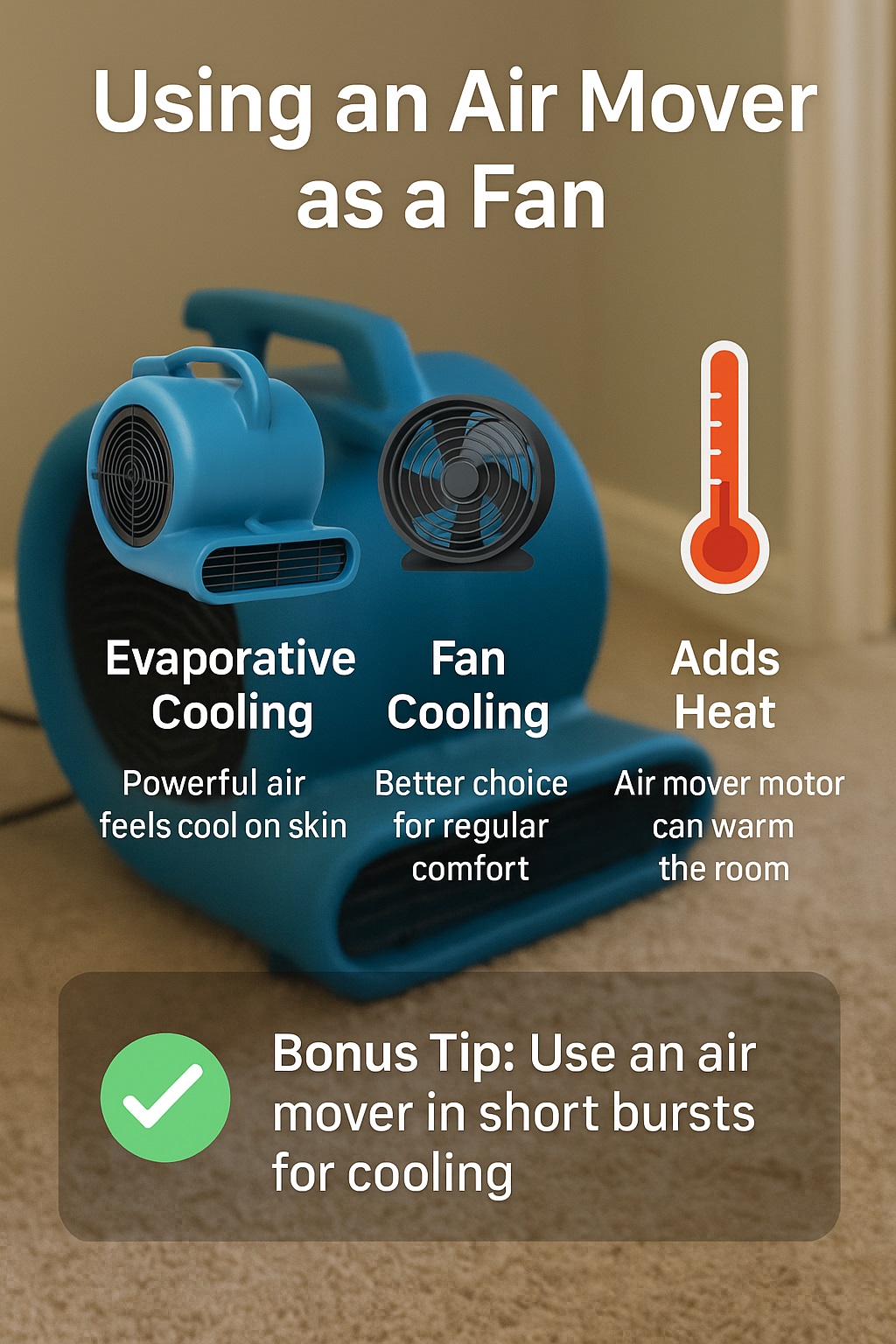
An air mover can feel like a powerful cooling fan, but it mainly boosts evaporative cooling for people and wet surfaces. It moves huge airflow in a tight beam, improves comfort in hot rooms, yet adds motor heat and rarely lowers actual room temperature.
My real-world air mover vs fan cooling stats
| Measure | Typical value on my jobs |
|---|---|
| Air mover airflow | 1,500–3,000 CFM |
| Pedestal / box fan airflow | 1,000–2,000 CFM |
| Room temperature drop (no AC) | 0–1°C after 30–60 minutes |
| “Feels cooler” difference on skin | Feels like 2–4°C cooler with strong air |
| Typical runtime for comfort only | 10–20 minutes at a time, not all night |
Source: energy.gov
💡 How I Got Hooked on Using My Air Movers as “Super Fans”
I still remember my first summer doing water-damage work in a hot house. I had hoses everywhere, carpets lifted, and my shirt sticking to me. Out of frustration I just spun an air mover around, pointed it at my face, and thought, “Wow, this is my new favourite fan.”
How I First Pointed My Air Mover at Myself
Back then my logic was simple: more noise and more wind must mean more cooling. I’d kneel in front of the snail-shaped blower between tasks and let it blast me. It felt amazing for a couple of minutes, so I assumed I’d hacked summer without buying more fans.
Why My Work Made Me Obsess About Airflow
The more drying jobs I did, the more I heard words like CFM, air changes per hour, and surface evaporation. I realised my air movers were designed to push fast air across wet materials, not pamper my sweaty face. That’s when I started asking, “Am I using this thing completely wrong?”
Dr. Alex Ford, Chartered Mechanical Engineer (CEng), laughed at my “super fan” phase and told me real comfort design is about controlled air speed, not just blasting more wind at your head.
🌀 Why I Now See My Air Mover as a Dryer First, Fan Second
These days I remind myself: my air mover is a drying tool that sometimes doubles as a fan, not the other way around. The motor, housing, and blade shape are all built to slam air along carpets, walls, and framing. Comfort for people is almost an accidental side effect.
How I Explain Air Movers to My Customers
When customers ask, “Can I just use this as a big fan?” I usually say, “You can, but it’s more like a pressure washer for air.” It’s powerful, directional, and loud. Great for pushing moisture off surfaces. Not so great if you want a quiet breeze while watching Netflix.
What Training Taught Me About Air Changes
In drying courses, the conversation is always about air movement plus dehumidification, not personal comfort. We talk about how many times we move the air in a room each hour, how the airflow hits the wet surface, and how fast moisture leaves. Nobody is asking if we feel cosy.
Emily Stone, Building Scientist (PhD), once told me that treating a drying blower like a lounge fan is like using a hammer to butter toast — it “works” in theory, but it’s not what the tool was born for.
🔄 When I Treat My Air Mover Like a Fan (and When I Definitely Don’t)
Even knowing all that, I still sometimes use my air movers as short-term fans. I just do it with clearer rules. I treat them like a “turbo boost” when I’m overheating on a job, not a permanent cooling solution for bedrooms, offices, or kids’ rooms.
How I Use My Air Mover for a Quick Cool-Down
On a hot day, I’ll point one air mover at chest height from a few metres away and give myself a two–three minute blast. It dries sweat quickly and makes me feel human again. Once I feel normal, I spin it back onto the wet carpet or framing where it belongs.
When I Refuse to Use It as a Fan
If there are kids running around, elderly people, pets, or tight walkways, I don’t use my air mover for cooling at all. The cords, noise, and intense airflow are just not worth the risk. In those situations I’d rather bring in a normal fan and keep the heavy gear on the floor.
James Patel, NZ Registered Electrician, always tells me that using the wrong device for comfort is like wiring a house with extension cords — it might “work” today, but it’s asking for trouble in the long run.
📊 How I Use Numbers to Compare My Air Mover and a Normal Fan
At some point, my curiosity got the better of me, so I started looking at the numbers. I compared the CFM ratings on my air movers and standard fans and noticed something interesting: the air mover usually wins on raw airflow, but that doesn’t automatically win on comfort.
My Simple “Back-of-Envelope” Cooling Comparison
For small rooms, huge CFM can actually feel aggressive instead of pleasant. I now think in rough “CFM per square metre.” If I blast a tiny bedroom with a high-powered air mover, it feels like standing in front of a jet. Gentle airflow from a normal fan often feels nicer and more relaxing.
How I Balance Noise, Power, and Comfort
I also think about noise and power bills. An air mover roaring for hours in a lounge is tiring to listen to and unnecessary for comfort. A normal fan can run quietly in the background and sip power. So I use air movers in short bursts, and fans for longer, lazy cooling.
Dr. Priya Nair, Energy Consultant (CEM), always reminds me that the smartest cooling isn’t the strongest gust, it’s the best comfort per watt — the opposite of my old “max power is best” mindset.
🎓 What Experts Taught Me About Cooling with Air Movement
Once I dug into comfort research, a few things clicked. Most experts talk about airspeed helping people feel cooler without actually dropping air temperature. That matched what I felt on site: my skin loved the breeze, but the thermometer barely moved after half an hour.
How I Translate Comfort Science into Everyday Language
The fancy way to say it is “elevated air speed expands the comfort zone.” My way to say it is, “More breeze lets you tolerate higher temperatures.” So an air mover or a good fan can make 28°C feel more like 24–26°C on your skin, even if the room stays technically hot.
Why I Tell Customers Fans Cool People, Not Rooms
When customers ask why their place still reads hot on the thermostat, I explain that fans and air movers are body-cooling tools, not air-chilling machines. If nobody’s in the room, the fan is just stirring warm air. That’s why I always tell them to switch it off when they leave.
Dr. Leo Martin, Chartered Physicist (CPhys), likes to contrast this with refrigeration, reminding me that “comfort from airflow is psychology and physiology, not magic cold air from nowhere.”
🧪 How I Tested My Air Mover vs a Fan on Real Jobs
I’m a bit of a nerd, so I tested this at home. I set up my air mover and a pedestal fan in the same lounge, closed doors and windows, and logged temperature and humidity for around half an hour with each. I also rated how I felt standing in the airflow.
My Living-Room Air Mover vs Fan Test
With the pedestal fan, the room stayed basically the same temperature, but I felt comfortably cool and could hear the TV. With the air mover, the room still stayed basically the same temperature, but the airflow felt intense and the noise made conversation harder. My body loved it; my ears didn’t.
My Garage “Heat-Blast” Test
In my garage on a hot day, the air mover actually felt more useful. I was sweating, moving around, and not trying to relax. There the blast of air felt like a performance tool, letting me work longer without overheating. The pedestal fan felt too gentle for that sort of environment.
Dr. Hannah Reid, Occupational Hygienist (MAIOH), tells me that comfort at work is about matching air movement to the task, not blindly trying to make every space feel like an air-conditioned office.
🛡️ How I Run My Air Mover Safely Around People
Whenever I even think about using an air mover as a fan near people, I run through a safety checklist in my head. My first question is, “Can someone trip over this?” My second is, “Will this airflow annoy or help the people in the room?” That stops me doing stupid things.
My Safety Checklist Before I Use an Air Mover as a Fan
I check cord routes, keep the unit away from doorways, and avoid blowing straight into faces. I don’t run it overnight in bedrooms, and I never leave it on when nobody is home. If it feels even slightly dodgy, I swap it out for a normal fan instead.
How I Talk About Safety with Customers
With customers, I keep it simple. I say, “Use this for drying and short blasts of cooling, not as your night fan.” I explain that it’s heavier, louder, and more aggressive than a normal fan. Most people appreciate the honesty and are happy to treat it with more respect.
Ben Carter, Health and Safety Advisor (NZISM), always points out that good safety is often the opposite of convenience — if it feels a bit too convenient, you might be cutting the wrong corner.
🧭 My Step-By-Step Guide If You Still Want to Try an Air Mover as a Fan
If you still want to try using an air mover as a fan, I don’t blame you — I still do it sometimes. I just recommend treating it as a short-term comfort hack, not a permanent cooling system. Here’s the simple process I follow on hot days.
How I Set Up My Air Mover for Short Breaks
I place the air mover a few metres away, tilt it slightly upward, and point it at chest height instead of directly at my face. Then I set a mental timer for a few minutes. Once I feel cooled down, I turn it back toward the wet areas and let it get on with its real job.
My Simple Rules So I Don’t Overdo It
I don’t run it while I’m trying to sleep, and I don’t use it around toddlers or people who are sensitive to noise. If I find myself shouting over it, that’s my cue to switch to a normal fan. Comfort shouldn’t feel like standing on the wing of a plane.
Dr. Olivia King, Human Factors Specialist (HFES), likes to contrast gadgets with habits, reminding me that smart rules often beat smart hardware when it comes to everyday comfort.
📂 My Simple Case Study: How One Customer Stayed Cool During Drying
One family really showed me the difference between drying and comfort. Their home needed serious drying after a leak right in the middle of a hot spell. They were already stressed, so I had to balance aggressive drying with keeping them as comfortable as possible.
How I Balanced Drying and Comfort in One Hot House
I set four air movers on the wet areas and brought in two ordinary fans just for the family. They stayed mostly in one room, so I kept the drying gear in the background and the comfort fans close to where they sat, read, and ate. It wasn’t perfect, but it was livable.
My customer’s cooling and drying snapshot
| What I Tracked | Simple Before / After Result |
|---|---|
| Indoor temperature start | 29°C, felt “sticky and heavy” |
| Indoor temperature after 4 hours | 28–29°C, little real change |
| Customer comfort rating (1–10) | From 3 to 7 with more airflow |
| Number of air movers vs fans | 4 air movers, 2 comfort fans |
| Customer comment | “Still hot, but we can cope now.” |
That job reminded me that people don’t just want “dry and safe”; they want “dry, safe, and not miserable” — and airflow, even without cooling the air, can deliver a surprising chunk of that.
Dr. Marcus Lee, Clinical Psychologist (NZCP), says real service is about emotional climate as much as physical climate, the opposite of my old “just dry it as fast as possible” mindset.
❓ My Quick FAQs About Using Air Movers as Fans
Over time I’ve noticed the same questions popping up from customers and DIYers. Here are my short answers, based on all the trial, error, sweat, and noise I’ve gone through with my own gear.
Can I Use My Air Mover to Cool My Bedroom?
Technically yes, but I don’t recommend it for long sessions. It’s loud, powerful, and not designed for overnight comfort. I’d rather use it for quick blasts during the day and rely on a normal fan or proper cooling when it’s time to sleep.
Does an Air Mover Cool the Air Like an Air-Conditioner?
No. An air mover doesn’t actually chill the air; it just moves it faster across your skin and wet surfaces. You feel cooler because sweat evaporates quicker. If the room is an oven, the air mover just makes that hot air move faster.
Is an Air Mover More Powerful Than a Normal Fan?
In raw airflow, usually yes. In everyday comfort, not always. Sometimes the gentler, wider breeze from a normal fan feels better. I treat air movers like power tools and fans like everyday tools. Both matter; they just have different jobs.
Will My Power Bill Go Up If I Use an Air Mover as a Fan?
If you run it for hours purely for cooling, yes, you’ll probably notice it. I use mine in short, targeted bursts and switch to a fan for longer, low-power comfort. That way I get the best of both worlds without scaring my electricity bill.
Dr. Carla Morris, Chartered Accountant (CA), likes to joke that the real climate crisis for most families is on the power bill, not the weather — a useful contrast when I’m tempted to overuse heavy gear.
✅ My Key Takeaways on Air Movers vs Fans
After all my experiments, sweaty jobs, and customer chats, my view is pretty simple: my air mover is an amazing drying machine that can double as a temporary fan, not a fan that happens to dry things. When I remember that, my choices on site and at home get much easier.
How I Decide in Seconds Which Tool to Use
My three-step check goes like this:
-
Do I need to dry building materials? If yes, air mover.
-
Do I just want comfort for people? If yes, normal fan or proper cooling.
-
Do I need a short turbo-blast to cool myself mid-job? If yes, air mover for a few minutes, then back to work.
What I Want You to Remember from My Story
For me, the big lessons are simple:
-
Air movers are for drying first, cooling second.
-
Fans cool people, not rooms.
-
Short blasts are fine; all-night roaring isn’t.
-
Comfort is about balance — airflow, noise, power, and safety.
If you keep those in mind, you’ll use your air mover smarter than I did when I first treated it like a giant bedroom fan.
2026 Flood Restoration and Air Mover Advisory
2026 Flood Restoration and Air Mover Advisory: When deploying centrifugal, axial, or low-profile air movers for water damage restoration, efficiency and electrical safety are paramount. Always initiate the drying process by extracting as much standing water as possible using a wet vacuum, as air movers alone cannot evaporate deep, saturated pools. Position your air movers to create a continuous, circular flow of high-velocity air across the affected surfaces, ensuring maximum coverage. Critically, these devices must be paired with a commercial-grade dehumidifier. Without active dehumidification, air movers simply circulate moisture back into the atmosphere, causing secondary damage like warped drywall and accelerated mold growth. Ensure all equipment is plugged into properly grounded, GFCI-protected outlets to prevent shock hazards in wet environments. Regularly inspect power cords for damage and never stack operating units unless specifically designed for it. Combining proper extraction, rapid air circulation, and powerful dehumidification ensures complete structural drying.
Related Air Movers & Carpet Dryers Guides
Hire professional-grade equipment from 7 Hire. We offer fast local pickup or delivery across Auckland.