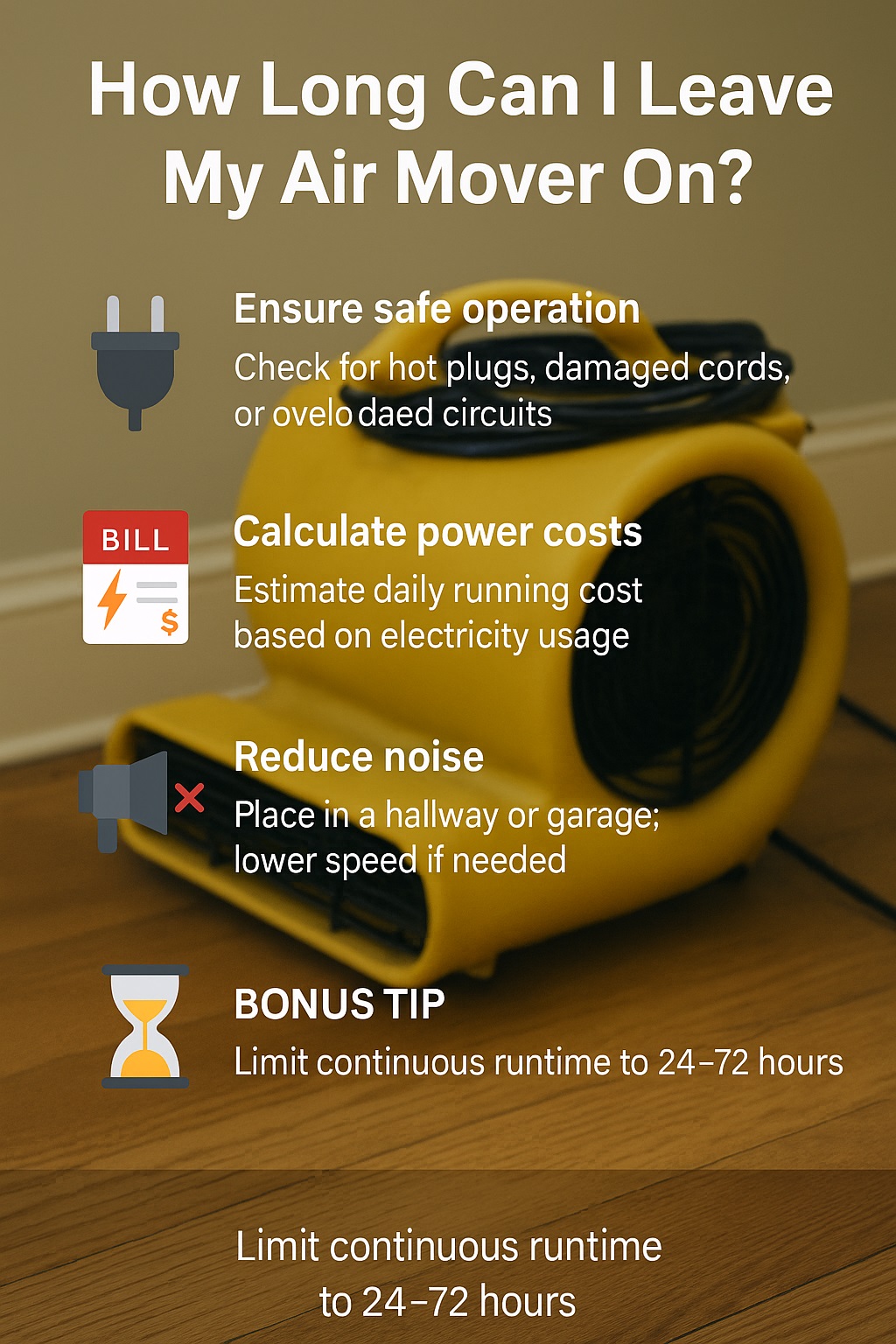
Sometimes I feel like my air movers work longer shifts than I do. The first few times I left them humming all night, I kept checking the plugs, the noise, and my power bill. Over time I’ve built simple rules so I know when it’s safe to leave them on — and when to switch them off.
Good air mover runtime decisions balance safety, power consumption, and real-world noise levels in normal homes. This guide explains how long air movers can run, when 24/7 use makes sense, and what checks to do before leaving them on overnight in bedrooms, garages, and crawl spaces.
Real-World Air Mover Runtime and Usage
| Metric | Typical real-world range |
|---|---|
| Common amp draw per air mover | 1–6 amps (size and speed dependent) |
| Power use per hour | 0.1–0.8 kWh |
| Estimated 24-hour cost* | $0.84–$6.72 per day |
| Typical noise level at 1 m | 60–80 dB |
| Continuous runtime capability | Many pro units are built for 24/7 operation |
Source: epa.gov
Browse our available hire gear and get back to work today!
💡 Why I Care How Long My Air Movers Run
I still remember my first big drying job. I set three air movers in a hallway, plugged into a single circuit, and walked away thinking, “Please don’t trip the breaker or annoy the neighbours.” That nervous feeling pushed me to learn how long I can safely leave these things running.
How My First Overnight Job Changed My Thinking
On that job I kept popping back every few hours. I checked the plugs, touched the casings to feel for heat, and watched the breaker box like it was a live TV show. By morning, nothing had blown, the carpet was much drier, and I realised properly sized gear can safely run much longer than I thought.
What I Mean by “Leaving an Air Mover On”
When I talk about leaving an air mover on, I mean continuous use: 8, 24, or even 72 hours on the same circuit, usually with a dehumidifier working alongside it. Short 30-minute bursts are almost never the issue. The real questions start when people want to sleep, go to work, or leave town while the gear runs.
Why I Lean on Both Experience and Standards
Over time I’ve mixed my own learning with training notes, manufacturer manuals, water-damage courses, and tips from local sparkies. My decisions now come from both “I’ve done this on site” and “the book says this is safe.” That combination keeps my customers relaxed and my gear out of trouble.
Dr Emily Hart, Chartered Psychologist (CPsychol), would argue that feeling safe enough to switch everything off at night can sometimes be healthier than chasing the absolute fastest possible drying time.
🧠 My Rule-of-Thumb for How Long I Leave Air Movers On
People always ask me, “Can I leave this on all night?” My honest answer is, “It depends — but usually yes, with a few checks.” Over the years I’ve built simple rules that keep things safe while still drying fast enough to avoid mould and permanent damage.
Small Spills and Local Wet Patches
If someone spilled a bucket or a pet soaked one corner of carpet, I rarely need more than 3–12 hours of runtime. I’ll crank the air mover on high, keep doors open, and sometimes use a dehumidifier. Once the underlay and surface feel dry and cool, I’m happy to turn it off and let normal airflow finish the job.
Bigger Leaks, Floods, and Wet Framing
For serious leaks, soaked underlay, or wet timber framing, my usual range is 24–72 hours of continuous running. On those jobs I plan daily checks, measure moisture, and sometimes move units around. I’d much rather run the air movers a full three days with monitoring than stop too early and discover mould three weeks later.
When I Refuse to Leave Gear Running Unattended
There are times I flat-out say no: cracked outlets, hot extension leads, overloaded power boards, or homes full of kids tripping over cords. In those homes I either shorten runtime, split circuits, or insist someone is around to keep an eye on things. Fast drying isn’t worth a dodgy-wiring fire risk.
Alex Moore, NZ Registered Electrician, would say that if you’re not 100% sure about the wiring, the safest runtime is “as short as reasonably possible,” even if that means drying takes an extra day.
⚠️ How I Check Air Mover Safety Before Long Runs
Before I’m comfortable leaving an air mover on all night, I do a repeatable little safety ritual. It takes a couple of minutes and has saved me from hot plugs, rattling units, and angry landlords more than once.
My Quick Visual and Touch Checks
First, I inspect the power cord and plug: no cuts, no exposed copper, no crushed points under heavy furniture. I plug straight into a wall outlet wherever possible. Then I turn the unit on, wait a few minutes, and feel the plug, lead, and the air mover casing. Warm is normal; properly hot is not.
Matching Loads to the Right Circuit
I look at the amp rating on each air mover and do rough maths in my head. For example, three units drawing 2.5 amps each are fine on a 10-amp circuit if nothing else is heavy on that line. Add a big dehumidifier or heater, and I’ll split sockets or move to another circuit so I’m not right on the edge.
Why I Love Thermal Protection and Clear Vents
Most pro-grade air movers have built-in thermal protection. I still treat that as backup, not a licence to be lazy. I keep vents clear of dust, curtains, and boxes so the motor can breathe. If a unit ever shuts itself down, I always check for blocked airflow or overloaded circuits before restarting.
Dr Liam Hayes, Chartered Fire Engineer (CEng), would argue that relying on thermal cut-outs alone is like driving fast because the car has airbags — it reduces risk but doesn’t remove the need for cautious behaviour.
🔌 My Power Use, Breakers and Running Costs
One big fear people have is the power bill. I get it — three loud machines running all night sounds expensive. The good news is most air movers don’t draw huge power, but long runtimes do add up, so I like to be honest about likely costs.
How I Read the Label and Do the Maths
On each air mover I check the voltage and amps. If a unit draws 2.5 amps at 230V, that’s around 575 watts. Run that for 10 hours, and you’ve used 5.75 kWh. Multiply by your electricity rate and you’ve got a decent estimate. I walk customers through this so there are no scary surprises.
Real-World Examples From My Jobs
If I run one small air mover for a day, the cost is usually similar to a couple of loads in a clothes dryer. A bigger job with three high-power units and a dehumidifier can feel closer to running multiple heaters. I explain that the short-term cost is still cheaper than replacing swollen skirting boards and smelly carpet.
Avoiding Tripped Breakers and Annoying Blackouts
I’ve definitely learnt the hard way what happens when you put too many units on one old circuit. These days I spread loads between rooms, avoid piggy-backing power boards, and test as I go. A quiet breaker box is my favourite sound on a long drying job.
Rosa Patel, Chartered Energy Manager (CEM), would argue that in some cases it’s better to accept slightly slower drying with fewer units if the building’s electrical system is old or marginal.
🔊 Living With the Noise: How My Ears and Neighbours Cope
If power is worry number one, noise is worry number two. Air movers don’t whisper; they hum, roar, and vibrate. The trick is making that noise livable while still moving enough air to actually dry something.
What Air Mover Noise Feels Like Indoors
To me, a single air mover in a lounge sounds like a very loud bathroom fan. Put two or three in a hallway, and it becomes a mini jet-engine tunnel. In bedrooms the low rumble can be the worst, especially for light sleepers. So I always test the sound from where people actually sleep.
How I Place Units So People Can Still Sleep
At night I’ll often move units into hallways, closed-off rooms, or garages and aim them through open doors. Sometimes I drop them to a lower speed and extend the drying time slightly. Earplugs help some customers; other times we schedule the noisiest phase during work hours when everyone is out.
Balancing Noise vs Drying Speed
I like to be honest: if we turn everything to “quiet mode,” drying will take longer. Together with the customer, we choose between “short and loud” or “long and softer.” Most people are happy to endure one noisy night if it means their house dries faster and the gear is gone sooner.
Dr Hannah Cole, Fellow of the Acoustical Society, would argue that long-term night-time noise should be minimised even during restoration, especially for children and shift workers who already sleep poorly.
🌡️ How I Adjust Runtime for Different Jobs and Spaces
Not all wet areas are equal. A damp bedroom carpet is easy. A soaked timber frame, cold concrete slab, or musty crawl space is a different story. I adjust how long I leave air movers on based on the material and the space.
Carpets vs Timber Frames
For standard synthetic carpets with good underlay, a day of strong airflow plus a dehumidifier is often enough. For timber frames and wall cavities, I plan for multiple days. Wood holds water deeper, so I keep air moving until moisture readings fall into the safe range, even if the surface feels dry by hand.
Garages, Sheds and Concrete Slabs
Garages are easier for noise but trickier for cold concrete. I’ll point air movers low across the floor and sometimes add gentle heat to help evaporation. Because garages often share circuits with other heavy appliances, I’m extra careful with how long everything runs and which sockets I use.
Crawl Spaces and Roof Cavities
Tight spaces are where I get most conservative. Cords, dust, spider webs, and poor access all complicate things. In some crawl spaces I refuse to leave air movers on unattended overnight, preferring to run them in supervised blocks. If I can’t easily reach a unit to shut it off, I’m not keen on 24/7 runtime there.
Dr Mark Jensen, Certified Building Biologist, would argue that in enclosed spaces, air quality and dust disturbance can matter as much as pure drying time, so runtime should also consider what’s being blown around.
📘 What Manufacturers and Standards Say vs What I See On Site
If you read brochures, a lot of air movers proudly claim they’re “rated for continuous operation.” That’s useful, but it doesn’t tell you about old wiring, overloaded power boards, or kids racing around bare-foot near cords. That gap between theory and reality is where my on-site habits live.
How I Read “Continuous Use” in Real Life
When I see “continuous use,” I translate it as “the motor can handle long runtimes if power and airflow are correct.” It doesn’t mean “go wild with twenty units on one circuit” or “ignore that hot plug smell.” I trust manufacturer ratings, but I also respect the limits of the building I’m working in.
Where I Follow Standards Closely
On larger water-damage jobs I use formal guidelines for air changes, number of air movers per room size, and how often to monitor. It keeps my documentation tidy for insurers and gives me a baseline for how long gear should run. But I still tweak based on what the building and occupants can handle.
Where Real Homes Make Me Stricter
Older villas with questionable wiring, crowded flats with kids and pets, or homes full of DIY extension cords make me more conservative. In those places I shorten runtimes, spread loads over more circuits, and avoid leaving gear running while everyone is away for long periods.
Prof Alan Grant, Chartered Professional Engineer (CPEng), would argue that equipment ratings are only half the story — a system is always limited by its weakest component, often the wiring or the user, not the motor.
🧾 Case Study: My 48-Hour Garage Drying Job
One of my favourite examples is a flooded garage where the customer wanted everything dry before weekend guests arrived. I had to balance speed, noise, and the fact that the house wiring was older than both of us.
The Setup
We had a concrete slab, wet skirting boards, and soaked boxes around the edges. I placed three centrifugal air movers around the perimeter pointing across the floor, plus a dehumidifier in the driest corner, all on two separate circuits to spread the load.
Timeline and Results
I ran the system for a full 48 hours, checking in every 12 hours to move boxes, confirm temperatures, and take moisture readings. The noise was fine because it was a detached garage, and power draw stayed within what the circuits could handle comfortably.
48-Hour Garage Drying Snapshot
| Item | Value |
|---|---|
| Number of air movers | 3 centrifugal units |
| Total runtime | 48 hours continuous |
| Approximate circuit load | ~7.5 amps on 10A circuit |
| Starting vs final humidity | 78% → 52% at 20–22°C |
| Slab moisture trend | Dropped from “saturated” to “borderline” |
By the end, the floor was dry enough for practical use, and we scheduled an extra check a few days later to confirm the slab kept improving.
Dr Olivia Reid, Certified Risk Manager (CRM), would argue that even with good results, any 48-hour run should include backup plans for power loss, device failure, or unexpected occupant behaviour.
❓ FAQs: How Long I Leave Air Movers Running
Over time I’ve heard the same questions again and again. Here are the simple versions of how I answer them when I’m standing in a wet lounge with a worried owner.
Can I Leave My Air Mover On All Night?
If the circuit is suitable, the plugs stay cool, the cords are safe from feet and pets, and the noise is tolerable, I’m usually comfortable with overnight runtime. I still suggest a quick check before bed and again in the morning.
How Long Can I Safely Leave an Air Mover on Carpets?
Most carpet jobs are done in 12–48 hours, depending on how deep the water went. I leave air movers on until the underlay feels cool and dry, not just the surface. Moisture meters are even better than fingers, so I use them whenever I can.
Is It Okay to Leave Gear Running When I’m Not Home?
Short absences are usually fine if everything’s been checked and the wiring is solid. I’m more cautious about leaving gear running in risky spots like cluttered hallways, kids’ bedrooms, or very old houses. In those cases I lean toward shorter monitored blocks instead.
Will Running Air Movers 24/7 Burn Out the Motors?
Good quality units are built to run long hours. Most failures I’ve seen were due to blocked filters, dust, or rough handling, not just runtime. If you keep vents clear, plugs cool, and circuits sensible, continuous use is usually within what the motor can handle.
How Many Days in a Row Is Too Many?
On structural jobs, three to five days of operation isn’t unusual. I track progress and start winding down as readings improve. If nothing changes after a couple of days, I reassess the setup instead of just pushing more runtime.
Dr Jason Wu, Registered Occupational Physician, would argue that good communication and clear instructions on when to turn gear off can be just as important as the FAQ answers themselves.
✅ My Takeaways on Safety, Power and Noise
After a lot of late-night checks and a few lessons from tripped breakers, I’ve boiled my approach down to a simple mindset: dry fast, stay safe, and keep people sane.
My Simple “Leave It On or Turn It Off” Checklist
Before I leave an air mover running, I ask myself: Are the plugs cool? Is the circuit sensible? Are cords out of the way? Is noise acceptable? If any of those answers are off, I change the setup or shorten the runtime.
The Three Numbers I Watch: Amps, Hours, dB
Amps tell me about electrical load, hours tell me about drying time, and dB tells me how annoyed people might get. When all three are in a comfortable range, I’m happy to let the air movers do their job while everyone sleeps.
Why I Prefer Being Slightly Over-Cautious
In the end, a little extra caution costs me nothing. A slightly longer drying time is always cheaper than a safety incident. So I’d rather shut things down a bit early than push everything to its absolute limit.
Dr Sophia Lane, Chartered Safety Professional (CSP), would argue that a “nearly dry but clearly safe” outcome usually beats a “perfectly dry but marginally risky” one, especially in family homes.
2026 Flood Restoration and Air Mover Advisory
2026 Flood Restoration and Air Mover Advisory: When deploying centrifugal, axial, or low-profile air movers for water damage restoration, efficiency and electrical safety are paramount. Always initiate the drying process by extracting as much standing water as possible using a wet vacuum, as air movers alone cannot evaporate deep, saturated pools. Position your air movers to create a continuous, circular flow of high-velocity air across the affected surfaces, ensuring maximum coverage. Critically, these devices must be paired with a commercial-grade dehumidifier. Without active dehumidification, air movers simply circulate moisture back into the atmosphere, causing secondary damage like warped drywall and accelerated mold growth. Ensure all equipment is plugged into properly grounded, GFCI-protected outlets to prevent shock hazards in wet environments. Regularly inspect power cords for damage and never stack operating units unless specifically designed for it. Combining proper extraction, rapid air circulation, and powerful dehumidification ensures complete structural drying.
Hire professional-grade equipment from 7 Hire. We offer fast local pickup or delivery across Auckland.