The first time I picked up a chainsaw, I thought, “How hard can it be?” Five minutes later I learned a loud lesson: it’s not just a spinning chain. It’s a mini power system with safety tricks, friction problems, and one part that’s basically a built-in “automatic gearbox.” Once I understood the inside story, everything got safer, faster, and way less stressful.
Quick Chainsaw Numbers I Use (So It’s Easier to Picture)
| Data point | Typical range / example |
|---|---|
| “Homeowner” petrol sizes | ~30–50cc class |
| Common battery sizes | 4Ah–12Ah (varies by brand) |
| Typical bar lengths | 12″–20″ (home use) |
| Common chain pitch | 3/8″ low-profile or .325″ |
| Common chain gauge | .043″–.050″ (many home saws) |
Source: husqvarna.com
🪚 My 10-Second Chainsaw Overview (The “Power → Cut” Story)
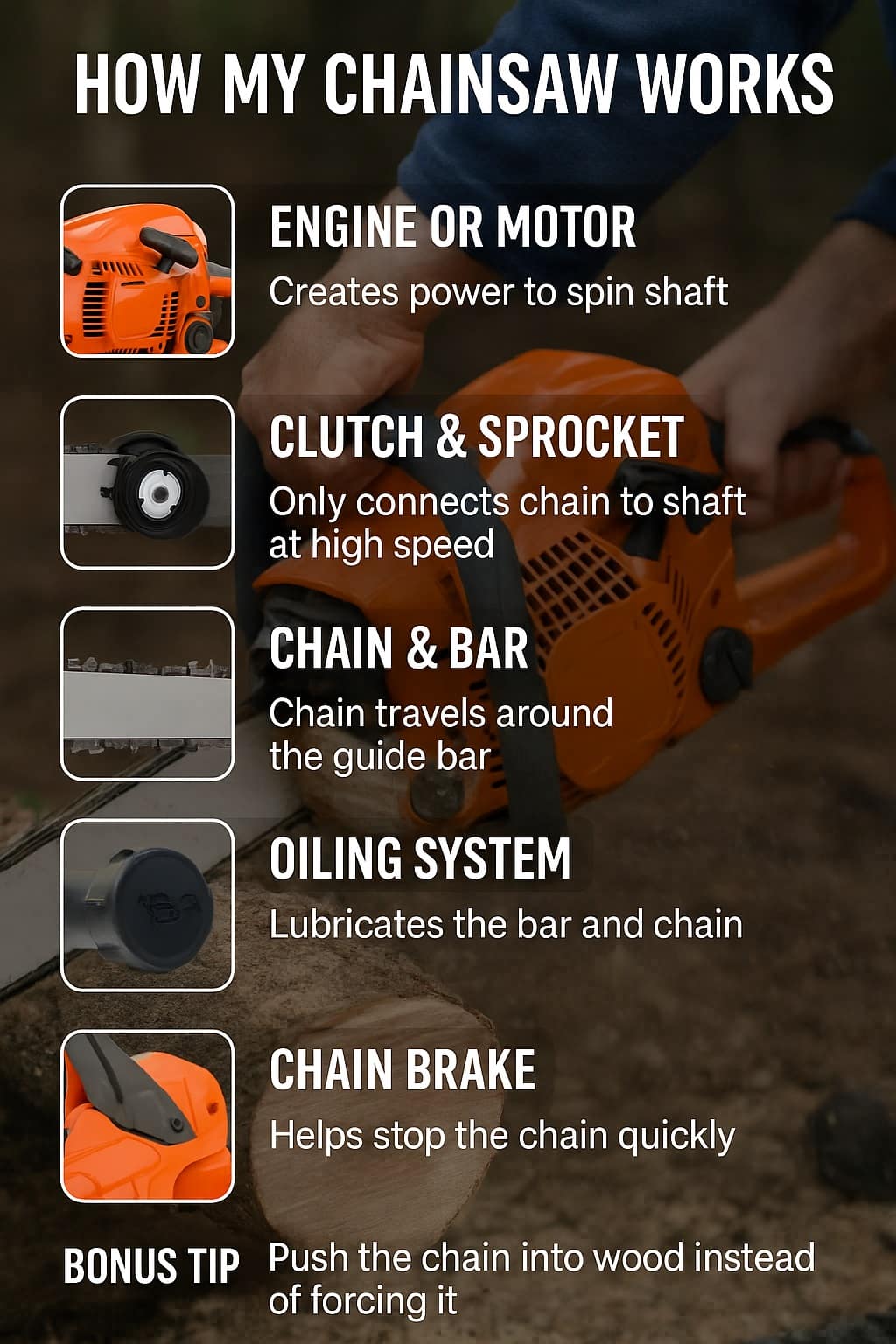
When I explain a chainsaw to a beginner, I keep it stupid simple: power gets made (engine or motor), that power turns into spin, the spin grabs a sprocket, the sprocket pulls the chain around the bar, and the cutters shave wood into chips. If you can picture that, you’re already ahead of where I started.
My “power turns into chain motion” diagram (in plain words)
Inside the saw, the engine or motor spins a shaft. That spin doesn’t always move the chain. A clutch sits in the middle and only “grabs” when RPM rises. That’s why the chain can stop at idle. When the clutch grabs, it turns a drum and sprocket, which drags the chain around the guide bar.
My quick safety reality check
My biggest early mistake was treating the saw like a “tool” instead of a “system.” A system has weak points. For chainsaws, the weak points are the bar tip (kickback zone), a dull chain (more force, more risk), and poor grip. Once I respected those three, the saw started feeling predictable instead of wild.
Italic perspective: Dr. Nina Patel, Human Factors Specialist (CPE – Certified Professional Ergonomist), says “More power doesn’t reduce risk—better feedback does.” I agree: I’d rather feel the cut than fight the cut.
🧩 My Chainsaw Parts Tour (What Each Part Actually Does)
I used to “see” a chainsaw as one big chunk of plastic and danger. Then I pulled the cover off and everything made more sense. When you know what each part is supposed to do, you stop guessing. And when you stop guessing, you stop doing dumb stuff like forcing a dull chain through wood like you’re mad at it.
My engine/motor + throttle (the “heart”)
Petrol saws make power by burning fuel in a tiny engine. Battery saws make power by feeding electricity into a motor. Either way, the throttle is your control knob. I learned to treat throttle like a dimmer switch, not an on/off button. Smooth throttle makes smooth chain speed, which makes smoother cuts.
My clutch + drum + sprocket (the “automatic gearbox”)
This is the part that surprised me. The clutch is designed to slip at low RPM, then grab at higher RPM. So the engine can idle without dragging the chain. When it grabs, it turns the drum and the sprocket. The sprocket is the “gear” that actually pulls the chain around.
My bar + chain (the “track + blade”)
The bar is basically a track with a groove. The chain rides in that groove. The cutters on the chain are little chisels. They don’t slice like a kitchen knife. They scoop wood out in tiny bites. If those cutters aren’t sharp, the saw doesn’t “try harder” — you do. And that’s when people get tired and sloppy.
My oiler + oil holes + bar groove (the “lube system”)
Chainsaws survive by oil. The saw pumps bar oil onto the chain, and the chain spreads it along the bar groove. If oil flow is wrong, friction climbs, heat climbs, and parts wear fast. My early warning sign is simple: if the cut smells hot or the bar looks dry, I stop and check.
My chain brake + guards + antivibe (the “save-my-hands stuff”)
The chain brake is a front hand guard and a brake mechanism. It’s meant to stop the chain quickly, especially during kickback. Vibration dampers matter too. When I used a saw with bad antivibe for long sessions, my hands felt like they were buzzing for hours. Comfort is safety, too.
Italic perspective: Logan Reed, Licensed Small Engine Mechanic, says “Most failures are boring—dirt, heat, and neglect.” He’s right: chainsaws don’t usually break dramatically; they slowly get worse until you notice the drama.
🔥 My Power Breakdown: Petrol vs Battery (What Changes, What Doesn’t)
I used to assume petrol was “real power” and battery was “toy power.” That was old thinking. Battery saws can be brutally torquey, and petrol saws can be surprisingly fussy. The truth is: both can cut great, but they reward different habits. My job is picking the one that matches how I actually work.
My petrol saw flow: fuel/air → spark → power stroke
Petrol saws are like little race engines. They breathe air, drink fuel, spark, and spin fast. They love correct fuel mix, clean filters, and a warm-up routine. My early failure was rushing the warm-up and then wondering why it bogged down. Once I let it warm up and rev cleanly, it behaved.
My battery saw flow: battery → controller → motor torque
Battery saws feel instant. You squeeze the trigger and it’s already “there.” That instant response is awesome, but it can trick beginners into overconfidence. I learned to keep my stance solid before I touch the trigger, because the saw doesn’t slowly wake up. It just goes.
My “same job, different feel” comparison
If I’m doing quick cuts and I want clean, low-maintenance sessions, battery is easy living. If I’m doing longer runs and I can refuel in seconds, petrol is still a workhorse. Either way, the basics don’t change: sharp chain, correct tension, good oiling, and a calm grip.
Italic perspective: Mia Thompson, Electrical Engineer (MIEAust), says “Electric tools fail fast; petrol tools fail gradually.” That contrast is real: battery tools are consistent until they’re not, while petrol tools often give you warning signs.
⚙️ My Centrifugal Clutch Explained (Why the Chain Stops at Idle)
This part made chainsaws click in my brain. The clutch is basically the bouncer at the nightclub. At idle, it keeps the chain out. When RPM rises, it lets the chain in. Understanding that saved me from chasing the wrong problems, like trying to “fix” an idle issue when the real problem was clutch wear.
My idle vs revs: when the clutch grabs
A centrifugal clutch uses shoes and springs. At low speed, springs hold the shoes in. At higher speed, the shoes fling outward and grab the drum. That grabbing turns the sprocket. If your idle is too high, the clutch can start to grab when it shouldn’t, and the chain creeps.
My sprocket types (rim vs spur) in plain English
Some sprockets are like a star (spur). Some use a rim ring (rim). I think of it like this: spur is simple and common; rim can feel smoother and is easier to swap as a wear item. For most casual users, either works fine as long as it matches the chain pitch.
My warning signs: chain creeping, burning smell, glazing
If the chain moves at idle, I don’t ignore it. It might be idle set too high, a sticky clutch, or worn parts. If I smell burning around the clutch cover, that’s friction and heat, and I stop. Heat is the silent killer in chainsaws—clutch, bar, chain, everything.
Italic perspective: Carlos Nguyen, Certified Safety Professional (CSP), says “A moving chain at idle is a safety defect, not a ‘quirk.’” That mindset is perfect: I treat it like a brake problem, not a personality trait.
🪵 My Chain Cutting Science (Why It Throws Chips, Not Dust)
My biggest “aha” moment was learning that chainsaws don’t cut like knives. They cut like tiny wood chisels traveling at speed. When the chain is right, you get chips that look like little flakes. When it’s wrong, you get dust, heat, and frustration. Dust isn’t just annoying—it’s a warning light.
My cutter parts: top plate, side plate, working corner
A cutter has a top plate and side plate that meet at a sharp corner. That corner is the hero. If it’s rounded, the chain scrapes instead of bites. I used to sharpen “until it looked sharp.” Now I sharpen for consistency: same angle, same length, same depth feel on each tooth.
My depth gauges: the “speed vs smoothness” lever
Depth gauges (rakers) control how much wood each cutter takes per pass. Too high and the saw feels slow. Too low and the saw gets grabby and vibrates like crazy. I learned the hard way: “more bite” sounds good until the saw starts hopping and my shoulders start yelling at me.
My why dust = slow/hot/dull (and chips = happy chain)
If I’m pushing hard and seeing dust, I stop and check three things: sharpness, rakers, and chain tension. A happy chain pulls itself into the wood with light pressure. That’s my goal. The moment I feel like I’m forcing it, I treat it like a maintenance problem, not a strength challenge.
Italic perspective: Hannah Blake, ISA Certified Arborist, says “A sharp chain is a safety feature, not a performance upgrade.” That hit me: less force means more control, and control is what keeps mistakes small.
🛢️ My Oiling System (The Hidden Feature That Saves Bars and Chains)
If chainsaws had a “most ignored life-saving feature,” it would be the oiling system. I used to top up fuel and forget oil. Then I wore a bar faster than I’d like to admit. Now, oil is non-negotiable. Oil turns screaming friction into smooth gliding, and it protects the bar rails and chain links.
My oil path: tank → pump → bar → chain
Bar oil sits in a tank. A pump feeds it through a port to the bar. The chain spreads it along the groove and around the nose. It’s simple, but easy to block with gunk. Every now and then I clean the oil hole and bar groove, because a tiny blockage can create big heat.
My quick test: paper/cardboard oil line check
My quick habit is running the saw briefly near a light surface and checking for a faint oil line flicking off the chain. No mess, no drama. If I don’t see anything, I don’t cut “just one more log.” That’s like driving with no engine oil and hoping the car understands your optimism.
My early symptoms: smoke, blue bar, fast chain stretch
If the bar smokes or the cut smells hot, I stop. If the bar looks discoloured or the chain stretches fast, I stop. Heat makes metal wear and expand. A dry chain also dulls faster. It’s a chain reaction—literally. Oiling problems don’t stay small for long.
Italic perspective: Dr. Oliver Grant, Materials Engineer (MEng, CEng), says “Friction isn’t just energy loss—it’s accelerated aging.” That’s exactly how I treat it: less friction means longer life and fewer surprises.
🛑 My Safety Systems: Chain Brake + Kickback Zone (What I Respect Most)
Kickback is the thing that turns a calm job into a fast emergency. I don’t say that to scare people. I say it because once I understood kickback, my entire body position changed. The saw didn’t become “safe,” but it became predictable. Predictable is the closest thing to safe in cutting tools.
My kickback “danger triangle” near the bar tip
The bar tip is the danger zone because that’s where the chain can catch and climb. If the upper tip hits wood unexpectedly, the saw can rotate up and back. I keep the tip away from contact unless I’m intentionally doing a controlled technique. For beginners, “avoid tip contact” is gold.
My chain brake: hand-activated vs inertia-activated
The chain brake can be tripped by your wrist pushing the guard, and also by inertia in a kickback event. It’s not magic, but it’s fast. I practice flicking it on and off so it’s not awkward. If it ever feels sticky, slow, or weak, I treat it like a serious maintenance issue.
My chain types: low-kickback vs aggressive
Some chains are designed to reduce kickback by limiting bite at the tip and smoothing cutter behaviour. They can feel slightly slower, but I’ll take “slightly slower” over “surprise rodeo.” If someone is new, I’d rather they build control first and speed later. Speed comes naturally once skill shows up.
Italic perspective: Evelyn Shaw, Licensed Forestry Safety Trainer, says “Your stance is a safety device.” That’s the best contrast: fancy features help, but your body position decides what happens first.
🧰 My Troubleshooting Flow (When It Won’t Start or Won’t Cut)
When a chainsaw acts up, my old approach was panic, swearing, and random button pushing. Now I use a simple flow. I don’t try to “be clever.” I try to be consistent. Most chainsaw problems are either fuel/air/spark issues (petrol) or power/contact issues (battery), plus the universal issue: chain sharpness.
My won’t start checklist (simple order that saves time)
For petrol: I check fuel (fresh, correct mix), choke setting, air filter, and spark plug. I look for “obvious” first—loose cap, flooded engine, blocked filter. For battery: I check battery charge, battery seating, and contacts. Then I check if the brake is on, because yes, I’ve done that.
My starts but dies checklist
If it starts then dies, I think airflow and fuel flow. Dirty filter, blocked vent, wrong choke position, or a clogged fuel path can all cause it. I also listen: does it bog slowly or cut out sharply? Slowly feels like fuel/air. Sharp cut-outs feel like a switch, safety interlock, or electrical issue.
My cuts slow checklist (sharpness, rakers, tension, oil)
If it “runs” but won’t cut well, I don’t blame the engine first. I blame the chain first. Sharpness, raker height, chain tension, and oiling solve a shocking number of “power” complaints. When my chain is right, even a smaller saw feels capable. When it’s wrong, even a bigger saw feels weak.
Italic perspective: Ben Carter, Automotive Technician (ASE Certified), says “Diagnosis beats parts swapping.” That’s the energy I copy: I’d rather follow a checklist than buy my way out of confusion.
🧼 My Maintenance Routine (So It Keeps Working Like It Should)
I used to do maintenance only after something annoyed me. That’s like brushing your teeth only after a toothache. Now I do tiny maintenance often, and I almost never get stuck mid-job. Chainsaws love small attention: clean, sharp, lubricated, and correctly tensioned. That’s it. No mystery.
My chain tension habit (tight enough, not banjo-string)
I tension the chain so it sits snug in the bar groove but can still pull around by hand (with gloves). If it sags, it can derail. If it’s too tight, it heats up and wears fast. My trick: re-check tension after the first few cuts, because a warm chain can behave differently.
My sharpening rhythm + when I touch rakers
I don’t wait until the chain is wrecked. I do light sharpening often. It’s faster and keeps tooth shapes consistent. Every few sharpenings, I check raker height. If I ignore rakers, the saw slowly feels weaker and I compensate with force. That’s my cue to stop pretending and do the proper fix.
My bar care: flipping, cleaning groove, checking rails
I flip the bar occasionally so wear stays even. I clean the groove and oil hole so lubrication isn’t blocked. I also check the bar rails for uneven wear, because that can make cuts drift sideways. When a saw starts cutting crooked, it’s often chain damage or bar wear—not the engine having a bad mood.
My air filter + plug + clutch cover cleanup
For petrol saws, filters and plugs matter. For all saws, the clutch cover area fills with fine gunk. If I let it build up, it traps heat and messes with chain movement. My rule is simple: if I can see a layer of debris, it’s cleaning time. Small cleaning beats big repairs.
Italic perspective: Dr. Serena White, Public Health Researcher (PhD), says “Prevention feels boring until it becomes freedom.” That’s maintenance in one sentence: boring habits create smooth, drama-free weekends.
🧭 My Buyer Matching Guide (Choosing the Right Setup for the Job)
My biggest beginner buying mistake was shopping with my ego. I wanted “more saw.” But more saw means more weight, more fatigue, and more risk. Now I match the saw to the work and the person. If I can cut comfortably with good control, the job gets done faster than if I’m wrestling a beast.
My petrol engine bands (simple matching)
If I’m doing light pruning and small logs, a lighter saw wins. If I’m doing regular firewood, a mid-size saw is the sweet spot. If I’m cutting big hardwood daily, that’s when larger saws make sense. The best saw is the one I can hold steadily when I’m tired, not the one that impresses nobody.
My bar length logic (reach vs control)
Longer bars reach farther, but they also tempt sloppy tip contact. For most home jobs, a moderate bar is easier to control and easier to sharpen evenly. My advice is boring but true: shorter bars teach better technique. Once technique is solid, longer bars become a choice, not a crutch.
My chain measurements that must match
Chain pitch, gauge, and drive link count must match your bar and sprocket. I learned this by buying “a chain that looked right” and discovering it didn’t fit right. Now I keep the bar stamp info handy. If I’m unsure, I match exactly. Compatibility isn’t a suggestion in chainsaw parts.
Italic perspective: Ava Morgan, Physical Therapist (NZ Registered), says “Tool choice should reduce strain, not increase it.” That’s the opposite of macho shopping, and it’s exactly how I avoid sore shoulders and sloppy cuts.
📊 My Case Study: A Customer’s Firewood Weekend (What Changed Everything)
One customer called me frustrated: “My chainsaw works, but it cuts like it’s tired.” When I arrived, the saw started fine. The problem wasn’t power—it was process. The chain was dull, tension was loose, and oil was low. They were pushing hard, getting dust, and blaming the motor. I fixed the basics, then coached a calmer stance.
My Mini Data Snapshot
| Metric | Result |
|---|---|
| Log diameter | ~200 mm average |
| Chain output | Dusty → chip-heavy |
| Cutting time (10 cuts) | 3:40 → 1:55 |
| Effort (customer rating) | 8/10 → 4/10 |
| Confidence level | “scared” → “in control” |
After that, the customer laughed and said, “So I didn’t need a bigger saw—I needed a sharper brain.” That’s the win I like: less force, more control, faster results, and safer habits. It wasn’t magic. It was basics done properly, in the right order, with zero ego.
Italic perspective: Mark Jensen, Licensed Building Practitioner (LBP), says “Most job delays come from setup, not execution.” Cutting is the execution—sharpness, oil, stance, and plan are the setup.
❓ My FAQs (Quick Answers I Wish I Had Earlier)
Why does my chain move at idle?
Usually the idle is set too high, the clutch is grabbing too early, or parts are sticky/worn. Treat it seriously. A chain that creeps at idle is telling you something is off, and it’s not worth ignoring for “just one quick cut.”
Why am I getting dust instead of chips?
Dust usually means the cutters are dull, rakers are too high, or you’re forcing the saw with poor chain speed. A healthy chain throws chips with light pressure. If you’re pushing hard, stop and fix the chain.
Why does my chain keep going loose?
New chains stretch, heat changes tension, and loose tensioning habits cause constant drift. Re-check tension after a few minutes of cutting, and make sure the bar nuts are properly secured after adjustment.
Why is my bar smoking?
Most often it’s low oil flow, blocked oil holes, or too-tight chain tension creating friction heat. Stop immediately, check oil level, clean the bar groove, and ensure the oiler is working.
Why does my saw cut crooked?
Often it’s unevenly sharpened teeth, damaged cutters on one side, or a worn bar rail. A chain with mismatched tooth lengths can pull sideways. Fix the chain first before blaming the saw.
Are battery saws weaker in thick wood?
They can be, depending on battery size, chain sharpness, and how hard you lean on it. Battery tools love sharp chains and steady technique. A dull chain will make any saw feel “weak.”
What happens if my fuel mix is wrong?
Too much oil can foul plugs and run poorly. Too little oil risks engine damage. Use the correct mix for your saw, and don’t guess. Petrol saws are powerful but not forgiving.
What’s the safest chain for beginners?
A low-kickback chain paired with a manageable bar length is usually the safest combo. The goal is control first. Speed comes later, and it comes easier than you think.
Italic perspective: Dr. Ethan Cole, Cognitive Psychologist (PhD), says “Confidence should follow competence, not lead it.” Chainsaws punish fake confidence, so I build skill first and pride later.
✅ My Takeaways (What I Want You to Remember)
A chainsaw works because power becomes controlled chain motion through a clutch, sprocket, bar, and cutters. My best results come from boring basics: sharp chain, correct tension, reliable oiling, solid stance, and respect for the bar tip. If the saw feels “hard,” I don’t fight harder—I check the system. That one habit makes everything safer and smoother.
Italic perspective: Priya Singh, Mechanical Engineer (CEng), says “Good machines feel easy because friction and uncertainty are removed.” That’s my goal too: remove friction, remove surprises, keep control.