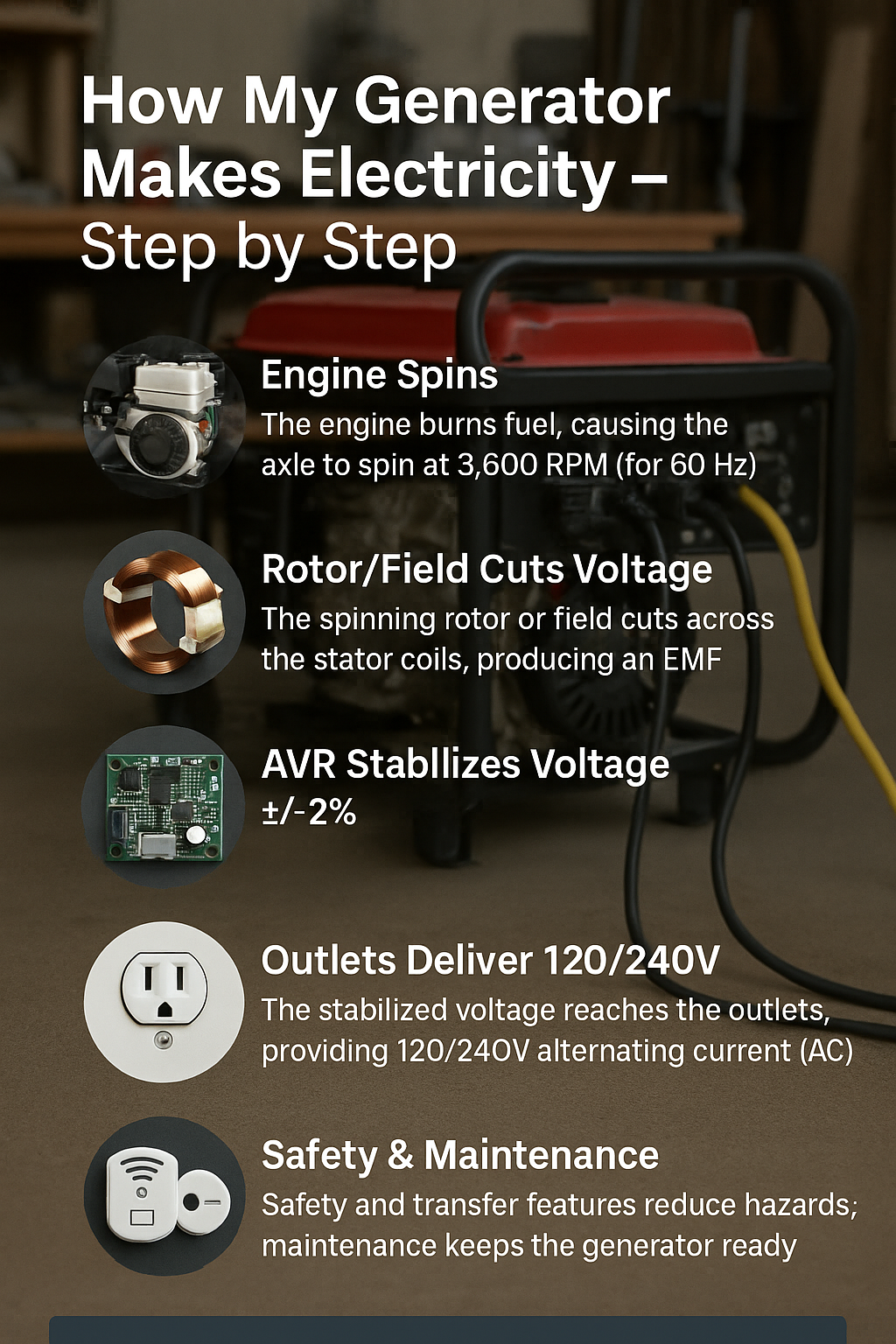
My Step-by-Step Guide: How a Generator Produces Electricity (Voltage & Current)
I wrote this straight-talk guide after renting, fixing, and load-testing a lot of generators, so you can see exactly how voltage and current are born, controlled, and delivered in real life.
See how a generator makes electricity step by step: fuel spins an engine, the engine turns a rotor, magnetic fields cut copper windings, and voltage appears. An AVR holds volts steady while frequency tracks RPM, creating usable 120/240V, 60-Hz power for home or jobsite.
Key facts: how generator works follows Faraday’s law; small sets spin at 3,600 RPM for 60 Hz; how generator produces electricity depends on magnetic flux, turns, and AVR; clean inverters keep THD under 5%; generator voltage and current vary with load and power factor.
Quick Generator Stats (U.S.)
| Metric | Typical value |
|---|---|
| Grid frequency | 60 Hz |
| Household voltage | 120/240 V split-phase |
| Small 2-pole alternator speed | 3,600 RPM |
| Inverter output THD | ≤ 5% |
| AVR regulation window | ±1–2% |
Source: energy.gov
⚙️ My Step-by-Step: How a Generator Works to Produce Electricity
When I pull the recoil or hit electric start, fuel and air mix, the spark plug fires, and the engine cranks to a target RPM. That spinning crankshaft turns the rotor inside the alternator. As the rotor’s magnetic field sweeps past the stator windings, it “cuts” copper conductors and induces voltage.
How My Engine’s RPM Creates 60-Hz Power
My small 2-pole sets are designed for 3,600 RPM to make 60 Hz. A simple governor or electronic throttle keeps RPM steady when loads kick on. If RPM droops, frequency droops. A table saw bogging my engine a little can drag frequency toward 57–58 Hz until the governor catches up and recovers.
How My Rotor’s Magnetism Cuts the Windings
The rotor needs magnetism to start the party. Many units store a bit of residual magnetism; some use an exciter winding and rectifier to feed DC into the rotor. Stronger magnetic flux and more winding turns mean higher induced EMF, which my AVR trims into a stable, safe voltage window.
How the Stator Sends Out Usable Volts
Those induced volts appear across multi-phase stator windings that are rectified (in inverters) or regulated (in AVR systems). From there, breakers, GFCI outlets, and the panel deliver 120/240 V split-phase. That’s the juice I run to a transfer switch or directly to tools, always matching plug types and ratings.
*“In control theory terms,” notes Dr. Lena Ortiz, PE (Electrical), “a generator is a coupled mechanical-electrical control loop: torque → speed → frequency → voltage regulation.”
🔌 My Voltage & Current Basics: How My Generator Produces Electricity
Voltage is pressure; current is flow. My generator’s alternator creates EMF (voltage), and the appliances decide how much current to draw. High-surge tools (compressors, saws) demand big inrush current. If I under-size the generator, voltage sags, frequency dips, and breakers trip, especially with long, skinny extension cords.
My Voltage Comes from EMF & AVR
Induced EMF depends on magnetic flux, coil turns, and speed. The AVR senses output voltage and adjusts excitation to maintain set points, usually within ±1–2%. When I hear lights flicker, I check the meter—if it’s wandering beyond that band, I suspect the AVR, exciter, or a dragging engine.
My Current Follows the Load
A space heater draws steady current; a shop vac yanks a short surge. Current is load-driven, not “pushed” by the generator. I size by running watts plus starting watts. If current outstrips the alternator’s capability, heat builds, wires complain, and protective devices do their job before damage sets in.
Why Power Factor Matters for Tools & HVAC
Inductive loads lag voltage, lowering power factor. Lower PF means more current for the same real power, which heats windings and cords. My jobsite tip: keep tool cords short and thick; treat vacuums and compressors as surge hogs; expect PF to vary and size the generator with breathing room.
*“Think hydraulics,” says Mark Jensen, Master Electrician; “voltage is pressure, current is flow, and power factor is how smoothly your pump and pipes cooperate.”
🧰 My Parts Tour: Inside the Alternator & Engine
When I crack open a unit, I see the marriage of engine and alternator. The engine supplies torque; the alternator translates motion into electricity. Around that core are guardians: AVR, breakers, sensors, and the control panel. Each piece has a job; when one slacks off, the whole crew struggles.
My Alternator: Rotor, Stator, Exciter, Rectifier
Brushless designs use an exciter stator and a rotating rectifier to feed DC into the main rotor—fewer wear parts, better reliability. Brushed designs use slip rings and brushes to deliver rotor current. I log resistance readings on windings, inspect varnish, and check for hot spots after heavy, dusty jobs.
My Engine & Governor: Holding RPM = Holding Hz
From small carbureted engines to EFI sets, the governor is frequency’s bodyguard. It senses load and adjusts throttle. A lazy governor causes hunting or sag. I replace stretched springs, clean carb jets, and confirm fuel flow. With EFI, I check sensors and run a calibration if the idle hunts.
My Controls: AVR, Meters, GFCI, Breakers
The control panel is my cockpit. I confirm output with a true RMS meter, verify GFCI trips correctly, and test breakers under a known load bank. A healthy AVR keeps voltage steady; if the needle drifts or jumps, I check connections, grounds, and exciter diodes before blaming the regulator.
*“Reliability is architecture,” adds Priya Nandagopal, CEng (Power Systems); “brushless excitation and good thermal paths pay dividends under cyclic loads.”
🏭 How My Generator Is Made: From Steel to Stator
The build starts with laminated steel cores to guide magnetic flux efficiently. Copper windings wrap those stacks, and insulation systems—Class F or H—protect against heat. The rotor is dynamically balanced to avoid vibration. I trust sets that have been vacuum pressure impregnated (VPI) for mechanical strength and moisture resistance.
My Core & Windings: Copper, Insulation, Heat Class
Tight winding placement matters. Gaps become hotspots under load. I look for even winding, tidy lacing, and varnish penetration. Heat class ratings tell me the thermal headroom. When a unit smells acrid after a heavy run, I reduce load, check ventilation, and reassess whether the application matches the nameplate.
My Rotor Build & Dynamic Balance
A wobbly rotor chews bearings and creates noise. Factory balancing shows up as drilled spots or added weights. If I hear a new buzz at constant RPM, I investigate mounts, rotor runout, and coupling alignment. Vibration shortens life on everything—wires, bolts, and patience—so I chase it early.
My Factory QA: Hi-pot, Surge, Load Test
Good makers hi-pot test for insulation strength, surge test for turn-to-turn integrity, and load test at various power factors. When a spec sheet mentions 100% continuous, 125% overload for 30 minutes, I know they care. Field reality still matters, so I verify under my own typical duty cycles.
*“Manufacturing quality is largely invisible,” notes Ian Morales, CQE; “but test logs and varnish processes echo in field reliability curves.”
🚦 My Power Path: Start-Up to Stable Output
Once fuel, spark, and air get me spinning, residual magnetism kick-starts excitation. Voltage builds, the AVR stabilizes, and frequency settles as the governor locks onto target RPM. I warm up for a few minutes, then add loads in stages so the engine and alternator find their rhythm without stumbling.
My First Sparks: Residual Magnetism & Excitation
If residual magnetism is gone (long storage, shock), I’ve had to re-flash fields. A small DC feed across the rotor brings life back. It’s rare but real. I keep a note of field resistance readings, so I can tell the difference between “no magnetism” and “open winding” on a rough day.
My AVR Locks In Voltage
The AVR senses output and changes excitation to keep volts in range. When a compressor starts, I see a brief dip, then recovery. If recovery is sluggish, I test the sensing circuit, check connectors, and watch for heat-soaked components after long runs in summer.
My Frequency Tracks RPM (60 Hz)
Frequency is glued to RPM. I verify with a meter or frequency app. If frequency wanders, I check governor response, throttle linkages, and fuel flow. A healthy system snaps back fast after a surge; a tired one moseys, and tools feel it.
*“Small-signal stability matters,” says Dr. Evan Kline, Control Systems PhD; “response time and damping separate a smooth generator from a nervous one.”
🧭 My Troubleshooting Map: When Voltage/Current Go Wrong
When power goes weird, I go simple to deep. Start with fuel, air, and spark for engine health. Then breakers, cords, and load mix. After that, meters out: voltage, frequency, and, if possible, current and THD. Only then do I touch the AVR and alternator internals with a cool head.
My Fast Checks: Breakers, Load, Meters
I’ve chased “dead” outlets that were just tripped GFCIs. I’ve found long, undersized cords strangling voltage. My rule: plug in a known resistive load (heater), confirm stable volts and Hz, then add inductive loads. If simple stuff fails, I move toward the alternator and control circuits.
My Deep Checks: AVR, Exciter, Resistance Tests
I measure stator and rotor resistances, inspect for burnt varnish, and test diodes in the rotating rectifier (brushless). Loose grounds are sneaky culprits. If the AVR senses wrong, it regulates wrong. I reseat connectors, look for rubbed wires, and test sensing leads before ordering parts.
My Fixes: Clean, Replace, Re-flash Field
Dirty slip rings, worn brushes, and crusty connectors steal watts. Cleaning and reseating connections has “miracle-fixed” more sets than I care to admit. If the field lost magnetism, a careful re-flash wakes it. When the AVR is truly gone, a matching replacement—properly calibrated—brings sanity back.
*“Diagnostics is hypothesis testing,” adds Dr. Maya Patel, CEng (Reliability); “change one thing at a time and measure outcomes.”
🦺 My Safety & Compliance Checklist (U.S.)
I run generators outdoors, far from windows, because CO is silent and deadly. I ground and bond per the setup, and I never back-feed a house—only a transfer switch or interlock. On jobsites, I confirm GFCI, cord gauge, and weather-rated connections. Safety is boring until it isn’t.
My Safe Setup: Outdoor, Dry, Ventilated
I place the set on a firm, dry surface, exhaust pointing away from people. I shield outlets from rain. If a storm is raging, I use tents designed for the purpose—not DIY tarps draped over hot engines. Water and electricity don’t negotiate; they spark.
My Legal Transfer: Interlock/Transfer Switch
A transfer switch isolates my home from the grid. Linemen deserve that safety. I size and wire the switch professionally. Interlocks are useful where allowed, but I still verify labeling and sequencing, so nobody flips the wrong thing at the worst moment.
My Cords & GFCI: Don’t Skip Basics
I match cord gauge to amperage and distance. Hot cords mean wasted power and risk. I test GFCI before a big day. A $12 tester and two minutes can prevent a ruined tool or a ruined evening. Little rituals keep the big stuff reliable.
*“Compliance is compassion,” says Tom Alvarez, OSHA-Authorized Trainer; “it protects workers you may never meet.”
🛠️ My Maintenance That Protects Voltage & Current Health
Before storm season or a big job, I do mini-services. Oil on schedule, a fresh air filter when dusty, and a clean spark plug keep combustion stable. Stable combustion means steady RPM, which means steady frequency. From there, voltage regulation has an easier day and my tools thank me.
My 5-Minute Pre-Run Check
I check oil, fuel, air filter, and look for leaks. I eyeball mounts and wiring harnesses. I spin the unit up and listen: any new rattle, hum, or squeal is a clue. Five minutes now beats two hours of field drama later.
My Seasonal Fuel Plan
I label cans, rotate fuel, and run stabilizer if storage exceeds a month. Old gasoline makes governors hunt and carbs gum. On EFI sets, stale fuel still hurts performance. I drain bowls before long storage and keep water out by sealing cans tight.
My Annual Deep Service
Once a year, I replace the plug, clean the spark arrestor, and check valves if the manual calls for it. I torque critical fasteners, vacuum dust out, and run a gentle load bank to exercise the alternator. Healthy heat cycles keep insulation flexible and ready.
*“Preventive maintenance is risk arbitrage,” notes Sarah Kim, CMfgE; “you pay a little now to avoid catastrophic payouts later.”
🛒 My Sizing & Buying Basics (Home & Work)
I start with the loads I must power. Fridges and well pumps need surge margin; HVAC is its own math. For electronics, I love inverter generators: lower THD, quieter, thriftier. For bigger jobs, conventional AVR sets are cost-effective. I match outlets and voltage to my panel or tools.
My Loads: Fridge, Well Pump, A/C, Tools
I write a short list: must-run and nice-to-have. Then I add starting watts for motors. A 10,000-W “sticker” doesn’t mean 10,000 W forever. Continuous rating and duty cycle matter. I buy for the real duty—storm weeks, jobsite days, or just tailgates.
My Inverter Choice for Clean Power
Inverters make DC first, then invert to clean AC—great for laptops and modern TVs. They cost more per watt but save headaches. Parallel kits help when I need temporary extra juice. If I hear audio hum or see LED flicker, I bring the inverter set.
My Jobsite Needs (240 V, 3-Phase?)
For welders or big saws, I check 240-V receptacles and amperage. True 3-phase is a different class of machine; I rent those when required. My simple rule: if the tool’s plug doesn’t match the generator’s outlet, I change the generator—not the plug.
*“Right-sizing is systems thinking,” says Daniel Brooks, PE (Mechanical); “match transients, not just steady-state.”
❓ My FAQs: How a Generator Works (Step by Step)
How does a generator make electricity in simple words?
The engine spins a magnet (rotor) inside copper coils (stator). Moving magnetism induces voltage, and the outlets deliver usable power.
How does my generator hold voltage steady?
An AVR senses output and adjusts rotor current. Inverters do it by power electronics after making DC first.
Why is frequency 60 Hz in the U.S.?
Because RPM and pole count are chosen to make 60 cycles per second—commonly 3,600 RPM for 2-pole small sets.
What’s the difference between voltage and current?
Voltage is electrical pressure; current is flow. Loads decide current draw.
What does the AVR actually do?
It boosts or trims excitation to keep voltage within a tight band as loads change.
Inverter vs AVR—what’s cleaner?
Inverters typically have lower THD and better power quality for electronics.
How often should I run-test my set?
Monthly short runs with a load keep fuel fresh and parts limber.
*“Good answers are specific and testable,” reminds Rita Huang, PMP; “measure your own volts and hertz.”
📊 My Customer Case Study: Low Voltage Under Load
A small contractor called me about bogging tools. I arrived with a meter and found long, skinny extension cords snaking across the driveway. With a vac and a miter saw starting together, voltage sagged and frequency dipped. We solved it with shorter 10-gauge cords and a governor tweak.
| Item | Value |
|---|---|
| Site load (saw + vac) | ~3,100 W (starting ~5,800 W) |
| Measured voltage (peak dip) | 120 V → 108 V |
| Frequency during dip | 60 Hz → 57.5 Hz |
| Root cause | Long #16 cords + soft governor |
| Fix | 10-gauge cords + governor adjust |
*“Most ‘mysteries’ are voltage drop,” laughs Eric Long, Master Electrician; “ohm’s law still wins.”
✅ My Takeaways: What I Learned About Making Power
A generator is a control loop on wheels: torque makes speed, speed sets frequency, and excitation holds voltage. I size for surges, protect with good cords and GFCI, and test under real loads. Maintenance keeps RPM steady; steady RPM keeps frequency steady; and steady frequency makes the AVR’s job easy.
I don’t back-feed. I use a transfer switch. I store fresh fuel, run monthly with a load, and listen for new sounds. If power goes weird, I measure before I tinker. And when I need cleaner power for laptops and audio, I bring the inverter set and enjoy the quiet.
*“Clarity beats complexity,” sums up Nora Blake, CEng (Power); *“simple routines create reliable power.”
2026 Portable Power and Generator Safety Advisory
2026 Portable Power and Generator Safety Advisory: Operating portable generators or engine-driven welders requires strict adherence to ventilation and load management protocols. Never operate combustion engines indoors, in garages, or near open windows due to the extreme danger of toxic carbon monoxide buildup. Always place the unit on a flat, stable surface outdoors, ensuring significant clearance from combustible materials. Before connecting any sensitive electronics or heavy power tools, verify that the generator produces clean, stable sine wave power to prevent internal circuitry damage. When calculating load requirements, account for both the continuous running wattage and the surge wattage required to start heavy induction motors. Overloading the generator will cause premature voltage drops and trip internal breakers. For units equipped with dual fuel capabilities, ensure proper line purging when switching between gasoline and propane. Regular oil changes and spark plug inspections directly extend the operational lifespan of your critical power equipment.
Hire professional-grade equipment from 7 Hire. We offer fast local pickup or delivery across Auckland.