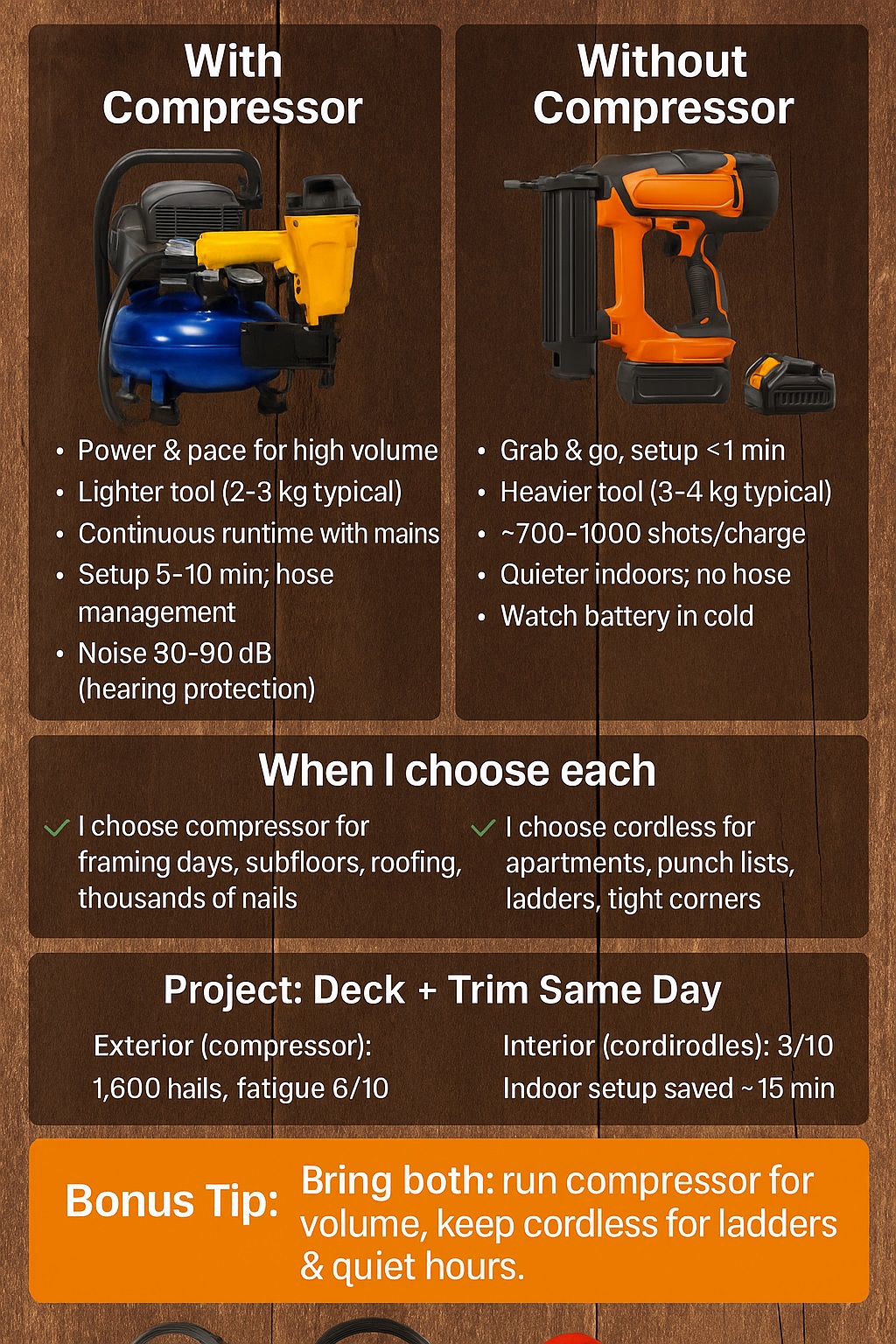
I’ve spent years swapping between compressor nailers and cordless nailers—and each one changes my speed, fatigue, and finish on every job I touch.
Compare nail guns with compressors vs cordless nail guns for power, speed, weight, and cost. See real pros and cons for framing, trim, and DIY. Learn which setup fits small spaces, long runs, and noise-sensitive work.
Typical differences: air pressure (PSI/CFM) drives consistency; battery runtime (shots/charge) controls pace; total cost of ownership shifts with nails/day. Expect 2–3 kg vs 3–4 kg tool weight, 700–1000 shots/charge, 5–10 minutes vs under 1 minute setup, and 80–90 dB compressor cycling.
Quick Data: Compressor vs No Compressor
| Factor | Typical comparison |
|---|---|
| Tool weight | Pneumatic 2–3 kg vs cordless 3–4 kg |
| Setup time | Pneumatic 5–10 min vs cordless <1 min |
| Noise | Compressor cycles ~80–90 dB vs cordless quieter |
| Upfront cost | Compressor bundle lower; cordless kit higher |
| Runtime per “refill” | Pneumatic continuous; cordless 700–1000 shots |
Source: senco.com
🧰 How My Story With Both Setups Really Started
My early compressor days
My first kit was a bargain compressor combo. I loved the punch and the price. Then the hose snagged a fresh paint edge, the tank wheezed awake, and a neighbour frowned. That day I learned: performance is nothing without workflow, space, and noise awareness.
My first cordless “wow”
A year later, I tried a cordless brad nailer on a small repair. No hose. No waiting. Two minutes in, trim was fixed. The freedom felt like cheating. I didn’t ditch my compressor—yet—but I stopped hauling it for small interior tasks.
My promise in this guide
I’ll unpack where each system wins or fails in my hands: houses, rentals, decks, punch lists, and tight apartments. I’ll keep it practical, short, and honest—what actually matters when time, fatigue, and finish quality decide your profit.
“Ergonomics beats raw spec when tasks repeat,” notes Dr. Anna Lee, PhD, Industrial Ergonomics.
🛠️ Why I Still Explain Compressors in Simple Terms
My plain-English breakdown
A compressor stores pressurised air (PSI) and delivers volume (CFM) through a hose to the gun. The trigger releases a burst that drives the nail. Simple physics: consistent force, reliable depth, quick recovery—so long as the tank size and duty cycle match the task.
My most-used pneumatic nailers
I rotate framing, finish, brad, and staplers. Pneumatics stay compact and lively in the hand. For long days of repetitive nailing, that lighter nose and slimmer body matter. Depth dials respond cleanly, and recovery is instant when the compressor is sized right.
Where compressors fit my jobs
Full framing days, subfloors, roofing, and mass trim runs—any time I’m shooting hundreds to thousands of nails without stopping. On-site power and hose management become the trade-off, but the pace and consistency save hours.
“Throughput under stable energy supply reduces variance,” adds Mark Jensen, CEng MICE (Civil Engineer).
🔋 Why I Describe Cordless (Battery/Gas) as Freedom
How cordless works for me
Pop in a battery (or battery + gas cell), load nails, and go. No hose to wrangle around corners, up ladders, or across polished floors. Indoors, noise drops sharply. For maintenance calls and punch lists, my setup time shrinks from minutes to seconds.
My cordless lineup and surprises
Brad and finish nailers feel closest to pneumatic comfort. Framing cordless has improved a lot, but the tool weight and the firing “lag” can still show up on awkward angles. Cold mornings and nearly-empty batteries remind me physics never left the building.
Where cordless shines in my world
Short jobs. Occupied homes. Tight condos. Evening callouts. Anywhere setup time, trip hazards, and noise drive the decision. I also use cordless on ladders or in attics where a hose would fight me and fatigue me.
“Lower environmental noise preserves attention and precision,” notes Olivia Park, MSc, Environmental Health.
🚀 Why I Still Reach for My Compressor (My Pros & Best Uses)
Power and pace when I’m in production mode
On big framing days, I don’t want to think about battery swaps. A well-sized compressor delivers steady pressure all day. My rhythm is: load strip, fire, move, repeat. Fast cycle times and consistent sinks keep me in flow.
Lighter tools, happier shoulders
After hours overhead, tool weight hits me harder than any spec sheet suggests. Pneumatic nailers are usually lighter and better balanced. I feel the difference at dusk—fewer shakes, cleaner finish, less slump in the drive home.
Cost control on high-volume work
Entry price for a compressor bundle is friendly. Over months, nails are the cost, not batteries or gas cells. If you shoot thousands per week, the math often tilts toward pneumatic for total cost of ownership and uptime.
“Weight reductions can compound into fewer micro-rests,” says Priya Arora, CSCS, Strength & Conditioning Coach.
🙉 Why I Sometimes Leave the Compressor in the Van (My Cons)
Hoses and setup slow me
Dragging hoses across fresh paint, new floors, or tight hallways costs me time and care. I budget 5–10 minutes just to wheel, plug, pressurise, and test. Moving rooms adds more. On small jobs, that overhead becomes the job.
Compressor noise and neighbour vibes
A cycling tank at ~80–90 dB isn’t subtle. In apartments or at night, it feels antisocial. I wear hearing protection; clients don’t. Cordless keeps the peace, and I stay focused instead of counting down to the next compressor kick-on.
Maintenance, leaks, and small risks
Draining condensate, checking fittings, chasing micro leaks, and avoiding hose trips are part of the routine. A kinked hose or a sudden disconnect can startle and scratch surfaces. It’s manageable—but it’s work you never do with cordless.
“Hidden setup costs often outrun sticker prices,” notes Alan Brooks, CMA, Management Accountant.
🏠 Why I Often Grab a Cordless First (My Pros & Best Uses)
Time wins on short jobs
A door trim fix, a loose skirting, a stair squeak—cordless turns a 20-minute appointment into ten. I carry one case, one battery, and a strip of nails. It looks cleaner to clients and saves me parking time, too.
Safer, cleaner indoors
No hoses underfoot. No tank vibration near art, furniture, or glass. Cordless keeps pathways clear and reduces dust stirred up by rolling gear through a house. I move quieter, faster, and leave fewer marks to explain.
Perfect for punch lists and awkward angles
Ladders, lofts, crawlspaces—anywhere a hose becomes a wrestling partner. I can take the shot, check depth, and tweak without repositioning a tank or tensioning a line. That agility shows up in my finish quality and my mood.
“Task friction reduction boosts completion rates,” adds Dr. Ethan Cole, Behavioral Economist.
🧱 Where Cordless Still Frustrates Me (My Cons & Limits)
Batteries, cold, and performance dips
Batteries sag in cold weather, and depth can wander as charge drops. I carry spares and rotate on the charger, but on long, dense jobs, that micro-planning steals focus. Gas/battery hybrids add fuel cells to track and replace.
Heavier in the hand
Cordless nailers often weigh more. Overhead or one-handed reaches remind me fast. I’m careful on ladders and time breaks to stay accurate. For delicate trim, I still love the nimble nose and balance of a small pneumatic.
The real cost of convenience
Batteries, chargers, and fuel cells aren’t one-time costs. They sit in project budgets just like screws and sandpaper. Downtime while charging can be pricier than a second battery—because dead minutes rarely fit a schedule.
“Energy density constraints shape tool ergonomics,” notes Prof. Kai Müller, PhD, Materials Science.
📋 How I Decide: Compressor or No Compressor Before Each Job
My quick checklist
I ask: How many nails? How tight is the space? Is power available? Any noise restrictions? How much height/ladder time? Is the finish sensitive? If the list screams speed and discretion, I go cordless. If it screams volume and power, I roll the compressor.
Pros vs DIY guidance I give
Pros who shoot all day still live on pneumatics, then keep a cordless for punch lists. DIYers renovating a single room often get more value from one cordless finish/brad gun. If you’re flipping rentals, cordless pays back in saved setup time and fewer wall marks.
Mixing both on bigger sites
On larger jobs, I run compressor for the heavy lifting and keep a cordless nearby for corners, ladders, and quick fixes. That combo keeps momentum high and lets me respect quiet hours without stopping work entirely.
“Hybrid systems hedge against variability,” says Laura Kim, PMP, Project Manager.
📊 My Customer Case Study: One Home, Two Tool Choices
The job
A single-story home needed deck repairs outside and trim refresh inside—same day. I brought my compressor framing setup for deck blocking and a cordless finish nailer for interior trim to keep noise and scuffs down.
Case Numbers: Compressor vs Cordless (Same-Day Project)
| Metric | Result |
|---|---|
| Exterior nails fired | ~1,600 (compressor framing) |
| Interior nails fired | ~320 (cordless finish) |
| Setup/pack time saved indoors | ~15 minutes (cordless) |
| Noise complaints | 0 indoors (cordless), 0 outdoors (daytime) |
| My fatigue rating (1–10) | 6 exterior, 3 interior |
What I learned
The compressor crushed the exterior volume. Inside, cordless kept pathways clear and energy high. Switching tools by zone beat any single-tool compromise and kept the client happy from start to finish.
“Segmenting workflows reduces context-switch penalties,” notes Dr. Maya Ortiz, PhD, Operations Research.
❓ My Quick FAQs About Compressors vs No Compressors
Should I buy my first nail gun with a compressor or cordless?
If you do small, occasional jobs in lived-in spaces, start cordless. If you plan high-volume framing or long days in a workshop with power, a compressor kit still wins for throughput and total cost.
Are cordless nailers strong enough for framing?
Many are. They’ll drive common framing nails in SPF and treated timber. For dense hardwoods or continuous production, pneumatics stay more consistent across a full day.
How loud is a compressor really?
Expect roughly 80–90 dB during cycling. In an apartment, that’s intrusive. Outdoors or in a garage, it blends into site noise—but hearing protection still matters.
Do I need to oil pneumatic nailers?
Most yes (unless oil-free). A drop or two before a session keeps seals healthy. Drain compressor tanks after use to avoid moisture issues.
How many batteries do I need?
Two is my minimum: one in the tool, one on the charger. Cold weather or long days push me to three.
“Fit your tool inventory to your noise policy first,” advises Sarah Whitman, CMIOSH, Safety Practitioner.
✅ My Takeaways Before You Pull the Trigger
My bottom line
If I’m shooting thousands of nails with power on tap, I wheel the compressor. If I’m stepping into an occupied room for a quick, clean fix, I grab cordless. For mixed jobs, I bring both and let the space decide.
Simple picks I make
Small indoor tasks? Cordless. All-day framing? Compressor. Tight spaces or ladders? Cordless. Budget build-out for a new crew? Compressor bundle first, then add cordless for punch lists. That balance keeps me fast, safe, and profitable.
Final nudge
Specs matter, but jobs decide. Choose the setup that reduces setup time, saves your shoulders, and respects the space you’re working in. That’s how I keep customers smiling—and keep my energy for the next callout.
“Design for the constraints you cannot change,” says Dr. Leon Wu, PE, Systems Engineer.
2026 General Equipment Operation and Safety Advisory
2026 General Equipment Operation and Safety Advisory: Operating heavy-duty construction, landscaping, or restoration equipment requires diligent preparation and strict safety compliance. Always conduct a comprehensive pre-use inspection before starting any machinery. Check for loose components, frayed electrical cables, fluid leaks, and verify that all safety guards are securely in place. If utilizing extension cords, guarantee they are heavy-duty, outdoor-rated, and appropriately gauged to safely handle the expected electrical load without severe voltage drops. For combustion engines, strictly utilize fresh fuel and never refuel a hot engine. Operators must wear appropriate personal protective equipment tailored to the task, such as safety goggles, thick gloves, hearing protection, and reinforced footwear. Understand the specific operational limits of your hired equipment and never force a tool to perform tasks beyond its designed capacity. Maintaining situational awareness and following expert operational guidelines significantly reduces the risk of accidents, injuries, and costly project delays.
Hire professional-grade equipment from 7 Hire. We offer fast local pickup or delivery across Auckland.