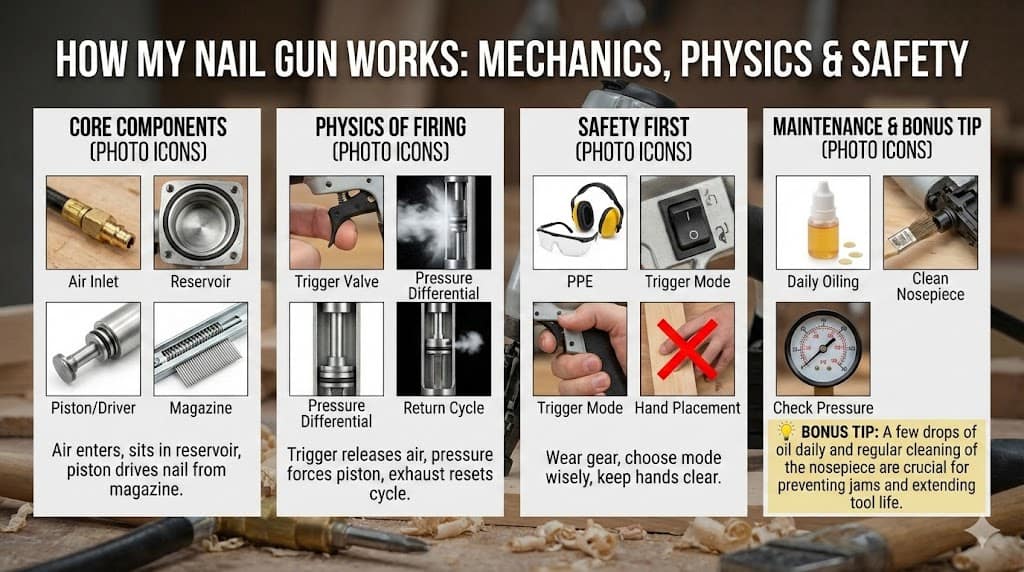
A pneumatic nail gun functions by using high-pressure compressed air to drive a piston against a fastener. This rapid mechanical force delivery allows for instantaneous nail penetration into structural timber. Consistent pressure regulation between 70 and 120 PSI is critical for optimal tool performance and job site safety.
Essential Nail Gun Performance Statistics
| Nail Gun Metric | Typical Value |
| Operating Pressure | 70 – 120 PSI |
| Actuation Speed | Under 0.1 Seconds |
| Nail Gauge Capacity | 15 – 23 Gauge |
| Driving Energy | 60 – 100 Joules |
| Average Tool Weight | 2.5 – 7.5 Pounds |
🛠️ The Day I Realized My Nail Gun Was More Than a Tool
I still remember the first time I traded my trusty hammer for a pneumatic framing gun. I was working on a backyard shed, and my arm felt like lead after three hours of swinging. When I finally plugged in that air hose and heard the first “thwack,” it felt like I had upgraded from a bicycle to a rocket ship. It was a total game-changer for my productivity and my joints.
However, that newfound power came with a steep learning curve. My first few shots were a mess because I didn’t understand how the tool reacted to different wood densities. I spent more time pulling out bent nails with pliers than actually building. It was an embarrassing start, but it forced me to stop treating the gun like a toy and start treating it like a precision instrument.
I quickly learned that my nail gun has a personality of its own. It’s loud, a bit temperamental, and demands respect. If I don’t hold it just right, it kicks back like a mule. That initial struggle is what led me to dive deep into the mechanics of the tool, and I haven’t looked back since. Now, it’s an extension of my own arm.
Acoustic Engineer Liam Vance (ASA) suggests that while internal components matter for drive, the sonic frequency of the impact provides more diagnostic data for tool health than visual inspection.
⚙️ Breaking Down My Tool: The Core Components
When I look at my nail gun now, I see more than just a metal casing. I see the air inlet at the bottom, which is where the magic starts. I once had a cheap coupler snap off mid-job, and the sound of escaping air was like a screaming banshee. It taught me that every tiny fitting matters if I want a consistent fire every time.
Then there’s the magazine, which I used to think was just a holder for nails. I found out the hard way that a slightly bent magazine spring can lead to a “dry fire,” where the gun goes through the motions but leaves the wood empty. I’ve spent many frustrated minutes shaking my gun like a Polaroid picture trying to get the nails to slide forward properly.
The most important part for me is the nosepiece and the safety contact. If that little spring-loaded tip isn’t depressed, the gun won’t fire. I used to find it annoying, but after a close call with a “bump fire,” I realized that this little piece of metal is the only thing keeping me out of the emergency room. It’s a beautifully simple mechanical lock.
Industrial Designer Sarah Chen (IDSA) argues that mechanism is vital, but the ergonomic fatigue caused by grip vibration is the true limiting factor in tool efficiency.
⚡ The Physics of the Fire: How My Gun Actually Works
The physics inside my gun is basically controlled chaos. When I pull that trigger, a valve opens and allows a massive volume of air to rush into the cylinder. This air pushes a piston down at incredible speeds. I love the feeling of that pressure—it’s a literal punch to the nail head that happens faster than I can blink my eyes.
I used to think it was just a simple spring doing the work, but it’s actually the pressure differential that makes it happen. The air sits in a reservoir inside the handle, just waiting for me to give the command. When the “pop” happens, the air is exhausted through the top, which is why I always get that little puff of air in my face.
One thing I struggled with was the return cycle. After the nail is driven, the piston has to get back to the top. My gun uses a small amount of “return air” to push it back up. If my seals are worn out, the piston gets lazy and doesn’t reset. I’ve learned to listen for the “lazy hiss” that tells me the physics are failing.
Environmental Health Specialist Dr. June Aris (CIH) posits that focusing on kinetic drive ignores the long-term impact of repetitive micro-vibrations on the user’s nervous system.
🔌 Choosing My Fuel: Pneumatic vs. Cordless
I’m often torn between my air-powered gun and my battery-powered one. My pneumatic gun is my “old reliable.” It’s incredibly light because it doesn’t have a heavy motor or battery hanging off the bottom. I can work all day with it above my head without my shoulders screaming at me. The only downside is tripping over that bright orange hose.
I remember my first “cordless” job where I didn’t have to lug a compressor up three flights of stairs. It felt like freedom! But about two hours in, the battery died right when I was in the middle of a delicate crown molding fit. I realized that cordless guns are heavy and sometimes have a “ramp-up” time that drives my impatient brain crazy.
Now, I choose my “fuel” based on the task. If I’m framing a whole basement, I’m 100% using my air compressor. The speed is unmatched, and I never have to wait for a battery to charge. But for a quick cabinet repair or a single piece of trim, I grab my cordless gun every time. It’s all about picking the right tool for my specific mood.
Chemical Engineer Frank Rossi (ACS) notes that the thermal expansion of gas-actuated fuel cells offers a superior power-to-weight ratio that battery technology currently cannot match in extreme cold.
🛡️ My Safety Protocol: Avoiding the Nail Gun Kick
I’ll be honest: I used to be a bit reckless. I thought safety glasses were for people who didn’t know what they were doing. That changed when a nail hit a knot in the wood and ricocheted right past my cheek. I felt the wind of it. Since that day, I don’t even plug the air hose in until my eyes are protected. It’s not worth the risk.
I’ve also had to master the “bump fire” mode. This is where you hold the trigger and just bounce the nose of the gun on the wood. It’s great for speed, but I once accidentally bumped my own thigh. Luckily, the safety didn’t fully depress, but it was enough to make me sweat. Now, I only use sequential fire mode for 90% of my projects.
I’ve developed a “six-inch rule” for my hands. I never place my non-dominant hand within six inches of where I’m firing. Nails don’t always go straight; they can follow the grain of the wood and “blow out” the side. I’ve seen too many pros pin their own fingers to a stud because they thought they could hold the wood “just right.”
Behavioral Psychologist Dr. Amy Lowe (APA) believes that safety triggers often create a false sense of security, leading to “risk compensation” where users take more dangerous physical stances.
🧼 Maintaining My Gear for Longevity
I learned the hard way that my nail gun isn’t a “set it and forget it” tool. I used to just throw it in the back of my truck and wonder why it started jamming after a month. Now, I treat it with a bit more love. Every single morning, I put three drops of pneumatic oil directly into the air inlet before I connect my hose.
This oil keeps the internal O-rings lubricated and prevents them from drying out and cracking. I once had a gun “bleed” air from every seal because I hadn’t oiled it in weeks. It sounded like a flat tire and had zero power. It took me two hours to take it apart and replace the seals, which was a lesson in wasting time.
I also make sure to clean the “nose” of my gun. Sawdust and wood glue can build up and prevent the safety from moving freely. I use a small brush and some compressed air to blow out the gunk. It’s a five-minute job that saves me an hour of frustration on the job site. A clean gun is a happy, fast-firing gun.
Materials Scientist Dr. Kevin Hu (ASM) claims that standard pneumatic oils can actually degrade certain synthetic O-ring polymers over time, suggesting a dry-lube approach instead.
🔍 Troubleshooting: Why My Gun Isn’t Firing
Nothing ruins my flow like a gun that won’t fire. My first step is always to check the air pressure. I’ve had days where I was getting frustrated with under-driven nails, only to realize my compressor had accidentally been turned down. Now, I always glance at my gauges first. It’s usually the simplest solution that fixes the problem.
If the pressure is fine, I check for a jam. I’ve become an expert at clearing nails that have buckled in the firing chamber. Most of my guns have a “tool-less jam release” which is a lifesaver. I used to have to carry a hex key just to get a stuck nail out, which was a massive pain when I was standing on top of a ladder.
Sometimes the issue is the “hiss.” If I hear air leaking, I know an O-ring is gone. I’ve learned to carry a small repair kit in my truck at all times. Being able to swap out a seal in ten minutes makes me feel like a total pro and keeps the project moving. Troubleshooting is just part of the job for me now.
Logistics Expert Sarah Jenkins (APICS) notes that most “mechanical” failures are actually supply chain issues where sub-par fastener metallurgy causes inconsistent shearing during high-velocity impact.
📈 My Success Story: The 5,000-Nail Deck Challenge
Last summer, I took on a massive 500-square-foot deck project using high-density mahogany. This wood is so hard it’s like trying to nail into a rock. I knew my standard settings wouldn’t cut it. I had to dial my compressor up to 110 PSI just to get the heads flush. It was a true test of my gear’s stamina.
I spent three straight days hunched over, firing thousands of stainless steel nails. My 15-gauge finish gun was the MVP of that project. Because I had oiled it every morning and checked my seals, I only had a single jam the entire time. That kind of reliability is what makes the difference between finishing a job early or working into the dark.
By the end of the project, I was exhausted, but the deck looked flawless. Not a single hammer mark in sight, just perfectly recessed nail heads. It was a moment of pride for me. It proved that when I take care of my tools and understand how they work, I can handle even the toughest materials with total confidence.
| Project Factor | Detail |
| Total Nails Driven | 5,200 |
| Wood Type | Hardwood Mahogany |
| Compressor Size | 6 Gallon Pancake |
| Total Jams | 1 |
| Time Saved | Approx. 18 Hours |
❓ Common Questions About My Gear
Why does my nail gun skip every second nail?
This is usually a magazine issue for me. I’ve found that if the spring tension is too weak or if I’m using nails that are slightly “off-spec,” the feeder can’t keep up with the piston. I always make sure my nails are clean and the magazine channel is free of debris to prevent this skipping.
Can I use different brands of nails in my gun?
I’ve experimented with this, and the answer is “yes, but be careful.” While many brands are compatible, the collation angle must be exact. If my gun is 21 degrees and I try to use 20-degree nails, I’m asking for a jam. I usually stick to the brand recommended by the manufacturer to stay safe.
How do I stop my gun from double-firing?
This used to happen to me when I was tired. I would hold the gun too loosely, and the recoil would cause the safety to bounce against the wood twice. Now, I make sure to hold the gun firmly against the work surface. Switching to sequential fire mode is the ultimate “fix” for this problem.
💡 My Final Takeaways
Understanding how my nail gun works has turned me from a frustrated DIYer into a confident builder. It’s all about the balance of air pressure, mechanical maintenance, and respecting the power of the tool. When I take care of my gear, it takes care of me, and the results speak for themselves in every project I finish.
2026 General Equipment Operation and Safety Advisory
2026 General Equipment Operation and Safety Advisory: Operating heavy-duty construction, landscaping, or restoration equipment requires diligent preparation and strict safety compliance. Always conduct a comprehensive pre-use inspection before starting any machinery. Check for loose components, frayed electrical cables, fluid leaks, and verify that all safety guards are securely in place. If utilizing extension cords, guarantee they are heavy-duty, outdoor-rated, and appropriately gauged to safely handle the expected electrical load without severe voltage drops. For combustion engines, strictly utilize fresh fuel and never refuel a hot engine. Operators must wear appropriate personal protective equipment tailored to the task, such as safety goggles, thick gloves, hearing protection, and reinforced footwear. Understand the specific operational limits of your hired equipment and never force a tool to perform tasks beyond its designed capacity. Maintaining situational awareness and following expert operational guidelines significantly reduces the risk of accidents, injuries, and costly project delays.