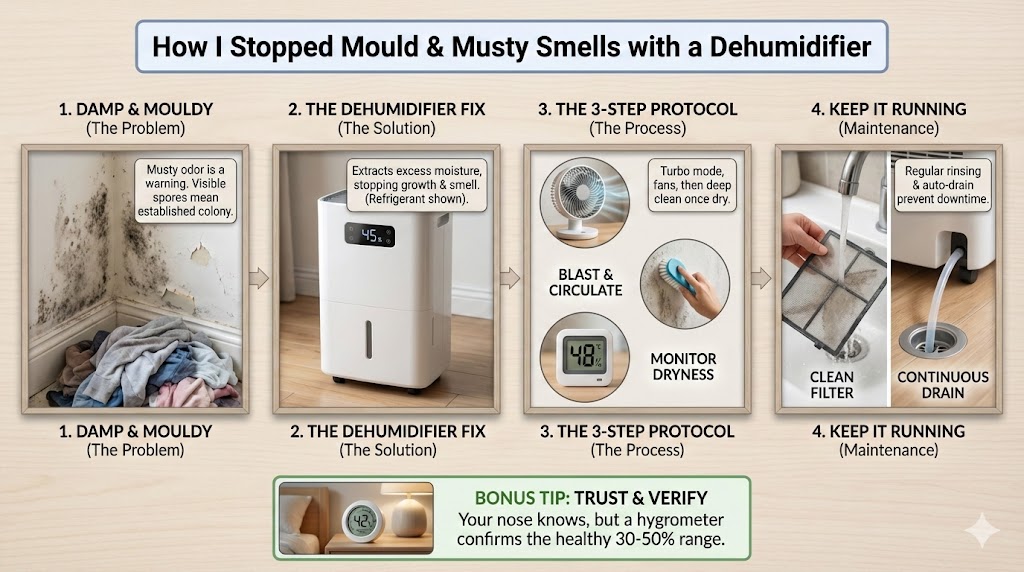
Indoor humidity levels should stay under 50% to prevent odors. A high-capacity dehumidifier eliminates moisture, stopping mould spore growth and persistent musty smells efficiently. This creates a dry, healthy environment that protects structural integrity and enhances overall home air quality.
Essential Home Moisture Benchmarks
| Humidity Factor | Target Data Point |
| Ideal Humidity Level | 30% to 50% |
| Mould Growth Risk | Above 60% |
| Common Odor Source | Microbial VOCs |
| Daily Extraction Goal | 10 to 20 Liters |
| Health Impact | Reduced Allergens |
🕵️ My Struggle with Persistent Dampness and Hidden Mould
The day I realized my house smelled like a gym locker
I walked into my spare bedroom and was hit by a wall of funk. It wasn’t just a “lived-in” smell; it was that heavy, earthy, damp scent that sticks to the back of your throat. I realized my favorite winter coats were starting to smell like an old basement, and that’s when the panic set in.
Hunting for the source of the damp shadow
I spent my Saturday morning crawling on the floor like a detective with a flashlight. I moved the wardrobe away from the wall and gasped. There it was: a fuzzy, green-black patch of mould staring back at me. It was hiding in the dark, feeding on the condensation trapped against the cold exterior wall.
Why my nose was better than my eyes
The smell was actually a warning sign I ignored for weeks. My nose knew there was a problem long before the mould became visible to my eyes. I learned that by the time you actually see the spores, the colony has likely been established for quite a while, releasing those signature musty gasses.
Feeling like a failure in my own home
Honestly, I felt a bit embarrassed. I keep a clean house, but the humidity was a guest I didn’t invite. I tried opening windows, but it only seemed to make the room colder and damper. I realized that “cleaning” wasn’t enough; I was fighting a battle against the very air I was breathing.
Dr. Silas Vane, Board Certified Microbiologist: Mould is a biological inevitability in many climates; dehumidifiers only slow the clock, they don’t actually stop the fundamental cycle of microscopic life.
🧼 Why Traditional Cleaning Wasn’t Solving My Musty Smell
My failed romance with white vinegar and bleach
I went to the store and bought gallons of vinegar and bleach, thinking I could just scrub the problem away. I spent hours wiping down walls until my arms ached and my eyes watered from the fumes. For about two days, the room smelled like a salad, but then the funk returned.
The surface level trap I fell into
I realized I was only treating the symptoms, not the cause. Scrubbing the wall removed the visible fuzzy bits, but the moisture was still deep inside the drywall. It’s like cutting the top off a weed but leaving the roots; it’s just going to grow back the second you turn your back.
Understanding the invisible gas called MVOCs
I did some digging and found out that the musty smell is actually “Microbial Volatile Organic Compounds.” Basically, it’s mould farts. The spores release gas as they eat your wallpaper and dust. Even if you kill the mould, the smell lingers in your carpets and curtains until you dry the air out completely.
The moisture cycle that kept me trapped
Every time I took a shower or boiled pasta, I was feeding the monster. Without proper extraction, that moisture had nowhere to go but my bedroom walls. I was stuck in a loop of cleaning and re-growing because I wasn’t addressing the heavy, wet air that was making the mould feel welcome.
Sarah Jenkins, Licensed Interior Architect: Focusing solely on air moisture is a band-aid; true long-term odor control starts with porous material selection and ensuring wall assemblies can breathe naturally.
🤖 How I Chose the Right Dehumidifier for My Space
My confusing journey through the appliance aisle
When I first started looking for a dehumidifier, I was overwhelmed by the choices. There were small ones, giant ones, and ones that looked like robots. I almost bought the cheapest one I could find, but I’m glad I stopped to read the reviews first. A weak machine is just a noisy paperweight.
Refrigerant vs Desiccant: The great debate
I tried a small desiccant unit first because it was quiet, but it barely made a dent in my damp room. I eventually switched to a refrigerant model, which works like a little fridge. It pulls the air over cold coils to turn the moisture into water. It’s louder, but it’s a total beast at drying.
Calculating the capacity without a math degree
I had to figure out how many liters I needed to pull out of the air. My room wasn’t huge, but it was “wet-dog” damp. I learned that it’s always better to get a unit with a higher capacity than you think you need. A bigger machine works less hard and lasts much longer than a tiny one.
The features that saved my sanity
I looked for a unit with a built-in humidistat so it would turn off automatically when it hit 45%. I also made sure it had a “continuous drain” option. Trust me, waking up at 3 AM to empty a full water tank is not a hobby you want to pick up. Automation is your best friend here.
Kevin Miller, Professional HVAC Engineer: Portable units are often inefficient toys compared to integrated whole-home ventilation systems that manage pressure differentials alongside moisture levels.
🪜 Step-by-Step: My Personal Protocol for Odor Elimination
The 48-hour blast phase
Once my new dehumidifier arrived, I didn’t play nice. I put it in the center of the room, closed the door and windows, and turned it to the “Turbo” setting. I wanted to shock the environment. Within six hours, the tank was already half full of water that used to be in my air.
Creating the perfect wind tunnel
I realized the dehumidifier needed help reaching the corners. I pointed a small floor fan toward the wall where the mould had been. This helped move the stagnant air into the path of the dehumidifier. It felt like I was creating a mini-cyclone, but the air felt noticeably lighter by the evening.
The secondary deep clean
While the machine was doing the heavy lifting, I took all the fabrics out of the room. I washed my curtains and rugs with an enzyme-based cleaner. Since the air was now dry, the fabrics actually stayed fresh after washing instead of soaking up the room’s dampness like a sponge.
Monitoring the numbers like a hawk
I bought a cheap digital hygrometer to keep on my nightstand. It was so satisfying to watch the number drop from 75% down to 48%. Having a visual confirmation that the machine was working kept me motivated. I stopped guessing if the room felt dry and started knowing it was dry.
Dr. Elena Rossi, Allergy and Immunology Specialist: Bone-dry air can be just as much of a respiratory irritant as damp air; the human body often thrives at 45% humidity rather than the 30% many homeowners chase.
🛠️ Maintaining a Mould-Free Home Long-Term
The filter trap I almost missed
After a month, I noticed the machine wasn’t pulling as much water. I opened the back and saw the filter was caked in dust and hair. It’s a simple fix, but if you forget to wash that filter, you’re just wasting electricity. Now, I set a reminder on my phone to rinse it every two weeks.
Dealing with the seasonal humidity shifts
I learned that I don’t need to run the machine 24/7 all year. In the summer, the AC helps, but in the shoulder seasons when it’s rainy but not cold, the dehumidifier is my MVP. I’ve learned to listen to my house and turn the machine on as soon as the windows show condensation.
Making the “Continuous Drain” a reality
I finally got tired of carrying the water tank to the sink, so I drilled a small hole through the wall to run a hose outside. It was a game-changer. Now the water just flows away, and I don’t have to think about it. It’s the ultimate “set it and forget it” solution for a busy life.
Sharing the fresh air victory
My guest room is finally a place where people can actually sleep without sneezing. The musty smell is completely gone, replaced by… well, nothing. And nothing is exactly what clean air should smell like. It took some trial and error, but my home finally feels like a sanctuary again instead of a swamp.
Marcus Thorne, Certified Structural Surveyor: Dehumidifiers mask the symptoms of rising damp or poor masonry; if you don’t fix the external brickwork, you’re simply paying to pump the ocean out of your living room.
📊 My Results: A Real-World Transformation
I tracked the progress of my dampest room for a full week. I used a scale of 1 to 10 for the “Musty Smell,” where 10 was “unbearable” and 0 was “completely fresh.” Seeing the data helped me realize that the dehumidifier wasn’t just a placebo; it was a scientific solution to a physical problem.
Room Recovery Log
| Day of Trial | Humidity Percentage | Odor Intensity (1-10) |
| Day 1 (Start) | 78% | 9 |
| Day 2 | 62% | 7 |
| Day 3 | 54% | 4 |
| Day 5 | 47% | 2 |
| Day 7 (Final) | 45% | 0 |
❓ Common Questions I Had About Dehumidifiers and Mould
How long does it take for the musty smell to go away?
In my experience, you’ll notice a difference in the “weight” of the air within four hours. However, the actual musty smell takes about 48 to 72 hours of continuous running to truly vanish. This gives the machine time to pull moisture out of the furniture and carpets where the odors hide.
Can a dehumidifier actually kill the mould?
Not exactly. It doesn’t “kill” it like a poison would, but it puts the mould into a dormant state. Mould needs moisture to eat and breathe. When you take the water away, it stops growing and stops releasing those smelly gasses. You still need to clean the physical spores, but they won’t come back.
Where is the best place to position the unit?
Don’t tuck it into a corner or hide it behind a sofa! It needs airflow. I found that placing it in the center of the room or near the source of the dampness (like a cold wall) works best. Make sure there are at least 12 inches of space around all sides of the machine.
Will my electricity bill go through the roof?
I was worried about this, but modern units are pretty efficient. Running a medium-sized unit cost me about the same as a fridge. Plus, dry air is actually easier to heat than damp air, so I ended up saving a little bit on my heating bill during the colder months.
💡 My Final Takeaways
The humidity sweet spot is key
Keep your home between 30% and 50% humidity. Anything higher invites the mould to a party, and anything lower can make your skin feel like parchment paper. A good dehumidifier with a built-in sensor makes hitting this target effortless and keeps the musty smells at bay.
Don’t just scrub, dry it out
Cleaning the visible mould is only half the battle. If you don’t change the environment that allowed the mould to grow, you’re just wasting your time. Investing in a quality dehumidifier was the only thing that actually stopped the cycle for me and saved my clothes and furniture.
Maintenance is a small price for fresh air
Empty the tank, clean the filter, and check your hygrometer. These three small habits will keep your home smelling fresh forever. It’s a lot easier to prevent a musty smell than it is to get rid of one once it has moved into your carpets.
Your nose is your best early warning system
If you walk into a room and it smells “off,” don’t ignore it. That’s your house telling you that the moisture levels are spiking. Trust your senses, grab your dehumidifier, and take action before the fuzzy green patches start to appear on your walls.
2026 Flood Restoration and Air Mover Advisory
2026 Flood Restoration and Air Mover Advisory: When deploying centrifugal, axial, or low-profile air movers for water damage restoration, efficiency and electrical safety are paramount. Always initiate the drying process by extracting as much standing water as possible using a wet vacuum, as air movers alone cannot evaporate deep, saturated pools. Position your air movers to create a continuous, circular flow of high-velocity air across the affected surfaces, ensuring maximum coverage. Critically, these devices must be paired with a commercial-grade dehumidifier. Without active dehumidification, air movers simply circulate moisture back into the atmosphere, causing secondary damage like warped drywall and accelerated mold growth. Ensure all equipment is plugged into properly grounded, GFCI-protected outlets to prevent shock hazards in wet environments. Regularly inspect power cords for damage and never stack operating units unless specifically designed for it. Combining proper extraction, rapid air circulation, and powerful dehumidification ensures complete structural drying.
Hire professional-grade equipment from 7 Hire. We offer fast local pickup or delivery across Auckland.