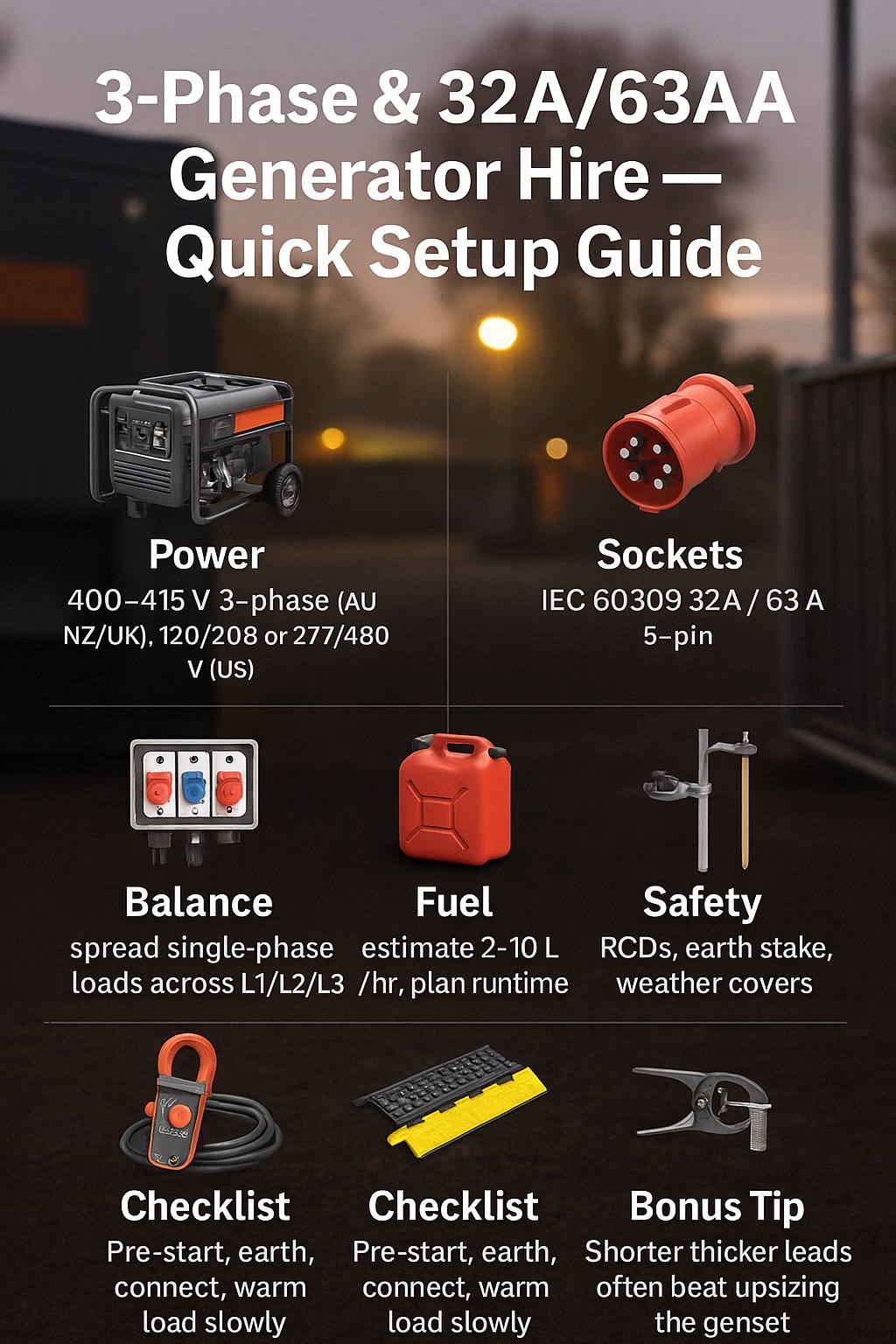
My 3-Phase & 32A/63A Generator Hire Guide (I Keep Power Simple)
I’ve hired, delivered, and powered dozens of sites with 3-phase gear—this is the playbook I wish I had on day one.
Hire 3-phase power safely and fast. This guide explains 3-phase generator hire, choosing 32A and 63A outlets, and matching kVA sizing for tools, kitchens, and site gear. It covers safety checks, cables, load balance, runtime, and noise in plain language anyone on site can use.
3-Phase Hire Quick Stats (NZ/AU context)
| Metric | Typical Figure |
|---|---|
| Common outlets | 32A 5-pin, 63A 5-pin |
| Standard voltages | 400–415 V (line-to-line) |
| Popular generator sizes | 20–100 kVA |
| Default power factor (PF) | 0.8 |
| Noise @7 m (canopied diesel) | ~60–70 dB(A) |
Source: ieee.org
⚡️ My Simple Overview of 3-Phase Hire
What 3-phase power does for me
Three phases spread the load, so motors start cleaner and kitchens don’t blink when ovens and extractors spike. When I moved from single-phase to 3-phase for medium jobs, nuisance trips dropped. I size the set, balance the phases, then protect everything with the right distribution board and RCDs.
When 32A or 63A is enough
I reach for 32A when a pop-up kitchen has a combi oven and a coffee cart. I jump to 63A when welders, big mixers, or multiple ovens want headroom. If in doubt, I step up a size. It keeps voltage sag and chef meltdowns away when the lunch rush hits.
Words I keep simple: kW, kVA, PF
I think in kW first because appliances list kW. I convert to kVA by dividing by power factor (usually 0.8). That number picks my generator. Then I add surge and a comfort margin. It’s simple math that saves me from “why did it trip?” phone calls at 8 pm.
“Design with margin like civil engineers add safety factors,” notes Ava Shah, CPEng.
🎛️ How I Explain 3-Phase Basics in 60 Seconds
The shortest 3-phase explainer
Imagine three legs of power, each taking turns carrying the load. Because they’re evenly spaced in time, motors feel steady torque and electronics see less wobble. On a job, that means smoother starts, better voltage stability, and fewer trips when everything kicks on at once.
Why balance matters
Unbalanced phases make one leg sweat while others chill. I group loads by phase and keep totals similar. If I can’t balance perfectly, I put the heaviest on separate phases and keep sensitive gear away from the messy stuff. A clamp meter and a calm head do wonders.
Site voltages that I plan for
Locally, line-to-line sits around 400–415 V. I still meter it before switching on, especially on long cable runs. If I see ugly drop or frequency drift under load, I re-route cables, shorten runs, or nudge the set’s governor under an electrician’s supervision—never guesswork, always measured.
“Balance phases like a dietitian balances macros,” says Liam Park, NZ Registered Nutritionist.
📏 How I Right-Size Generators (kW, kVA & PF)
My easy kW → kVA math
I add up appliance kW, include likely “both-on” scenarios, then divide by 0.8 PF to get kVA. If I’ve got a 24 kW kitchen at PF 0.85, that’s ~28 kVA. I’ll spec 40–60 kVA because ovens surge, fridges cycle, and people love plugging in “just one more” thing.
Headroom that saves the day
Headroom is cheap insurance. I aim for 20–30% extra capacity so the set cruises around 60–70% load where fuel efficiency and noise are happier. Running too light can glaze cylinders; running too heavy invites trips. The sweet spot keeps everyone fed, paid, and relaxed.
Heat, altitude, and derating
On scorching sites or hills, engines make a bit less power. I derate the set if ambient temps soar or we’re above sea level. It’s boring math that prevents spectacular failures. I also check manufacturer curves—real numbers beat wishful thinking a hundred times out of a hundred.
“Think of derating like athletes acclimatising at altitude,” adds Dr. Mei Chen, Sports Scientist (ESSA).
🔌 Why I Pick 32A vs 63A
My 32A checklist
Small commercial kitchens, light production rigs, and modest motor loads usually live happily on 32A. I keep 5-pin 32A connectors, short runs, and tidy DBs. If the team wants induction, refrigeration, and coffee with a combi oven, I double-check the peaks before I lock it in.
My 63A checklist
When welders arrive or the kitchen grows legs—double ovens, fryers, dishwashers—I land on 63A. I like the extra thermal headroom in connectors and breakers. It buys me calmer voltage during spikes, especially when long cables and temporary ramps are unavoidable in tight venues and muddy sites.
When I level up capacity
If the plan shows growth or multiple vendors, I’ll oversize the generator and split to both 63A and 32A spurs. Diversity across phases keeps surprises small. If someone sneaks in a bain-marie or a second grinder, I’ve already made space for it—no frantic rewiring mid-service.
“Plan like urban designers plan for peak commute,” notes Hannah Reid, NZPI (Planner).
🧰 My Cables, Plugs & Distribution Boards
Cables that don’t sag voltage
Long, thin cables turn watts into heat and grumpy appliances. I choose larger cross-section for longer runs and keep joins minimal. If a fridge complains or lights flicker, I suspect volt drop first. A shorter, thicker route often fixes more than any breaker change ever could.
Plugs and IP ratings I trust
Outdoors, I want IP44 or IP67 connectors, tight glands, and proper strain relief. I tape labels that survive rain and late nights. If the connector looks tired, it goes in the bin. Wet events taught me the cost of one cheap plug can dwarf the cost of doing it right.
DB layouts that stay tidy
A lockable DB with RCDs/RCBOs, clear phase strips, and room to move keeps the setup sane. I map sockets by phase, then log what I’ve plugged in. When someone asks “what can we add,” I can answer with confidence, not vibes. Tidy boards make tidy days.
“Clarity in layout mirrors how UX designers reduce user error,” says Noah Patel, UXPA Member.
🛡️ My Safety & Compliance Checklist (AS/NZS friendly)
Earthing without the jargon
I confirm earthing points, bond where the electrician specifies, and never improvise “because it worked last time.” MEN systems and portable generators aren’t guesswork. If I’m not certain, a registered sparky is on the phone before a single plug leaves the case. Safety loves humility.
Isolation I can point to
I place a clear, lockable isolator near the DB with signage people can actually read. In rain, I shelter generators and boards. Refuelling zones stay away from foot traffic, kitchens, and cigarette breaks. One tidy, roped-off area calms the chaos and reduces the “oops” moments.
My daily safety routine
Before first coffee, I do a lap: leaks, cables, guards, fire gear, trip tests, and a quick load balance check. I write it down. If something feels off, we pause. A five-minute check beats a five-hour outage and a fridge full of spoiled, angry prawns.
“Treat procedures like pilots treat checklists,” advises Sofia Alvarez, CPL (Aviation).
⛽ My Fuel, Runtime & Noise Planning
Fuel I actually budget for
Load drives fuel. A 60 kVA set sipping at mid-load might burn a few litres per hour; at high load it drinks more. I estimate from manufacturer curves, then add a buffer so nights aren’t a nail-biter. External tanks make long events boring—in the best way.
Runtime targets by job type
For single-day events, I plan continuous runtime plus a contingency hour. For construction, I schedule daytime operation and lock it down at night with tamper alarms. On 24/7 jobs, I rotate refuels during the lowest load period and keep a spill kit ready, not buried in the van.
Noise I keep under control
Canopies help, but placement is king. I face exhausts away, put distance between the set and the crowd, and use barriers when space allows. Moving a generator ten metres has saved more noise complaints than any gadget I’ve tried. Neighbours remember quiet, not kVA numbers.
“Acoustics reward distance like photography rewards light,” notes Elena Rossi, MIOA (Acoustician).
🎪 My Fit-For-Purpose Picks (Events, Construction, Manufacturing)
Events that need clean power
Coffee machines and combi ovens share badly with welders. At events, I separate food gear from anything spiky. Refrigeration gets its own phase where possible. I also double-tag critical lines so a tired runner doesn’t yank the wrong plug during the dinner rush. Clear labels save reputations.
Construction gear that bites
Welders, hoists, and compressors like to misbehave at start-up. I plan phases so motors don’t all kick at once, and I upsize where duty cycles stack. A DB with spare ways lets me adapt when a subcontractor shows with a “quick job” that needs a dedicated outlet.
Motors and machines that care
CNCs and VFD-driven motors prefer steady voltage and sensible earthing. I give them short, thick runs and a clean phase. If harmonics whine, I escalate to an electrician. Productivity beats pride. A calm machine operator is a priceless ally when the clock runs faster than the blueprint.
“Segment loads like chefs separate raw and cooked zones,” says Marcus Cole, NZChefs (Chef de Partie).
🌀 How I Handle Motor Starts & VFDs
Inrush made simple
Locked-rotor amps can be 5–7x running current. That’s how a “small” compressor nukes a “big” plan. I check nameplates, ask vendors for start current, and spread motor starts across phases. If it still groans, the generator grows. It’s cheaper than apologising to an entire kitchen.
Soft-starting my headaches away
Star-delta starters and VFDs smooth the punch. They also add their own quirks—space for heat, settings that drift, and harmonics that sing. I keep spares and label tuning notes. If a drive hunts or trips, I call the controls engineer sooner, not later.
VFDs without the math class
Filters, correct bonding, and clean routing silence a lot of gremlins. I avoid sharing VFD phases with sensitive kit. When someone begs for space, I move plugs, not goalposts. Measured changes beat random button mashing every time I’m tired and tempted.
“Manage surges like hospitals triage patients—separate and prioritise,” adds Priya Nair, RN (NZNC).
🧭 My Setup Workflow (Delivery → Test)
Walk the site with me
I start with the path: where the generator sits, airflow, exhaust, and how we’ll run cables without creating ankle traps. I note water, kitchens, stages, and vendor tents. A ten-minute walk prevents a ten-hour headache, especially when weather and foot traffic collide.
Balance before you blast
I pre-label phase groups on the DB, then distribute loads to keep each leg in the same neighbourhood. A clamp meter confirms reality. If one phase climbs, I shuffle plugs before the public arrives. Doing this early gives me a quiet afternoon later—my favourite magic trick.
Test it like you mean it
I meter voltage and frequency at no-load, mid-load, and near peak. I test RCD trips. I log results and snap a photo for the job file. If the numbers wander, we fix, not hope. Customers love a confident “we’ve tested it,” not a shrug and a prayer.
“Test like software teams test before deploy,” says Dylan Brooks, ISTQB (Tester).
💸 Pricing, Bonds & Hire Packages I Offer
Simple prices that hold up
Daily and weekly rates are clear. I bundle cables, ramps, and DBs in packages so budgets don’t explode from “little” add-ons. Long-term hires get a sanity discount because good customers are worth keeping. Every quote lists what’s included—ambiguity is the enemy of trust.
Bonds that feel fair
Bonds cover risk but shouldn’t sting. I scale them by equipment value and site risk. Deliveries include a handover checklist so everyone knows the rules. When customers return tidy gear, refunds are fast. Word gets around that I’m strict but not sneaky, and that’s the balance I like.
Add-ons people actually need
Spill kits, cable ramps, lockable chains, and spare RCDs save the day. I’d rather upsell protection than apologise for a booth that tripped mid-service. My customers learn these add-ons aren’t fluff—they’re the difference between smooth revenue and chaotic refunds on a rainy Saturday.
“Price like accountants price risk,” notes Olivia Tan, CA (ANZ).
🛠️ Troubleshooting I Do Before Calling a Sparky
The five quick checks
Fuel in, filters clear, breakers set, RCDs not tripped, and cables seated—those five fix most panics. I walk the trunk line with my eyes and hands. If a connector feels warm or looks stressed, I rest it. Plastic tells the truth when meters argue.
Tripping that tells a story
Frequent RCD trips usually point to leakage, water ingress, or a grumpy appliance. I isolate branches and plug loads back one by one. Patience beats heroics. When the culprit shows itself, I replace or re-route rather than argue with physics and bad weather.
When I tag-out
If a fault hints at insulation damage, arcing, or mystery heat, I stop and tag. A registered electrician finishes the story. I like sleeping at night and seeing the same customers next month. Pride won’t solder a winding back together on the pavement anyway.
“Escalate like doctors escalate beyond scope,” adds Ethan Ward, MBChB.
🧪 My Customer Case Study: Pop-Up Event Kitchen on 63A
What the site needed
An outdoor food festival ran twelve vendors with ovens, fridges, and coffee machines. Peaks were scary on paper, and the venue didn’t want cable spaghetti. I chose a 60 kVA 3-phase set with a 63A main DB and a few 32A spurs, plus short, fat cable runs.
How I wired the win
I mapped vendors by phase and gave refrigeration a calmer leg. Ovens got their own circuits. I tested at 60% load, then again near peak during a vendor rehearsal. The numbers stayed tidy, so the chefs could focus on food, not flickering lights or sulking grinders.
Lessons I took home
Short cables beat heroic generators. Labels beat shouting. And oversizing a little beats apologising a lot. The organiser booked me again before pack-down, which tells me the plan worked where it counts—in their cash drawer and in their stress levels.
Case Data (concise)
| Item | Detail |
|---|---|
| Site | Outdoor food festival (12 vendors) |
| Peak load | ~42 kW (PF 0.86) |
| Generator | 60 kVA, 3-phase, 63A DB + 32A spurs |
| Cables | 20–35 m runs, 6 mm² & 10 mm², IP44/67 |
| Result | Zero trips, <65 dB(A) at 7 m, 11 h runtime |
“Run rehearsals like theatre techs run cues,” says Grace Miller, MEAA.
❓ FAQs I Get About 3-Phase & 32A/63A Hire
The short answers I give
Do I need 32A or 63A? If your biggest appliances push past 20–25 kW combined or you’ve got welders and big mixers, 63A keeps things calm.
Can I run single-phase off a 3-phase set? Yes, with the right DB—just balance phases.
How loud is it? About normal conversation at 7 m for canopied sets.
My “it depends” moments
What fuel for a full day? Depends on load and tank size—allow buffer.
Who signs off the electrical work? A registered electrician.
What about long cable runs? Upsize cable and shorten routes to prevent volt drop.
Can I parallel generators? Yes, if the sets are compatible and a qualified technician commissions them.
“Answer nuance like lawyers answer ‘it depends,’” notes Chloe Wright, LLB.
✅ My Key Takeaways
What I never skip
I always right-size with PF and surge, balance phases, protect cables, and test under real load. I plan fuel and noise before anyone turns up. And I partner with a sparky for anything beyond my scope. That combination has saved more weekends than any shiny new gadget.
The 60-second summary
Pick 32A for compact jobs, 63A when peaks or motors loom. Keep cables short and thick. Label everything. Test before the crowd arrives. And leave yourself headroom—financially, electrically, and emotionally. Calm power equals calm people, and calm people make better events and safer sites.
“Summarise like journalists write nut graphs,” says Ben Carter, MEAA.
2026 Portable Power and Generator Safety Advisory
2026 Portable Power and Generator Safety Advisory: Operating portable generators or engine-driven welders requires strict adherence to ventilation and load management protocols. Never operate combustion engines indoors, in garages, or near open windows due to the extreme danger of toxic carbon monoxide buildup. Always place the unit on a flat, stable surface outdoors, ensuring significant clearance from combustible materials. Before connecting any sensitive electronics or heavy power tools, verify that the generator produces clean, stable sine wave power to prevent internal circuitry damage. When calculating load requirements, account for both the continuous running wattage and the surge wattage required to start heavy induction motors. Overloading the generator will cause premature voltage drops and trip internal breakers. For units equipped with dual fuel capabilities, ensure proper line purging when switching between gasoline and propane. Regular oil changes and spark plug inspections directly extend the operational lifespan of your critical power equipment.
Hire professional-grade equipment from 7 Hire. We offer fast local pickup or delivery across Auckland.