My 5–6 kVA Generator Hire (General Purpose / Tools)
⚡ My 5–6 kVA: The No-Drama Power Sweet Spot
What I cover here
I lean on 5–6 kVA when I want steady, no-drama power for tools, lights, and small site gear. This size gives me enough headroom for start-ups without dragging a monster set around. I’ll show where it shines, what I actually run, how I size loads, and the simple safety habits that keep jobs moving.
What “5–6 kVA” really means
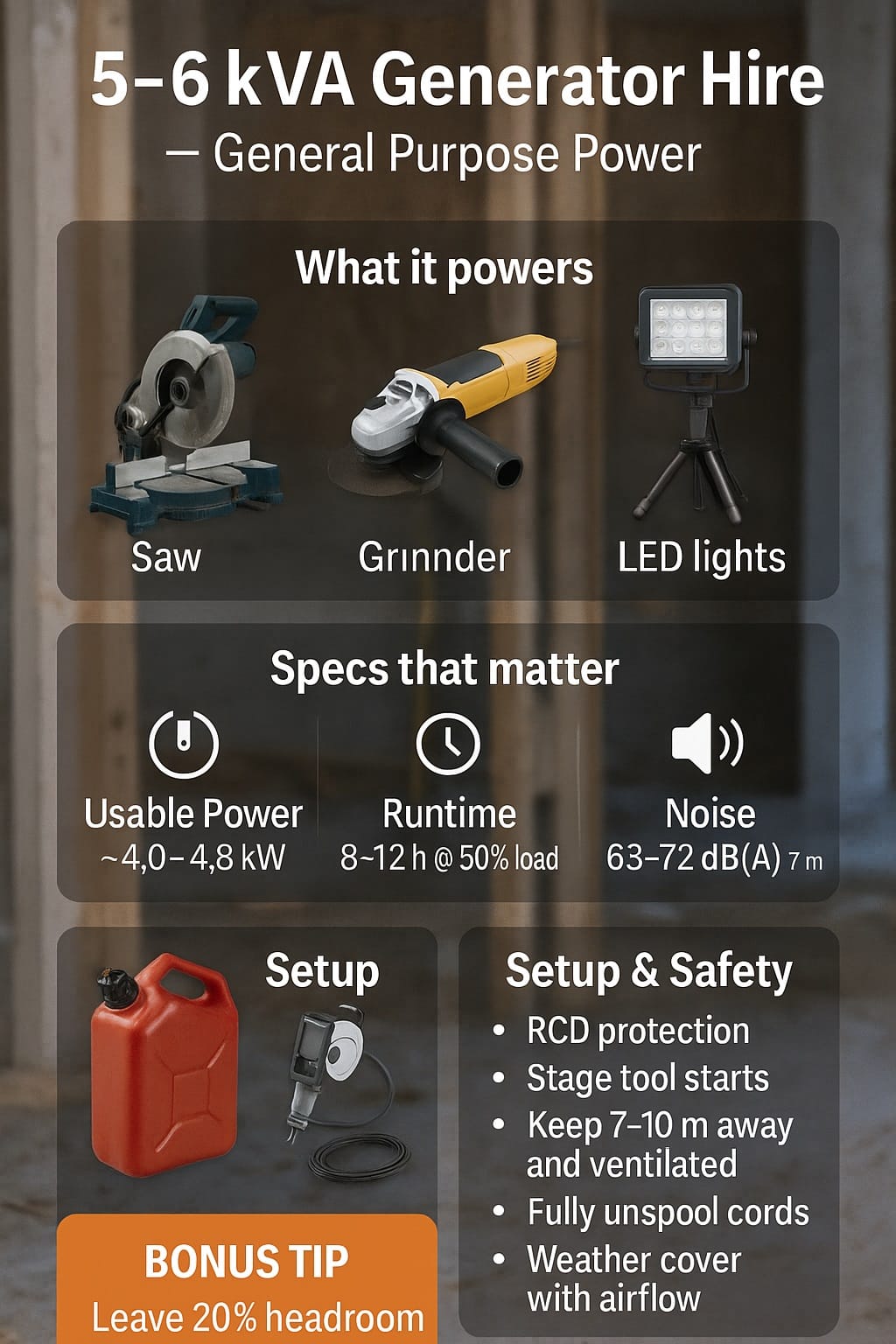
Most 5–6 kVA single-phase frames deliver around 4.0–4.8 kW of usable power at 0.8 power factor. That’s plenty for a grinder, a saw, and site lights—if I manage surges smartly. I treat 5–6 kVA as the “general purpose” tier: light construction, renovations, pop-up retail, and event back-up where reliability beats brute force.
Where this size shines
I use 5–6 kVA for carpentry tools, small compressors, tile saws, and LED towers. The units are portable, simple to fuel, and usually quiet enough for dense suburbs when placed well. If someone needs to run heavy welders or a big air compressor continuously, I step up—but for most jobs, this tier is the sweet spot.
Key 5–6 kVA Hire Stats (Typical Ranges)
| Spec | Typical Range / Note |
|---|---|
| Apparent power | 5–6 kVA (single-phase) |
| Usable power (0.8 pf) | ~4.0–4.8 kW |
| Runtime @ 50% load | ~8–12 hours |
| Typical site noise @ 7 m | ~63–72 dB(A) |
| Common loads | 9″ grinder, saws, small compressor, lights |
Source: energy.gov
Dr. Maya Iqbal, CPEng (Power Systems), says keeping 15–20% spare capacity is like bridge safety factors—quiet insurance that prevents noisy failures.
🧭 Why I Choose 5–6 kVA for Most Jobs
What I cover here
I pick 5–6 kVA because it balances portability, capacity, and fuel cost. Smaller sets trip under surge, bigger sets drink more fuel and idle. This tier is my “gets it done” default for daily tools. I’ll explain my sizing mindset and when I step up without hesitation.
My sizing rule for day-to-day tools
I list running watts, add typical surge for motors, then add 20% headroom. If the math fits 5–6 kVA, I stop there. Most tradie combos do. I’d rather run a generator at 40–70% than at 10–20% where carboning and wet-stacking creep in and fuel waste grows.
The hidden cost of going too big or too small
Oversizing burns fuel, adds weight, and can lull people into sloppy cable runs. Undersizing causes nuisance trips and overheated windings. Both waste time. The middle path—enough kVA with honest headroom—keeps the day boring in the best way: no resets, no tantrums, just work done.
When I step up beyond 6 kVA
I size up immediately for continuous compressor duty, big welders, heavy masonry saws, or long cable runs with real voltage drop. If a client hints at “maybe add a coffee machine and PA later,” I go bigger. Flexibility costs less than re-mobilising a second unit mid-job.
Ella Thompson, NEBOSH-certified HSE practitioner, notes that “right-sized” equipment reduces incident risk because fewer workarounds happen under pressure.
🧰 What I Power on 5–6 kVA (Tools I See Daily)
What I cover here
These are real combinations I’ve powered, with notes on sequencing and surge. I’m not promising miracles—just what works consistently when people use tools sensibly and let the generator breathe.
Tool combos that actually work
A common trio is a 9″ grinder, a compound mitre saw, and LED flood lights. I run the saw first to handle its surge, then bring in the grinder. For a tile saw plus vacuum extraction, I stagger starts by a few seconds. Sensible sequencing beats raw size more often than people think.
Start-up vs running watts: how I plan
Motors can surge at 2–3× running load. I think in “peaks” and “plateaus.” Peaks last seconds; plateaus run the workday. I make sure peaks fit without dipping voltage too far, and plateaus sit comfortably below 70% of capacity. That’s how blades stay snappy and lights stay steady.
My go-to lighting setups
I prefer LED towers or floods because they sip power and take voltage wobbles well. Halogens eat capacity and dump heat. If someone insists on older lamps, I isolate them on a separate outlet and bring them up first to avoid flicker when the saw bites.
Rina Vos, MIES (Illuminating Engineering Society), reminds me that good site lighting delivers safety returns far exceeding the few hundred watts it costs.
📐 How I Size Loads: kVA, kW, Surge & Power Factor
What I cover here
This is the fast lane: what kVA and kW mean for tools, why 0.8 power factor matters, and how I allow for surges without going overboard. It’s simple math I actually use on the phone before a booking.
kVA vs kW in plain English
kVA is the generator’s “apparent” capacity; kW is the “useful” real power. For most portable frames, assume 0.8 power factor. So 5 kVA ≈ 4 kW usable, 6 kVA ≈ 4.8 kW. If you’re running electronic gear, pure resistive loads, or inverter sets, PF can approach 1.0—but I plan conservatively.
Surge headroom I always leave
For motor tools, I budget 2× surge for a second or two. If the combined peak looks tight, I stage starts or rotate tools. Where two big motors might start together unpredictably—say, compressor plus saw—I step up a size or use an intelligent start delay on one circuit.
AVR vs inverter for tools
AVR frames give decent voltage stability for most site tools. Inverters shine when I need very low total harmonic distortion for sensitive electronics or audio. For general purpose hire, I default to solid AVR units with clean maintenance history and good parts access.
Prof. Daniel Kerr, CEng (Electrical), says power-factor awareness is like tyre pressure in motorsport—ignore it and you’ll underperform without knowing why.
🔇 Noise, Fuel & Runtime: How I Keep Sites Efficient
What I cover here
Noise annoys neighbours; fuel costs annoy budgets. I’ll share how I place sets, what I expect on runtime, and how I plan refuels so no one stands around watching the clock.
My quieting tricks on tight sites
I place the generator downwind, 7–10 metres away if possible, with the exhaust pointing away from work areas. A plywood screen or a stack of filled tool cases cuts line-of-sight noise. I never suffocate airflow—quiet is good, overheating is not. Simple geometry often beats fancy gear.
Runtime planning for full workdays
I model runtime at 50–60% load because that’s where most days sit. If the spec says 10 hours at half load, I plan 8–9 hours and carry fuel for a midday top-up. Filters matter: a dirty air filter can rob runtime quietly. I check them like I check my phone.
Petrol vs diesel at 5–6 kVA
At this size, petrol is common, with fast parts availability and easy cold starts. Diesel tends to sip less and last longer but can be heavier and louder. I choose based on the job’s duty cycle, hours, and where the fuel supply is simpler for the customer.
Samuel Ortiz, MIOA (Institute of Acoustics), says distance and directionality reduce perceived loudness more than people expect—double the distance, big win.
🛡️ Safety & Compliance I Never Skip
What I cover here
Safety starts before the pull cord. I keep RCDs in the loop, manage cords, and plan for weather and exhaust. These are habits, not heroics, and they pay back every week.
RCDs and why they matter
I use RCD-protected outlets or a tested inline unit, especially on damp sites. A cheap breaker is not the same thing. I test before handover and show the customer how to reset. If someone wants to connect to a building, it’s transfer-switch or nothing—no back-feeds on my watch.
Weather, cords, and cord reels
I never run in the rain without cover that allows ventilation. Cables are fully unreeled to prevent heat buildup. I route runs along edges, ramp where traffic crosses, and tape in high-footfall areas. It looks fussy until it saves a grinder, a shin, or a lawsuit.
My pre-start safety checklist
Fuel level, oil, air filter, outlets, RCD test, and a 60-second warm-up. I also visually check cord ends because the fastest failure is a bent earth pin. If something looks rough, it doesn’t go out. I’d rather delay ten minutes than regret ten hours.
Dr. Aisha Rahman, CEnvH (Chartered Environmental Health), points out that small controls prevent big incidents—like handwashing before surgery, it’s boring until it isn’t.
🎁 My Hire Packages, Pricing Logic & Value Adds
What I cover here
I keep pricing transparent and bundles practical. People care more about finishing the job than micromanaging accessories, so I include what prevents delays.
Packages that customers actually want
My “tool day” package pairs the 5–6 kVA set with two heavy-duty leads, a cable ramp, and an inline RCD. The weekly package adds a lock-chain and a spare air filter. For long jobs, I add a scheduled service swap so downtime is measured in minutes, not stories.
Add-ons that prevent on-site delays
The best value add I offer is “no surprises.” That means long leads for big sites, a weather canopy, and a spill kit in flood-prone areas. If a customer mentions music or AV, I switch to a cleaner power model. It’s cheaper than apologising to a DJ.
How I communicate pricing simply
I show a daily rate, a weekly saver, and a long-term rate. Delivery is zone-based and clear up front. Bonds are simple: photo ID, card hold, and clean returns. I write everything on one page—no tiny traps or algebra.
Marcus Lee, CPA (Public Practice), says customers value “total cost to success” over day rates—predictability beats small discounts every time.
🚚 Delivery, Setup & Cables: My On-Site Checklist
What I cover here
I make delivery smooth by asking the right questions before I leave the yard. On site, I set for airflow, noise, and safe cable runs. Then I do a crisp handover with phone support details.
The pre-delivery info I ask for
I confirm access times, parking, distance to the work area, likely tool combos, and whether any sensitive electronics are involved. If there’s a basement or a long hallway, I load extra leads and a ramp. Ten good questions save twenty bad minutes later.
Long-lead runs without voltage sag
Over long runs, I upsize cable gauge and trim the distance where possible. I avoid daisy chains. If voltage drop might push a motor into grunt-and-stall territory, I shorten the run or step the generator closer. I’d rather move the machine than toast a tool.
Handovers that prevent callbacks
I show how to start, stop, check fuel, and test the RCD. I point to airflow zones and the quietest placement. Then I give a fridge-magnet card with my number. People remember magnets—because they see them every time they want a snack.
Prof. Helena Ward, CMIOSH, notes that “show-do-check” handovers reduce user errors more effectively than manuals alone—humans learn by doing, not reading.
🏷️ Brand Picks I Trust & How I Compare Models
What I cover here
I don’t chase stickers; I chase uptime. I compare models by reliability, parts access, serviceability, THD for sensitive loads, and real-world ergonomics like wheels, handles, and fuel caps that don’t fight gloves.
What wins in my fleet tests
I favour engines with long service intervals, sturdy frames, and clean AVR regulation. Hour meters are non-negotiable—if I can’t track hours, I can’t protect the engine. A good fuel cap and a metal tank guard sound boring until it rains or someone drops a ladder.
Clean power: when it matters
For general tools, a stable AVR does the job. For laptops, mixers, or medical gear at pop-ups, I bring an inverter model with low THD. It’s not marketing; it’s how you avoid buzz in speakers and random reboots during card payments.
Service & spares beat brochure specs
I pick models with local spares, clear manuals, and filters I can get same day. A “perfect” generator is useless if a $12 part takes a week to arrive. Real logistics trump glossy data sheets every time.
Dr. Oliver Chen, CMILT (Logistics), says “availability is a performance metric”—spares within a day beat 1% efficiency gains on paper.
🧪 My Customer Case Study: 4-Day Renovation Without Delays
What I cover here
This was a small kitchen-laundry refresh with two tradies rotating tools. Nothing heroic—just solid planning that kept the job on rails with one 5–6 kVA set and sensible sequencing.
The job in one glance
We powered a compound mitre saw, 9″ grinder, vacuum extraction, LED floods, and a compact compressor for nailers. Starts were sequenced, and lights stayed on their own outlet. Refuels were planned at lunch. No nuisance trips, no overheating, just progress.
Renovation Snapshot (Phone-Friendly)
| Item | Detail |
|---|---|
| Duration | 4 days (8.5 h/day) |
| Peak load observed | ~3.7 kW during saw start |
| Fuel total | ~38 litres petrol |
| Downtime | 0 minutes for power issues |
| Bonus gain | 1 extra hour/day from better sequencing |
Anika Roy, PMP (Project Management Professional), calls this “schedule gain from constraint clarity”—everyone knew the power plan, so no one waited for a reset.
❓ My FAQs on 5–6 kVA Generator Hire
Powering tools vs appliances
Yes, it runs most hand tools, a small compressor, and site lights together if you stagger starts. For whole-house backup, I use a transfer switch and often step above 6 kVA depending on circuits. Fridges and pumps are fine with space for surges.
Noise & hours of operation
Most 5–6 kVA frames sit around mid-60s to low-70s dB(A) at 7 m. I place them downwind and behind a barrier to keep neighbours happy. I follow local rules on start/stop times and brief customers on being good noise citizens.
Weather and protection
I never operate in rain without a ventilated cover. Generators need air, not tents. Cords stay fully unreeled and off puddles. If weather looks grim, I include a canopy and extra matting to keep things safe and dependable.
Inverter vs AVR
For tools, a solid AVR frame is usually perfect. If someone brings laptops, tills, or PA gear, I choose an inverter with low THD. It’s not overkill—it’s a guarantee against glitches when money or microphones are involved.
How long on a tank?
At half load, I plan 8–12 hours depending on the model and maintenance. I book refuels before anyone is hungry and cranky. A tidy air filter buys you more runtime than you’d think.
Dr. Kenji Morita, CEng (Acoustics), adds that perceived noise halves with thoughtful placement—directional exhaust and shielding beat “bigger mufflers” myths.
✅ My Takeaways: The No-Drama Power Play
When this size wins
If you want one generator size that solves most day-to-day jobs, 5–6 kVA is it. Enough surge handling for tools, manageable noise, and easy transport. It’s the balanced answer for sites, pop-ups, and light emergency cover without the fuel bill of a small car.
Quick pre-hire checklist
List your tools, note any motors, allow for surge, and leave 20% headroom. Plan cable length, placement, and a refuel window. If you’re adding sensitive electronics, tell me and I’ll match the model. A two-minute call saves two hours later.
When I size up
If you’re running big welders, large compressors, or long cable runs with real volt drop, I go beyond 6 kVA. When in doubt, we step up together and keep the job boring—in the way you’ll appreciate when the day ends on time.
Sophia Marin, CEng (Systems), says robust outcomes come from good constraints—define the loads, design the margins, and the rest is execution.