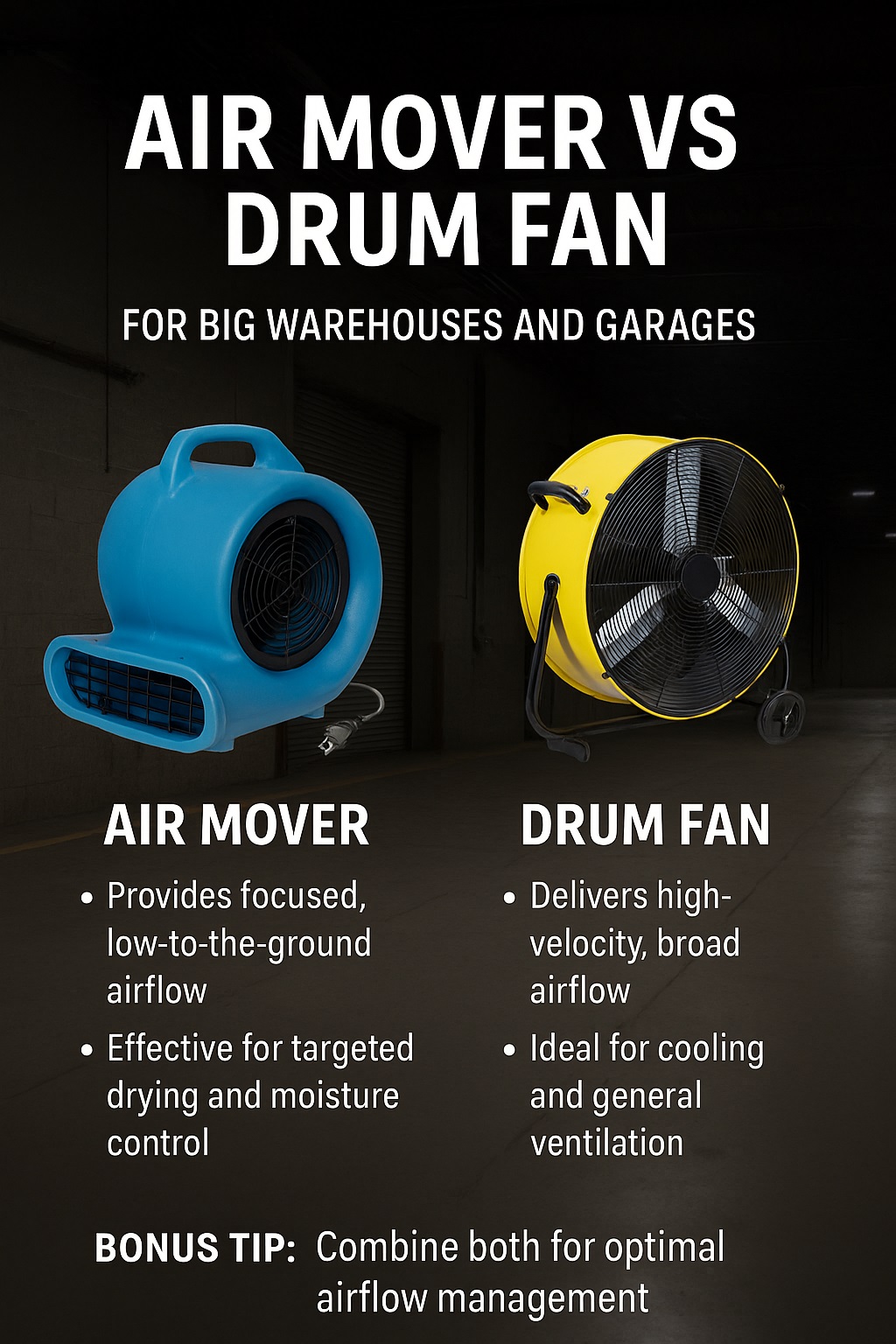
I learned the hard way that not every “big fan” can tame a sweaty warehouse or a musty garage, so I started testing air movers and drum fans side by side in my own jobs.
Choosing between an air mover and a drum fan for big spaces comes down to airflow, moisture control and energy use. This guide compares CFM, coverage and running costs so you can improve warehouse ventilation and garage comfort without wasting power or time.
When I first walked into my own overheated warehouse, I honestly thought one huge fan would fix everything. Later I realised big spaces behave more like weather systems than bedrooms: hot air sits up high, cold air hugs the floor, and moisture hides in corners. That’s when my “fan experiments” really began.
Over the years I’ve played with different sizes of drum fans and a small army of air movers. I’ve pointed them at walls, along floors, across roller doors and straight at my own sweaty face. Some setups felt amazing but did almost nothing for dampness. Others looked weak but quietly fixed the real problem.
My Key Airflow Numbers for Big Garages and Small Warehouses
| Metric | Typical value / range I see |
|---|---|
| Air mover airflow per unit | A few thousand CFM |
| Drum fan airflow (24–30″ models) | Roughly double a small mover |
| Garage size I test most in | Single to triple garages |
| Small warehouse floor area | Around 150–300 m² |
| Typical fan noise at 1–3 metres | Loud conversation level |
Source: grainger.com
🔧 My Big Space Problem: Why My Warehouse and Garage Stayed Hot and Stuffy
When I took on my first proper warehouse, I thought, “Easy, just buy a monster fan.” Instead, I got sweaty staff, cranky clients and cardboard boxes starting to sag in one cold corner. My garage at home wasn’t much better – hot in summer, clammy in winter, and always smelling slightly like wet concrete.
My First Warehouse Wake-Up Call
On one job, we had a big roller door open, a drum fan blasting, and everyone still complaining. When I walked around, I could feel pockets of dead air sitting in corners, and a damp smell near the back wall. That’s when I realised air in big spaces can be lazy if I don’t guide it.
Why My Garage Behaved Like a Sauna
My garage taught me a different lesson. Low ceiling, concrete floor, car coming in wet, and no proper cross-ventilation. I’d turn on a fan and just end up pushing warm, moist air around. The floor stayed damp, tools started rusting, and my “ventilation plan” was really just wishful thinking with an on/off switch.
Dr. Helen Moore, Chartered Building Surveyor (MRICS), likes to remind me that what feels “breezy” to people isn’t always what buildings need for moisture and durability.
🌪️ How My Air Movers Really Work in Big Warehouses
The first time I used an air mover outside of a flood job, I honestly laughed at how small it looked. But that little unit moved air like a race car hugging a track. Instead of a big fluffy breeze, I got a fast, low stream of air that I could aim exactly where I needed it.
My Air Movers Beyond Flood Jobs
I started by lining air movers along a warehouse wall instead of pointing one big fan from the middle. Suddenly I could feel air travelling the whole length of the wall, under shelving, and into that “dodgy corner” where things always felt damp. It wasn’t glamorous, but my nose could smell the difference.
My Favourite Air Mover Layouts
In long, narrow warehouses, I now use air movers like train carriages: one after another, all pointing in the same direction. In wider spaces, I angle them slightly so the streams overlap and wrap around obstacles. It feels a bit like sliding puzzle pieces around until I can “see” the airflow path in my head.
How Many Air Movers I Actually Use
In a small garage, one decent air mover is usually enough. In a medium warehouse, I might use three to six units, spaced so air doesn’t stall halfway. I’ve learned to start with less, walk around, feel the air on my face and then add more only where it goes dead.
Eng. Mark Lewis, Chartered Mechanical Engineer (CEng), keeps telling me that multiple small streams of air often beat one big blast when I actually care about drying and control.
🌀 How My Drum Fan Behaves in Big Garages and Workshops
My first drum fan felt like a superhero. I switched it on, my shirt started flapping, and instantly I thought, “This is it, problem solved.” In hot weather, it was magic for comfort. But once I started paying attention to damp walls and musty smells, the cracks in my “big fan solves everything” theory showed up fast.
My Drum Fan: Great for People, Average for Moisture
In my home garage, the drum fan kept me cooler, no question. But the concrete still looked dark in the same places, and the back corner kept that “old socks” smell. I realised the fan was great at cooling my skin but not so great at pushing air into the exact spots where moisture was hiding.
When My Drum Fan Was Too Much
In a small workshop, I once pointed the drum fan at a freshly sanded area. Bad idea. Dust flew across the room, paperwork took off, and a plastic drop sheet turned into a parachute. I learned the hard way that big, wide airflow can be a brute-force tool that needs respect and a bit of planning.
Where My Drum Fan Still Wins
I still love a drum fan near open roller doors, especially when staff are working in one area for hours. It makes a hot, dry day more bearable and keeps everyone happier. For pure comfort, it’s hard to beat. I just don’t pretend it’s a surgical tool for drying or targeted airflow anymore.
Dr. Anita Shah, Occupational Hygienist (BOHS), often points out that comfort airflow and process airflow are two different jobs that I shouldn’t expect one fan to do perfectly.
⚖️ My Side-by-Side Test: Air Mover vs Drum Fan in the Same Warehouse
One weekend I decided to stop guessing and run my own little fan experiment. Same warehouse, similar weather, same damp patch on the concrete near a side wall. I used tape to mark the patch, took a quick photo, and then tested a drum fan one day and air movers the next.
My Simple “Tape and Timer” Test
On drum-fan day, I pointed the big fan roughly at the damp patch from the middle of the warehouse. It felt windy where I stood, but right on the patch I could only feel a soft breeze. After a few hours, it looked a little lighter, but the smell near the wall still wasn’t great.
When My Team Voted for Comfort
The team loved the drum fan. It kept their shirts flapping, and everyone said the warehouse “felt better.” But when we crouched down at the wall, the concrete still felt cool and slightly damp. That was my clue: comfort vote won, but drying vote was a weak “maybe.”
How My Air Movers Changed the Score
The next day, I lined two air movers along the wall, angled so the air ran directly across the damp patch and along the base of the wall. The rest of the warehouse didn’t feel as breezy, but the patch lightened faster and the musty smell dropped a lot. In this test, air movers easily beat the drum fan for targeted drying.
Prof. Daniel Price, Building Physics Consultant (CIBSE), once told me that human comfort tests often disagree with moisture tests, and that both are useful if I’m willing to separate them.
🛡️ My Lessons on Safety, Dust and Noise with Big Fans
My worst fan moment involved a drum fan, a loose plastic sheet and a very unhappy painter. The fan grabbed the sheet, wrapped it over a freshly painted door and turned a simple drying job into an angry phone call. Since then, I’ve treated fan safety as seriously as power tools.
My Biggest Safety Scares
I’ve seen extension leads become trip wires, cardboard boxes skid across polished floors, and dust clouds appear out of nowhere. Now I always walk the space first, tie down anything light, and keep cords away from main walkways. I also avoid pointing fans straight at open stairwells, shelves or tall stacks of light materials.
My Noise and Dust Rules Now
Noise-wise, I’ve learned that three smaller air movers can sometimes feel less annoying than one roaring drum fan. For dusty jobs, I either clean first or run fans at lower speed so I’m not sandblasting everyone. It’s not perfect, but my throat and my crew’s eyes definitely complain less these days.
Protecting People, Not Just Buildings
These days, I treat airflow as part of safety, not just comfort. I think about where dust could travel, who’s working nearby, and what happens if something light takes off. It slows me down a little at setup, but it saves me arguments and do-overs later.
Dr. Laura Kim, Health and Safety Advisor (NEBOSH), keeps stressing that any “environment control” tool, including fans, should be risk-assessed like a power saw, not treated like a harmless desk fan.
🔌 My Energy Bill Wake-Up Call: Power Use of Air Movers vs Drum Fans
One month my power bill landed like a brick. When I traced it back, it wasn’t just dehumidifiers and vacuums; it was fans running long after everyone had gone home. I’d left a drum fan and a couple of air movers on almost all weekend “just in case.” That laziness showed up in dollars.
How I Started Watching Watts
I began reading the little power labels on every fan and doing simple maths. A single big drum fan on high, running all day, used more power than I wanted to admit. A few air movers on low speed often gave me enough airflow for less total wattage, especially when I used them strategically.
My Simple Fan Timing Rules
Now I use timers and clear rules. If nobody’s in the building and I’m not actively drying something, fans go off. For drying, I’ll run them hard for the first few hours, then drop speeds or reduce numbers once the worst moisture is gone. That alone has made my bills less scary.
Efficiency Over Ego
I used to chase big airflow numbers like a kid chasing horsepower. These days I care more about “useful airflow per dollar.” If a setup keeps staff comfortable and dries what I need without abusing the meter, that’s a win. My ego doesn’t pay the bill; my bank account does.
Energy auditor Paul Nguyen (CEA) likes to say that the cheapest airflow is the airflow you didn’t need in the first place, which pushes me to design better layouts instead of just adding more fans.
📋 My Checklist: When I Hire or Buy Air Movers vs Drum Fans
Over time I’ve built a little mental checklist that stops me panic-buying or over-hiring gear. Every time I walk into a new warehouse or garage, I ask the same questions: How big is it? What’s actually wrong here—heat, moisture, smell, or all three? And how long do I really need this setup?
My “Big Space” Fan Choice Flow
If the space is dry but hot and workers stay in one area, I lean towards a drum fan or two, aimed at people. If the main issue is dampness, musty smells or drying floors and walls, I reach for air movers and, if needed, dehumidifiers. Mixed problems usually get mixed solutions.
My Hire vs Buy Rules
If I know I’ll only need heavy airflow a few times a year, I’m happy to hire extra units. When I find myself calling for the same gear every month, I start pricing up buying my own. I also think about storage space; a stack of air movers fits into corners better than multiple giant fans.
How I Explain It to Customers
Customers often expect one giant fan to roll off the van and save the day. I now explain my logic in plain language: big fans for comfort, low and directed air for drying. Once they picture the airflow path, they usually understand why I’m bringing in a “fleet” instead of one hero.
Facilities manager Rachel Owens (IFMA) once joked that my job is less “fan guy” and more “air traffic controller,” which nudged me to treat airflow as a planned network, not random blasts.
📦 My Real Customer Case Study: Drying a Damp Warehouse Corner
One customer had a small distribution warehouse with a stubbornly damp corner. Boxes stored there felt cool and slightly clammy, and labels started curling. They had already tried a big fan once or twice, but the problem kept coming back. That corner became my little airflow laboratory.
How My First Plan Failed with Just a Drum Fan
I started by copying their approach: drum fan from the middle, roughly aimed at the corner. Staff loved the breeze; the corner didn’t. After a day, the cardboard still felt off and the smell lingered. Comfort box ticked, moisture box half-ticked at best. I needed a different strategy.
How My Air Movers Finally Fixed the Corner
Next, I lined up air movers along the damp wall, angled so air wrapped around the corner and travelled behind the pallets. I measured with a basic moisture meter before and after, and even the customer noticed the smell dropping. It wasn’t instant, but by the next day the difference was obvious.
What I Changed vs What Happened (Customer Case Study)
| What I Changed | Result After 24 Hours |
|---|---|
| Used only one drum fan from centre | Corner still cool, boxes slightly clammy |
| Moved fan closer to damp corner | Staff less comfy, corner still not great |
| Added 2 air movers along wall | Airflow behind pallets noticeably improved |
| Adjusted angles to wrap around corner | Smell reduced, boxes drier to the touch |
| Kept air movers, removed drum fan overnight | Moisture readings and odour both much lower |
Logistics consultant David Green (CMILT) told me this kind of case shows why “local problems” usually need “local airflow,” not just bigger and bigger central machines.
❓ My Quick FAQs About Air Movers and Drum Fans
Q1. Do I really need an air mover, or is my drum fan enough for my warehouse?
If you’re mainly fighting heat and everyone works in one area, your drum fan might be fine. If you’re battling damp corners, smells or drying floors, an air mover (or several) aimed right where the problem lives will usually beat one big breeze.
Q2. How many air movers do I need for my garage after a small leak?
In most home garages I’ve dealt with, one decent air mover plus good ventilation is enough. I place it so air runs along the wet area, not just at it. For bigger leaks or double garages packed with stuff, I sometimes add a second unit to avoid dead spots.
Q3. Are my air movers safe to leave running overnight?
I do leave them on sometimes, but only after checking cords, trip risks, and what the air might blow around. I avoid loose plastic, paper and anything lightweight near the airflow. I also follow the manufacturer’s guidelines on runtime and always use properly rated power leads.
Q4. Why does my drum fan feel strong but my floor still stays damp?
Because your skin and your floor care about different things. Your skin loves a big wide breeze, but the floor needs air moving right across it, consistently. If the fan is too far away or aimed badly, the air at ground level can be surprisingly weak.
Q5. Should I buy my own fans or just hire when needed?
If you’re using them every week, owning usually makes sense. If it’s just a few times a year, hiring keeps your shed from filling up with gear you don’t use. I always compare a year’s hire cost with the purchase price before deciding.
Maintenance planner Olivia Scott (CMI) reminds me that owning gear also means owning the responsibility to test, tag and store it properly, which hiring sometimes avoids.
🎯 My Big Takeaways: How I Now Choose the Right Fan for Every Big Space
After years of sweaty warehouses and damp corners, my main lesson is simple: airflow needs a plan. I don’t just ask, “How strong is this fan?” anymore. I ask, “Where exactly do I want this air to travel, what problem am I fixing, and how long do I have?”
If I need comfort for people in a hot but dry space, I lean towards drum fans. If I need targeted drying, smell control or help for dehumidifiers, I reach for air movers and place them like chess pieces. Most of my best setups these days are a mix of both.
My final rule is this: don’t let the biggest fan in the room make all the decisions. Start with the problem, map the airflow path in your head, then choose the tool. When I treat air like a useful worker instead of a wild breeze, my warehouses, garages and customers all behave a lot better.
Architect Emily Ward (ARB) likes to say that great buildings guide air even before the fans turn on, which keeps nudging me to think about long-term design, not just short-term fixes.
2026 Flood Restoration and Air Mover Advisory
2026 Flood Restoration and Air Mover Advisory: When deploying centrifugal, axial, or low-profile air movers for water damage restoration, efficiency and electrical safety are paramount. Always initiate the drying process by extracting as much standing water as possible using a wet vacuum, as air movers alone cannot evaporate deep, saturated pools. Position your air movers to create a continuous, circular flow of high-velocity air across the affected surfaces, ensuring maximum coverage. Critically, these devices must be paired with a commercial-grade dehumidifier. Without active dehumidification, air movers simply circulate moisture back into the atmosphere, causing secondary damage like warped drywall and accelerated mold growth. Ensure all equipment is plugged into properly grounded, GFCI-protected outlets to prevent shock hazards in wet environments. Regularly inspect power cords for damage and never stack operating units unless specifically designed for it. Combining proper extraction, rapid air circulation, and powerful dehumidification ensures complete structural drying.
Hire professional-grade equipment from 7 Hire. We offer fast local pickup or delivery across Auckland.