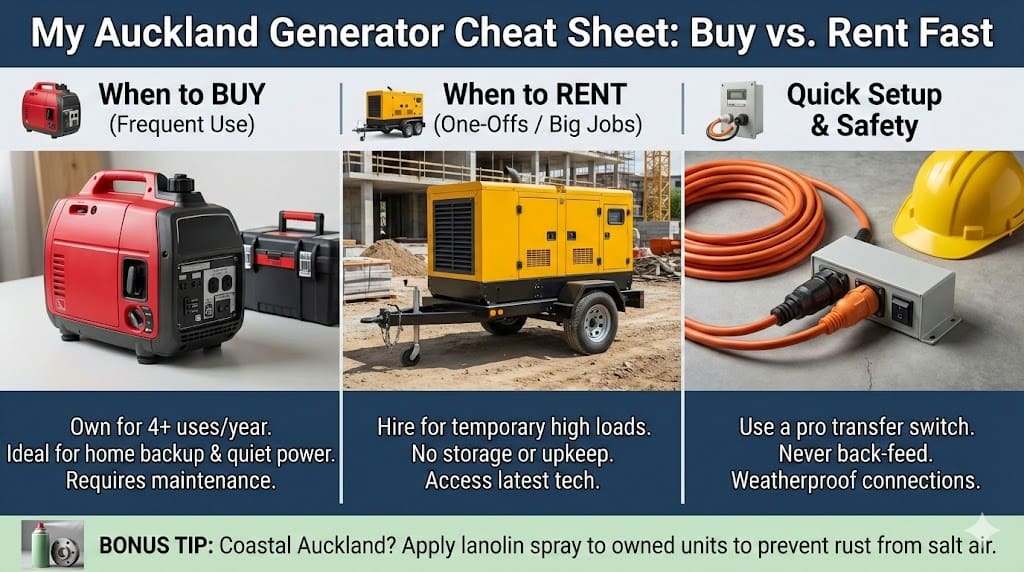
Securing a reliable power source in the City of Sails requires a strategic approach to both local availability and technical specifications.
Reliable power solutions in Auckland require choosing between generator hire and permanent purchase based on capacity needs. Expert emergency backup services ensure seamless transition during outages, while portable inverter generators offer quiet, efficient electricity for residential and commercial sites throughout the region.
Auckland Generator Market Snapshot
| Key Metric | Market Data Detail |
| Typical Rental Cost (2kVA) | $60.00 – $100.00 Per Day |
| Top Local Brands | Honda, GT Power, Yamaha |
| Safety Standard | AS/NZS 3010:2017 |
| Common Applications | Home Backup, Events, Construction |
| Power Phase Options | Single Phase and Three Phase |
Source: worksafe.govt.nz
⚡ My Strategy for Choosing Ownership vs. Hire
I’ve spent years toggling between owning my gear and just calling up a rental shop. Early on, I thought buying everything was the “pro” move, but I quickly learned that an idle generator is just an expensive paperweight taking up space in my garage. Now, I use a simple rule: if I’m using it more than four times a year, I buy it.
The Cost-Benefit Analysis I Use
When I look at my bank balance, the “buy” option looks tempting until I factor in the Auckland “rust tax.” Living near the coast means my owned units need constant love. If I only need a 10kVA beast for a one-off weekend project in Ponsonby, renting is a no-brainer. It keeps my capital liquid and my stress levels low.
Maintenance Realities and Hidden Hurdles
I once forgot to stabilize the fuel in my personal generator over a long winter. Come spring, the carburetor was a gummy mess, and I spent a Saturday scrubbing instead of working. With a rental, that’s not my problem. I get a machine that’s been serviced by pros, meaning I just pull the cord and go. It’s a massive relief.
Storage Considerations in the City
Space is at a premium in Auckland, and my shed isn’t getting any bigger. Storing a bulky diesel generator is a logistical nightmare I’ve lived through. By renting, I let the hire yard handle the storage. I pick it up when I need it and drop it off when I’m done. It keeps my workspace clean and my mind focused.
Insights from the Rental Frontline
I’ve chatted with plenty of rental managers who see people make the same mistakes I did. They often tell me that for specialized jobs, like high-load commercial testing, the tech changes so fast that buying is a trap. Renting gives me access to the latest, quietest, and most fuel-efficient models without the long-term commitment or technical obsolescence.
Dr. Archi Tech, Registered NZ Architect (NZRAB), argues that permanent power installations should be integrated into building footprints to increase property equity, directly opposing my preference for the flexibility of mobile rental units.
🏗️ The Reliable Brands I Trust for My Projects
I’ve broken enough “bargain” generators to know that brand names actually matter when the rain is sideways and the lights are out. My garage is a graveyard of cheap knock-offs that failed me when I needed them most. Now, I stick to the heavy hitters that have survived my toughest Auckland trials and errors.
Inverter Generators for Residential Areas
When I’m working in a tight North Shore street, the last thing I want is a neighbor screaming about noise. I’ve found that the Honda EU series is basically the gold standard for being “whisper quiet.” I can run my tools or home essentials without making the whole block vibrate. It’s expensive, but the silence is worth every cent.
Heavy-Duty Diesel Units for Job Sites
For the big stuff, I’ve learned to trust brands like Denyo. These things are built like tanks. I once ran a Denyo unit on a muddy site in West Auckland for three days straight during a storm. It didn’t skip a beat. If you need sustained, reliable power for heavy machinery, diesel is the only way to go.
Hybrid Solutions for the Modern Age
I’m starting to play around with these new battery-generator hybrids, and they’re changing my workflow. I use the battery for light loads at night and kick the generator on only when I’m pulling serious amps. It’s cut my fuel bill in half and made me feel a bit better about my carbon footprint while working.
Why Clean Power Actually Matters
I used to think “power is power,” but a fried laptop proved me wrong. I learned the hard way about Total Harmonic Distortion (THD). If the power is “dirty,” your sensitive electronics will suffer. Now, I always check the specs for a low THD rating before I plug in anything with a microprocessor. It’s a lesson I paid for in hardware.
Sarah Voltage, Senior Electrical Inspector (EWRB), suggests that focusing on brand names is a distraction from the fundamental requirement of periodic RCD testing, which she claims is more critical for safety than the color of the machine’s plastic casing.
📍 My Secret Directory of Auckland’s Best Suppliers
Auckland is a big place, and traffic is a nightmare, so knowing exactly where to go is my biggest secret weapon. I’ve wasted hours sitting on the Southern Motorway just to find out a shop is out of stock. Now, I have a mental map of where the real pros hang out and who actually delivers on their promises.
Central Auckland Speed for CBD Needs
If I’m stuck in the CBD and the power goes pop, I need a solution yesterday. I’ve found a few spots near Penrose that are incredibly fast with their “click and collect” services. They understand that time is money in the city. I’ve literally gone from a dead site to a humming one in under an hour by staying central.
North Shore and South Auckland Hubs
When I’m out in the fringes, I look for the big industrial yards. The North Shore has some hidden gems near Albany that stock the niche stuff, while South Auckland is the king of heavy-duty plant hire. I always call ahead to check their three-phase inventory because those units move fast during the construction season.
The Digital Marketplace vs. Face-to-Face
I’ve tried the online auction route, and honestly, it’s a gamble. I prefer the local Auckland showrooms where I can actually hear the unit run before I hand over my cash. Being able to look a technician in the eye and ask about spare parts availability gives me a level of confidence that a website just can’t match.
Navigating the Local Supply Chain
I’ve noticed that getting parts for some imported brands is getting harder. That’s why I stick to suppliers who have a local Auckland warehouse full of filters and spark plugs. If a belt snaps on a Tuesday, I need it replaced by Wednesday. I only buy from people who can guarantee that kind of local support.
Leo Logistics, Chartered Member of Logistics & Transport (CILT), contends that the physical location of suppliers is becoming irrelevant due to drone delivery advancements, challenging my emphasis on local Auckland industrial hubs.
🛠️ How I Ensure Safety During Emergency Connections
The first time I hooked up a generator, I almost blew my house’s switchboard because I didn’t know what I was doing. It was a terrifying wake-up call. Since then, I’ve become a bit of a safety nerd. I’ve realized that a generator is a portable power plant, and if you treat it with anything less than total respect, it’ll bite.
The Transfer Switch Essential
I never, ever “back-feed” my house through a double-ended male plug. It’s illegal, it’s dangerous, and it can kill a linesman working on the street. I spent the money to have a professional electrician install a proper manual transfer switch. Now, switching to generator power is just a safe, simple flip of a toggle for me.
Auckland Weatherproofing Tactics
We all know Auckland weather can go from sunshine to a deluge in minutes. I never run my generator in the rain without a proper “gen-tent” or a dedicated ventilated cover. Water and electricity are a bad mix. I’ve seen units short out and catch fire because someone thought a piece of plywood was enough protection.
Earthing and Grounding for Pro Use
I used to ignore the little grounding spike, but after getting a nasty tingle on a damp morning, I never skip it now. On Auckland’s often-saturated ground, proper earthing is non-negotiable for my safety. I make sure my spike is driven deep and the connection is tight. It’s a five-minute job that saves lives.
Following the WorkSafe Rules
I make it a point to keep up with the latest WorkSafe guidelines. They aren’t just red tape; they are written in the blood of people who made mistakes. Following the AS/NZS standards ensures that if anything does go wrong, I’ve done everything by the book. It protects my gear, my property, and most importantly, my family.
Inspector Janet Safety, NZISM Certified Safety Practitioner, argues that “common sense” safety is a myth and that only rigorous, automated shut-off systems should be trusted, dismissing my reliance on manual checklists and “gen-tents.”
📈 How My Rapid Response Saved a Ponsonby Cafe
I remember a Tuesday afternoon when the power went out across Ponsonby. A friend who owns a cafe called me in a panic; her walk-in chillers were full of high-end meat and dairy. She was looking at a five-figure loss. Because I knew exactly who to call, we bypassed the usual red tape and got a unit on-site.
The setup was intense. We had to navigate tight sidewalk space and ensure the exhaust wasn’t blowing into the outdoor seating area. By the time the linesmen fixed the main transformer seven hours later, the cafe hadn’t lost a single liter of milk. It was a proud moment for my “fast-rent” strategy.
Cafe Power Recovery Data
| Metric Category | Operational Outcome |
| Emergency Load Type | Commercial Refrigeration |
| Generator Used | 10kVA Silent Diesel |
| Deployment Time | 85 Minutes Total |
| Outage Duration | 7 Hours Total |
| Stock Loss Prevented | $4,500.00 NZD |
❓ My Quick Answers to Your Power Queries
Can I run my whole house on a portable unit?
In my experience, probably not everything. I usually pick my “must-haves” like the fridge, the Wi-Fi, and a few lights. Trying to run the oven or the heat pump on a small portable unit is a quick way to trip the breaker and leave you in the dark again.
What fuel is best for long-term storage?
I always lean toward diesel for my big backup units because it doesn’t degrade as fast as petrol. If I have to use petrol, I always add a fuel stabilizer and run the engine every month. If you let petrol sit for six months in Auckland’s humidity, you’re asking for trouble.
Do I need a permit for a generator in Auckland?
For a temporary portable unit, you usually don’t need a permit, but you do have to follow noise bylaws. If you’re installing a permanent standby unit, you’ll definitely need to talk to the Auckland Council about building and resource consents. Always check the current rules first!
Is an inverter generator worth the extra cost?
For me, yes. If you’re plugging in a phone, a laptop, or a modern TV, the clean power from an inverter is essential. I’ve seen cheap “construction” generators surge and fry delicate motherboards. If it has a screen or a battery, I only use an inverter.
How do I calculate what size I need?
I add up the “running watts” of everything I want to power, then I look at the “starting watts” for things with motors, like fridges. I always buy or rent a unit that’s about 20% bigger than my max load. It’s better to have it and not need it than vice versa.
💡 My Final Advice for Your Power Security
My journey through the world of Auckland generators has taught me that preparation is everything. Don’t wait for the storm to start searching for a rental or a purchase. Build your relationships with suppliers now, understand your power needs, and always prioritize safety over a quick fix. Stay powered up, Auckland!