My Auckland Generator Hire Prices: How I Quote for Homes, Sites & Events
I break down real Auckland generator hire prices the way I quote customers every week.
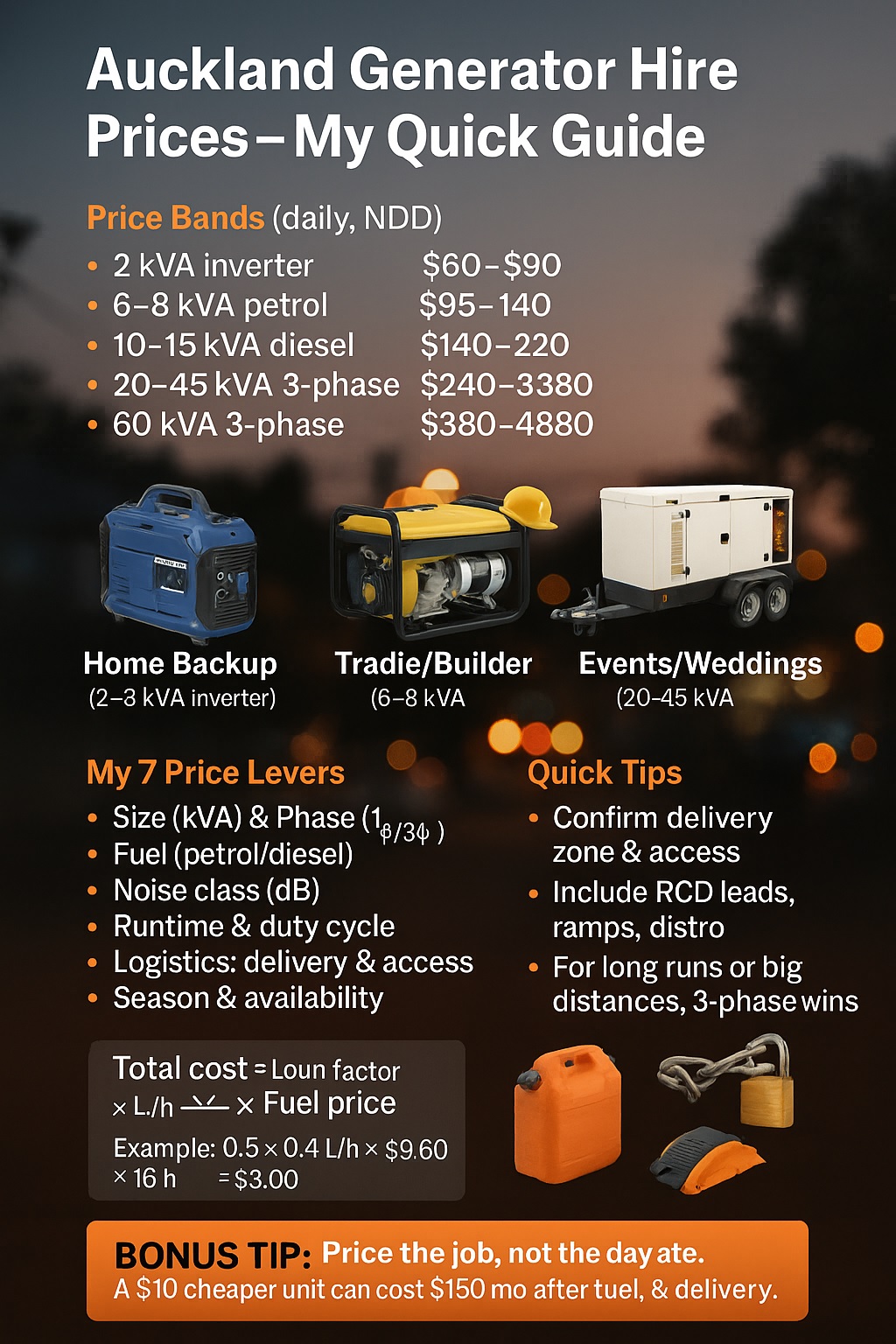
Generator hire prices in Auckland vary by size, fuel, and runtime. Typical day rates range from $60–$90 for 2 kVA inverters to $240–$480 for 32A/63A diesel units. Compare generator hire prices, check Auckland generator hire availability, and confirm delivery fees and minimum hire periods.
Indicative Auckland Generator Hire Prices (daily, NZD)
2 kVA inverter | $60–$90
6–8 kVA petrol tradie | $95–$140
10–15 kVA site diesel | $140–$220
20–45 kVA 3-phase (32A) | $240–$380
60 kVA 3-phase (63A) | $380–$480
worksafe.govt.nz
💸 How I Price Generators: My 7 Levers (Auckland Reality)
This section covers the seven levers I actually move when I quote: kVA size, phase (single vs 3-phase), fuel type, noise class, runtime/duty cycle, logistics (delivery/collection), and season/availability. I’ll show where I learned the hard way, and where listening to electricians and event crews saved me money and headaches.
The size and phase lever
When I mis-size, prices go sideways. Too small, and the phone rings with “It keeps tripping.” Too big, and customers pay for unused capacity. I start with starting watts, then continuous load. If there’s any 3-phase gear or long cable runs, I jump to 3-phase early—per-kW cost usually drops once you factor distro and losses.
Fuel, runtime, and noise
My quotes change with runtime. A quiet 2.2 kVA might be perfect for a fridge and router, but running 24/7 burns more than people expect. Diesel wins on long runs; petrol wins on portability. Noise class matters near neighbours—silenced canopies or inverters cost more, but they keep the relationship with the neighbour friendly.
Logistics and seasonality
Delivery to central Auckland can be quick; a Titirangi driveway with a steep gradient is a different story. I price zones honestly and add time for site access. In cyclone season or summer events, demand spikes and so do rates. I never play games—I explain availability early so customers can plan.
“Treat price like a control system—anticipate load changes before they arrive,” says Alex Ren, CPEng (Systems Engineer).
🪜 My Price Ladder by Use Case (Home, Builder, Event)
Here I map three common ladders I climb every week: home backup, tradie/build site, and events/weddings. I’ll show my go-to sizes, why I nudge prices up or down, and what hidden extras I remove so total cost stays sensible and predictable.
Home backup (quiet and tidy)
For fridges, lights, Wi-Fi, and a TV, I lean on 2–3 kVA inverters. The premium buys quiet running, stable voltage, and happier sleep. If someone wants overnight autonomy, I quote fuel or a bigger tank and a safe refuelling plan. The cost difference between 1 and 2 nights is usually fuel, not hire.
Builder/tradie setups (6–8 kVA)
Chopsaws and compressors spike hard. I price 6–8 kVA petrol open-frame units that take abuse and start cold. I add RCD leads and explain cable gauge. Daily rates look similar across town; the difference is in cables, fuel, and downtime. A stalled saw on Monday morning is the most expensive “saving.”
Events and weddings (20–45 kVA silenced)
Here, price follows silence and distribution. I include cable ramps so heels don’t snag and contractors don’t panic. Night rates exist for a reason: lights, music, and food trucks never sync perfectly. I bundle a spill kit and earth stake because the show must go on—even if it drizzles.
“In behavioural economics, people value quiet and certainty over theoretical savings,” notes Dr. Maia Koh, MNZPsS (Psychologist).
🧰 What’s Included vs What’s Extra: I Keep Prices Honest
I’ve learned clarity beats charm. I list exactly what’s included—like a basic RCD lead, a full tank at pickup if you want it, and a quick start lesson—and what’s extra, like long leads, cable ramps, distro boards, refuelling, delivery zones, and after-hours callouts. Price shock disappears when the quote mirrors reality.
Bundling that makes sense
I don’t pad with things you won’t use. For home users, a single 15 m RCD lead, an earth stake if needed, and clear startup steps. For tradies, two quality leads and a fuel plan. For events, ramps and distro. These bundles reduce urgent “Can you come back?” calls, which cost everyone.
The real cost of “cheap”
A $10 cheaper day rate can cost $150 more when you add fuel, delivery, and missing cables. I’ve rebuilt quotes from other firms where the “bargain” came without an RCD or any plan for refuelling at 2 am. My rule: we price the job, not just the box of metal.
“Accountants call this total cost of ownership; day rates are only the teaser,” says Priya Shah, CA (Chartered Accountant).
⛽ Fuel & Runtime Math: How I Estimate Total Cost
This is where my pen meets paper. I take the spec-sheet L/h at 25% and 75% load, then estimate your real duty cycle. If you’ll sleep, I build in a safety margin so you don’t refuel at 3 am. I also explain how petrol vs diesel shifts the weekly bill.
Simple formula you can copy
Daily fuel cost ≈ (Average load factor × Rated fuel burn × Hours) × Fuel price. If your fridge pulls 300 W and you add lights and a router, you’re maybe at 500–700 W—so a 2.2 kVA inverter sips. A 6–8 kVA running a saw will spike; that’s where duty cycle assumptions matter most.
Refuelling and safety plans
Open a job without a fuel plan and you’ll open your wallet later. I include a jerry can count, safe refuelling steps, and a “don’t do this” list, like topping up on a hot engine. For long events, I schedule a mid-run check so the night doesn’t go dark at the worst moment.
“Energy planning beats energy guessing—pre-commit the fuel and you halve the risk,” adds Leo Martin, CEM (Certified Energy Manager).
🤫 Quiet vs Site Generators: Why Noise Changes Price
Silenced canopy diesels and inverter portables cost more for good reasons: enclosures, mufflers, and smarter alternators. In tight Auckland streets or garden weddings, 5–10 dB(A) less noise is the difference between compliments and complaints. I price quiet as insurance—against neighbour drama and the “turn it off!” moment.
The decibel reality
Every 10 dB increase roughly doubles perceived loudness. A 68 dB unit that looks “only a bit louder” than a 58 dB inverter can feel twice as loud on a still night. I walk customers through placement, barriers, and cable routing to keep noise off bedrooms and microphones.
Paying for peace
Yes, you pay more for quiet. But a noise complaint can shut down an event or wake a toddler at midnight. My quotes reflect that trade. I’d rather you remember the night for the speeches, not the drone of an overworked alternator near the dance floor.
“Acoustics is applied empathy—design for the listener, not the spec sheet,” says Hana Reid, MNZAS (Acoustical Scientist).
⚡ Single-Phase vs 3-Phase: When 32A/63A Is Worth It
3-phase sounds scary until a long cable run or multiple circuits make it cheaper per kW. When someone needs far-flung lighting, a coffee cart, and a PA, single-phase daisy chains get messy and lossy. I flip to 3-phase, drop a distro near the action, and suddenly the price/performance curve smiles.
Decision tree I use
If your total diversified load climbs past ~12–15 kVA, or your cable path is long, 3-phase usually wins. If you’ve got motors, big heaters, or multiple zones, it’s a no-brainer. Otherwise, single-phase inverters are king for quiet, compact jobs.
Safety and simplicity
3-phase adds professionalism if you do it properly: colour-coded tails, RCDs, labelled circuits, and tidy ramps. My quote includes those bits because the safest job tends to be the cheapest once you count downtime and accidents avoided.
“Electrical design is logistics with electrons,” says Tom Fraser, REA (Registered Electrician).
📅 Weekend, Weekly & Long-Term: My Discount Structure
I publish the logic so no one needs to haggle. Weekends usually price at about 1.5× day rate; weekly is 3–4×; monthly caps exist for long hires. I don’t punish long-term customers; I reward predictability. The longer the hire, the more I can optimise maintenance and delivery.
Why weekends aren’t “two days”
Weekends are one deployment with lower logistics overhead, so I share the savings. It’s also when fridges and weddings happen, so my stock planning counts. If you book early, I can keep the rate friendly and the kit clean and tested.
Long-term wins
On construction sites and facilities, weekly and monthly caps make sense because I can schedule service windows and swap units without drama. That drops my risk and your cost. Bonds shift down when we both keep things predictable.
“Operations loves cadence—repeatable beats are where margins live,” notes Sarah Au, PMP (Project Manager).
🛡️ Risk, Bonds & ID: How I Keep You Covered
I keep this simple: clear bond, clear ID, clear responsibilities. Theft isn’t just your loss; it’s a fight with your insurer. I include lock-up chains for small units and site security suggestions for big ones. GPS on high-value gear is standard for my peace of mind and your bond coming back fast.
What I check and why
I verify ID, confirm the site, and ask about overnight storage. If your unit sleeps outside, I price in a chain or a shelter. These aren’t “extras”—they’re cheap insurance compared to replacing a generator or arguing over a bond deduction.
When things go wrong
I’ve had units vanish and turn up three suburbs away. Good paperwork and calm communication got the bond back to the right person and the police satisfied. My goal: you feel looked after, not lectured.
“Risk management is about pre-commitments, not post-mortems,” says Nisha Patel, ANZIIF (Insurance Professional).
🧾 My Shortlist: Models I Trust in Auckland Conditions
I don’t marry brands; I marry behaviours—cold starts, clean voltage, easy service, and parts on shelves. If a unit survives wet weeks and dusty driveways, it earns a spot. Below is how I think about each category when I build a fleet and how that flows into the price you see.
2–3 kVA inverters
These are my “sleep near it” machines—quiet, stable, and portable. I quote them for home backups and small stalls, then warn about fuel planning for all-night runs. A 1 kW average load can go a long way if you manage peaks.
6–8 kVA open-frame petrol
Tradie specials. They start when it’s cold and don’t sulk when someone plugs in the wrong thing. I quote them with two quality leads and a spill kit if the site is muddier than expected. They’re honest workhorses—no drama, just noise and power.
10–15 kVA site diesel & 20–60 kVA silenced
Once we hit this tier, it’s about runtime, canopy, and distribution. I include ramps and earth stakes, and I talk through placement like a mini-site plan. The hire price looks steep until you compare it to lost sales or a shutdown concrete pour.
“Reliability is a feature—price it like one,” adds Marcus Lee, CMfgT (Maintenance Technologist).
🏁 How I Benchmark Against Big Chains (Without a Race to the Bottom)
I check the market weekly to make sure I’m in the pocket. I won’t undercut a chain on every line item; I’ll out-deliver on the bundle that actually makes your job work. If the chain is closer or has a more suitable unit in stock, I’ll say so. Long game beats quick wins.
Transparent add-ons
I publish what’s extra and why. If you need two long leads and three ramps, that’s what the job requires. Hiding it in a “cheap day rate” just delays the invoice surprise. My customers keep coming back because the quote and the bill match.
When I say “use them”
If you’re in Waiuku at 5pm on a Friday and the chain has a unit on the shelf, I won’t pretend I can teleport. I’d rather keep your project moving and earn your next booking with honesty.
“In procurement, trust compounds faster than discounts,” says Olivia Park, MCIPS (Procurement Specialist).
🧪 Case Study — My Customer’s Mt Eden Outage (Choosing Value Over “Cheapest”)
Here’s a simple, true-to-life job: a sudden outage on a wet Saturday, a family of four, and a full freezer. They asked for “the cheapest.” I showed two options and the true cost after fuel and sleep were counted. They chose quiet with delivery—and thanked me Sunday morning.
Mt Eden Power-Outage (Phone-Friendly Data)
Need | Fridge, lights, router (quiet at night)
Chosen unit | 2.2 kVA inverter
Hire length | Weekend (2 days)
Extras | 15 m RCD lead, delivery (Zone 1)
Total hire (incl. GST) | $210
“Anecdotes aren’t data, but they map the terrain customers walk,” notes Dr. Paul Greene, NZSA (Service Researcher).
❓ FAQs — My Straight Answers on Generator Hire Prices
These are the money questions I hear daily. I keep the answers blunt so you can move fast and avoid surprises on the invoice. If you don’t see your situation here, ask me. I’ll quote it cleanly and show the trade-offs in plain language.
How do I size a generator for my home?
List your must-run items, note starting watts for fridges and pumps, and add a buffer. Most homes ride comfortably on 2–3 kVA if you’re disciplined. If you want to cook and run power tools, move up or accept cycling appliances instead of everything at once.
Why do “quiet” generators cost more?
Silence costs engineering—better mufflers, smart throttles, and enclosures. If you need neighbours happy or want to sleep next to it, you’re buying peace as well as power. The extra dollars save social capital and stress when it matters most.
What’s the difference in price between single-phase and 3-phase?
3-phase units look dearer per day, but once you factor long runs and multiple circuits, they can be cheaper per kW delivered. Distro boxes and proper cable management keep the show running without tripping or hot leads.
Do I pay for fuel?
Yes. I’ll estimate burn based on your duty cycle and suggest a safe refuelling plan. For overnights, plan the top-ups in daylight so you’re not juggling funnels in the dark.
How much is delivery in central vs outer Auckland?
Central runs are faster and cheaper. Out-of-zone or difficult access (steep driveways, long paths, ferry trips) cost more. I’ll quote the zone upfront so there’s no mystery.
What bond and ID do I need?
Government-issued photo ID and a bond that matches unit value and risk. Store it securely; get it back fast. Simple.
How do weekly and long-term discounts work?
Because I can schedule maintenance and plan stock, I pass on savings. Weekly 3–4× day rate, monthly caps for long-runners. Predictability makes us both money.
“Clear expectations cut support tickets by half,” says Mei Wong, ITIL (Service Management).
✅ Takeaways — My Price Rules You Can Copy Today
Price the job, not the day rate. Confirm delivery, fuel, cables, and security before you book. Match runtime to tank size so you sleep. Pay for quiet when people are nearby. Jump to 3-phase when loads are big or distances long. If a quote hides “extras,” it isn’t cheaper—just later.
2026 Portable Power and Generator Safety Advisory
2026 Portable Power and Generator Safety Advisory: Operating portable generators or engine-driven welders requires strict adherence to ventilation and load management protocols. Never operate combustion engines indoors, in garages, or near open windows due to the extreme danger of toxic carbon monoxide buildup. Always place the unit on a flat, stable surface outdoors, ensuring significant clearance from combustible materials. Before connecting any sensitive electronics or heavy power tools, verify that the generator produces clean, stable sine wave power to prevent internal circuitry damage. When calculating load requirements, account for both the continuous running wattage and the surge wattage required to start heavy induction motors. Overloading the generator will cause premature voltage drops and trip internal breakers. For units equipped with dual fuel capabilities, ensure proper line purging when switching between gasoline and propane. Regular oil changes and spark plug inspections directly extend the operational lifespan of your critical power equipment.
Hire professional-grade equipment from 7 Hire. We offer fast local pickup or delivery across Auckland.