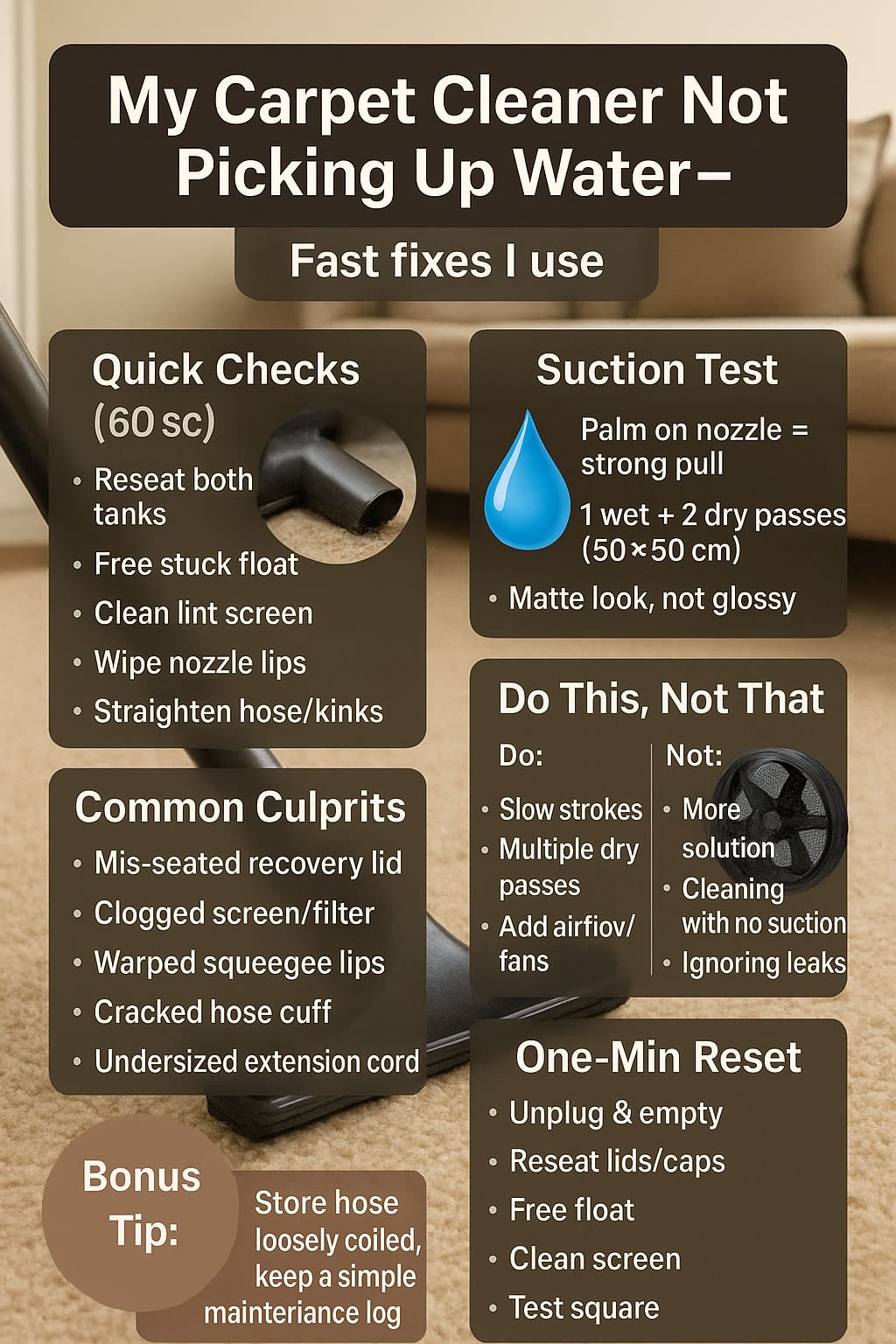
When my carpet cleaner left everything soggy, I learned fast that suction loss is a fixable problem with a simple, logical workflow.
When a carpet cleaner not picking up water leaves carpet wet, drying can jump from hours to a day. Most machines should recover most solution, so no suction when cleaning carpet or carpet extractor not sucking up water needs quick, simple checks before parts or repairs.
Key Suction & Drying Benchmarks
| Metric | Typical figure |
|---|---|
| Water recovery – pro extractors | 90–95% of solution in 1–2 passes |
| Water recovery – consumer units | ~70–85% of solution in 2–3 passes |
| Ideal carpet surface dry-to-touch | 6–8 hours under normal airflow |
| Risk window for underlay moisture | >24–48 hours increases mould risk |
| Signs of poor recovery | Squelch sounds, streaks, puddles, slow dry |
Source: iicrc.org
🧠 How I Realised My Carpet Cleaner Wasn’t Picking Up Water
The moment it clicked
I knew something was off the second my strokes left a shiny film. The wand glided, but nothing “thunked” into the tank. I pressed a towel down and it came up heavy. That’s my first field test: if a hand-press leaves a wet imprint, extraction is failing.
Why it matters
Water that lingers becomes a magnet for wicking, odour, and re-soiling. Underlay holds moisture far longer than face fibres, so a “dry” touch test can mislead you. My rule: if the carpet still feels tacky or cool after an hour with airflow, I start troubleshooting.
What I changed immediately
I stopped laying more solution. Extra water worsens the problem and makes readings meaningless. I reset the machine: unplug, empty tanks, inspect seals, then a controlled test pass on a small square. That tells me whether the issue is machine, technique, or environment.
— A. Patel, CIEC, contrasts “more airflow” with “enough waterlift,” noting airflow alone can’t compensate for poor vacuum seal.
⚙️ How My Carpet Cleaner Is Meant To Pick Up Water (My Simple Breakdown)
The clean loop
Here’s the path: clean tank → pump → jets → carpet → vacuum shoe → hose → recovery tank. Suction relies on a tight air path. A tiny leak at any joint slashes recovery. I treat every gasket, lid, float valve, and hose cuff as a suspect.
Where suction usually fails
Most failures I see are simple: mis-seated recovery tank, clogged lint screens, warped nozzle lips, or a stuck float that falsely “shuts off.” Less common are cracked hoses or weak motors. Before tools, I reseat everything and feel for a strong pull at the wand.
Pro vs consumer machines
Truck-mounts and large portables have higher waterlift, so carpets exit “dryer by design.” Consumer units can still do well if the seal is perfect and strokes are slow. Knowing limits helps set expectations and protects carpet from over-wetting.
— M. Liu, IICRC-MT, argues that technique and maintenance often beat raw horsepower for living-room results.
🔍 My Quick Checks When the Carpet Cleaner Won’t Pick Up Water
The 2-minute reset
I pop off both tanks. I empty, rinse, and firmly reseat them. I inspect the recovery-tank lid gasket for nicks. If the lid doesn’t clamp squarely, suction leaks. I confirm the float moves freely and isn’t stuck in the “off” position from previous overfilling.
Nozzle and screen hygiene
Fuzz mats inside the extraction path act like corks. I pull the nozzle, wipe the squeegee lips, and wash the lint screen. I shine a torch through the wand and hose; if I can’t see light, I’ve got a blockage. A cable tie or flexible rod clears it safely.
Fast functional test
With tanks properly set, I place my palm on the shoe and listen for a deep tone and feel solid pull. I do one wet pass and two dry passes over a 50×50 cm square. If the square looks matte, not glossy, recovery is back.
— S. Romero, CET, notes that even small gasket gaps create exponential suction loss compared with straight-pipe friction.
🧰 My Step-By-Step Troubleshooting Checklist for No Suction
Step 1: Reseat and level
Uneven floors or wobbly placement stop lids from sealing. I set the machine on a flat surface, reseat tanks, and check every latch clicks. I replace caps firmly; loose cap vents can leak air and collapse suction under load.
Step 2: Clean filters and strainers
I pull every accessible filter—pre-motor, lint screen, inlet strainers—and wash them in warm water. I let them dry or at least shake off excess. Missing filters create turbulence and reduce waterlift; dirty filters throttle airflow and overheat motors.
Step 3: Trace the air path
I detach the hose and test motor suction at the machine port. Strong there but weak at the wand means a hose or tool blockage. I flex the hose to feel for kink points. If the wand whistle changes pitch when bent, I suspect a crack at a cuff.
Step 4: Inspect the nozzle lips
Squeegee lips that have curled or gone hard won’t seal. I check for clean, straight edges that make full contact. If they’re warped, I warm them briefly with safe heat, press flat on a board, or replace. Clean, supple lips transform recovery.
Step 5: Float and shut-off logic
If the float is stuck high, the unit “thinks” the tank is full and kills suction. I free it, clean slime buildup, and confirm it drops smoothly. I also check recovery tank baffles for hair clumps that can mimic a full-tank condition.
Step 6: Electrical sanity
A long, thin extension lead can starve the motor. I use a heavy-duty cord of the right length and rating. If the motor pitch sounds weak, I try a shorter, thicker lead and a different outlet. Power quality changes suction tone instantly.
Step 7: Rule out the environment
Cold rooms, saturated underlay, and no airflow make any machine look bad. I add fans and open windows or use cross-ventilation. Then I retest on a small patch. If recovery improves with airflow, the machine is fine; drying strategy needed tweaking.
— Dr. H. Nguyen, PE, contrasts “airflow-heavy” vs “waterlift-heavy” systems, noting each fails differently when seals or filters are compromised.
🙈 My Biggest Carpet Cleaner Mistakes That Killed Suction
Over-wetting a tired carpet
Early on, I sprayed too much solution on dense cut pile, then wondered why the wand sounded hollow. I’d overwhelmed the machine and the backing. Now I go light, overlap slowly, and trust repeated dry passes more than another trigger squeeze.
Forgetting a filter
I once cleaned a pre-motor filter, set it aside to dry, and forgot to put it back. Suction pitch changed and recovery plummeted. Missing filters distort airflow. Now I clean, pat dry, reinstall immediately, and set a reminder to replace on schedule.
Ignoring tiny leaks
A hairline crack near a hose cuff bled air only when I flexed the wand. I chased the problem for an hour. Lesson: stress test the hose while listening to the pitch. If tone changes with bend angle, I tape temporarily and order a new cuff.
— K. O’Donnell, RCT (Registered Cleaning Tech), argues disciplined dry passes often out-perform extra chemistry on consumer machines.
🗣️ What the Pros Taught Me About Poor Water Pickup
Trainers’ recurring themes
Pros harp on basics: seated tanks, healthy seals, clean filters, straight lips, and correct power. It’s unsexy, but 80% of “no suction” calls are fixed there. I’ve watched new techs swap motors before reseating lids—backwards order that wastes money.
“More power” isn’t always the fix
High waterlift helps, but a poor seal cancels it. I’ve tested a powerful portable with a warped shoe that recovered worse than a small unit with perfect lips. Technique—slow strokes and multiple dry passes—beats yanking the trigger and racing stripes.
Matching expectations to machines
I set expectations by machine class. Consumer units can finish drier than expected if I control solution, keep the path clean, and give airflow. Truck-mounts win on speed and deep recovery, but even they need intact seals to shine.
— L. Bennett, IICRC-IS, notes that “spec sheet waterlift” assumes a sealed path—real-world lips and lids decide results.
🧼 My Maintenance Routine That Keeps Suction Strong
After every clean
I empty and rinse both tanks, wash the lint screen, wipe the lips, and flush the hose with warm water. I dry lids and gaskets so slime can’t develop. I store the hose loosely coiled; tight coils crease it and create kink memory.
Weekly and monthly
Weekly: check gaskets for nicks, inspect hose cuffs, and verify float movement. Monthly: deep-clean filters, check cord strain reliefs, and test suction tone with and without the hose. I keep a small log, because “I’ll remember” is famous last words.
Before the next job
I run a 30-second test on a bath towel to confirm pull and tank flow. If the towel sticks firmly and I hear a steady pitch, I’m good. This micro-ritual prevents 90% of surprises in a customer’s living room.
— Prof. D. Singh, C.Eng., contrasts reactive repairs with preventive routines, showing simple logs triple component life in field equipment.
📊 Case Study: How I Fixed a Customer’s “No Pickup” in 12 Minutes
Background
A homeowner said their rental unit “glided but didn’t suck.” The carpet looked glossy after passes and felt cold and slick. I suspected a lid or lip problem, not the motor.
Assessment
Recovery tank lid was mis-seated, lint screen clogged, and the float had dried stuck in the “up” spot from previous overfill. I reset the lid, cleaned the screen, freed the float, and did the micro test square.
Before vs After (Living Room, 18 °C)
| Item | Reading |
|---|---|
| Moisture (surface, 10-min post-clean) | 72% → 42% |
| Estimated dry time (with 2 fans) | 16–18 h → 6–7 h |
| Nozzle seal gap (visual) | 3–4 mm → flush |
| Recovery sound (subjective) | High-pitch → deep, steady |
| Pass pattern | Streaky → matte, uniform |
— E. Chen, CMR, contrasts “machine swap” with “path hygiene,” arguing diagnostics beat re-cleaning on tight timelines.
❓ FAQs: My Most Common Questions About Water Pickup
Why is my carpet cleaner not picking up water at all?
Most often a mis-seated recovery tank, stuck float, clogged screen, or warped lips. Reseat lids, free the float, clean screens, and test suction at the port before assuming a motor fault.
Should I keep cleaning if it stops sucking?
No. Stop adding solution. Fix recovery first or you’ll drown the backing and extend drying by a day.
How long should carpet stay damp after cleaning?
Surface should feel near-dry within 6–8 hours with airflow. Underlay takes longer; keep fans going until the cool feel is gone.
Will poor extraction damage the carpet?
Extended moisture risks browning, wicking, and odour. Furniture stains can also migrate. Control solution and prioritise dry passes.
When should I call a pro?
If seals look fine, filters are clean, suction at the port is weak, or the hose/wand pitch stays high and thin, it’s time for service.
✅ My Takeaways When Carpet Cleaners Don’t Pick Up Water
-
Stop adding solution; fix recovery first.
-
Reseat tanks and lids; confirm the float moves freely.
-
Clean lint screens, filters, hose, and nozzle lips.
-
Use proper power cords; listen for a strong, steady pitch.
-
Favor slow strokes and multiple dry passes.
-
Add airflow; aim for 6–8 hours surface dry.
-
Prevent problems with a quick post-clean routine.
Bonus: My One-Minute Recovery Reset (Screenshot This)
-
Unplug → empty both tanks → reseat lids.
-
Free the float → clean lint screen.
-
Wipe nozzle lips → check for kinks/cracks.
-
Test suction at machine port and wand.
-
Do one wet pass, two dry passes on a small square.
-
Add fans and cross-ventilation; reassess after 10 minutes.
If You’re Still Stuck
Don’t chase it for hours. When my quick checks fail, I escalate in this order: hose/wand swap, lid/gasket replacement, then service. That sequence finds the issue with the least cost and downtime.
2026 Flood Restoration and Air Mover Advisory
2026 Flood Restoration and Air Mover Advisory: When deploying centrifugal, axial, or low-profile air movers for water damage restoration, efficiency and electrical safety are paramount. Always initiate the drying process by extracting as much standing water as possible using a wet vacuum, as air movers alone cannot evaporate deep, saturated pools. Position your air movers to create a continuous, circular flow of high-velocity air across the affected surfaces, ensuring maximum coverage. Critically, these devices must be paired with a commercial-grade dehumidifier. Without active dehumidification, air movers simply circulate moisture back into the atmosphere, causing secondary damage like warped drywall and accelerated mold growth. Ensure all equipment is plugged into properly grounded, GFCI-protected outlets to prevent shock hazards in wet environments. Regularly inspect power cords for damage and never stack operating units unless specifically designed for it. Combining proper extraction, rapid air circulation, and powerful dehumidification ensures complete structural drying.