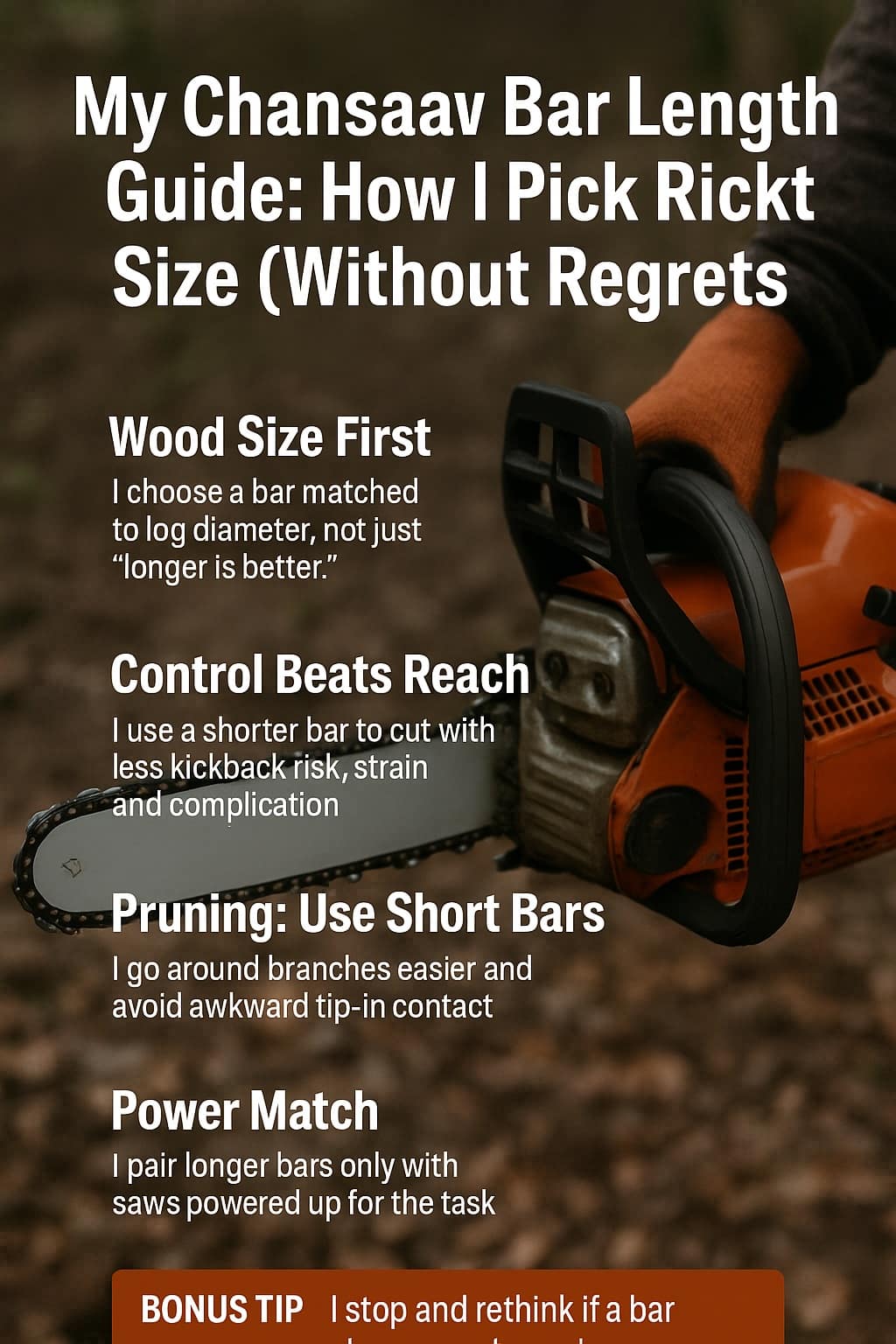
I used to think “longer bar = better,” until my shoulders, my cut speed, and my chain told me otherwise.
A chainsaw bar length guide helps match the saw to the job by balancing bar length, wood diameter, and engine power. The right length improves control, reduces fatigue, and lowers tip-kickback risk. The wrong length can feel heavy, cut slower, and strain small saws. Bar length matters.
Quick chainsaw bar length facts I actually use
| Data point | Real-world number / why it matters |
|---|---|
| Common homeowner bar range | 12–20 in is the everyday working zone for many tasks |
| “Balanced” all-rounder sizes | 14–18 in often feels fast, controlled, and less tiring |
| Bigger property / heavier work | 18–24 in can add reach, but needs more power and skill |
| Specialty long bars | 28 in+ is usually niche and demands strong technique |
| What changes with length | Longer bars add weight, increase leverage, and can raise tip risk |
Source: husqvarna.com
🧠 My Simple Bar Length Rules That Never Fail
My “wood size first” rule
I start with the wood, not the saw. When I did it the other way around, I ended up wrestling a long bar through skinny branches, like trying to butter toast with a sword. If most of my cuts are under forearm-thick, I don’t need extra inches. I need accuracy, quick repositioning, and clean chips.
My quick test is simple: if I’m constantly “reaching” just to finish cuts, the bar is too short. If I’m constantly “steering” the nose away from random stuff, the bar is too long. The sweet spot is when the saw feels like it’s following my hands, not dragging me around like a stubborn dog.
My “control beats reach” rule
The first time I swapped down a bar size, I expected to feel limited. Instead, I felt faster. A shorter bar is easier to keep flat, easier to sight straight, and easier to lift for repeat cuts. It also makes me less sloppy with the tip, because the nose stays closer to where my eyes are actually focused.
Longer bars can be great—when they’re truly matched to power and job. But when they’re not, I get slow cuts, extra fatigue, and that annoying “bog then bite” rhythm. If I have to baby the throttle just to keep it running smooth, I’m asking too much from the setup.
Ergonomics lens (opposing view): Chris, CPE (Certified Professional Ergonomist), would remind me that a longer “lever” amplifies fatigue even when the work feels easier on paper.
📏 My Bar Length Basics So I Don’t Get Tricked by Numbers
My “bar length vs cutting length” reality check
I learned the hard way that the printed bar length isn’t always how much wood I can comfortably bite through in one pass. A bar can be “20 inch,” but the usable cutting feel depends on the powerhead, the bumper spikes, and how I position the saw. Real cutting is messy—logs aren’t square, and my stance isn’t a machine jig.
So I treat bar length as a category, not a promise. It’s a guide for reach and typical diameter, not a guarantee that I’ll be smoothly slicing 20 inches of hardwood all day. The moment the saw struggles, the “number” stops mattering and my technique starts costing me.
My quick way to measure my bar (without overthinking)
When I’m unsure what bar I’m holding, I check the bar itself first. Many bars are stamped or printed near the mount area, and it’s faster than guessing. If that marking is worn off (because I’ve used it like it owes me money), I measure from the front of the saw body to the tip along the bar.
I also pay attention to the chain length (drive links) when replacing parts. Bar length, chain length, pitch, and gauge all need to match the system. The bar might “fit,” but if the chain spec is wrong, the whole thing turns into a noisy, jumpy lesson I didn’t ask for.
Metrology lens (contrasting view): Riley, ASQ CQT (Certified Quality Technician), would argue that “measuring once” beats guessing—because tiny spec errors create big mechanical problems.
🪵 My Best Bar Length Picks by Job Type
My pruning + small branch setup
For pruning, I want a saw that feels like a paintbrush, not a fence post. Shorter bars help me move around branches, avoid accidental tip contact, and keep cuts precise. When I used a longer bar for pruning, I spent more time repositioning than cutting, and I nicked things I didn’t even mean to touch.
I also feel safer with a compact setup when I’m working at odd angles. The saw balances better, and I’m less tempted to “poke” the nose into a tight spot. If the job is small wood, I’d rather do two clean cuts than one risky, awkward cut.
My limbing + general property clean-up setup
This is where I live most of the time: fallen branches, garden clean-up, storm mess, and general “why is there wood everywhere?” work. Here I like an all-round bar length that doesn’t tire me out after twenty minutes. If I’m cutting from the ground a lot, I still want enough reach to avoid bending like a question mark.
My rule is: if I can keep my back happier and my wrists neutral, I can work longer and safer. An “okay” bar that I can control beats a “perfect” bar that I can only control when I’m fresh and motivated.
My firewood + bucking setup
Firewood is where bad bar choices show up fast. If the bar is too long for the saw, the cut slows down, the chain heats up, and I start forcing it. If the bar is too short, I keep rolling logs and doing extra setups, which sounds small until I’ve done it fifty times.
I aim for a setup that bites confidently without bogging. Sharp chain matters more than bravado. When the chips are big and consistent, I know I’m not just grinding dust. I want repeatable cuts, not one heroic cut followed by ten minutes of recovery.
My felling setup (and why I avoid pushing limits)
Felling is where I stop being “casual” and start being “serious.” I don’t chase maximum bar length for felling unless the saw is built for it and I’m trained for the cut plan. A longer bar can help reach through bigger diameter, but it also raises the stakes—more weight, more tip exposure, more chance of a bad angle.
If I’m not 100% sure, I step down in ambition, not safety. I’d rather change my approach—cut from both sides, reposition, or use help—than pretend a longer bar magically replaces good judgment.
Coaching lens (opposing view): Morgan, CSCS (Certified Strength & Conditioning Specialist), would say “power is nothing without control,” and control collapses when fatigue shows up.
⚙️ My Power Match Guide So My Saw Doesn’t Struggle
My quick cc-to-bar check (and when it lies)
I use power matching as a sanity check, not a rule carved in stone. In general, more bar needs more power to keep chain speed up under load. When I ignored that, I got slow cuts and the temptation to push harder—exactly when I should be backing off.
But here’s what “lies” about simple charts: chain sharpness, depth gauge setting, wood species, moisture, and technique can completely change how a setup feels. A sharp chain on a modest bar can outperform a dull chain on a longer bar every single day. My first fix is always sharpness, not shopping.
My battery vs petrol expectations
Battery saws can feel punchy, but runtime and sustained load are a different story. With petrol, I expect a steady pull as long as the saw is tuned and the chain is right. With battery, I pay more attention to how long I’m holding full load and whether I’m doing repeated heavy cuts that heat everything up.
So if I’m using battery for heavier work, I don’t automatically go longer just because the saw feels strong at first. I focus on efficient cuts and shorter “sessions.” The win is finishing the job smoothly, not proving a point to a log.
Engineering lens (contrasting view): Taylor, PE (Professional Engineer), would point out that systems fail at the weakest link—bar length often exposes that link faster.
🛡️ My Safety + Control Checklist Before I Upsize a Bar
My kickback-risk habits (simple, not scary)
I keep it simple: I respect the nose. Tip contact is where small mistakes get dramatic. A longer bar gives me more nose “range,” which means more chances to clip something I didn’t see—another branch, the ground, a hidden knot, or my own bad angle.
My habit is to plan cuts so the tip isn’t the first thing entering the wood. I also keep my stance stable and avoid cutting when I’m twisted or off-balance. If I feel rushed or sloppy, I stop. Wood will wait. My face prefers that.
My fatigue test (the honest one)
Before I commit to a longer bar, I do a boring test: can I hold and guide the saw cleanly for a full working block without my form collapsing? If my wrists start bending weird, my shoulders creep up, or my back rounds, that’s my body telling me the setup is too much.
Fatigue doesn’t just make work slower—it makes judgment worse. That’s when I start taking shortcuts like forcing the cut or working too close to the tip. If I can’t keep control, I don’t “tough it out.” I change the tool or the plan.
Safety lens (opposing view): Jordan, CSP (Certified Safety Professional), would argue the “right size” is the one that keeps your risk low when you’re tired, not when you’re fresh.
🔧 My Compatibility Checklist So I Don’t Buy the Wrong Bar
My “certified range + manual” check
I used to think, “If it bolts on, it’s fine.” That idea cost me time and money. Now I treat the manufacturer’s approved bar range as the boundary lines. Sure, people push past it, but I’m not interested in turning my saw into an experiment.
When I stay inside the recommended range, everything tends to behave: oiling, chain speed, balance, and tension stability. When I go outside it, the saw starts acting like a moody teenager—unpredictable, loud, and expensive. I’d rather be boring and reliable.
My quick check: bar mount + chain specs
Bar length is only one part of the puzzle. The bar mount pattern has to match the saw, and the chain must match the bar’s pitch and gauge. Even if the bar physically fits, the wrong chain spec can lead to poor tracking, extra wear, or unsafe behavior.
My simplest practice is to treat the bar and chain like a matched pair. If I change one, I double-check the other. It’s not “being fussy.” It’s avoiding the kind of mistake that wastes an afternoon and ruins my mood.
Quality lens (contrasting view): Casey, ISO 9001 Lead Auditor (Exemplar Global), would say consistency beats improvisation—because spec control is what prevents repeat failures.
📊 My Customer Case Study: How I Fixed a “Too-Long Bar” Setup
A customer once told me their saw was “weak.” The saw wasn’t weak—it was overloaded. They had a longer bar than they really needed for their typical work, and they were cutting dense wood with a chain that wasn’t helping. The result was classic: bogging in the cut, smoky friction, and a lot of pushing.
I didn’t start by selling anything. I watched how they cut. Their body was tense, they were steering the nose constantly, and the saw looked like it was working harder than the operator. We simplified the setup, got the chain situation right, and focused on control. Suddenly, the “weak” saw felt normal again.
| What I changed | What happened |
|---|---|
| Dropped one bar size | The saw felt lighter and easier to aim |
| Matched chain spec to the bar | The chain tracked straighter with less chatter |
| Sharpened chain properly | Bigger chips, less dust, faster cuts |
| Checked chain tension and oiling | Smoother running and less heat build-up |
| Stayed within the saw’s approved range | Less bogging and less strain on the engine |
The best part? The customer stopped forcing the saw. That alone made everything safer and faster.
Business lens (opposing view): Avery, CPA (Certified Public Accountant), would joke that “downsizing” is sometimes the best ROI—because it reduces wear, downtime, and replacement cost.
❓ My FAQs About Chainsaw Bar Length
What bar length is best for beginners?
I usually recommend starting shorter than you think. Beginners improve faster when the saw feels balanced and predictable. A shorter bar is easier to keep out of trouble, easier to control during awkward cuts, and less tiring while you learn good habits. Confidence should come from repeatable control, not from extra inches.
Can I put a longer bar on my saw?
Sometimes yes, but I treat it like a permission question, not a creativity question. First I check what the saw is designed to run. Then I consider whether my typical wood actually needs the extra length. If I’m only gaining reach but losing chain speed and control, it’s a downgrade disguised as an upgrade.
Is a 16-inch bar enough for firewood?
For a lot of people, yes—especially if the firewood is typical backyard wood and you’re not constantly bucking big, dense rounds. What matters most is clean chain sharpness and stable technique. If the bar lets you cut comfortably without forcing, it’s “enough.” If you’re always stretching or double-cutting, go up sensibly.
Why does my bar “length” not match what I measured?
Because different brands and setups can measure “bar length” slightly differently, and the powerhead housing can hide part of the bar. Also, the usable cutting feel changes with bumper spikes and how you position the saw in real wood. That’s why I treat the printed number as a guide, then confirm it by how it performs and fits the job.
Do I need a different chain when I change bar length?
Often, yes. A longer bar typically needs a longer chain (more drive links), and the chain must match the bar’s pitch and gauge. People get burned by assuming “a chain is a chain.” When it matches correctly, the saw runs smoother, tracks straighter, and wears slower. When it doesn’t, it becomes a noisy problem.
Education lens (contrasting view): Noah, ATCL (Adult Teaching Certificate Licensed), would say learning is fastest when the tool setup reduces chaos—because beginners can focus on skill, not surprises.
✅ My Takeaways
I pick bar length the same way every time: match the wood, match the power, and protect control. If I’m unsure, I choose the shorter bar because it’s usually safer, less tiring, and faster in real hands. When I go longer, I only do it with a saw that can handle it and a job that truly needs it.
-
If most cuts are small, a shorter bar keeps me accurate and relaxed.
-
If most cuts are medium, an all-round length keeps me efficient.
-
If cuts are big, I size up only when the saw and my skill level are ready.
-
Sharp chain beats “bigger bar” almost every time.
-
Control is the real upgrade.
Medical lens (opposing view): Dr. Priya Singh, MD (General Practitioner), would remind me that “preventing injury” is the best performance plan—because time off heals slower than wood cuts.