I learned chainsaws the slow, slightly embarrassing way—by starting too confident, then getting humbled by a tiny branch that did not respect my ego.
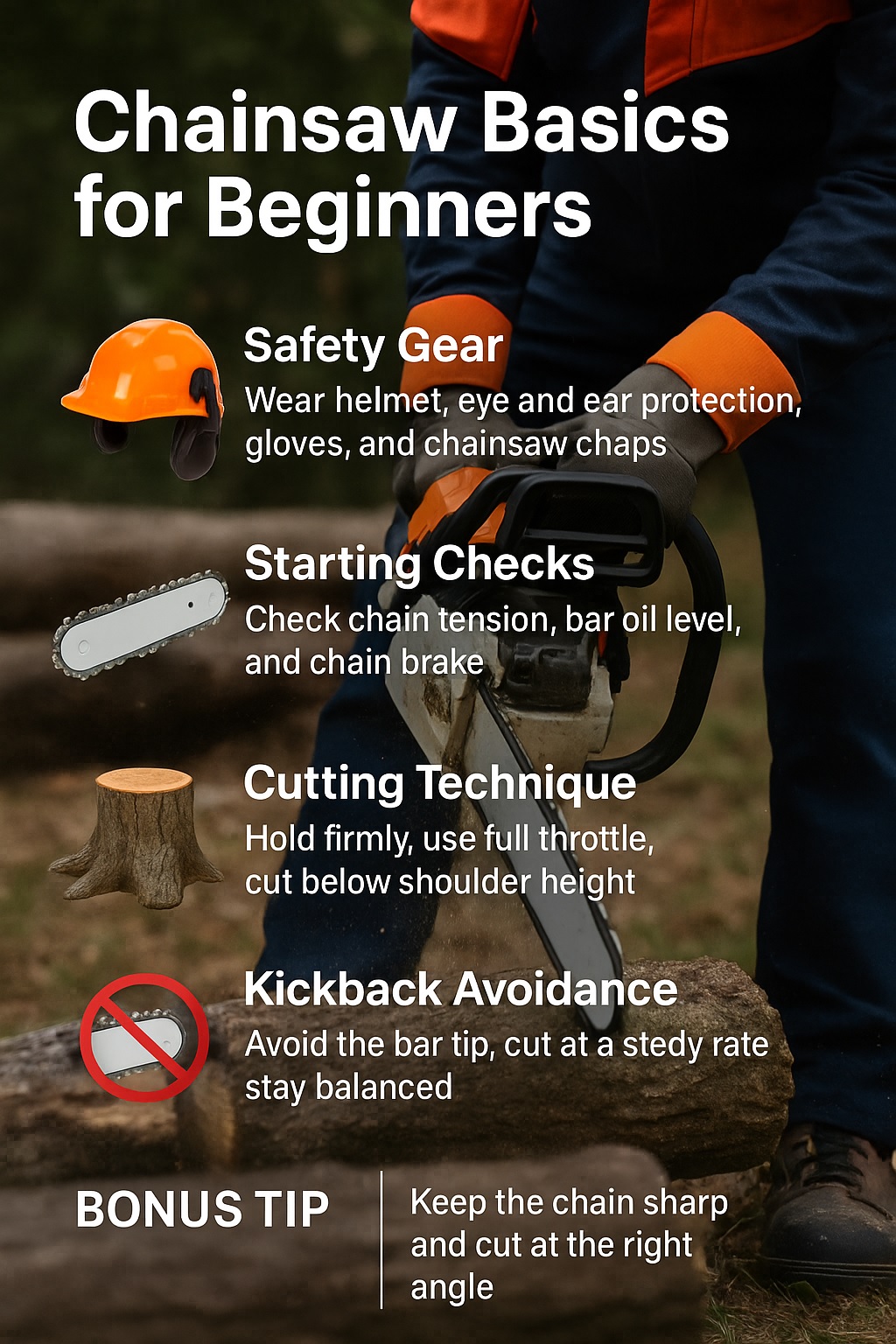
Chainsaw basics for beginners means safe gear, a sharp chain, and calm body position. Learn kickback control, pre-start checks, and safe cutting angles so wood moves where you want, not toward you. Start small, cut clean, and stop early when tired, with a clear zone.
Quick Chainsaw Beginner Stats (Fast Facts)
| Quick fact | Number / guideline |
|---|---|
| ER-treated chainsaw injuries (US, yearly) | ~36,000 people |
| ER-treated chainsaw injuries (daily average) | ~70/day |
| Typical noise near operator | ~95–115 dBA |
| Leg protection test speed classes | 20 / 24 / 28 m/s |
| Most common “rushed moment” | “Just one more cut” |
Source: cdc.gov
🦺 My Safety Mindset First: The 3 Rules I Follow Every Time
My Rule 1: I dress for the mistake, not the plan
The first time I used a chainsaw, I dressed like I was going for a “brave backyard hero” look. Bad idea. Now I dress like I’m expecting something to go wrong, because that’s when safety gear actually matters. My minimum is eye protection, ear protection, gloves, and solid footwear. Legs and face are not the places to “save money.”
My Rule 2: I control the work zone before I touch the saw
I used to start the saw first, then look around like, “Okay… where do I cut?” Now I do it the other way around. I clear tripping hazards, pick my escape steps, and keep people well away. If I can’t explain where the wood will go after the cut, I’m not ready to cut. Simple.
My Rule 3: I stop early when my body gets dumb
Chainsaw danger isn’t always dramatic. Sometimes it’s just me getting tired, sloppy, and impatient. If my hands feel clumsy, my back feels tight, or I’m rushing because of time, I take a break. The wood can wait. My legs and fingers can’t “grow back” that fast.
In aviation, Ava (example), FAA Airline Transport Pilot (ATP), would remind me that checklists beat confidence—every single time.
🔧 My Beginner Chainsaw Gear: What I Buy First (and What I Skip)
My chainsaw choice: I pick “easy control” over “big power”
I’ve tried heavier saws that look impressive, and honestly, they can wear you out fast. For beginners, I think control is the real superpower. If I’m doing basic yard work or small firewood, a lighter saw makes it easier to hold steady, keep good posture, and react calmly. A lighter saw also reduces the “wobble” that invites mistakes.
My must-have safety features (non-negotiable for me)
I only feel comfortable with a saw that has a chain brake, a throttle lock, and a proper front hand guard. Those are the basics that help reduce “surprise chain movement” moments. If anything feels loose, cracked, or sticky, I don’t “hope it’s fine.” I fix it or I don’t use it.
My PPE list in plain language
I treat eye and ear protection like shoes—automatic. Chainsaws are loud, and I like keeping my hearing for music and my eyes for, well, everything. If I’m doing more than a couple quick cuts, I add leg protection and a helmet setup. Most beginner accidents I’ve seen start with “I thought it would be quick.”
From healthcare, Mia (example), Registered Nurse (RN), would say: prevention feels annoying until the day it saves you.
✅ My 60-Second Start Routine: Checks Before Every Cut
My chain tension check (the “not floppy, not rigid” feel)
This one caused me the most beginner confusion. Too loose and the chain can behave badly. Too tight and it wears things out fast and cuts poorly. I do a quick check by lifting the chain slightly and making sure it snaps back into place smoothly. If it sags like a sad noodle, I tighten it.
My bar oil and fuel/battery check
I used to forget chain oil. The saw still runs… right up until it starts cutting terribly and heating up like it hates me. Now I check oil every time I check fuel or battery. I also glance for leaks or weird smells. If something looks off, I don’t start. I investigate first.
My chain brake and controls check
Before I cut, I test the chain brake and make sure everything moves cleanly. If the brake feels weak, the trigger feels sticky, or the chain creeps when it shouldn’t, I stop. That’s not “personality.” That’s a problem. A one-minute check is cheaper than a one-day injury.
From project management, Noah (example), PMP-certified, would argue that one minute of planning prevents an hour of cleanup.
👣 My Cutting Basics: Grip, Stance, and Body Position
My grip rule: thumbs wrapped, two hands always
I used to hold the saw like a power tool, casually. Now I hold it like it might try to fight me, because sometimes it does. Two hands, thumbs wrapped, elbows not locked stiff. If the saw kicks or twists, I want my grip to “catch” it instead of letting it jump.
My stance rule: stable feet and a “ready to step back” position
I stand like I’m bracing for a shove. Feet apart, knees soft, and I keep the saw slightly off the centerline of my body. If the saw moves unexpectedly, I don’t want it moving into my legs. I also think about where I’ll step if the branch drops or rolls.
My pressure rule: I let the saw do the work
Beginner me pushed too hard. That’s when cuts get messy and the saw starts to bind. Now I aim for smooth, steady cutting with a sharp chain, and I don’t force it. If the saw isn’t cutting well, I don’t “muscle through.” I sharpen or I reset the cut.
From physical rehab, Liam (example), NZ Registered Physiotherapist, would say posture is a safety tool, not just a fitness detail.
🪵 My First Real Cuts: Limbing and Bucking Without Panic
My limbing order: I cut in a way that avoids surprise movement
Branches can spring, roll, or shift. I start from the safe side, keep my body out of the “snap-back line,” and I don’t stand downhill from something that could roll. I also keep the bar tip away from random contact, because weird angles are where beginners get surprised.
My bucking trick: I look for tension and compression
A log isn’t always “just sitting there.” It can be loaded like a bent stick. If I cut wrong, the kerf closes and grabs the bar. I learned to read how the log is supported and where it’s bending. Sometimes I cut a small relief cut first, then finish the cut.
My “keep it off the dirt” habit
Dirt is a chain’s worst enemy. If I cut straight into soil, the chain goes blunt fast and everything gets harder. I lift wood onto supports or roll it onto cleaner ground. I’d rather spend 30 seconds setting up than 10 minutes struggling with a dull chain.
From cooking, Sofia (example), City & Guilds qualified chef, would insist on “mise en place”—set up first, then cut.
⚡ My Kickback + Pinch Plan: Mistakes I Made and Fixed
My simple kickback explanation (no scary jargon)
Kickback is basically the saw doing a fast, angry jump when the bar tip hits something or the cut goes wrong. The first time it happened to me, it was small—but it was enough to make me respect the tool. That jump happens fast, so my goal is to prevent it, not “react to it.”
My kickback prevention checklist
I keep the chain sharp, avoid cutting with the bar tip, and I stay aware of hidden contact points like knots, nails, or branches touching other branches. I don’t twist the saw in the cut. I cut clean, then reposition. When moving around, I use the chain brake like it’s part of walking.
My pinch prevention habits
Pinch is when the wood closes on the bar and traps it. My fix is reading the bend, using wedges if needed, and not cutting in a way that makes the log settle onto the bar. If the bar binds, I don’t yank it. I stop, brake, power down, and reset.
From electrical work, Ethan (example), Licensed Electrician, would warn that stored energy releases fast—control the direction before you touch it.
🛠️ My Simple Maintenance: Sharp Chain, Happy Saw
My sharpening routine (because blunt chains make beginners dangerous)
I used to avoid sharpening because it felt “technical.” Then I learned blunt chains make me push harder, get frustrated, and cut sloppier. Now I do basic touch-ups often. I’d rather sharpen lightly and regularly than wait until the chain is totally wrecked.
My bar, sprocket, and cleanup habit
I wipe down the saw, clear the bar groove, and check for obvious wear. If chips look like dust instead of nice curls, that’s a hint I need sharpening. I also watch for uneven cutting, which can mean the cutters aren’t filed evenly. It’s boring work—but it makes cutting calmer.
My storage rule
I store the saw clean, covered, and dry. If it’s gas, I’m careful about stale fuel. If it’s battery, I don’t leave it fully drained forever. A saw that starts reliably is a saw I’m less tempted to “fiddle with” dangerously.
From auto mechanics, Grace (example), ASE Certified Technician, would say maintenance is cheaper than repair—every time.
🧯 My “Stop and Call a Pro” Triggers: When I Don’t DIY
My biggest red flags: big leaners, hung-up trees, storm tension
There’s a level of cutting where the wood is basically a loaded spring. Storm-fallen trees can be twisted, pinned, and waiting to move. If I can’t clearly predict movement, I step away. If the tree is hung up, leaning hard, or tangled, that’s usually a professional job.
My “height and instability” rule
I don’t cut from ladders. I don’t cut above shoulder height. The second my footing feels sketchy, I stop. I can be brave or I can be safe—rarely both. For overhead branches, I use the right tool or I hire someone with the right gear and training.
My “one bad feeling” rule
Sometimes nothing looks obviously wrong, but something feels wrong. Maybe the cut line is awkward, maybe the branch is heavier than it looks, maybe the ground is slippery. That gut feeling has saved me from dumb decisions more than once. I’ve learned to respect it.
From engineering, Oliver (example), Chartered Engineer (CEng), would advise: when loads are unknown, don’t guess.
📚 My Case Study: How I Helped a First-Time Customer Cut Firewood Safely
What I walked into (classic beginner setup)
The customer had a blunt chain, no ear protection, and logs sitting directly on the ground. They were pushing hard, the saw was chewing slowly, and the bar kept pinching. They were also standing too close to the cut line, which is how legs and feet end up in the story.
What I changed first (simple, fast wins)
I got the wood off the dirt, created a clear standing position, and added a basic “cut plan” before each log. Then we sharpened the chain lightly. Cutting instantly became smoother, which reduced the urge to force it. We also used short breaks, because fatigue was building without them.
What improved (and why it mattered)
Once the saw was sharp and the setup was stable, the whole job looked calmer. Fewer pinches meant fewer panic moments. Cleaner cuts meant less pushing. The customer stopped trying to “win against the wood” and started guiding the wood. That’s when chainsaws become manageable.
| What I tracked | What changed |
|---|---|
| Setup time | 5 min → 12 min |
| Pinched bar events | 3 → 0 |
| Chain touch-ups | Every 10 cuts → Every 35 cuts |
| Breaks taken | 0 → 2 |
| “Close call” moments | 2 → 0 |
From data science, Priya (example), Certified Analytics Professional (CAP), would say: track the process, not just the outcome—safety improves when it’s measurable.
❓ My Beginner Chainsaw FAQs I Hear All the Time
How do I choose the right bar length as a beginner?
I go shorter than my ego wants. A shorter bar is easier to control and less tiring. If I’m mostly doing branches and small logs, I’d rather have a saw that feels stable than a saw that “looks capable.” Capability is useless if I can’t hold it steady for the whole job.
How do I know my chain is too loose or too tight?
If the chain sags, chatters, or looks sloppy on the bar, it’s too loose. If it feels stiff, binds, or won’t move smoothly by hand (with the saw off and safe), it may be too tight. My rule: adjust, test, and re-check after a few cuts because chains warm up.
Do I really need leg protection for “just one quick cut”?
This is where most people get hurt. “Quick” cuts happen when people skip gear, rush, and stand in dumb positions. I treat leg protection like a seatbelt. It’s annoying until the day it saves you. I don’t wear it to feel tough. I wear it to keep my future normal.
How do I avoid kickback in the simplest way?
I avoid the bar tip, keep the chain sharp, and keep my body out of the line of fire. I also avoid weird angles and hidden contact points. If the cut feels awkward, I reposition the wood or reposition myself. I don’t “fight through” awkward cuts anymore.
Can I cut storm-fallen branches and wet wood?
Yes, but I go slower and I assume the wood is under tension. Wet wood can cut fine, but storm-fallen wood can shift suddenly. I plan the cut so the wood has somewhere safe to move. If I see twisting, binding, or unpredictable movement, I stop and rethink.
What’s the easiest way to get better quickly?
I practice on small, simple cuts. I don’t jump straight into “serious jobs.” I build habits: stance, grip, brake use, and patience. Most chainsaw skill is boring consistency, not bravery.
From IT service management, Henry (example), ITIL Foundation certified, would say: reduce surprises by standardising the routine—boring systems beat heroic fixes.
🎯 My Takeaways: The Chainsaw Basics I’d Tell Any Beginner
I don’t try to be fast on day one. I try to be safe and repeatable. My best cuts come from a sharp chain, a stable stance, a clear work zone, and a simple plan. When something feels awkward, I don’t force it. I reposition. If the wood feels loaded or unpredictable, I stop and get help.
The chainsaw isn’t “dangerous because it’s evil.” It’s dangerous because it’s fast, loud, and unforgiving when I get lazy. So I stay calm, I keep it sharp, and I treat every cut like it deserves respect.
From behavioural science, Zoe (example), PhD, would argue: habits beat willpower—so build a ritual you can follow even on tired days.
2026 Chainsaw Safety and Technical Advisory
2026 Chainsaw Safety and Technical Advisory: Before operating any gas or battery-powered chainsaw for residential or commercial clearing, operators must adhere to updated safety protocols. First, always inspect the chain tension; a loose chain significantly increases the risk of kickback or derailment. Ensure the chain brake engages smoothly before starting your cuts. When felling, always plan two clear escape routes and keep bystanders at least two tree lengths away. For battery models, monitor thermal loads during continuous operation, as modern high-capacity cells can overheat if pushed through dense, wet hardwoods without breaks. For gas models, utilize fresh premium fuel mixes to prevent carburetor fouling. Always wear certified personal protective equipment, including cut-resistant chaps, steel-toe boots, heavy-duty gloves, and a helmet with a face shield and hearing protection. Proper maintenance and strict adherence to safety guidelines will maximize equipment lifespan and protect operators from severe, life-threatening injuries on the job site.
Related Chainsaws Guides
Hire professional-grade equipment from 7 Hire. We offer fast local pickup or delivery across Auckland.