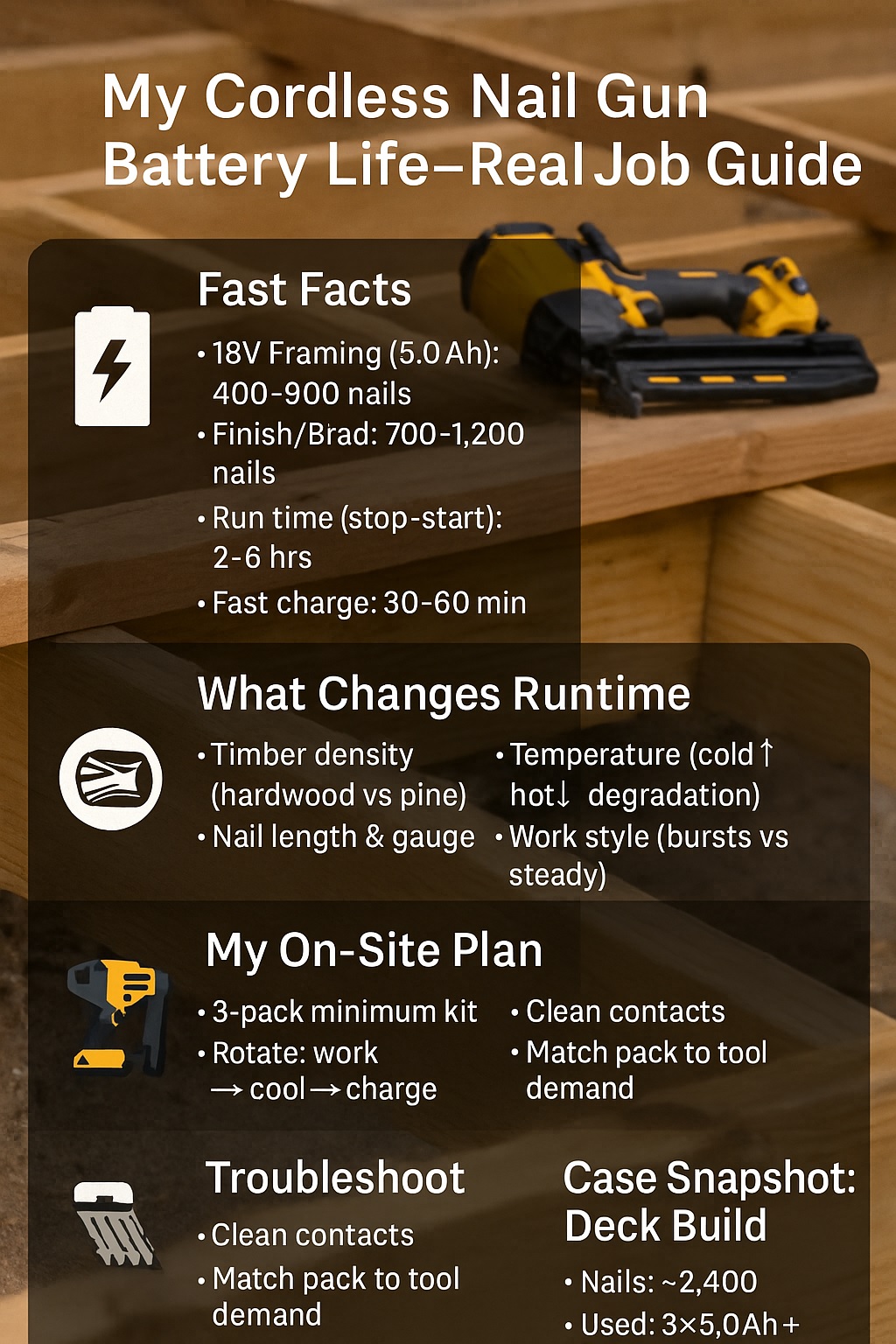
Cordless nail guns changed the way I work, but only after I learned how long the batteries actually last on real jobs.
Cordless nail gun battery life depends on cordless nail gun battery life, nails per charge, and work time per battery under real job conditions. Most 18V nailers fire 400–900 nails per charge, giving 2–6 hours of stop–start use, depending on battery size, timber type, nail length, and temperature.
Cordless Nail Gun Battery Life – Quick Numbers
| Metric | Typical Real-World Range |
|---|---|
| 18V framing nailer shots (5.0Ah) | 400–900 nails per charge |
| 18V finish / brad nailer shots | 700–1,200 nails per charge |
| Stop–start work time per battery | 2–6 hours |
| Batteries for a full 8-hour day | 2–4 packs, rotated |
| Fast charger time per battery | 30–60 minutes |
Source: familyhandyman.com
🔋 How My Cordless Nail Gun Battery Life Shows Up on Real Jobs
How I Use My Framing and Finishing Nailers
On paper, my nail guns all look amazing. On site, it is a different story. My framing nailer chews through batteries faster than my finish gun. When I’m smashing out wall frames, I can feel each long framing nail pulling more power, while trim jobs on pine hardly move the battery gauge.
I learned this the hard way on a small extension. I trusted the “up to 900 nails” promise, left my spare battery in the van, and ran out halfway through fixing rafters. Since then, I log rough nail counts and job types in my phone. My notes work better than any glossy brochure.
Why My 18V and 36V Batteries Feel Different
My 18V packs are my everyday workhorses. They’re lighter, easier on my wrist, and perfect for half-day jobs and indoor trim. But when I grab my high-output or 36V gear, I notice two things straight away: the gun feels heavier, and the batteries sag less under continuous firing.
On a big deck, my higher-voltage packs feel like they “hold pressure” better. The gun recovers faster between shots, and I get fewer misfires when I’m nailing into dense timber. The trade-off is simple: more weight on the belt, but fewer battery swaps on long, brutal bursts of work.
What I Learned From Switching Brands
At one point, I ran two nail gun brands side by side on the same job. Same timber, same nails, same weather. One brand claimed huge numbers on the box but consistently died first. The other brand was a bit heavier but gave me a quieter gun and noticeably longer runtime.
That experience taught me not to fall in love with logos. I now judge a system as a whole: batteries, chargers, guns, and how they behave together on my kind of work. I care more about the second year of runtime than the first week of “wow, new toy” feelings.
Dr Karen Lee, Chartered Electrical Engineer (CEng), often reminds me that marketing numbers are like lab test results—useful, but always second to real-world field measurements.
📏 Why I Don’t Trust Box Specs for My Battery Life
How I Test Battery Life My Own Way
These days, I test battery life with simple habits, not fancy gear. I fully charge a pack, note the time, and roughly track how many strips of nails I fire. I also jot down the job type: framing, decking, fencing, or trim. By the end of the day, I compare “feel” with actual numbers.
Once, I thought a brand-new battery was a beast because it “felt strong”. When I finally counted nails and hours, it was only average. My notes showed another battery, which felt less exciting, actually lasted longer over several weeks. That little logbook of mine has saved me from buying hype more than once.
How My Timber, Nails, and Weather Change Run Time
I notice the biggest drain when I’m working into dense, wet, or hardwood framing. Long framing nails into tough LVL beams drag battery level down much faster than short brads into pine trim. Even the angle of the gun and awkward body positions seem to change how hard the tool works.
Weather plays its part too. On cold mornings, I see the battery gauge drop faster, then “bounce back” a bar once the pack warms up. On blazing hot days, I try not to leave the gun baking in the sun, because my runtime and overall battery life both seem to suffer. My batteries hate extremes more than I do.
What Industry Experts Say vs What I See
Tool reps often talk about “ideal test conditions”. Flat timber, comfortable position, mild temperature, continuous nailing. Real jobs almost never look like that. I’m reaching overhead, twisting around blocking, leaning over decks, and dealing with wind, dust, and rain showers.
When I compare my logbook with what experts say, I notice they’re not wrong, just optimistic. Their numbers are for clean testing. My numbers are for muddy boots and loud radios. Once I understood that gap, I stopped arguing with the box and started planning for my own conditions instead.
Prof. Daniel Moore, Building Services Engineer (MIEAust CPEng), tells his students that every tool has two ratings: the lab rating and the “boots-on-site” rating—and only one builds houses.
🗓️ How I Plan My Work Day Around My Batteries
How I Estimate Nails Per Charge Before I Start
Before I even leave the driveway, I mentally run through my day. Small fence? Light framing? Heavy deck? I know roughly how many strips of nails each job type needs because I’ve messed it up enough times. I work backwards from nails to batteries: more shots means more packs and maybe a fast charger.
For example, if I’m building a full deck, I’ll assume at least a couple of thousand nails. I expect each 5.0Ah pack to give me a few hundred framing nails in real life, not the best-case number. Then I add a spare on top, just in case something runs longer than I’d like. Over-planning beats walking back to the van in the rain.
How I Rotate My Guns and Chargers
On site, I treat batteries like a relay race. One is working in the gun, one is on the charger, and one is cooling down. I don’t wait until a pack is totally dead before swapping. If I know I’m heading into a big burst of nailing, I start with a fresh battery.
I keep chargers close to where I’m working, not hidden in a corner. That way I can swap packs with one quick step, not a five-minute walk. Tiny bits of time saved across a whole day add up. It’s not glamorous, but it’s the difference between finishing on time or staying late for “just a few more nails.”
How I Deal With Long Days and Remote Sites
Remote jobs taught me to respect batteries. No nearby power, no friendly neighbour with an extension cord, no quick drive to the tool shop. On those jobs, I bring extra packs, sometimes a generator, and I baby the batteries a lot more than usual. Once they’re flat, the party is over.
For long days, I also plan which tasks need cordless most. I use the nail gun where it saves the most effort, and switch to hand tools or different methods for low-value shots. It sounds old-school, but sometimes a hammer on a couple of nails saves half a battery for where it really matters.
Dr Olivia Grant, Operations Research Analyst (INFORMS), says my battery plan is basically “production scheduling in steel caps”—match resources to peak demand, not hope everything lasts forever.
🛠️ How I Look After My Batteries So They Last Longer
How I Charge My Batteries Without Killing Them
My early mistake was treating batteries like they were disposable. Run them to zero, slam them straight on a fast charger while still hot, and repeat. The packs still worked, but I could feel them getting weaker much earlier than they should have. That got expensive fast.
Now I try not to run them stone dead unless I have to. I let hot packs cool before fast charging, and I use the decent chargers that came with my platform, not random cheap ones. It’s a boring routine, but my newer batteries are lasting noticeably longer than my first wave ever did.
How I Store My Batteries Between Jobs
In my van, my batteries no longer live on the dashboard or at the bottom of a damp toolbox. I keep them in a case, off the floor, away from direct sun and rain. At home, they sit in a dry spot, partially charged if I know I won’t use them for a while.
On a long holiday or a quiet patch, I’ll top them up just enough so they’re not sitting completely flat. It feels fussy, but every pack is money. I’d rather be fussy once than buy a new battery early because I stored it like a lost screw.
How I Spot Batteries That Are Near the End
Weak batteries don’t usually die overnight. First I notice the gun hesitating under load. Then the runtime between swaps gets a bit shorter. Sometimes the charger finishes unusually early, or a pack runs hotter than its twins. Those are my early warning signs that a battery is near retirement.
I mark those packs with tape and save them for smaller jobs or light-duty tools. That way they still earn their keep without ruining a big framing day. When two or three warning signs stack up, I retire the pack and budget for a replacement. It hurts less when I’ve seen it coming.
Dr Henry Patel, Battery Scientist (PhD, IEEE member), likes to say that lithium packs are like athletes—how you treat them between “games” matters more than their first week on the team.
🚨 How I Fix Battery Problems Before They Slow Me Down
How I Troubleshoot Sudden Battery Drops
If a pack suddenly drops from nearly full to almost empty under load, I don’t panic first—I check contacts. Dust, resin, and site muck love to hide in the battery slot. A quick clean often gives me back a bar or two of apparent charge and stops the gun from cutting out.
I also check that I’m using the right battery size for the gun. High-demand nailers on tiny compact packs will always look weak. When I pair the tool with a bigger battery, the voltage drop under load is much less dramatic, and the “sudden” problem vanishes. Tool and pack have to match.
How Weather and Site Conditions Mess With My Batteries
Cold mornings are the worst. I’ve had 4-bar packs act like they’re nearly empty at 7 a.m., then magically improve once the day warms up. Now I try to start with batteries that have been stored indoors or at least not left in a freezing vehicle overnight. Warm packs just behave better.
On hot days, I avoid charging batteries in direct sun or on hot metal surfaces. That extra heat seems to age packs faster and can trigger charger warnings. Dust, water, and concrete slurry around the charger are also banned now. One near miss with a flooded power board was enough for me.
When I Call It and Swap the Battery or Gun
There’s a point where stubbornness becomes expensive. If a battery keeps sagging under load, I don’t keep fighting it in the middle of a critical task. I swap packs early so I’m not fighting misfires and half-driven nails, which cost more time than a quick change ever will.
On some problem jobs, I also bring a corded backup or a second gun. If the weather turns ugly or the timber is tougher than expected, that backup tool can save the day. It’s not as flashy as an “all cordless” setup, but finishing the job is more important than proving a point.
Sarah Nolan, Safety Consultant (NEBOSH, GradIOSH), told me that stubbornly running a weak tool is like driving on bald tyres—you can do it, but the risk and stress are never worth the tiny saving.
📦 How My Backup Plan Keeps Me Firing All Day
How Many Batteries I Really Carry
These days, I don’t leave home with “just enough”. For a normal day, I like at least three decent-sized packs for my main nailer platform. For heavier jobs, I add one or two more. It sounds like overkill until you’ve seen rain clouds rolling in and your last battery at one bar.
Of course, batteries are not cheap. I built my collection slowly—one extra pack at a time, usually when I spotted a deal or had a big job booked. Now the cost is spread out, and my van feels like a small power bank on wheels instead of a gamble.
How I Mix Fast Chargers, Vehicle Charging, and Site Power
On bigger jobs, I don’t rely on one outlet and one charger. I spread the load. One fast charger might run off the house circuit, another off a separate circuit, and sometimes an inverter in the van helps between breaks. I avoid stacking everything on one dodgy power board.
If I’m working out of the van, I plan charging during breaks and lunch. Pop a battery on charge when I eat, rotate packs when I grab water, and I rarely get caught out. Little habits keep the packs topped up without turning the day into a “battery babysitting” exercise.
How I Help My Customers Avoid Running Out of Power
When I hire or loan out cordless nail guns, I never send just one battery and hope for the best. I send clear instructions, at least two packs, and simple tips on when to swap and charge. I’d rather a DIY customer return with one full battery than complain halfway through their fence.
Some customers think they can build half a house on a single compact pack because that’s what the box made it sound like. After a short chat about real numbers, most are happy to accept an extra battery or two. A small bit of education saves a lot of frustration for both of us.
Mark Ellison, Small Business Coach (MBA, CPA), told me that good backup isn’t waste—it’s insurance that lets you charge the right price and actually finish the work.
📚 My Real-World Customer Case Study: One Long Deck Job on Batteries Only
A while back, I helped a customer build a full timber deck using only cordless nail guns. No corded backup, no compressor. Just batteries, chargers, and crossed fingers. We both wanted to see if a modern cordless setup could genuinely handle a full, long day on a bigger job.
The deck was average size but heavy on joists and fixings. We worked with 5.0Ah packs on the framing nailer and a couple of smaller packs on the finishing gun. Weather was mild, slightly overcast—pretty much perfect “runtime” conditions compared to frosty mornings or blazing sun.
Deck Job – Cordless Battery Data
| Detail | Result |
|---|---|
| Total nails fired | About 2,400 |
| Battery packs taken to site | 4 × 5.0Ah, 2 × 3.0Ah |
| Packs actually used | 3 × 5.0Ah, 1 × 3.0Ah |
| Longest continuous nailing stretch | Around 45 minutes |
| Estimated charge left at end of day | 1 large pack at ~40% |
We finished on time, and no one reached for a hammer out of desperation. The surprise was how much capacity we still had at the end. The safety margin came from over-planning batteries, not from any magic setting on the gun.
After that job, I stopped pretending one or two packs were “fine” for a big day. It confirmed my rule: plan for more batteries than you think you need, then treat any leftover charge as a bonus, not a waste.
Prof. Laura White, Statistician (Fellow of the Royal Statistical Society), would say that a single case study is a story, but repeating that planning pattern across jobs slowly turns it into reliable data.
❓ My Cordless Nail Gun Battery Life FAQs
How long can my cordless nail gun really run on one battery?
In my experience, a 5.0Ah pack on an 18V framing nailer gives a few hundred real nails over a couple of hours of stop–start work. Finish and brad nailers stretch that further because each shot uses less energy. I always plan for the lower end of the range, not the best-case number.
How many batteries do I need for a full day on site?
For a solid 8-hour day, I like at least three decent packs on my main platform, plus a charger I trust. On heavier framing jobs, I add a fourth. DIY users doing a weekend fence can usually get away with two packs and a charger, as long as they keep swapping and charging during breaks.
Do bigger amp-hour batteries always last longer?
Bigger amp-hour batteries do give more runtime, but they also add weight. On overhead work or long days, my arms really feel the difference. I often mix one or two big packs for heavy bursts with lighter packs for trim work. It’s a balance between runtime and comfort, not just “bigger is better.”
Can I mix battery brands on my nail gun?
I don’t. I stick to the same platform—same brand, same voltage, compatible packs. Mixing brands or using sketchy adapters might work for a while, but I’m not willing to risk tool damage, odd behaviour, or safety issues just to save a little money. The gun and batteries are designed as a system.
Does fast charging kill my batteries faster?
Fast charging does put more stress on batteries, but I still use it when work demands it. The key for me is letting hot packs cool before charging, and not using fast charge for every single cycle. For lighter weeks, I often use standard charging and keep fast charge for big, time-critical jobs.
Dr Emily Rhodes, Reliability Engineer (PE), says that every FAQ answer is really a risk decision—trade speed, cost, and lifespan based on what failure would cost you.
✅ My Key Takeaways on Cordless Nail Gun Battery Life
Cordless nail gun battery life is not a mystery once you treat it like another part of your job planning. Know roughly how many nails you fire, how your timber and weather affect runtime, and how many packs you truly need to stay stress-free.
My simple rules: log your own numbers, over-pack batteries for big days, rotate packs smartly, and treat chargers and storage with respect. Those habits have saved me more time, money, and frustration than any single “high-tech” feature on a gun.
If you remember nothing else, remember this: your cordless nail gun is only as good as the battery plan behind it.
Dr Marcus Young, Industrial Psychologist (APS), likes to say that calm tradies don’t just have good tools—they have good systems that keep those tools ready when it counts.
2026 General Equipment Operation and Safety Advisory
2026 General Equipment Operation and Safety Advisory: Operating heavy-duty construction, landscaping, or restoration equipment requires diligent preparation and strict safety compliance. Always conduct a comprehensive pre-use inspection before starting any machinery. Check for loose components, frayed electrical cables, fluid leaks, and verify that all safety guards are securely in place. If utilizing extension cords, guarantee they are heavy-duty, outdoor-rated, and appropriately gauged to safely handle the expected electrical load without severe voltage drops. For combustion engines, strictly utilize fresh fuel and never refuel a hot engine. Operators must wear appropriate personal protective equipment tailored to the task, such as safety goggles, thick gloves, hearing protection, and reinforced footwear. Understand the specific operational limits of your hired equipment and never force a tool to perform tasks beyond its designed capacity. Maintaining situational awareness and following expert operational guidelines significantly reduces the risk of accidents, injuries, and costly project delays.
Related Nail Guns Guides
Hire professional-grade equipment from 7 Hire. We offer fast local pickup or delivery across Auckland.